


How can we qualify for a higher sales price?
Question of the week: How can we qualify for a higher sales price?
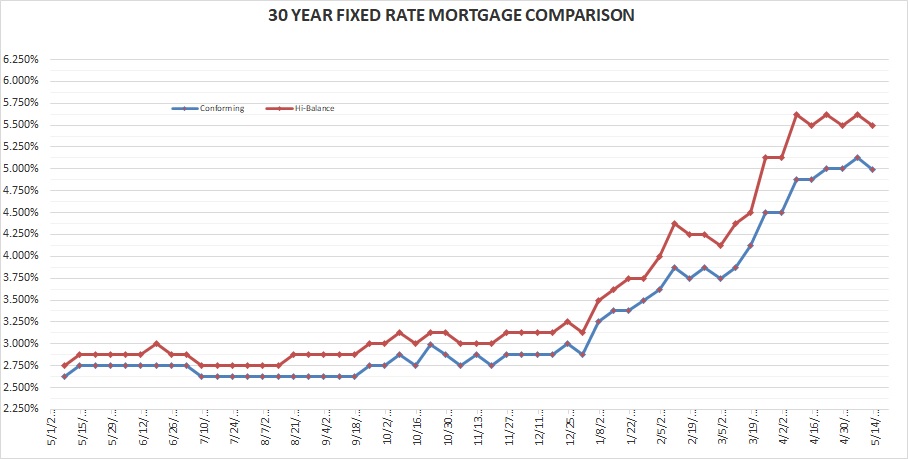
Answer: With rates having jumped over 2% since New Year’s Eve, an almost 75% increase, purchasing power has dropped considerably for most families. Looking to qualify for the maximum mortgage, the highest sales price, they can, many are feeling shut out of a housing market they were in at the end of 2021.
The most obvious way to qualify for a higher loan amount is to have a lower interest rate. One way to get a lower interest rate, today, is to obtain an adjustable-rate loan, with the risk that the rate and payment will be higher in the future.
Another option is one we used for many years in the mortgage industry, before the internet made those looking for mortgages extremely rate conscious: buy-down the interest rate.
Long time readers of the WR&MU know that there is a trade off between the interest rate on a mortgage and the cost of the loan. If you want lower costs you will need to have a higher interest rate. If you want a lower rate, and therefore payment, you will need to pay a higher cost.
Loan costs are called points. One point is equal to one-percent of the loan amount. Because the cost is a percentage of the loan, the label is points to differentiate between the rate. It would be very confusing is you were told, “the 30-year mortgage rate is five-percent at one-percent.” Hence, “the 30-year mortgage is five-percent at one-point.”
For most refinances the cost of the loan is zero points because the math is better than paying more money for the transaction to lower your payment incrementally. For the past decade or more, the cost of a purchase mortgage is usually quoted as one to one and a quarter (1.25) points, sliding depending on the market on the date the loan is locked.
A primary factor in mortgage qualifying is your debt-to-income (DTI) ratio. The percentage of your gross income that is being used for your new housing payment, plus any monthly payments for other credit obligations. Depending on the program, the maximum DTI can be from 41% to 49% of your gross income.
The lower the interest rate the higher loan you can qualify for using the same DTI, if we are qualifying you using 35% of your income just for your housing payment (Principle, Interest, Taxes, Insurance, aka PITI), if the rate is 3% you will qualify for a higher payment that if the rate is 5%.
By paying more points you can buy the interest rate down and therefore increase your purchasing power, while having a 30-year fixed rate mortgage with no worries about a higher payment in the future.
Here is the math for a couple making $200,000 per year, we are assuming their other payments for cars, credit cards, student loans, or not more than 6-7% of their gross income.
Their monthly income is $16,666, 35% of this is about $5835 per month for their loan payment plus property taxes and insurance.
If they purchase a home for $1,000,000 with 20% down, they will apply for a $800,000 mortgage. At a rate of 5.5% with a cost of 1.25 points, their total PITI will be $5784 with $10,000 in points.
By spending one point more in loan costs, they can buy the rate down to 5.125%. At this rate for about the same payment and DTI, they can qualify for a $840,000 mortgage and purchase a home for $1,040,000 price. The payment would be $5877 per month PITI, and the points for the loan would be $18,900. For $8,900 more in points their purchasing power has increased by 5%.
Another option that may be used to leverage into a lower rate is having the seller credit funds for closing that can be used to buy down your rate. This option may/will be more viable as the market transitions from the strongest seller’s market in my thirty-five-year career to more of level market, or possibly a buyer’s market.
Coming off of two years of historic low interest rates, the probabilities that mortgage rates will drop to the 3% range are extremely low. If there is a regression to the mean of the past decade, the conforming rate will fall into the 4% range. For a decade plus when I started in the industry, two or more points for the cost of mortgages was the industry standard. For the past two decades, about the time the internet was becoming mainstream, the cost buyers were willing to pay lowered to one-point, not willing in most cases to pay more for lower rates. In our current rate and real estate market environment, homebuyers who explore the best leverage of funds available for closing with the payment for which they qualify will open up more options for their new home purchase.
Have a question? Ask me!
Mixed news was in the Consumer Price Index data for April released this week. The overall CPI was down on an annual basis for the first time in eight months, dropping to 8.3% from March’s 8.5%. A more closely watched index within the CPI is the “core” index, which strips food and energy from the basket of goods and services used to calculate CPI. Because those two items are the most volatile, eliminating them from the calculation presents what should be a more stable look at consumer prices. While the overall CPI data is positive news, the core data is negative as for the month core prices from 0.6% from March, the largest one month increase since January. Looking at the changes in overall CPI dropping and the core index rising, it makes sense that the primary factor in the overall index’s decline is falling gasoline prices.
Looking ahead, there is still pressure for prices to climb. The lockdowns in China will have an increasingly greater impact on supply of consumer goods and manufacturing material. Russia’s invasion of Ukraine will continue to impact prices for oil, gas and wheat. Domestically, with over 11 million job openings and 5 million job seekers, there is continuing pressure on wages, which will work into prices for goods and services.
All these factors support the Federal Reserve’s current policy to increase rates through the year and constrict the money supply by selling its holdings of U.S. Treasury debt and mortgages.
Rates for Friday May 13, 2022: We end the week with rates dipping from last Friday; this is the first Friday since the first Friday in March we have seen a week-to-week decline. Ideally this is an indication that rates level off in the near future.
FIXED RATE MORTGAGES AT COST OF 1.25 POINTS LOCKED FOR 45 DAYS FOR PURCHASE TRANSACTIONS:
30-year conforming 4.99% Down 0.135%
30-year high-balance conforming 5.50% Down 0.125%
Please note that these are base rates and adjustments may be added for condominiums, refinances, credit scores, loan to value, no impound account and period rate is locked. Rates are based on 20% down with 740 FICO score for purchase mortgages.
A friend of mine is involved with EntreNous, an organization that is aligned with Compton YouthBuild. EntreNous works with young people in Compton, from 16-29, providing educational and occupational services to help launch them into careers in the culinary arts and contracting trades.
On Wednesday May 25th, EntreNous will be having an Open House from 12:00 – 4:00 PM and an opportunity for employers in the restaurant or building industries to meet and interview participants in the program for job openings.
If you are interested in more information here is a link to the EntreNous website, here is link to register for the open house, or contact my friend Meegan Johnson at 310-462-4257, or email her, [email protected] .
Have a great week,
Dennis
Past Weekly Rate & Market Updates can be found on my blog page at my website www.DennisCSmith.com/my-blog


