


How much further has purchasing power dropped?
Question of the week: How much further has purchasing power dropped?
Answer: This is a follow to the Question of the Week on February 11th, “How much has my purchasing power dropped since the beginning of the year?”
On that Friday the 30-year conforming rate had risen from 2.875% on January 1st to 3.875%. For potential homeowners earning $100,000 and using 40% of their income for their total housing payment, with 20% the potential homeowners had lost $90,000 in purchasing power (click the link above for the details of the qualifying calculations).
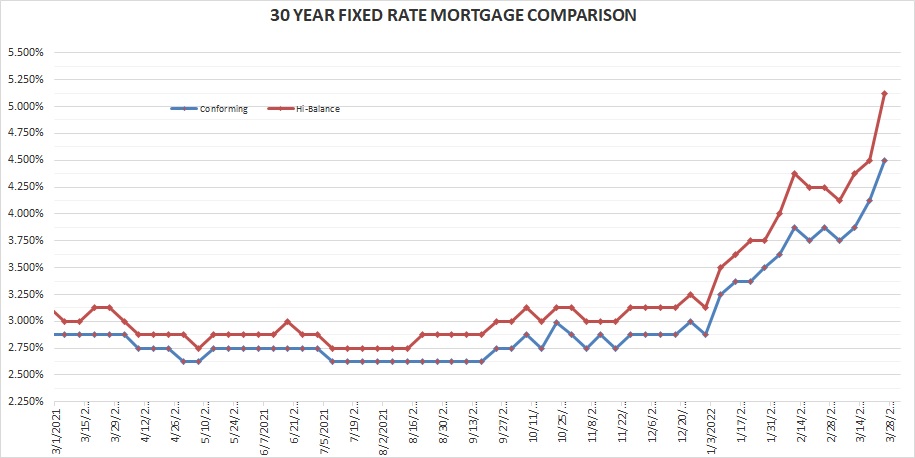
Rates have been spiking since the beginning of the month, and soaring this week, as you can see below from our Friday rate quote, the 30-year fixed rate is at 4.5%.
For a couple making $100,000 that could afford $750,000 home on December 31, 2021, how much can they afford at today’s rates?
Using the same calculations from six weeks ago, the couple can afford a mortgage payment of $2500 per month. At 4.5% this converts to a 30-year mortgage of approximately $495,000, if they are putting 20% down the sales price is approximately $620,000.
This sales price is $40,000 less than six weeks ago, and $130,000 from twelve weeks ago when the $100,000 couple qualified for $660,000 and $750,000 respectively.
Going the other way, the 30-year mortgage payment today for a $750,000 home purchase today with 20% down ($600,000 mortgage) is about $3040, compared to about $2500 on December 31st, an increase of 22%.
There are several follow up questions to these numbers.
Will the higher rates cause property values to fall? Possibly, this will depend on location. For much of Coastal California (which I loosely define as any county that touches the ocean), most areas will more likely see prices flatten, with possible slight decreases in some area. For other areas where historically, meaning non-pandemic historic low rates, there could be some decline in prices if enough current homeowners put their homes on the market.
Should we wait for lower rates? Rates are “high” only compared to what we know to be “low” or “normal.” Talk to those in their 70’s or 80’s and they will tell stories of “back in the 1980’s we bought our first home for…” Mortgage rates for the decade were under 10% for only six months, most of the decade the rate was over 12% and from January 1981 to October 1982 was never below 15%, peaking at 18.53% in October 1981. Homes were still being bought and sold. In January 1980 (12.85% mortgage), the median home price in the California was $100,000, on January 1, 1981 it had climbed to $117,500 (rate 14.95%), in 1982 the median price had dropped to $105,000 (15.13% rate, down from 18.53% high months earlier), in January 1983 the price was $116,000 (rate 13.46%). At the end of the decade, the 30-year fixed rate was 9.78% and the median price had climbed to $230,000.
Throughout the state the median price dipped from a high of $117,000 to a low of $105,000, about 11%, in one year following the highest rates, and rebounded about a year later.
That’s ancient history… In 2018 the 30-year rate spiked to the 4.5% range for most of the second half of the year, median prices continued to climb.
We have been very fortunate in that rates have been below 5% for the past decade, but through this time we set historically lowest rates a few times. Looking ahead, when we will see rates drop again, and if so is it wise to expect they will drop down to previous historic lows?
Having seen the increase in cost for the same priced home, or the decrease in value for the same mortgage payment, is it worth the risk to wait to see if rates drop below where they are today? What if rates do not drop for more than a year, what if when they do drop, they drop to where we are today?
Should we wait for home prices to fall? Will they fall? Prices are based on supply and demand. For prices to fall we will either need an increase in supply and/or a decline in demand. What if supply stays the same, which is insufficient for demand as evidenced by prices rising sharply for the past two years and demand slows. Will demand slow enough to cause prices to drop? Or will demand slow to keep prices somewhat flat? Over time, in our region, prices climb. With the exception of the Great Recession, caused by the real estate price balloon exploding, any “slow” market results in relatively flat, or a brief period of slightly dropping, prices.
But what about the Great Recession price drop? The balloon that was primarily caused by buyers purchasing properties with little to no money down with loans that did not require verification of income? The transfer of billions and billions of dollars in equity to homeowners through refinances pulling cash out of properties to near or to the value of the property. The market that resulted in very little equity in most new buyers’ homes, and for many who refinanced? The bubble was easily popped when people who could not really qualify for the homes they bought, who had very little money in the home they bought, saw they were paying for a home that was basically a rental and walked away. This caused their neighbors’ homes to be worth less, causing them to be upside down and therefore willing to walk away. The dominos falling resulted in a domino triggering a dart into the real estate price balloon.
The fundamentals of homeownership for the past decade plus are significant down payments, the ability to qualify, very low underlying mortgage rates, and a change in attitude from buying a home with little to no down payment to sell in a few months or a year to make money. Our current real estate market is fundamentally strong and most at risk to significant unemployment to middle class professionals—which is why the pandemic causes a real estate boom instead of a bust, middle class professionals as a group did not lose jobs or income.
The risk to waiting to see if prices and/or rates decline in the future to make today’s home more affordable is that prices do not decline and rates go up, rates do not decline and prices go up, neither decline and both go up.
The advantage of staying, or entering the market, if you are considering homeownership, you should buy when you can. A home is not an investment for the short term, it is primarily a home where your family will live. Owning your home with a 30-year fixed rate mortgage pretty much fixes your housing costs for the long term and does not put you at the desires of a landlord to raise your housing cost, or sell your house.
The advantage of buying today is that in the long term, in our region, prices go up. Demand over time exceeds supply.
Rates may go down in the short term, but not to where they were. More likely is they will continue to rise, and if the fall they will do so somewhere near closer to 4% than 3%. Remember, a primary reason the rates were so low was the Federal Reserve buying mortgages, to keep rates low. If you purchase your home and rates do drop in the future, you can refinance to a lower rate and payment.
If rates and or prices continue to climb, even at a much slower pace than in recent weeks for rates or the past tow years for prices, your overall costs of homeownership are cheaper today than it will be in the future. In other words, there is likely greater risk in waiting to buy your new home than there is in buying today.
Have a question? Ask me!
Rates for Friday March 25, 2022: Friday to Friday we saw the biggest increase mortgage rates this week since December 31, 2021 to January 1, 2022. The war in Ukraine does not appear to ending in the near future, oil and gas supplies are still tight keeping, pushing, prices higher, and inflation has no reason to abate. The Fed announced seven rate hikes in 2022, which are typically 0.25% at a time, instead of the 1.75% increase seven hikes would have, investors are supposing 2.25—2.75% as the total in hikes.
FIXED RATE MORTGAGES AT COST OF 1.25 POINTS LOCKED FOR 45 DAYS FOR PURCHASE TRANSACTIONS:
30 year conforming 4.50% Up 0.375%
30 year high-balance conforming 5.125% Up 0.375%
Please note that these are base rates and adjustments may be added for condominiums, refinances, credit scores, loan to value, no impound account and period rate is locked. Rates are based on 20% down with 740 FICO score for purchase mortgages.
I smiled this morning when I was reading Jim Alexander’s column in the sports page of the Long Beach Press-Telegram. He combined my past and my pleasure in one column.
In the WR&MU of February 11th, referenced and linked above, in the first paragraph of the market update section I spoke about one of my economics professors in college, Gary Smith (no relation). In the personal, final, section of last week’s WR&MU I wrote about the NCAA basketball tournament, March Madness, one of my favorite sporting events every year.
In his column today, Alexander began his column quoting Professor Smith. The topic, “the paradox of luck and skill” and their impact on the outcome of sporting events. Mostly, that getting through a 68-team tournament, such as the NCAA tournament, to be champion requires luck, more for some teams than others.
Economics, sports, analytics, chance, professor, it was the perfect column for me!
Here is the link to Alexander’s column.
Have a great week,
Dennis
Past Weekly Rate & Market Updates can be found on my blog page at my website www.DennisCSmith.com/my-blog


