


What is a “seller carry back?”
Question of the week: What is a “seller carry back”?
Answer: When the seller of a property exchanges cash proceeds for a note, or loan, against the property, the seller is “carrying back” part of the purchase price.
For those who were active in real estate in the early part of the century, you will recall that “piggy-back” transactions were very popular. A seller carry back is very similar.
Here are the mechanics of such a transaction.
The Smith’s are selling their home to the Cleary’s for $750,000. The Cleary’s are getting a mortgage for $600,000 (80% loan to value), and are putting $75,000 down (10% of purchase price), the Smith’s are going to carry back $75,000 (10% of the purchase price). This means the Cleary’s will have two loans as part of their purchase a $600,000 conventional mortgage payable to the lender, and a $75,000 loan payable to the Smith’s.
The conventional mortgage will be a 30-year fixed rate mortgage at the current market rate, let’s us 4% for easy numbers. The Smith’s loan is a 5-year loan, with an interest rate of 5%, and a payment due monthly for a minimum of interest only.
The 30-year mortgage is the 1st, or primary, mortgage, and the note with the Smith’s is the 2nd, or secondary. They are labelled 1st and 2nd as this is the order they will be recorded with the County Recorder, which is also how they will be paid when the property is sold, either willfully or unwilfully. As for the latter, if the property is foreclosed on, that would be unwilfully; if the property is sold at auction due to foreclosure the proceeds from the sale will pay taxes and government liens, then the principle, interest and costs to the 1st lien holder (i.e., the mortgage lender), then the principle, interest and costs of the 2nd lien holder (in this case the Smith’s), and any proceeds remaining would go to the foreclosed owner (in this case the Cleary’s).
The Cleary’s loan payments per month will be approximately $2865 for the 1st mortgage and $315 to the Smith’s, for a total of $3180. To purchase the home they will need $75,000 plus closing costs today, and another $75,000 in 5-years to payoff the loan with the Smith’s, unless both parties agree to extend the loan.
Why would either party agree to this type of transaction?
Let’s start with the Cleary’s, there are several benefits to them for this transaction.
- Purchase with only 10% down
- Because the primary loan is 80% loan to value the avoid mortgage insurance
- Lower monthly payment (mortgage $3225, mortgage insurance $135, monthly payment $3360 compared to $3180)
- Cheaper to have seller carry-back than get a HELOC or fixed rate loan from a lender
- Relatively low fixed rate payment
The elephant is the $75,000 they will need to come up with in five years. However, this may not be a problem depending on the Cleary’s financial situation. Maybe they have the funds for 20% down but would rather leverage $75,000 at a 5% rate. Perhaps they have an expected in-flux of cash within the 5-year period that will enable them to payoff the loan.
As well, they will likely have the opportunity to refinance in five years, either refinancing the primary loan and the 2nd with the Smith’s, or obtaining a HELOC or other secondary loan to just pay off the balance due to the Smith’s.
Here are some benefits to the Smith’s if they carry back.
- If they property has increased significantly in value they may be able to defer capital gains taxes until the note is paid (seek guidance from a tax professional).
- They have some income from the monthly interest payments at a fixed rate.
- Depending on the market, offering to carry back some of the sales cost may make their property more attractive.
The biggest disadvantage, quite obviously, for the Smith’s is if the Cleary’s are not able to make payments on either the 1st or 2nd mortgage. If this is the case they will need to either make the payments on the 1st to keep it current and foreclose, hoping they will get their money back after all the costs, or let the primary lender foreclose, and hope they get their money back.
Another disadvantage is they have $75,000 tied up in a long-term investment that is not very liquid; i.e., they cannot access it quickly.
Seller carry backs do not need to be for just 10% of the sales price, they can be for as high as buyer and seller feel comfortable in making the transaction, for instance the buyer putting down 20% and the seller carrying back 80%, in other words cutting out any institutional lender.
With rates climbing, prices still on the rise, and a bit of a slow down in transactions, the seller carry back may be an option for buyers and sellers as our market moves forward.
Thanks to friend, fellow Rotarian, and real estate agent Mollie for the question of the week suggestion!
Have a question? Ask me!
Rate will increase on March 16th, per testimony before Congressional committees this week by Federal Reserve Chair Jerome Powell. Stating he supports a 0.25% (one-quarter of one percent) increase in its benchmark interest rate, Powell confirmed that the Fed will raise rates. “Supports” does not mean that will be the result, it is still possible that the Fed will hike the rate 0.50%, but less likely if the Fed Chair is publicly pronouncing his wishes. The mortgage markets have priced in this increase a few months ago, the indication the increase will not be higher than 0.25% is somewhat beneficial to current mortgage rates.
J-O-B-S, JOBS, JOBS, JOBS! If economic writers and pundits were Jets’ fans this would be their cheer today. The Labor Department this morning released jobs data from February, which showed an increase of 678,000 new workers for the month, way (WAY) more than expectations from said writers and pundits. Also in the report was a revision upward of 92,000 jobs to the December and January data.
Getting there, is the quick look at the employment growth. February’s data puts the economy at 90% of pre-pandemic employment. However, with a labor participation rate (percentage of employment eligible people who are employed) at 62.3% in February compared to 63.4% in February 2020, there are still three million fewer workers as a percentage of eligible workers getting paychecks.
Speaking of paychecks, the average pay for the month was only one-cent more per hour than in January. However, even with the almost zero gain in wages for the month, year over year wages grew 5.1%, the fasted increase since the early 1980’s. The increase in pay lags significantly between the increase in prices, 7.5%, which is troubling.
Overall, the report is positive for rates. With the slow down in wage increases, there is a little less pressure for rates to climb higher and quicker due to the slowing in wage growth, which should put less pressure on prices to rise. As has been discussed many times in the Weekly Rate & Market Update, higher prices lead to higher rates. High inflation is going to be present in the economy into 2023 due to tight labor market, continuing supply chain issues, and higher energy costs exacerbated by Russia’s invasion of Ukraine.
Rates for Friday March 4, 2022: Rates spiked on Wednesday and have slipped back some from the spike to end the week lower than last Friday. The slip in rates may be, is likely in my opinion, to be a temporary dip as rates will go up—as acknowledged by the Fed with their plan to continue to raise rates through 2022. How long, how much, are the questions that we do not know the answers to.
FIXED RATE MORTGAGES AT COST OF 1.25 POINTS LOCKED FOR 45 DAYS FOR PURCHASE TRANSACTIONS:
30 year conforming 3.625% Down 0.125%
30 year high-balance conforming 4.125% Down 0.125%
Please note that these are base rates and adjustments may be added for condominiums, refinances, credit scores, loan to value, no impound account and period rate is locked. Rates are based on 20% down with 740 FICO score for purchase mortgages.
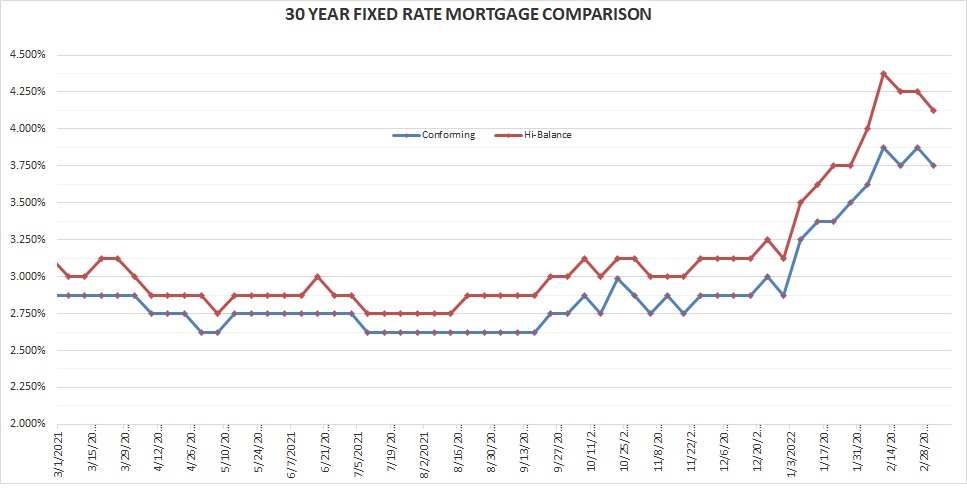
Putting a damper on rates is the war in Ukraine. Russia’s unprovoked invasion of Ukraine, and prospects for the war spreading to other nations—or President Putin’s turning north to invade other nations in his quest to re-establish a nation state similar to the Soviet Union—creates enough uncertainty to have investors nervous about investing in volatile stocks and looking to bonds and mortgages.
I would like to see the markets return to a “normal” course of action based on economic events and data, which means higher rates. I would like this as it would mean peace in Ukraine, ideally with Russia pulling back their military to within its own borders.
The resistance by the Ukrainian military and civilians has been courageous and inspiring as they fight for their freedom and their democratically elected government. Their resolve has resulted in support from the United States and other nations, facing a delicate line that if crossed could push Putin to more drastic action.
As it always does, the Red Cross is on the ground and assisting the Ukrainian people, and bordering nations who are serving refuges fleeing the war. If you wish to assist the Red Cross in their mission and service to those in need as a result of the war please click here.
Praying for peace and liberty for Ukraine, and all nations.
Have a great week,
Dennis
Past Weekly Rate & Market Updates can be found on my blog page at my website www.DennisCSmith.com/my-blog


