


How does war impact mortgage rates?
Question of the week: How does war impact interest rates?
Answer: Historically armed conflict, war, violent political unrest result in lower interest rates. As long-time readers of the WR&MU know, the past several years we have seen historical economic cause and effect relationships have always been our current day reality. So far this disconnect from historical patterns has played out in the past few days.
Economic principles that are the basis for many investors decisions are that certain events or data determine where they will direct their money. For simplicity, there are three options for investors to place their funds, cash, equities, or fixed rate investments.
Cash is, well cash. Funds in bank accounts. Cash is the safest investment as the primary risk is inflation, if you have $1000 in cash and inflation is 7% for one year, in one year your $100 will able to buy 7% less than the prior year, or more simply what cost $100 when you put the money in bank will cost you $107 one year later.
The next safest investment, historically, are fixed rate assets, such as bonds and mortgages. When you purchase a fixed rate asset you are buying a financial instrument that will pay you a fixed percentage on a regular basis for the life of the bond. For instance, if you purchase a $1000 10-year bond from the U.S. Treasury with a rate of 2%, you will receive a check for $10 every six months (2% of $1000 is $20, paid every six months results in two payments of $10 per year). Treasury bills and bonds are debt to the government and investments for buyers; the government is borrowing money from investors to run the government.
United States Treasury debt is considered to be the safest investment in the world as the U.S. government has never defaulted on its debt, it has always paid investors their interest payments and at the maturity of the bill or bond the principal has been paid in full. Because it is so safe, it generally has the lowest return on investment for non-cash investments.
Fixed rate assets have an inverse relationship between their price and their rate of return, or interest paid. Higher prices result in lower interest rates, lower prices result in higher rates. If you hear, “The bond market was off today,” or, “mortgage backed securities lost ground,” this means that rates are going up. Why?
If you buy a $1000 bond with a 2% return, and in one year interest rates are at 3%, why would I buy your bond for $1000? I could buy a new bond and get $30 a year instead of the $20 yours is paying. If I buy your bond I will pay you $666.67, as that is the amount of money that will give me a 3% return if I get $20 per month. The rates are higher, but your cash return if you sell your bond before maturity is lower.
Conversely, if rates are down to 1% I will pay you $2000 for your bond; 1% of $2000 is $20, which is what your bond is paying annually. Rates are lower, and if you sell your bond before maturity your cash return is higher.
Equities are stocks in companies, or funds that are created by the purchase of stock in a multitude of companies. There are several different types of equity offerings, some pay dividends on a regular basis, others pay no dividends. Regardless of whether dividends are paid to investors or not, equities are volatile individually and as a group. Bad management, or management malfeasance, can result in a large drop in the value of that company’s stock as investors will sell not wanting to retain ownership in a company that is facing possible, or probable, declining value in the future. As well, a company’s stock may increase if it receives a patent, or government approval, for a new product. For instance, if a pharmaceutical company develops a new drug that is approved by the FDA that prevents infectious disease, its stock will go up as the company will have more sales and profits in the future.
Some stocks are a lot more volatile than others, but as a group, equities are considered to be much more volatile than fixed rate assets.
Investors make their decisions as to where to direct their funds based on where they see the economy in the near, medium and longer terms.
If news is positive, supporting economic and job growth, investors will direct their funds to equities. A growing economy leads to more economic activity, leads to more profits for companies, leads to higher stock prices in the future.
Because they are directing their investing to equities, they are either pulling funds from other investments, or not investing more money in other investments. The result is the price of fixed rate assets go down, and as we saw above this pushes rates higher.
If news is negative, investors engage is what is known as “flight to safety.” They take flight from volatile equities, causing those prices to decline, and invest in the safety of fixed rate assets, such as Treasury bills and bonds, and mortgages, causing those prices to increase. Higher prices for fixed rate assets results in lower interest rates.
It is hard to imagine more negative news than a war, or armed conflict. Historically, Russia’s invasion of Ukraine triggers a flight to safety by investors.
Initially this is what occurred. Yesterday the stock markets dropped precipitously at opening as the Russian military began their assault. Simultaneously, Mortgage Backed Securities (MBS), which is the market for mortgages, spiked up, which leads to lower rates.
Careful readers will note that I have been using the word, “historically” throughout today’s WR&MU. Historical patterns are not being followed, at least for the last two days.
With reports that Russian President Putin is open to negotiating some type of settlement with Ukraine that would result in Russia ceasing hostilities provided Ukraine pledges neutrality—i.e. does not pursue admission to NATO—stock markets quickly reversed direction and are now up about 3% from Wednesday’s close.
The potential removal of bad events is good news and investors are acting accordingly.
Should talks fall apart and Russia seizes control of Ukraine, we should expect lower rates. However, this would result in concerns regarding higher inflation driven by higher energy and natural resources costs. The Ukraine is extremely rich in many natural resources. It is unarguably the bread basket of Europe, it is a primary supplier of many minerals for manufacturing and technology, and its location facilities global trade. Expectations are that should Russian take control of Ukraine there will be a significant decline in production and distribution of Ukraine’s exportable resources.
All that said, today is Friday and there is uncertainty as to what will occur over the weekend while markets are closed. As we approach the close in markets today it would not be surprising to see a drop in equity prices and increase in fixed rate asset prices as investors engage in flight to safety until Monday and markets open.
Back to our question of the week, how does war impact mortgage rates? It should be a positive impact for lower rates, however so far this week we have seen that “should” is the operative word.
Have a question? Ask me!
Rates face continued upward pressure as economic data released today shows American consumers are still on a spending spree. Even though personal incomes were flat in January, Americans increased their spending in January by 2.1%, 1.5% after adjusting for inflation. Spending at restaurants, bars and other entertainment outlets dropped for the month due to the omicron variant, but consumers made up for their going out less by buying bigger ticket items like cars and recreational items.
While spending was up, personal incomes were flat from December to January. With one measure of inflation showing a 0.6% increase in January, and 6.1% year over year, workers experienced a downturn in real income—wage increase less inflation.
How much? That is the question the pundits are discussing, as they opine on how much will the Federal Reserve increase their benchmark interest rate in March. More and more are indicating the Fed will bump the rate 0.50% instead of the traditional 0.25% movement the Fed typically makes when moving rates. Inflation is still very hot, as you have seen at the pump and driving around town, locally gas is over $5 per gallon, putting more pressure on prices to continue to rise. My bet is that the Fed will increase their rate by 0.50%, and I would hedge the bet with a smaller one on a 0.75% increase.
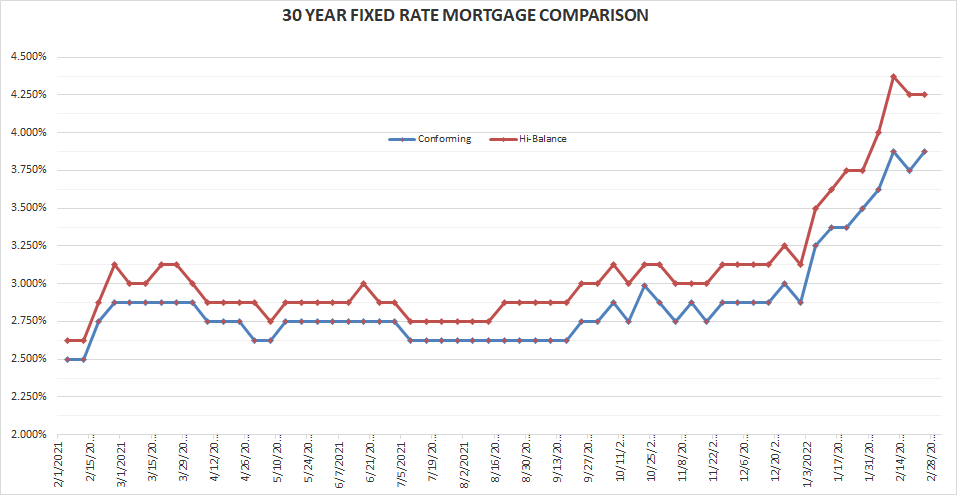
Rates for Friday February 25, 2022: In times of uncertainty lenders are very quick to raise rates with the market, and very slow to lower rates if other market rates are dropping. They do not want to get caught with a portfolio of mortgages that are suddenly below market price, costing them dearly when they take them to market (see above with price of a bond when rates increase and your currently own a bond with a lower rate). With the fluctuations as a result of Russia’s initiating a war, and the uncertainty, rates are higher this week after their dip last week.
FIXED RATE MORTGAGES AT COST OF 1.25 POINTS LOCKED FOR 45 DAYS FOR PURCHASE TRANSACTIONS:
30 year conforming 3.875% Up 0.125%
30 year high-balance conforming 4.25% Flat
Please note that these are base rates and adjustments may be added for condominiums, refinances, credit scores, loan to value, no impound account and period rate is locked. Rates are based on 20% down with 740 FICO score for purchase mortgages.
I am excited for this evening. Both of our girls went to Long Beach Poly High School, along with all the kids on our street as they grew up. One of their playmates is still at Poly, he is senior on the basketball team. The past two weeks I have been going to the Jackrabbits games as they faced win or go home playoff games for the CIF Southern Section.
After winning the last two games on the road, in very tight and exciting games, the team travels up to Sun Valley to play a very good Village Christian team for the championship. While not looking forward to the drive across the LA basin to get to the game, I am looking forward to watching the game and hopefully the young men from Long Beach lifting the trophy sometime around 8:15.
Go Jackrabbits!
Have a great week,
Dennis
Past Weekly Rate & Market Updates can be found on my blog page at my website www.DennisCSmith.com/my-blog


