


Who chooses escrow and title?
Question of the week: Who chooses escrow and title?
Answer: Inquisitive neighbor, author, speaker and consultant Alex was kind enough to send me a list of questions of the week a few months ago and this week we answer another one.
Before we answer Alex’s question, we should answer the questions, what is escrow and what is title? For those who want slightly more detailed descriptions click here for What is Escrow and here for What is Title Insurance and why do we need it.
For those who want the quick version, escrow is a neutral third party who receives the contract and ensures that its terms are completed by all parties. As well, funds for transactions move through escrow. For a purchase transaction, no changes can be made to the original contract without both parties’ consent, escrow ensures this. At closing, the buyers funds are deposited with escrow, who then pays those who are getting paid and sends the remaining funds, net proceeds of the sale, to the sellers.
For a refinance, escrow receives the funds from the new lender and sends the funds to payoff any liens and obligations listed for payoff, and if there are any remaining funds sends those to the owner of the property.
Title insurance, or “title” in real estate parlance, insures that the transaction. For purchases the title company issues policies insuring that the seller is legally able to transfer the property, that all liens that are supposed to be paid off are paid off, and that all liens that are to remain against the property, such as the new loan, remain on the property.
Back to Alex’s question, who chooses these services? In our region, escrow and title services is the choice of the seller; in reality since most people do not know any escrow or title companies, the listing agent representing the seller determines who will be used.
For refinances, again because most property owners do not know any escrow or title companies, the choice is usually made by the lender—me.
How do we decide what companies to use for these services? Any cynic will say, “whichever pays you the biggest referral.” The cynic would be wrong as the paying of referrals, or “kickbacks,” for services is a violation RESPA, the Real Estate Settlement Procedures Act. Enacted in 1975, RESPA requires certain disclosures be provided to consumers and made it illegal to affiliated industries (lending, title, escrow, home warranty, etc) to pay referral fees or provide gifts and services to other real estate agents or other real estate professionals in return for business. No tickets to Clippers’ games, no rounds of golf at local country clubs, no weekends in Palm Desert, no cash in envelopes, no paying for advertising outside certain regulations.
Unfortunately, there are still individuals on both sides of referrals who violate RESPA, like every industry, ours has bad actors. Thankfully, there are fewer transgressions in years past.
So how do we decide which escrow and title companies to open transactions for our clients? Service, experience, service, competence, service, knowledge, service, fair market pricing, and service. Like having someone prepare your will and trust, repair your brakes if you live in the mountains, or performing major surgery, price is less of an issue than a job very well done. For another analogy, when it comes to escrow and title, like an umpire or referee, when they are very good you don’t really notice, when they are not really good or bad, you notice and it is a bad experience. Except instead of a bad penalty or out call in a game, it is your money and your home that are at risk.
Have a question? Ask me!
A lot of economic news this week. First and foremost was statement by Federal Reserve Chairman Jerome Powell that the Fed “is of a mind” to raise its benchmark interest rate in March due to inflatation. Translation of “is of a mind,” the Fed will raise rates in March. Unknown are, if it will have a surprise increase in February, not real likely, and how high will it bump the rate? As to latter, typical rate moves by the Fed are in one-quarter of one-percent increments (0.25%), though in the past they have raised or lowered by one-half of one-percent (0.50%).
Overcoming slower consumer spending, the U.S. economy grew at a 6.9% rate in the final quarter of 2021. For the year, GDP grew 5.7%, the most since 1984, fueled by multi-trillion dollar government stimulus, and consumers buying goods and services. In 2019, prior to the pandemic, economic growth was a steady 2.3%. Boosted by businesses stocking inventory as the supply-chain woes slowly improved, and consumers ringing cash registers and clicking on-line shopping carts full, the economy surged, dragging prices up. Looking forward, the challenges for the economy remain shortages of labor, continued supply-chain issues, and 40-year high inflation.
Salaries continued to grow, spending shrank as 2021 came to an end. Personal income increased 0.6% in December, and a whopping 7.3% increase for 2021. Two factors to note regarding the surge in incomes. One, the massive amount of stimulus funds from the federal and state governments that boosted incomes. Two, real wages increased 0.3% as the Consumer Price Index increased 7.0% in 2021.
Consumer spending dropped 0.6% in December from November, adjusted for inflation the drop of 1.0%. The decline in spending is mostly attributed to the introduction of the omicron variant which led to fewer shoppers. The higher costs were also a damper on spending as consumers either would not buy higher cost goods and services, or could not afford to make their purchases.
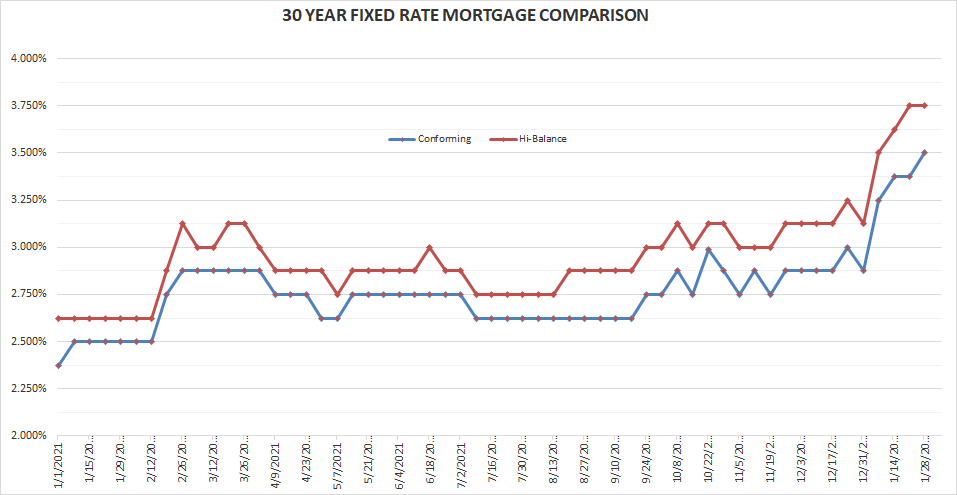
Rates for Friday January 28, 2022: With the Fed announcement indicating it is raising rates in less than a month, mortgage rates jumped up earlier in the week. As we close January, the 30-conforming rate is up from last week, and up 0.625% from the last Friday of 2021. The high-balance conforming rate ends up flat for the week and also up 0.625% for the month.
FIXED RATE MORTGAGES AT COST OF 1.25 POINTS LOCKED FOR 45 DAYS FOR PURCHASE TRANSACTIONS:
30-year conforming 3.50% Up 0.125%
30-year high-balance conforming 3.75% Flat
Please note that these are base rates and adjustments may be added for condominiums, refinances, credit scores, loan to value, no impound account and period rate is locked. Rates are based on 20% down with 740 FICO score for purchase mortgages.
What were you doing in January 1989? I watched the Cincinnati Bengals get beat by the San Francisco 49ers in one of the best Super Bowls to that point in the games history. Bengals fans have not returned to the big game since, while the 49ers have won three more Super Bowls since. Sunday the Bengals are playing for the opportunity to play another Super Bowl.
In their way are the Kansas City Chiefs, who are looking to make their third Super Bowl in a row, having lost last year to Tampa Bay, and won the previous year when they beat the 49ers.
Californians are likely more interested in the other game that will produce a Super Bowl team, long time intrastate rivals, the Los Angeles Rams and the San Francisco 49ers. This will be the third time the two teams have played this season, the Niners won both games. The Rams were in the Super Bowl following the 2018 season, losing to the New England Patriots. San Francisco lost the big game the following year to Kansas City.
When the teams last met in the final game of the regular season at SoFi Stadium in Inglewood, those who were watching on television, or listening on radio, would have thought the game was played in the Niners home stadium due to all their fans that bought tickets. Concerned about losing home field advantage, the Rams required fans looking for tickets on-line have a Southern California zip code for the billing address on their credit card. I looked earlier this week at the tickets for sale for the game, and it appeared 30-40% of the seats were available on the secondary market.
Look for a lot of fans in red to be at the game on Sunday.
Have a great week,
Dennis
Past Weekly Rate & Market Updates can be found on my blog page at my website www.DennisCSmith.com/my-blog


