


Is the Federal raising rates for mortgages?
Question of the week: Is the Federal government raising rates for mortgages?
Yes.
In last week’s Weekly Rate & Market Update I wrote that the Federal Reserve does not control mortgage rates.
That is true.
What is also true is that the Federal Housing Finance Authority (FHFA), a member agency of the Financial Stability Oversight Council, which is an entity within the Department of the Treasury.
The FHFA can, and does, control interest rates. In an October WR&MU discussing loan limits, we discussed the FHFA and its role in the mortgage industry. For those who did not read, nor wish to click and read, in brief after the mortgage and real estate market meltdowns, the Dodd-Frank Act created the FHFA (and the FSOC). The Act also put control of Fannie Mae and Freddie Mac with the FHFA.
It is within the power of the FHFA to not only determine the loan limits for Fannie & Freddie (henceforth GSE’s), but also to determine the pricing matrixes that they will charge lenders selling their loans to them.
In mortgage industry parlance these pricing adjustments are called LLPA’s, Loan Level Pricing Adjustments. We covered tiered pricing on mortgages in 2018, covering additional costs for credit scored, occupancy, property type, type of transaction and other factors.
Very quickly, a cashout refinance mortgage on a non-owner occupied condominium will have a higher rate (i.e. cost) than a purchase mortgage for an owner occupied detached single family residence. This is because of pricing adjustments.
In August of 2020 the FHFA announced it was requiring the GSEs to add to all refinance transactions an “adverse market fee” of 0.500 points (one-half of one point, equivalent to one-half of a percent of the loan amount, or $500 on a $100,000 mortgage). The purpose of this fee was to recoup expected losses to the GSEs from the pandemic. This fee is known as an LLPA, it adjusted the price for all refinance mortgages.
It should be noted at the time the LLPA was announced the industry was in the midst of historic mortgage volumes and the GSEs were likewise having historic volumes. When the adverse market fee was rescinded in July 2021 the fee had generated an estimated $5.3 billion in revenue—taken from homeowners refinancing their homes.
Late last week the FHFA announced a new set of LLPAs that impacts all high-balance (see WRMU on loan limits) and some second home mortgages. In announcing the new fees, the FHFA stated, “These targeted pricing changes will allow the Enterprises (Fannie and Freddie) to better achieve their mission of facilitating equitable and sustainable access to homeownership…”
Supposed the fees collected will be directed to various programs the GSEs have for first-time, lower income and other affordable housing target programs.
The LLPAs are based on loan to values, transaction types and length of the rate lock for the mortgage. The biggest price add-ons will be for loans that are locked for longer than 60-days.
The LLPAs that will affect more applicants for high-balance mortgages is an additional 0.25 points ($250 per $100,000) for all purchase and rate and term refinances. The largest increase for mortgages locked for 60-days or less is a 1.00 point ($1000 per $100,000) for cash-out refinances.
The new pricing hit to those seeking mortgages on second homes is 0.25% for mortgages with a loan-to-value of 85.01% or greater for loans locked 60-days or less.
The pricing structure for the LLPAs very strongly favor loans with the short rate lock terms, for those looking to lock their rate for longer than 60-days it appears to be worth the risk to float the rate until you are within the 60-day window.
Back to our Question of the Week, yes, with the LLPAs added to high-balance mortgages, the Federal government is raising interest rates.
Many jumbo loan programs will fund mortgages down to the conforming loan limit plus one-dollar ($647,201), encompassing the loan amounts in the conventional high-balance market. This is meaningful because some jumbo programs have more favorable underwriting, or pricing, terms than high-balance guidelines and pricing. At the start of the pandemic the jumbo market disappeared. Over the past several months lenders have slowly been reintroducing their jumbo mortgage programs, which is good timing for many borrowers looking for loans above the conforming limit as they will provide more options.
Have a question? Ask me!
Economic data for December indicate a possible contraction of the economy in the 4th quarter of 2021. The Consumer Price Index rose 0.5% in December, resulting in a 7% increase in prices for the year, the largest one-year increase since 1982. For families the hit was felt at dinner tables as grocery prices rose 6.5% for the year. Ordinarily the new would push rates significantly higher, but investors were anticipating the news.
Other news supporting a slowing economy, actually a primary data set for a slowing economy, was the large drop in retails sales in December. Retailers saw sales drop 1.9% in a month that traditionally sees higher sales due to holiday shopping. Leading the drag on sales were on-line retailers which saw a 8.7% decrease. Keep in mind that retail sales are based on prices and are not indexed, factor in inflation and retails sales in volume are down even more than the data indicate. Consumer spending is 65-70% of our economy, declining purchases from consumer leads to a slowing economy.
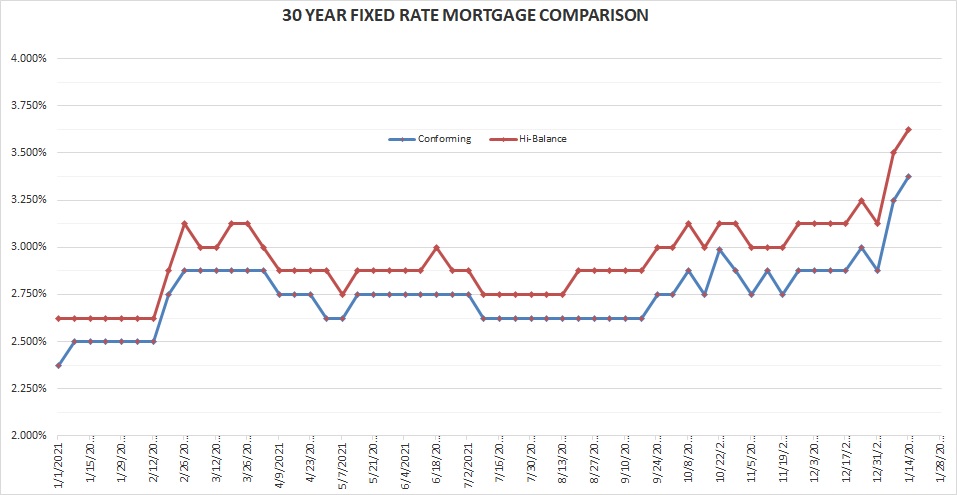
Rates for Friday January 14, 2022: After rates spiked last week, the mortgage markets were fairly flat this week. Until today when investors sold off following the retail sales news, and ahead of a 3-day weekend. We appear to be approaching a leveling off in rates, next week will tell if this is so.
FIXED RATE MORTGAGES AT COST OF 1.25 POINTS LOCKED FOR 45 DAYS FOR PURCHASE TRANSACTIONS:
30 year conforming 3.375% Up 0.125%
30 year high-balance conforming 3.625% Up 0.125%
Please note that these are base rates and adjustments may be added for condominiums, refinances, credit scores, loan to value, no impound account and period rate is locked. Rates are based on 20% down with 740 FICO score for purchase mortgages.
We have had both of our daughters’ home since the third week of Christmas, plus a bonus guest this week as our oldest’s boyfriend has been with us seeing the sites of California. They both leave on Monday to head back to Boston and the final semester of their senior year. Our youngest will still be with us for a while. Originally schedule to return to New York City to start her sophomore year late next week, her school has announced that they will be holding classes virtually for the first two weeks of the semester. She has decided she would rather stay here, earn more while working at a local restaurant, than return to school without in-person classes. I wish I could say staying with Mom and Dad is the big draw, but in reality, it is more likely that her friends at school will also not be returning right away.
Our interrupted empty-nest-living is on pause for a few more weeks.
Have a great week,
Dennis
Past Weekly Rate & Market Updates can be found on my blog page at my website www.DennisCSmith.com/my-blog


