


Will increase in loan limits impact housing markets?
Question of the week: Will increase in loan limits impact housing markets?
Answer: Yes. Next question, how?
As expected, on Tuesday the Federal Housing Finance Agency announced the maximum loan amounts for conforming, and high-balance conforming, that can be funded in 2022; these are the mortgages that are funded through lenders and then purchased by Fannie Mae or Freddie Mac (aka, GSE’s or Government Sponsored Entities).
In October the WR&MU question of the week was, “Why do loan limits matter?”; at that time the expected new loan limits had been announced, this week we received the official limits for 2022, and they are slightly higher than expections.
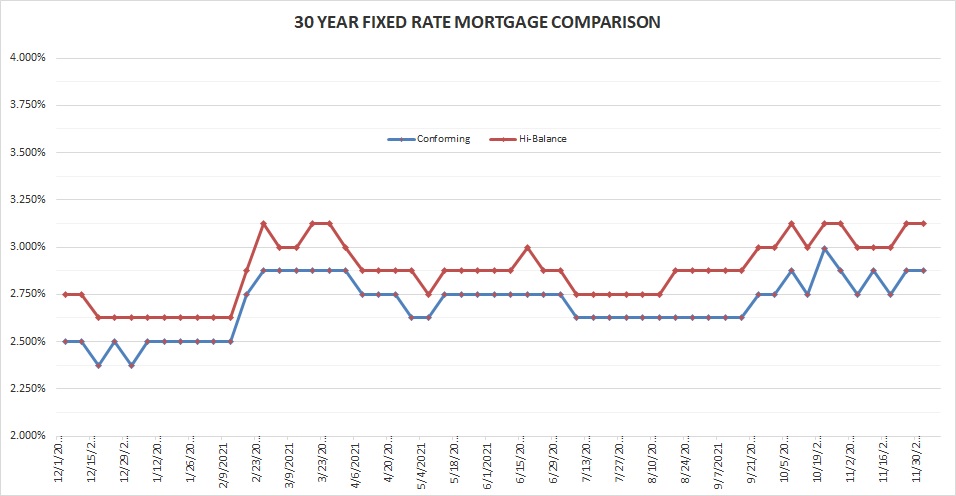
For all counties the maximum conforming mortgage limit will be $647,200. For the approximately 100 counties that are considered “high-cost” the high-balance loan limit will be $970,800. As seen in the weekly rate update each week, the high-balance interest rate is always higher than the conforming loan limit.
Not to repeat the WR&MU from October, but a few quick notes. Prior to the announcement this week*, mortgage applicants can have loan amounts almost $100,000 higher and obtain the conforming loan limit. As well, for those in the high-cost areas, they can borrow more money for a home with the same value.
*The 2021 loan limits are $548,250 for conforming loans and $822,375 for high-balance loans. Almost every lender are now accepting and funding loans to the new loan limits, for loans funded in December they will sell them to the GSEs in January when the new limits are effective.
The impact on housing markets is to increase affordability, either due to lower available rates, or lower down payment requirements. For high end home buyers and home owners, the higher loan limits enable these borrowers to have loans underwritten and approved with guidelines from Fannie or Freddie, and avoid what are typically much more difficult guidelines for “jumbo” mortgages.
For instance, in many instances, the GSE guidelines will require only one-year tax returns for self-employed borrowers (not all instances, but many, depending on length of time in business and other factors), where as jumbo guidelines require two years of tax returns and income averaging.
As well, most jumbo programs have maximum loan amounts to 80% of the property value (LTV). Prior to the loan limit increases, home buyers, or borrowers, who wanted a mortgage of $825,000 or higher needed a home value of $1,031,250, which is over $200,000 in equity, to meet the jumbo requirements. With the new loan limits, borrowers can borrow to purchase a home or refinance a current home up to 95% of a home valued at $1,021,895—or $970,800, or only $51,095 in down payment or equity.
The new loan limits will have the effect of enabling more homebuyers into middle and higher end markets with easier qualifying. The more eligible buyers there are in the market, the more potential demand in the market. Prices are a factor of supply and demand, if the is more potential demand prices are supported at their current values, or increase if the demand exceeds supply.
Does this mean that housing prices will remain the same, or continue to increase across the region, state and county? No. While the higher loan limits will expand eligibility due to lower interest rates for buyers in the conforming and high-balance mortgage markets, the loan limits will have no impact on the rates themselves, which are the primary element in loan qualifying.
While a buyer purchasing a $720,000 home with 10% down, or a $1,000,000 with 5% down may have a lower rate, and/or down payment, in 2022 than s/he would have had in 2021, if the interest rate on that loan is significantly higher in 2022 the borrower’s ability to qualify is more challenging due to the higher payment.
That said, the higher loan limits do somewhat dampen the impact of higher rates that are expected in 2022 since there is a relatively lower rate and possibly down payment requirement. A buyer of that $720,000 home with a conforming loan may be getting a rate of 3.5%, or 3.75% in mid- to late-2022, but without the loan limit increase they could be looking at a rate as high as 4% depending on the high-balance rates at that time.
The buyer of a $1,000,000 home in 2021 needed a $177,625 down payment (about 18%) and would obtain a rate between 2.625% (the low in 2021) and 3.125% (the high, so far in 2021). In 2022 the million-dollar home buyer needs only $50,000 down, benefiting high income buyers who want to highly leverage their purchase, or have high income but low savings.
For some perspective on how much of an effect this has on housing markets, consider than 60% of all mortgages in 2021 were purchased by Fannie or Freddie, up from 42% in 2019. With the higher loan limits the percentage of the mortgage market purchased by the GSEs should increase.
The advantages created by the loan limits will add support to the housing markets in 2022 that can mitigate a slow down should rates increase, as expected.
Have a question? Ask me!
Not all the high-end buyers will benefit from the higher loan limits. According to the California Association of Realtors, approximately 25% of the home sold in 2021 between $1.25 to $2 million were to first time buyers, in San Francisco it was almost 40%.
It’s that time of the month, jobs data for the prior month was released by the Labor Department today, as it is on the first Friday of every month. Expectations for new hires were around 570,000 in November, only 210,000 new jobs added, the lowest hiring in one month so far this year. A positive number in the data was that 594,000 people rejoined the labor force in November, pushing the labor participation rate to its highest level since before the pandemic, 61.8%. Also positive was the 4.8% increase in wages from a year ago; however, this is less positive with inflation at 6.2%, in effect real average wages are down 1.4% from last year. The data is a bit of a mixed bag, but the long-term takeaway is not positive. Based on the current pace of jobs being filled, it will take two years, or more, to have our labor force back to pre-pandemic levels; which will be a drag on economic growth.
Rates for Friday December 3, 2021: From an interest rate perspective the jobs data was somewhat friendly as it has some investors wondering if the sluggish labor market may result in the Fed pushing back its intention to increase its benchmark rate to later in 2022, or beyond. While the mortgage markets reacted favorably to the news today, rates remain flat this Friday after the increase last week.
FIXED RATE MORTGAGES AT COST OF 1.25 POINTS LOCKED FOR 45 DAYS FOR PURCHASE TRANSACTIONS:
30 year conforming 2.875% Flat
30 year high-balance conforming 3.125% Flat
Please note that these are base rates and adjustments may be added for condominiums, refinances, credit scores, loan to value, no impound account and period rate is locked. Rates are based on 20% down with 740 FICO score for purchase mortgages.
You have likely seen reports that the new coronavirus variant, omicron, in is the United States, in California in fact with the first case reported in San Francisco and recently a case in Los Angeles County. From what I have read, those in the U.S. that have been detected with the virus were vaccinated and had some symptoms consistent with Covid, but not severe nor requiring extensive medical treatment, i.e., hospitalization. This may change of course as more people contact the variant; however, it is positive news that thus far the vaccinations are successful in mitigating the impact of the new strain. Let’s hope this is the case for all those who contact the virus so our medical system is not severely impacted with new cases.
It is my hope that the reporting and commentary on Covid-19 moves from crisis communication to educational communication. By this, that the message is not what “might,” “could,” “maybe” occur that is horrible and creates fear. Rather the message is that the coronavirus and its variations are here to stay, thankfully we have very smart people who have developed, and will continue to develop, vaccines that lessen the impact of the virus on the overwhelming majority of people who are infected. Like getting flu shots and boosters for other diseases, we will need them on a regular basis if we wish to diminish the viruses impact.
Vaccines are not 100% effective, but they can in most instances prevent severe illness. This is our future with Covid-19, I wish the media, bureaucrats and politicians would switch from the-sky-is-falling messaging that creates fear, to acceptance of the long-term presence of this, and other, viruses. Of course, friendly messaging and communication does not get clicks, likes or tribalization that separates society so…
Of my soap box, have a great week,
Dennis
Past Weekly Rate & Market Updates can be found on my blog page at my website www.DennisCSmith.com/my-blog


