


Is it true we shouldn’t get a new credit card or car loan before we buy a home?
Question of the week: Is it true we shouldn’t get a new credit card or new car loan before we buy a home?
Answer: Thank to neighbor Alex for the question of the week. Yes, it is probably true that you should refrain from taking out new debt before you purchase your new home, or perhaps even refinance.
However, as with most questions of the week, the answer is circumstantial to your financial situation and objectives.
Over the years we have covered credit reports, credit scores, debt-to-income ratios is our questions of the week. This week’s question encompasses all of these factors that impact the ability to qualify for a mortgage.
One of the impacts of applying for new credit is the potential hit that your credit score may take because of the inquiry. (Why did my credit score drop?) If you have just one credit card inquiry your score may not be impacted, or impacted to severely; however if you have multiple inquiries for credit cards or department store cares your credit score will definitely be impacted.
If you are shopping for a new car and have inquiries from two or three different auto dealers, there may be some slight impact on your credit score, but it should not be significant as the algorithms for the scoring models are set up to accept multiple inquiries for auto loans, and also mortgages.
The other impact on your credit score is percentage of outstanding debt to available credit. If you obtain a new credit card with a $10,000 credit limit and put $10,000 worth of kitchen appliances on the card your credit limit will be negatively impacted as your credit-usage is 100%. If you put $2500 on the card there may be an impact on your credit score depending on other factors within your credit report, but it will not be as significant as maxing out the available credit.
Possible impact on your credit score is one reason you may not to obtain new credit before applying for a mortgage.
The next factor to consider is how much will the monthly payment be for my new credit? Using the above credit card example, if you obtain a new credit card and maximize the limit the probably minimum monthly payment will be $200 (rule of thumb for most credit cards is the minimum payment is 2% of the outstanding balance); or, if you purchase a new car and obtain a $35,000 loan with a payment of $630 per month, this will impact your debt-to-income ratio.
The impact on new credit inquiries and balances can impact the interest rate, or cost, for your new mortgage (lower credit scores can lead to higher cost for same rate, or higher rate for same cost).
Debt-to-income ratios determine if you can qualify for a mortgage or not.
Depending on your income, other debt, cost of your new home and resulting costs for mortgage, taxes and insurance, the additional monthly payment for new debt may put you beyond the maximum debt-to-income limits for qualifying. This is the primary reason my mantra for years has been, “buy the garage and then the car.” Auto lenders are much more lenient on their debt-to-income qualifying than mortgage lenders, and it is usually easier to obtain an auto loan if you have a mortgage history.
This argument is especially true for self-employed borrowers with the extra scrutiny given to their income and how it is used for qualifying for mortgage programs.
If you are considering purchasing a new home in the somewhat near future, or refinancing your current one, before obtaining new credit it is strongly suggested you have your financial information reviewed by a mortgage professional (me) with your objective of homeownership as the focus to determine if you should wait or not for your new wheels or major purchase.
Have a question? Ask me!
As some expected, the Federal Reserve announced this week it would slow down its purchases of bonds and mortgages. Known as Quantitative Easing, since early in 2020 the Fed has been purchasing $120 billion in bonds and mortgages every month. Starting in November and December the Fed will reduce their purchases by $15 billion per month, with the current plan to cease all purchases by June; this is known as “tapering.” In the announcement the Fed did say that depending on circumstances it may halt the tapering process to support the economy. Also in the announcement, the Fed said at this time it will taper its asset purchases rather than increase its benchmark interest rate.
A somewhat positive jobs report for October was released, but also some interesting employment data. Employers hired 531,000 new workers in October, and their wages are 4.9% higher than they were in October 2020. The wage number is positive as it is the first time since inflation has spiked that wages are at or above the rate of climbing prices. What is causing some concern is the participation rate, the percentage of able adults who are working. Despite over 9 million workers losing their jobs at one point in the pandemic, millions have not returned to the workforce. Add to those who have not returned are the millions who are new to the workforce due to aging into the working force demographic. Of those who are age sixteen or older only 61.6% are working, the lowest participation rate since the early 1970’s. There are many reasons that are being postulated, however no consensus or reason has come to the forefront for this almost dangerously low rate of participation in our labor markets. One danger to consider is the loss of payments into social security.
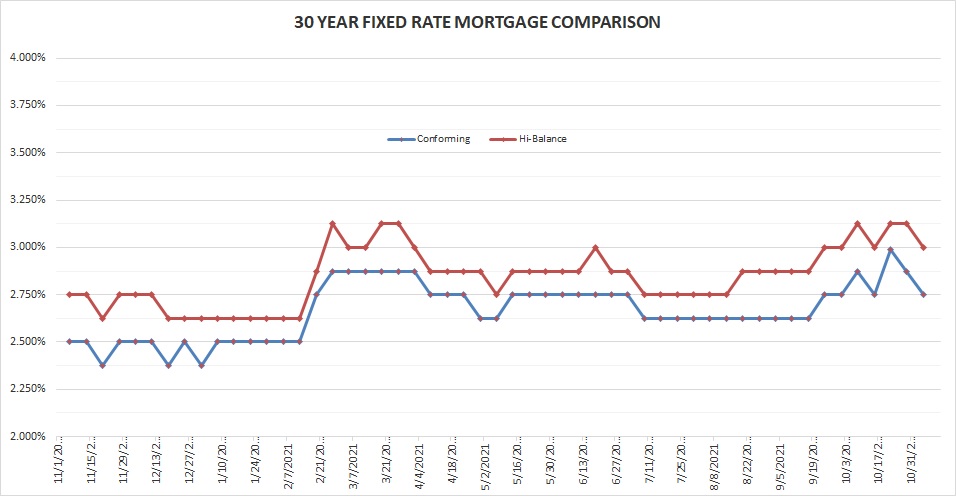
Rates for Friday November 5, 2021: Investors have continued their purchases of Mortgage Backed Securities and the momentum of lower rates that began late last week continues into this Friday. The economic news and action by the Fed should put upward pressure on rates, or at least eliminate downward pressure.
FIXED RATE MORTGAGES AT COST OF 1.25 POINTS LOCKED FOR 45 DAYS FOR PURCHASE TRANSACTIONS:
30 year conforming 2.75% Down 0.125%
30 year high-balance conforming 3.00% Down 0.125%
Please note that these are base rates and adjustments may be added for condominiums, refinances, credit scores, loan to value, no impound account and period rate is locked. Rates are based on 20% down with 740 FICO score for purchase mortgages.
Anyone need some bags of candy? Last week I mentioned how we were excited to see Halloween return to “normal” and Leslie stocked up on candy for us to hand out to trick-or-treaters. Well, after only six or seven small groups rang the bell, we have plenty left—too much—despite us grabbing handfuls of little candy bars and dropping in the bags and buckets.
Thankfully one of the young moms in my gym workout group volunteered to take a bag off our hands! Yes, I see the irony of sloughing off candy at the gym…
Have a great week,
Dennis
Past Weekly Rate & Market Updates can be found on my blog page at my website www.DennisCSmith.com/my-blog


