


What steps should we take to purchase a new home?
Question of the week: What steps should we take to purchase a new home?
Answer: Typically, May is the start of home-buying season as many families wait until school is out for the summer to move. As you are aware, this has not been the typical year and with school age children not going to school for over a year many families moved in the middle of the school year. However, many families are starting to enter the home-buying market, so here are some tips that should lead to a smoother process.
Before you look at properties, consult with a mortgage professional (synonymous with Dennis Smith), have readily available your financial information:
- Recent paystubs
- Prior two years’ W2’s
- Prior two years’ federal tax returns—especially if your income is commission base, self-employed, full or part ownership in a company, or have any investment property
- If receiving retirement income have award letters available indicating the gross amount you will be paid
- Statements for asset accounts, including but not limited to checking, savings, investment and retirement accounts
- List of credit obligations, credit card balances and minimum payments, auto loans, student loans, anything that will show on your credit report
- If you own other property, you will be retaining, mortgage, insurance and HOA (if applicable) statements
This information will be needed to determine sales price and mortgage options for your new home purchase.
During the initial consultation, reveal your secrets. The most apt metaphor for going through the mortgage price, while a bit crude, is going through a financial enema. If you have, or had, spotty credit, tax liens, judgements or liens, short sales or foreclosures, employment gaps for more than two years, they will come out as early as when a credit report is pulled, or later when a title company does some investigating. The sooner we know about these items the sooner we can create a plan that will enable you to move forward with your home purchase. Holding back information can create bigger problems later when you are in escrow, and in some instances result in your losing your deposit. Like your doctor, lawyer, or priest, anything you tell us is confidential, but we need to know.
After discussing price and mortgage options, the next step is to be obtain a pre-approval. This will require all the items listed above that you already have ready to send to us. At this point a loan application will be initiated and a credit report will be pulled.
“But I don’t want an inquiry on my credit report.” Then you will not get a pre-approval. You will get pre-qualification that says, “subject to credit report.” Which tells a seller’s agent, “they might not be able to purchase the house, why don’t we look at another offer.”
With your financial documents and credit report, for the vast majority of home buyers purchasing with a loan below the Fannie Mae/Freddie Mac loan limits ($822,375 in high-cost areas), we will upload your information to Fannie and/or Freddie to get credit approval.
At this stage we will be ready to provide your real estate agent with a pre-approval package to show a seller. This will include a letter stating the price you are qualified for in purchasing a new home, evidence of your credit scores, funds to close, income used to qualify and very importantly, a copy of the approval from Fannie or Freddie.
If you have not already found an agent to represent you for your purchase, this is your next step. Like with your mortgage professional, your agent should have experience and knowledge to provide you with advice and solutions should any issues crop up. You do not have to be best friends with your agent; however, you do want to have a very good working relationship.
Whether it is your first home purchase or your tenth, it can be, and often is, an emotional experience. Consider that you are committing yourself for a long period of time, spending a significant amount of your savings, obligating yourself to what will likely be your largest monthly expense; oh, and looking at moving your family which entails packing, unpacking, shutting off and turning on utilities, all while continuing to work, parent, volunteer and lead your normal life.
You need to get along with and trust your agent and mortgage professional.
Advice that I have given home buyers, again whether first time or tenth time but especially first-time buyers, that has worked very well is to make a list. This is more important is you are purchasing your new home with a spouse or significant other than if you are buying on you own, but important none the list.
If buying with someone else, each of you needs to agree to be selfish. Go into separate rooms and think about the home you want. Write down the three things you most want in your home.
It can be anything, walking distance to school, three bedrooms, more than one bathroom, a pool, single story. Whatever you really want your home to have. When we purchase our current home in 1998 Leslie said all she really wanted was a formal dining room. Guess what we have?
After your “must have” list, make a list of items that if a home has it you won’t buy it. Again, it can be anything, not on a busy street, a pool, an outdated kitchen, choppy floor plan.
I recommend only three items on your “must have” list because after each of you have completed your lists you will want to compare. If you each have three different must-haves, you now have six items on the checklist, which can be a lot to fill. Typically, the two lists have at least one, possibly two but rarely all three, that are similar. I put no limit on the “can’t have” lists because most people only have one or two items. If the can’t-have list is too long it puts you in the same position as the must-have list being too long, i.e. decreasing your chances of finding the right home.
Now, compare your lists. This is important because if one spouse has on the must-have list a pool and the other spouse has that on can’t-have, how do you reconcile? It is challenging because one spouse will not get what they want. Another personal interjection, neither Leslie nor I put down having a pool on either list. Neither of us had a backyard pool growing up and we just didn’t really consider it. We bought a home with a pool and are not sorry that we did. We lucked out in that regard.
With your list in hand, and all discussions had on any cross-overs, present the list to your agent. This will make the agent’s job a lot easier, and not infrequently leads to a call. “Hi Dennis, this is Fred. I’ve met with Maria and Burt to discuss their new home and what we will be looking for. They have given me a list of what they want or don’t want and looking through homes in the area they want to buy it looks like they will need to go about $40-50,000 higher in price. Can they do it?”
Once you identify your agent introduce him/her to your mortgage professional so they can initiate communication. Clear, open communication between your agent and us is critical to how your transaction will go. This is one example of why.
What do we do if what you want costs more than we discussed when going through price and mortgage options? Were we restricted by funds to close and need to put less down? Was it debt-to-income ratios and we need to pay off debt? Add mom and dad as a co-signer? Or with your financial situation that large of an increase is not possible, which means to get the home you want you need to look in another area?
Working together, you, your agent, and we will discuss all the what-if’s and show what will work and what will not work within the parameters of your new home, its amenities, location and ability to finance.
Finally, get off perfect.
I have seen many would be homeowners, almost always first-time buyers, over the years who have an idea of the home they want that is unrealistic with their financial abilities. They want the perfect home in the best location and they just cannot afford to purchase. Often, after meeting with the agent and me we can show them what is available in their price range. Discuss with them that this is their first home and over the years as their financial position improves, and their home acquires more and more equity, they can have a better opportunity to purchase a home that is closer to their dream home. However, waiting to purchase until you can buy the dream home may entail more years of waiting as you chase its price growing at the same, or faster, rate than you are able to be in a better financial position.
When you decide the time is right to purchase your new home, work with professionals and be open with them about what you want and what you can afford. I strongly recommend working with trusted professionals instead of trying to find the right home and loan on the internet. You can save hours, days, weeks, working with professionals who know what you want, what you can afford and have a lot of the leg work already done.
If you or someone you know is thinking about buying a new home click the link below to reach out to a mortgage professional helping families purchase homes since 1987.
Have a question? Ask me!
Words matter. A pre-recorded interview with current Treasury Secretary, and former Chair of the Federal Reserve, Janet Yellen, was released on Tuesday morning in which Yellen seemed to contradict the Fed’s rate policy, saying that “rates may need to be slightly higher if the economy overheats.” The comments caused markets to dip, later mostly recovering after Yellen responded by saying she is not predicting or recommending the Fed raise interest rates. Some saw Yellen’s rates comment as what could occur based on President Biden’s release of different spending plans that total approximately $4 trillion. Of course, what Yellen said is true, if the economy begins to overheat, or even over-warm, rates will need to be higher. From my perspective looking at the current economic growth and possible additional spending from Washington the question is not if rates go up, but when, how much and how fast.
Swing and a miss. The monthly first Friday of the month jobs report was a shocker. Every month prior to the release Dow Jones and The Wall Street Journal survey economists for their estimates on how many jobs were created or lost in the prior month. For April the consensus was an estimated 1 million new jobs added to the economy for the month. Today the Labor Department’s data showed that only 266,000 new jobs were created in April. In the decades I have followed labor statistics this is by far, on a factor of ten to fifteen times, the biggest miss by the estimators. To say the job gains are a disappointment is an understatement. What happened? The economy is opening up with the leisure and entertainment industries approaching full activities, bars, restaurants, hotels, entertainment venues have millions of job openings, and there are still millions of unemployed workers.
Interviews with employers show that many businesses are saying it is harder to find employees largely due to the emergency unemployment benefits have deterred some workers from accepting jobs, or looking for them; the benefits do not expire until September. Average wages have climbed, in some part due to businesses offering higher pay to attract workers. The smart long-term play for those unemployed is to get hired now before a wave of workers coming off benefits enter the job market.
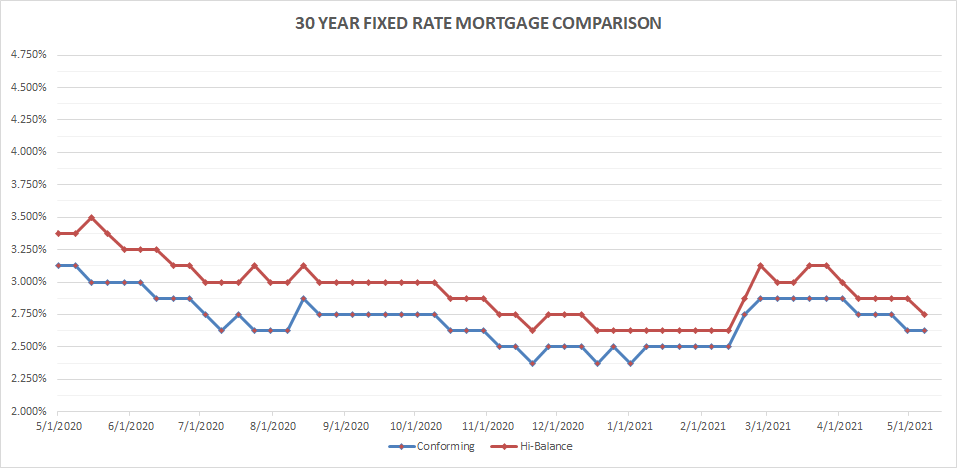
Rates for Friday May 7, 2021: Yellin was not wrong in her comments, but for the meantime rates hang around our historic lows. The conforming rate remains flat after last week’s decline and the high-balance rate dips for the first time in a month.
FIXED RATE MORTGAGES AT COST OF 1.25 POINTS LOCKED FOR 45 DAYS FOR PURCHASE TRANSACTIONS:
30 year conforming 2.625% Flatt
30 year high-balance conforming 2.875% Down 0.125%
Please note that these are base rates and adjustments may be added for condominiums, refinances, credit scores, loan to value, no impound account and period rate is locked. Rates are based on 20% down with 740 FICO score for purchase mortgages.
My turn. This afternoon I am getting my second vaccination shot. Looking forward to having whatever part of my subconscious has been on hyper-alert to recede to relative caution as a result. Many people I have spoken to about their vaccinations have commented how they had an unexpected feeling of relief, or calm, following their being vaccinated. This feeling will become even stronger if we, as a community, can encourage everyone to receive both doses. And sooner rather than later.
Happy Mother’s Day to all the moms. This past year has been extremely challenging for many, especially the mothers to younger children who have been home all day every day. It is challenging enough to juggle jobs, parenting, marriage, friendships, in normal times when everyone has a place to go every weekday. Removing those places-to-go, and increasing workloads for at home schooling, has created additional challenges. One bright spot through the pandemic has been seeing how well most people have adapted and coped, in some cases thrived, as home-school-work lives were re-created.
Have a great week,
Dennis
Past Weekly Rate & Market Updates can be found on my blog page at my website www.DennisCSmith.com/my-blog


