


Should we get a HELOC?
Question of the week: Should we get a HELOC?
Answer: Follow up question for some readers, “What is a HELOC?”
HELOC (Hee-lock) stands for Home Equity Line of Credit. A HELOC is a loan that operates in the same way as a credit card (credit line instead of credit card), with the exception that there is a deed recorded that secures your home, or property, as collateral against the line of credit.
Here are the similarities between a credit card and a HELOC:
- There is a maximum credit limit that you can borrow
- There is a monthly minimum payment that is less than the entire balance
- The amount you can borrow fluctuates between the outstanding balance borrowed and your credit limit
- Here are the primary differences between a credit card and a HELOC:
- HELOCs do not have open-ended terms; they typically must be paid off and closed within 15 or 20-years
- The interest rate on HELOCs are not fixed, they almost always tied to the Prime Rate and the rate adjusts every time the Prime Rate goes up or down; note that most HELOC rates are not the Prime Rate, but the Prime plus a margin
- Most HELOCs have a minimum payment of interest only on the outstanding balance or a percentage of the balance
- The interest you pay on a HELOC may be tax deductible (consult your tax preparer)
- Many HELOCs have two terms, the first is how long you may access funds, the second when it must be paid in full and closed
- I.e. A 20-year HELOC may allow you to draw funds for 15-years and then the line is closed and you have 5-years to pay off the balance and close the line of credit
- Typically, once the draw term is closed, any outstanding balance is then fully amortized for the remaining term, with the payment adjusting as the Prime Rate adjusts. For instance if you have a 15-year draw on a 20-year lifetime term and at the end of the draw you have a balance of $75,000, your minimum payment will be amortized over 5-years, which will be a very high payment
- Similar to some credit cards, such as American Express, most HELOCs have an annual fee. Some only charge the fee if you have not obtained any funds or carried a balance in the past year, others charge regardless of whether you have accessed funds or not
- Most HELOCs have an early closure fee if you close the line within 3 or 5-years, this can vary from $300 to up to $750 depending on the lender and the amount of the credit line
Quick recap, a HELOC is line of credit that allows you to obtain funds over a period of time, and like a credit card your balance can fluctuate as you obtain funds and pay down the balance.
Now that we have quickly covered what I HELOC is, why would you want one?
Our industry puts HELOCs into one of two categories, purchase money and non-purchase money. Whether you would want one depends on when you obtain one.
Here are some reasons some buyers obtain a HELOC at the time they purchase their home:
- To avoid mortgage insurance
- The buyers are purchasing their new home before their current property sells, when their current home sells they use the proceeds to pay-off or pay down the HELOC balance
- Buyers are anticipating a large sum of money in the future from inheritance, bonus, sale of another asset and intend to use the money to pay-off the HELOC balance
- To have one in place for possible use later and avoid going through another home lending process—typically these types of users close without putting any balance on the HELOC
- Purchase a home with a HELOC, some lenders do not allow, and not traditional mortgage, as they intend to payoff not long after closing and want to retain the HELOC should they need funds in the future
There are several reasons property owners obtain HELOCs after they have purchased their home:
- To pay for property maintenance or remodel
- Have funds available if needed for children (or grandchildren) college costs and expenses
- To obtain funds for down payment on a new primary home, vacation or 2nd home, or investment rental property
- To have funds available should they need then in the future, an emergency funds-available account
For most homeowners I recommend they obtain a HELOC even if they have no immediate use for one so they have access to funds should they require them in a short period of time. Perhaps a family member is ill and you have additional medical or care expenses, as mentioned a child is going to college and you need some funds to bridge paying tuition or other costs and when you will have funds available to pay them, your home sustains significant damage through an accident or natural disaster and there is a large gap between what your homeowners’ insurance policy will pay and the costs of repair. All of these scenarios can create a quick need for funds, quicker than it would take to obtain a HELOC, because of this many will tap their credit cards for the funds at much higher rates than the rate on for a HELOC.
If you are considering a HELOC and talking to different banks and lenders here are some factors to compare:
- What is the margin above the Prime Rate that will create the rate we will pay
- Note that HELOCs are somewhat different in that some lenders base the margin added to Prime based on several factors, your credit score, how much you want for the maximum borrowing limit and what percentage of the value of your home will be the combination of the balance of your primary mortgage and your maximum credit limit (the combined loan-to-value or CLTV)
- Ask your lender if your margin will be higher or lower if you apply for a larger credit limit or if you apply for less based on the CLTV
- How long is the draw period compared to the life of the HELOC
- What is the minimum payment
- At some point after the draw period is over is any balance fully amortized or do you still have a minimum payment
- Is there an annual fee, if so how much is it
Is there an early closure fee, if so how long before there is not fee and how much is it
As typical for the WR&MU, a long way to answer the question, “should we get a HELOC,” with a “Yes, it might make a lot of sense for you to have one.”
For those considering obtaining a credit line and paying it off in the future with a refinance of your primary mortgage, please read the January 24, 2020 Weekly Rate & Market Update, “Why does it cost more to refinance if we are paying off a Home Equity Line?”
If you are considering obtaining a HELOC please do not hesitate to contact me to talk it through and possible sources you may wish to consider when doing your research.
Have a question? Ask me!
Consumer prices rose more in January than in the previous five months. The Consumer Price Index increased 03% in January, for an annual inflation of prices of 1.4% from last January. The push up in prices was primarily due to higher fuel and gasoline costs. Stripping out food and energy the “core” rate of inflation for the month was flat—no increase or decrease. Prior to the pandemic inflation was running hotter than the Fed or the markets preferred, at 2.3%. With energy prices expected to continue to climb as domestic production and shipping is curtailed, and the economy slowly opening due to fewer cases of Covid-19 and exponentially more vaccinations occurring, the outlook is for prices to increase at a more rapid pace than many expected not too long ago. The CPI data is mortgage rate unfriendly as higher prices historically lead to higher rates.
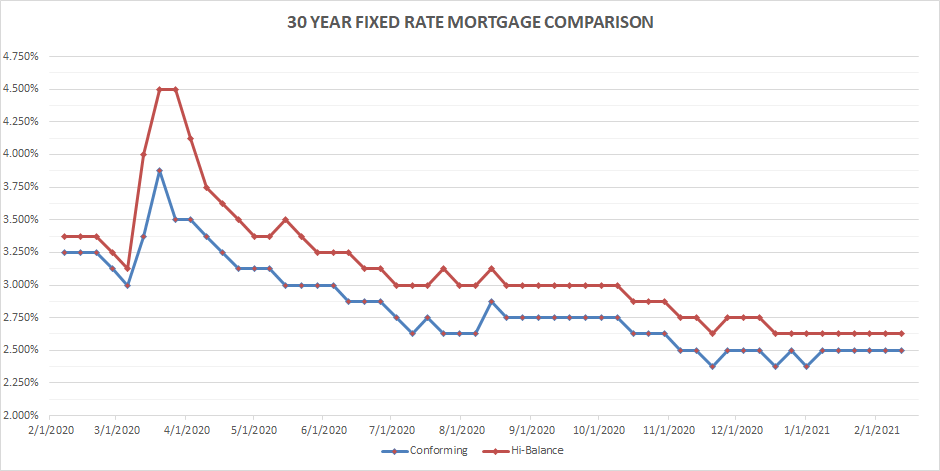
Rates for Friday February 12, 2021: Rates are flat from last Friday, with some upward pressure over the past few days. With the 3-day weekend upon us investors are holding tight and may come back to market to push rates lower when markets open next week.
FIXED RATE MORTGAGES AT COST OF 1.25 POINTS LOCKED FOR 45 DAYS FOR PURCHASE TRANSACTIONS:
30 year conforming 2.50% Flat
30 year high-balance conforming 2.625% Flat
Please note that these are base rates and adjustments may be added for condominiums, refinances, credit scores, loan to value, no impound account and period rate is locked. Rates are based on 20% down with 740 FICO score for purchase mortgages.
One of my friends last week asked, “how can you want to see Tom Brady win another Super Bowl?”
I answered, “Two reasons, one I want to see him win one without the ‘he only wins because he is with the Patriots and Coach Belichick.” Two, I feel it would be like watching Babe Ruth hit his 714th or Henry Aaron hit his 755th home run. Historic events that at the moment you did not know they were.”
It is interesting how our culture tends to build up and then, or simultaneously, tear down excellence for those in the public eye—especially in sports and entertainment. As much as people cheered Tiger Woods incredible achievements on the golf course, they followed that with smug gratification (some not so smug) to see his fall when his humanous was revealed. As it is with Tom Brady, many people root against him because he is so good and they want to see him fail. In doing so they are actually celebrating how amazing he is at what he does and that bothers them.
We over celebrate our celebrities, putting too much power to their opinions and deeds, and then are disappointed when we find out they are normal people, just better as some things than almost everyone else. When this disappoint arrives, we tear them down, how dare they have faults like all of us?
Congratulations to Tom Brady for obtaining his 7th Super Bowl ring, and to his defensive teammates who were primarily responsible. Let’s acknowledge and applaud what this man has achieved. So far.
Happy Valentines everyone, I hope you are able to have a special-quarantine-at-home-modified celebration of your loved ones!
Have a great week,
Dennis
Past Weekly Rate & Market Updates can be found on my blog page at my website www.DennisCSmith.com/my-blog


