


Should we exchange our investment property or sell it and pay the taxes?
Question of the week: Should we exchange our investment property or sell it and pay the taxes?
Answer: This is a great question, and one I ask many of my clients who have investment property and call to inquire about financing for an “upleg” should they sell a rental property and transfer the proceeds to another rental property.
NOTE: THE FOLLOWING CONTAINS EXAMPLES AND ESTIMATES FOR TAXES AND LIABILITIES. I AM NOT A TAX PROFESSIONAL NOR ATTORNEY, BEFORE ENGAGING IN ANY TRANSACTIONS INVOLVING INVESTMENTS AND TAX CONSEQUENCES CONSULT A LICENSED TAX AND/OR LEAGAL PROFESSIONAL.
Quick primer: If you own a stock and it goes up in value and you sell it you owe taxes on the profit, what is known as capital gains.
If you sell the stock in less than one year you will have short-term capital gains, and the gain will be added to your income for tax purposes. If you own the stock for more than one year you have long-term capital gains for tax purposes. Why is this important? Because in
For example, you purchase 20 shares of GameStop stock on January 24th for $1300 and sell the stock on January 28th for $470 per share for $9400. You have made $8100, which is added to your income for 2021 taxes. If at the end of the year you and your spouse are in the 24% federal tax bracket then you will pay $1944 in taxes on the GameStop profit, so your net profit, before state taxes, will be $8100 less $1944 or $6156. Not bad for four days “work.”
Now let’s say you purchased 20 shares GameStop on January 27, 2020 for $4 per share. You sell those 20 shares on January 28th for $9400 for a gain of $9320. If you are in the 24% tax bracket your federal taxes on your gain will be 15%, or $1398 for a pre-state tax profit of $7922. As you can see, even though your profit on the stock was higher due to the lower purchase price, your taxes are lower because the long-term capital gains rate is 15%, as opposed to the short-term capital gains tax rate being added to your income.
The long-term capital gains tax is historically low. Currently, if you are a married couple and earn up to $80,000 the long-term capital gains tax on the sale of an investment is 0% (zero); if you earn over $80,000 and up to $496,600 the tax is 15% (at the upper limit your income tax rate goes up to 32%), if your combined income is over $496,600 the long-term gains rate is 20%.
Back to real estate. Many real estate investors are familiar with IRS tax code section 1031. This code states that if you sell your residential rental property and purchase another property(s) and postpone paying the capital gains if certain conditions are met.
Example, you purchased 123 Main Street in 2010 for $350,000 and sell it in 2021 for $575,000 after paying costs of the sale and the mortgage your net proceeds (i.e. gain) is $300,000. You immediately transfer that $300,000 as down payment on a $750,000 property at 321 First Street, then you will not have to pay taxes on the $300,000 as you have completed an IRS 1031 exchange. Yet.
This is called a 1031 exchange and has been used for decades by real estate investors to delay taxes on their real estate capital gains. There is no limit on how many times you can exchange the proceeds from one property to the next. However, your capital gains calculation goes back to your initial investment property’s cost basis.
For instance, in the above transaction, after purchasing and holding the First Street property, you sell it and transfer the proceeds to property C after three years, five years later you sell property C and buy property D with the proceeds. In 2031 you consider selling Property D that has a value of $1.6 million. After the dust settles on costs and loans, your account lets you know that if you sell the property at $1.2 million the gains, going back to your original $350,000 purchase price for 123 Main Street in 2010, are approximately $1 million. Unless you engage in another 1031 exchange, this is the amount that will be subject to capital gains tax.
What will be the long-term capital gains federal tax rate in 2031?
Chances are that rate will not be as low as it is today. There is a good chance that the capital gains tax rate will not be as low in a few years as it is today.
Anyone who has even tangentially followed politics in the United States over the past decade plus is aware that there is a strong sentiment in certain political circles to increase taxes on “wealth.” While the term is loosely described, it is most commonly used to describe assets and not income. For example, funds held in investment and savings accounts, equity in real estate and other valuable assets. The challenge is how to effectively appraise the value of wealth and therefore be able to tax it.
Fortunately for those who wish to tap into this vast potential revenue stream for the government, besides taxes the other certainty in life is death. When people pass away their assets and holdings must pass along to someone else.
In various proposals I have read through the years, the means by which to tax wealth can be made with some amendments to the tax code. Here are some of the proposals I have read that have garnered attention and backers:
- Raise or eliminate the long-term capital gains tax rate. In the past long-term capital gains were also taxed as ordinary income. If you had a $300,000 gain on the sale of property that plus your ordinary income for the year could put you in the highest tax bracket. The other option is to raise the rate so it begins above the current 15% for middle income earners and higher than 20% for high income earners.
- Abolish the 1031 exchange, or significantly modify. The abolish piece is easy to understand. When you sell an investment property and purchase a new one the whole amount of your gains would be taxed. This would be strongly opposed by the real estate industry, and those who understand how this would have a significantly negative impact on the housing industry in high rental markets. The other option would be to modify the 1031 exchange such that a portion of the proceeds from sales would be taxed at a lower rate than the long-term capital gains rate, allowing the government to capture some of the gains with each transaction instead of waiting for some time in the distant future when taxes will be paid. Similar to the taxing of distributions from IRAs and other retirement accounts, and the mandatory distribution of from these retirement accounts when individuals reach 72 and a half years of age.
- Alter the inheritance tax to either lower the exemption amount, or to have a carve out for investment real estate that had been purchased by an estate via use of the 1031 exchange method.
Regarding this last proposal, transferring wealth at death is the primary change that has been made through the years to tax wealth and subject to a very large industry for accounts and lawyers who work with individuals on structuring estates such that their assets, aka wealth, are able to be transferred to family members with the minimum of tax consequences. The maximum value that can be transferred following the changes to the tax code in 2017 is about $11.5 million for individuals and $23.2 million for married couples. In 2025 these limits revert to pre-2017 limits of $5 million for individuals due to a sunrise clause in the 2017 tax act that reverts most of the changes made to 2017 levels.
One reason that many families hold investment properties for decades and avoid paying capital gains taxes is because if the properties are transferred through their estate upon their death the properties are given a “step up in basis.” Meaning the value of the property is adjusted to current market prices for purposes of calculating taxes. Let’s go back to our example.
Maria and her husband Fred purchased 123 Main Street in 2010 and engaged in the exchanges described above. In 2025 Fred passed away and the Maria became the owner of the properties through the trust they created. In 2030 Maria passes away and the estate has a property worth $1.6 million. Her two children inherit this property and sell it for $1.6 million.
Depending on the exemption before having to pay inheritance taxes, the kids can sell this property for the value it transferred to them, they will have no federal taxes on the sale. To recap, the property was purchased for $300,000 and later sold for $1.6 million and no taxes were paid because of the exemption in the tax code.
This is the transaction that many have their focus on to capture more taxes from the accumulation and transfer of wealth.
With the changes in leadership in Congress and the White House, there is a two-year window whereby Democrats can make significant changes to the IRS tax code. With significant pressure from several of their party members in Congress, and donors, to alter the tax code to increase taxes on “wealth” it would not be unexpected to see some of the changes described above go into effect as soon as 2022.
Back to our question of the week. {Finally, he’s getting to it…} If you own investment property now and no longer wish to own it, should you sell it and pay taxes or sell it and go through a 1031 exchange and purchase another property?
My advice is to consult your account and have him/her determine if you were to sell and keep the proceeds what your current tax liability would be. Back to our example above, if you sell 123 Main Street and your gains are $300,000, due to your tax bracket the federal long-term capital gains tax would be approximately $45,000.
That is a lot of money to pay the government, plus you would have state tax (California taxes all capital gains as ordinary income). If your sale puts you in the 10.3% rate that adds another $30,900 to your taxes.
Why would you pay almost $76,000 in taxes when you can avoid those taxes by purchasing another rental property?
First, you will have $224,000 tax free—you’ve paid the taxes on the money.
Second, strongly consider potential changes to future tax laws that may increase the amount of taxes you may have to pay on investments.
Third, consider the political environment in California that has been slowly, but steadily, moving towards being more and more favorable to tenants over landlord, and altering the Prop 13 protection for real estate taxes on non-owner occupied and commercial properties. What will be your costs and liabilities of future ownership of rental property?
Fourth, is it worth being a landlord until you pass away just to pass property along to your children so they can sell it and, possibly depending on future tax laws, avoid taxes.
Most people are very tax adverse. Using the tax code, we try to minimize the amount of taxes we have to pay. However, there are times when paying taxes in the present to avoid future taxes, costs and liabilities in the future may be a very good option.
If you own investment properties speak with your tax preparer and family law attorney (assuming you have a trust, if you do not then get one immediately, I know several excellent attorneys in this area I can refer you to). Perhaps now is the time to transfer property to children? Perhaps now is the time to sell and pay the taxes to clear your equity into cash you can use for retirement? Perhaps now is the time to sell, pay the taxes and stop being a landlord?
Reiterating the disclosure above, I am neither a tax professional nor an attorney. Before making any decisions regarding the sale and disposal of property consult your tax and legal professionals.
Have a question? Ask me!
The economy saw largest decline since 1946 in 2020. With 4th quarter Gross Domestic Product increasing 4% on an annualized rate, the year over year growth was negative 3.5% for the year. Not surprising given the 33% contraction in the 3rd quarter. The news is slightly rate market unfriendly as in normal times 4% growth would be considered very strong.
Income up, spending down, savings up. Personal incomes in December increased 0.6% from November. The increase is largely attributed to enhanced unemployment benefits and layoffs at entry level and lower income positions. Unusual for most Decembers, consumer spending in December dropped 0.2% from the prior month, the second straight decrease in spending. Consumers holding off from buying big ticket items was the largest factor in the decline. The personal savings rate in December was 13.7%, pre-pandemic the rate was considered high at 8%. Overall, the news is interest rate neutral. Consumer spending is 65-70% of our GDP, weak spending is a concern which would push rates lower, however the increase in savings points to pent up demand that may cause the economy to rapidly grow once people feel comfortable with their incomes to spend and buy purchases they have been refraining from during the pandemic.
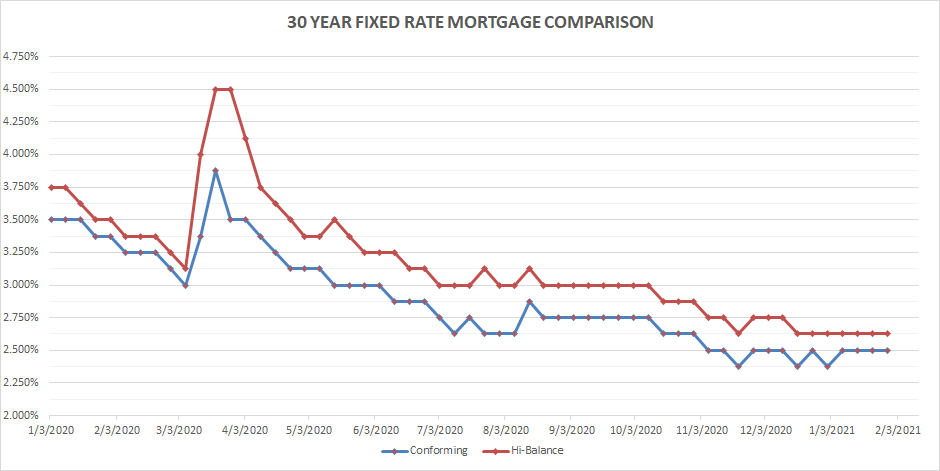
Rates for Friday January 29, 2021: Rates continue to be flat Friday to Friday, however there has been upward pressure on rates and I would not be surprised if we see a slight increase next by the end of next week.
FIXED RATE MORTGAGES AT COST OF 1.25 POINTS LOCKED FOR 45 DAYS FOR PURCHASE TRANSACTIONS:
30 year conforming 2.50% Flat
30 year high-balance conforming 2.625% Flat
Please note that these are base rates and adjustments may be added for condominiums, refinances, credit scores, loan to value, no impound account and period rate is locked. Rates are based on 20% down with 740 FICO score for purchase mortgages.
Many of our choices in life have unforeseen consequences. Some are positive, some less than positive. In 1994 I made a choice that had a wonderful unforeseen consequence, I asked Leslie to marry me, and thankfully she said yes.
Foreseen consequences that were positive were our desire to start a family, which resulted in our two wonderful daughters. Homeownership, family dogs, trips, were some of the many foreseen consequences we planned for and have enjoyed.
Unforeseen, by me, was that when one gets married one expands their family. In this case I was very fortunate to get Don, later known in our home as DonPa. Very quickly Don and I got along very well. Together we enjoyed dumb jokes, clever jokes and perhaps a sip together once in a while.
The first several yeas of our marriage, from time to time he would call me at work at the beginning of the month. “Hi Don!”
“Oh good, you’re at work. My social security check is due tomorrow and I wanted to make sure you were working so I keep getting it.”
He spent thirty years as an examiner for the Fed, and was always interested in what was happening in the mortgage and money industries.
Last Friday DonPa passed away due to Covid-19. He was 91 years old and lived a full life. He was a wonderful father, grandfather, uncle, brother and friend. He was also the best father in-law a husband could ask for.
Cheers DonPa, toasting you for a wonderful next adventure. Thank you for enabling me to be part of this one.
Have a great week,
Dennis
Past Weekly Rate & Market Updates can be found on my blog page at my website www.DennisCSmith.com/my-blog


