


Will the Biden Administration impact the mortgage industry?
Question of the week: Will the Biden Administration change the mortgage industry?
Answer: Yes. In fact, it already has.
Government entities control more than half the mortgages funded in the United States through the FHFA, FHA and VA. The majority of mortgages are funded through Fannie Mae and Freddie Mac, both under conservatorship of the federal government via the Federal Housing Finance Agency regulation, FHA mortgages are insured through Federal Housing Administration and VA mortgages are insured through Veteran’s Administration.
On January 20th, inauguration day, FHA issued a waiver that removed a prior policy that “Non-US citizens without lawful residency in the U.S. are not eligible for FHA insured mortgages.” The waiver states that FHA is permitting individuals classified under the “Deferred Action for Childhood Arrivals” program (DACA) are legally permitted to work in the U.S. are eligible to apply for mortgages backed by the FHA.
FHA mortgages have been a foundational program that changed the path of homeownership since created in 1934, insuring mortgages provided by banks and private lenders. This enabled lenders to not only fund more mortgages knowing some of their risk was reduced, but also to create mortgages that were amortized over 30-years, thereby reducing the cost of homeownership and enabling more Americans to purchase homes. A critical economic change during the Depression that changed the country as it enabled families to move out of the cities and into surrounding areas—the forerunners of suburbanizing America post World War II.
This waver by FHA opens up FHA mortgages for DACA classified individuals who otherwise qualify. It is estimated that there are over 700,000 DACA residents currently in the United States.
Officials in the Trump Administration were working almost from day one to separate Fannie and Freddie (GSEs) from their conservatorship under the U.S. Government. A very quick recap, as part of the recovery from the housing and mortgage market melt-downs in 2007-8, the federal government, to prevent the two GSEs from collapsing, purchased preferred stock in the companies and essentially took them over. Since the purchase the GSEs profits have gone into the U.S. Treasury to repay the funds used to purchase the stock. Over the last year, an agreement was made to allow the GSEs to retain $45 billion ($25B for Fannie and $20B for Freddie) in profits so they can increase their capital.
The objective was for the GSEs to each have around reach the $283 billion in total capital as part of the preferred stock purchase agreements between the FHFA, Treasury and the GSEs. Once the figure was reached the GSEs would leave their conservatorship, no longer have the backing of the U.S. Treasury guaranteeing their mortgages to investors, and essentially be close to independent but still under government supervision.
It is unclear at this time if the Biden Administration will continue to pursue separating the GSEs from the government and enable their independence. Many in the Administration, and in Congress, wish to see the federal government still retain strong control, and they like the profits flowing into the Treasury. Others wish to remove the risk to tax payers of the government guarantee and see mortgage risk on conventional mortgages move to investors.
A huge impact that may occur on the mortgage industry is President Biden’s proposal to offer legal citizenship to the approximately 11 million immigrants in the United States illegally. This would greatly expand the number of individuals eligible for mortgages in the United States, the largest single increase in eligible potential borrowers since President Reagan since the Immigration Reform and Control Act in 1986 granting amnesty and citizenship to approximately 3 million immigrants who had entered the country prior to 1982.
Having an impact on the mortgage industry, but not as significant at the FHFA is the Consumer Financial Protection Bureau. Its strongest impact on the industry is probably regulations on how mortgage companies must pay their loan originators. However, with its very strong involvement in pay-day loan companies, student loan lenders, and other consumer credit industries, the CFPB tangentially impacts mortgages through how those various lenders must treat consumers and very importantly for the mortgage industry, report to credit agencies.
Any major significant changes that need to go through Congress will require negotiations between the White House and both chambers of Congress. With a narrower majority in the House and a non-filibuster proof majority of one vote (Vice President Harris), any changes that impact homeownership will likely require moderates from both parties to agree for legislation to pass.
As always, with every new Presidential Administration the early days provide a lot of proposals, promises, hope and angst (depending on which side of the of the aisle you are on). As always, once the Cabinet members are appointed, people find out how to unjam the copy machine, where to find members of Congress or the Administration in their cafeterias, the reality of governing comes to bear and major changes take a little longer than initially expected.
That said, the FHA’s statement regarding DACA individuals to be eligible for FHA mortgages is an immediate impact on housing and the mortgage industry opening up the markets to hundreds of thousands potential borrowers and homeowners.
Have a question? Ask me!
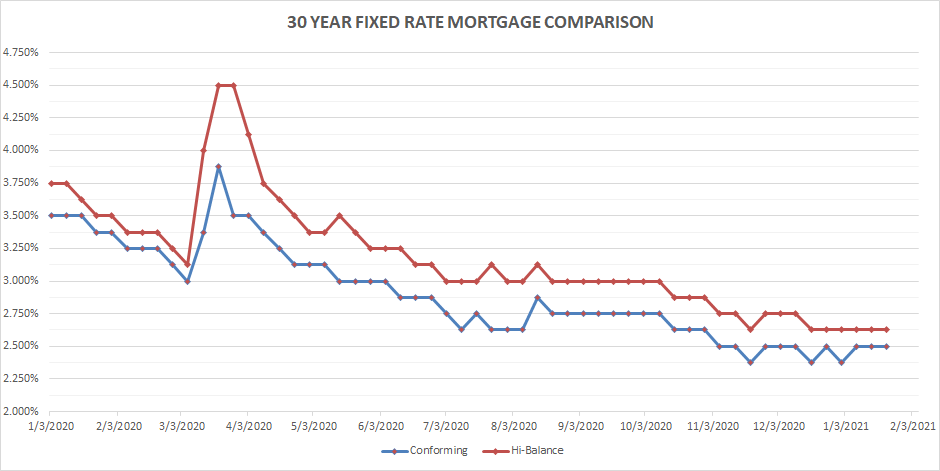
Rates for Friday January 22, 2021: Not a lot of economic news this week impacting mortgage rates, and not surprisingly they are flat from last week, and the week before, and in the case of high-balance rates the weeks before. Investors have been pushing stock prices higher on expectations of a lot more government spending, but have not been pulling money out of fixed assets like mortgages. Were it not for the Fed purchasing mortgages and U.S. Treasury debt I would assume rates would be creeping up.
FIXED RATE MORTGAGES AT COST OF 1.25 POINTS LOCKED FOR 45 DAYS FOR PURCHASE TRANSACTIONS:
30 year conforming 2.50% Flat
30 year high-balance conforming 2.625% Flat
Please note that these are base rates and adjustments may be added for condominiums, refinances, credit scores, loan to value, no impound account and period rate is locked. Rates are based on 20% down with 740 FICO score for purchase mortgages.
Our oldest daughter flew back to Boston on Monday to start her the spring semester of her junior year. On Tuesday Leslie flew to New York City with our youngest daughter where she will be starting her college career as a freshman spring semester. So, it’s just been me and the dog, and will be until Leslie returns on Wednesday. Undoubtably the experiencing of being home alone is different with the lock downs than they would normally be if the restaurants and bars on the street over from us were open. This means a positive of Covid-19 for me this week is staying home, eating a bit better than I would have otherwise, foregoing some of the beverages I would have enjoyed and saving money.
Of course, had this been a year ago I’m sure several evenings would have been spent with friends who would need to “console” me on my being home alone by sharing in some of those meals and beverages…
My strong hope is that the promise of the new administration to bring unity to our country comes to pass. Of course, this will require those on the edges of both sides who have been screaming, yelling, cursing, etc to be marginalized so the overwhelming majority of us who live, work, play and think more towards the middle don’t feel like they have to pick one side and hate the other.
I’m looking forward to the days to return where civil disagreement is pervasive, and encouraged, to explore many different options and solutions to issues and problems.
Have a great week,
Dennis
Past Weekly Rate & Market Updates can be found on my blog page at my website www.DennisCSmith.com/my-blog


