


Why are refinances suddenly more expensive?
Question of the week: Why are refinance mortgage suddenly more expensive?
Answer: This is a lesson in government bureaucracy, over-reach and supporting Ronald Reagan’s comment, “The nine most terrifying words in the English language are: I’m from the Government, and I’m here to help.”
Some background for this week’s Question of the Week can be found in the WR&MU from March 16, 2018, What is the difference between Fannie Mae and Freddie Mac and from February 8, 2019, Why are there different rates or costs for the same mortgage product.
Many are familiar with Fannie Mae and Freddie Mac, at least familiar with their names but perhaps not what they actually do. Very briefly, Fannie and Freddie purchase mortgages from lenders and then package those mortgages into bundles called Mortgage Backed Securities (MBS) and sell them to investors.
Fannie and Freddie are known as GSEs, Government Sponsored Enterprises. Since 2008 they have been in conservatorship under the Federal Housing Finance Agency (FHFA). While there is no explicit guarantee, they have the backing of the United States Treasury and as such an implicit guarantee that they will not default on their debts and obligations.
The FHFA was created in 2008 and combined, and expanded, the duties of the Federal Housing Finance Board and the Office of Federal Housing Enterprise Oversight. It regulates not only Fannie and Freddie but also the eleven Federal Home Loan Banks, it has not connection to the Federal Housing Administration.
It should be noted that in September 2019 the Fifth Circuit Court of Appeals ruled that the structure of the FHFA is unconstitutional. The ruling was appealed and the case is currently pending before the Supreme Court.
The Director of the FHFA is Mark Calabria, appointed by President Trump in 2019 and confirmed by the Senate.
Director Calabria has a lot of power in that his directives determine policies and regulations for the GSEs.
In the WR&MU referenced above from February 2019, we explained that the GSEs have pricing add-ons for different facets of a mortgage. These add-ons are called Loan Level Pricing Adjustments, LLPAs. Whenever we are pricing a loan for a client, we see the LLPAs for loan-to-value, credit score, type of property, type of transaction and a few other factors.
The adjustments for LLPAs are shown in basis points, or percentage of the loan amount. One-hundred basis points is one percent, or $1000 for $100,000; fifty basis points, 0.005, is one-half of one-percent, or $500 for $100,000.
For rate and term refinances for owner-occupied properties the LLPAs are the same as for a purchase mortgage that meet all the same criteria. For the GSEs, a rate and term refinance is one in which there is no funds being pulled out of the property and no other loans are being paid off that were not part of the original purchase transaction. If cash is being pulled out as part of the refinance, depending on loan-to-value, the cost of the refinance will be higher from 0.375% to 0.875% (or $375 to $875 per $100,000 loan amount).
On Wednesday evening the news was released that following a directive from Director Calabria and the FHFA, the GSEs would charge lenders an additional fifty-basis points (0.50%, or $500 per $100,000) for all refinance transactions effective for all loans funded on or after September 1, 2020.
There are few reading this who have a $100,000, putting it in terms more relatable to Southern California homeowners, a $500,000 refinance will cost an additional $2500.
There are several issues with this directive.
The fee is being imposed as an “adverse market fee.” Essentially, the fee is to recoup losses in revenue by the GSEs due to early mortgage payoffs due to the refinancing boom and missed payments due to forbearances issued under regulations from the CARE Act. The FHFA has seen the revenue numbers from lenders for the first two quarters of the year and are using the LLPA for refinances to essentially tax lenders to transfer income to the GSEs.
If the purpose is to tax the lenders then the action is typical of many government regulations imposed on businesses that are not paid by the business but by consumers. The announcement was made after the close of business on Wednesday, on Thursday morning every lender had increased their costs for refinances by 0.5% on their rate sheets. The $500,000 refinance at a 3.00% rate that was at no points on Wednesday cost $2500 on Thursday.
Billions of dollars of refinance mortgages are locked in with lenders for closing after September 1st. Lenders will have to honor their rate-locks with originating companies, hence they will take a 0.5% loss on every refinance loan they fund that was locked prior to August 13th.
For locks that expire due to the length of time for refinance loans to get through pipelines, lenders have been very good about extending rate lock deadlines, and even floating down rates on many loan applications. Looking forward it is unlikely rate locks will be extending without costs to consumer and/or originators.
The two-week run up to the imposition of the fee is extremely penal to the industry and consumers. Typically, adjustments to LLPAs are announced several months in advance to give lenders and originators notice so they can properly price loans for homebuyers and homeowners looking for purchase or refinance mortgages. The September 1st date to impose the fee is essentially a retroactive tax on lenders who have committed to purchase refinance mortgages from originators are specific rates and prices, and now find 0.50% of their pipeline revenue being confiscated by the GSEs. This amounts to from a half to one-third of their gross revenue.
Part of the explanation for taxing refinance mortgages and not including purchase mortgages was that refinances are “riskier” to investors purchasing MBS. This is a fallacy. Consider a purchase transaction, many of which are first-time homebuyers. Most homebuyers are seeing an increase in their monthly housing obligation in actual dollar amount and as a percentage of their monthly income. Most buyers purchase with 20% or less down payment, if the loan goes into foreclosure the cost to the lender is greater than 20% causing losses for the lender.
For refinance transactions the borrower has a history of homeownership, has a history of timely mortgage payments, most often has more than 20% equity, in our current market most of our transactions have been below 70-75% loan to value, and is lowering their mortgage payment in dollar amount and as a percentage of their monthly income.
In March, Director Calabria made a statement that Fannie and Freddie “reminded” lenders that forbearances were an option for homeowners impacted by the coronavirus. Indicating that the policy was to assist homeowners retain their homes if suffering from a loss of income due to the pandemic.
In August, Director Calabria essentially told homeowners that if your family is being impacted by a loss of income due to the pandemic and can ease financial pressure by refinance your current mortgage to a lower payment, that the FHFA is more concerned with extracting more money from you than enabling you to lower your payment even further.
Doing the math, on a $500,000 mortgage the additional fee for refinances is approximately $70 per month, or $840 per year, that borrowers are paying.
In a conversation about this issue yesterday I was told, “you just care about this because it will impact your business.” That is partially true, we may see a bit of a downturn because of the slightly higher rates due to the fee being charged by the GSEs. What is fully true is that I am concerned with the timing of this action can impact homeowners currently in refinance transactions depending on where they are in the process. As well, I know that our company, nor any lender will be paying the additional fee, but homeowners will bear the cost. As they due whenever government agencies and departments impose additional costs on businesses.
What is really head-scratching is that the Treasury Department, the Federal Reserve, are spending trillions of dollars to assist families hard hit by the shut down of the economy due to the pandemic and one federal agency has decided to do the opposite. Part of the Federal Reserve response to the pandemic has been to purchase MBS to ensure continued liquidity for the GSEs to ensure lenders are able to fund not only purchase but also refinance mortgages for homeowners and ensure a stable housing market.
There is some sentiment that the Director Calabria and the FHFA will reverse the additional costs for refinances before it takes effect on September 1st. That the announcement was made when Congress is in recess and out of town diminishes the amount of pressure that will come from Capitol Hill from members who want to see their constituents’ costs to save money by refinancing their homes increase. There is tremendous pressure being put on the Agency from the mortgage industry and homeowners groups from across the country, we will see if it has any impact.
Looking forward over the next few weeks, those considering refinancing may want to consider floating their rate to see if the fee is lifted and a possible drop in rates and/or costs. The risk is that the fee is not lifted, that if it is lifted rates are higher due to other conditions, and a possible missed opportunity to save a bit more on your refinance.
An analogy I use often with clients when we are discussing a refinance and whether to lock in their rate or float and risk the rate going higher is the blackjack table in Las Vegas. You have done well and have won $400. Do you take your profit and go to your room, or stay to play some more to see if you can increase your winnings—or have a few losing hands and cut into your winnings? When I used to go the Vegas several times a year, when I hit a number, I colored up my chips, cashed in and went to bed. I would rather leave a few potential winning hands in the deck than run into a few bad hands.
Have a question? Ask me!
For the first time since February, mortgage rates are being a bit sensitive to positive economic data. This week the Producer and Consumer Price Indices both showed healthy increases (0.6% each) and today’s release of the July Retail Sales data showed that consumer buying is back to pre-pandemic levels with a modest 1.2%.
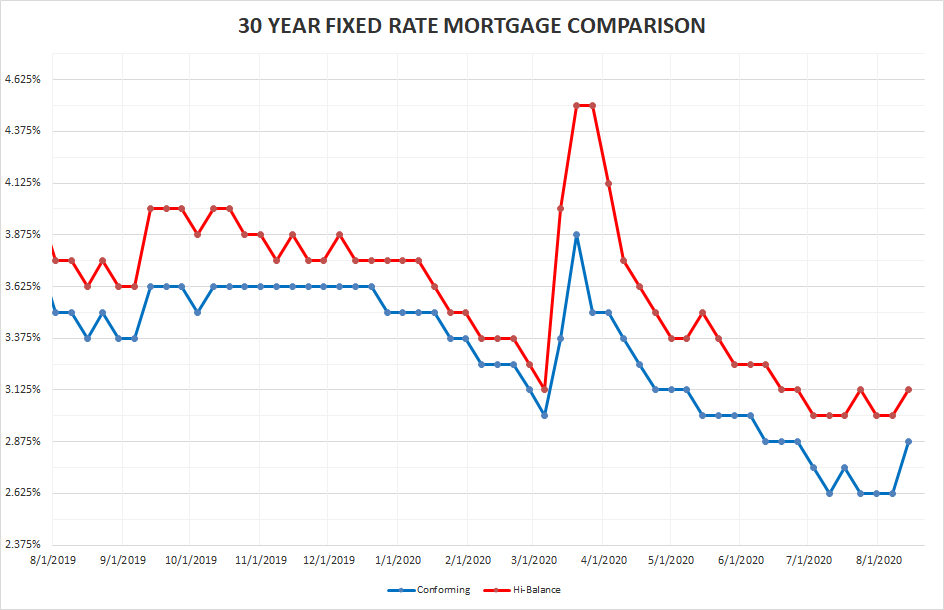
Rates for Friday August 14, 2020: Whether the positive economic news or the imposition of the Adverse Market Fee that lenders are looking to recoup, rates pop us this week.
As mentioned above, refinance rates are not the same as rates for purchases. Call for details and quotes as rates can vary significantly depending on the situation.
FIXED RATE MORTGAGES AT COST OF 1.25 POINTS LOCKED FOR 45 DAYS:
30 year conforming 2.875% Up 0.25%
30 year high-balance conforming 3.125% Up 0.125%
Please note that these are base rates and adjustments may be added for condominiums, refinances, credit scores, loan to value, no impound account and period rate is locked. Rates are based on 20% down with 740 FICO score for purchase mortgages.
For the third year in a row the house was up pre-dawn, or for those with teenagers who stay up into the wee-hours with friends on Facetime and using Netflix share pre-bedtime, to get our oldest to the airport to fly to Boston for school.
I have no anxiety based on the information we have received regarding her trip and time at Boston U. JetBlue has been very conscientious in ensuring their planes are wiped down before every flight, providing passengers with hand sanitizers and disinfectant wipes and leaving every middle seat empty. Our daughter’s 6:00 a.m. flight was sparsely booked and she had no one in the rows directly in front or in back of her’s.
Boston University has been a leader for creating as safe an environment as possible for students, faculty and staff. Robert Brown, BU’s President, has been terrific in creating the resources the school needs and communicating to the entire BU community, including parents, as to what is happening and how the school will operate.
Being a research university is a big plus. The University has spent several million dollars on equipment for their labs so they can process 6,000 tests for Covid-19 each day. Every student is tested twice a week, non-students are tested less frequently but still regularly. They have developed an app for students to answer health questions each morning and depending on testing, answers to questions they are “green” and good to go to buildings, classes, etc. Yesterday the school sent out a notice to students as to consequences if they break any of the guidelines and policies; the number one factor that seemed to get their attention is shutting off their WiFi access.
Our young people are undergoing experiences that will impact them for their lifetimes. When we look back a few decades hence I am hopeful that they have been strengthened as a result of their experiences and have used them to create a better community for themselves, and us old fogies.
Have a great week,
Dennis
Past Weekly Rate & Market Updates can be found on my blog page at my website www.DennisCSmith.com/my-blog


