


Should we pay points to refinance our mortgage?
Question of the week: Should we pay points to refinance our mortgage?
Answer: Yes, maybe no.
My mantra for over thirty-years has been, “do the math.” Our industry has been disrupted since the CARES Act was passed in March, as result we have seen more points being paid for refinance transactions in the past three months than over the last decade plus combined as “doing the math” has led many families to choose paying points for a refinance.
Why is this? I see the two primary reasons more points are being paid to refinance being cost vs. savings driven and opportunity driven.
Before we explore what I mean by cost-savings driven and opportunity driven let’s review the difference between points and rates.
For a mortgage the rate is the on-going cost of a mortgage and the points are the one-time upfront cost of a mortgage. Both are a percentage of the loan amount, the rate being how much interest you will pay on your outstanding balance, the points how much you will pay for the rate.
For example, on a $500,000 loan at 3.5% for a cost of one point, the annual interest is $17,500 and the cost is $5000. For a 30-year mortgage this translates to having a monthly principal and interest payment of $2245.22 for 360 months.
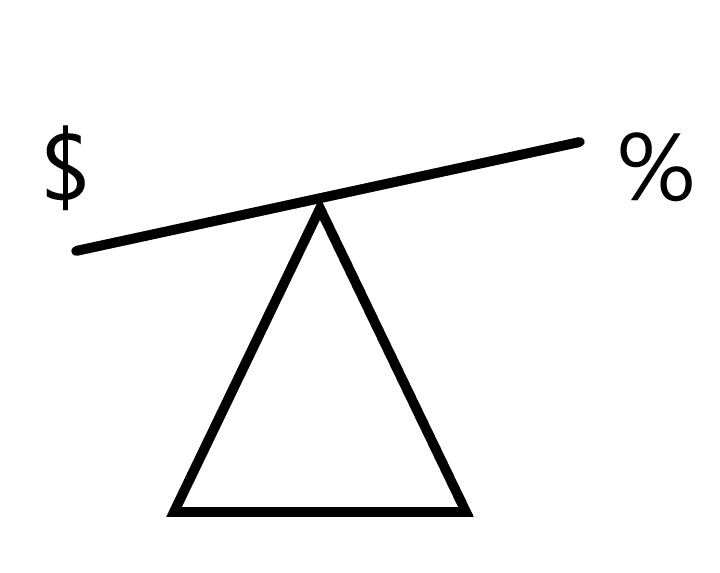
There is an inverse relationship between rates and points. Think of a teeter-totter where one kid has the rate and the other kid has the points. The higher the points the lower the rate, and therefore payment; the lower the points the higher the rate, and therefore payment.
Using our $500,000 mortgage above, if the rate were to be 3.25% the cost could be two points: Monthly payment would be $2176.03 per month, for a cost of $10,000. As you can see the payment is $69.19 lower per month, but it costs you $5000 more to lower the payment.
If the rate were to be 3.75% the cost could be no points: Monthly payment would be $2315.58 for zero cost for points. Doing the math, we see the payment is $70.36 more per month, but you save $5000 from the 3.5% mortgage.
There are many factors that go well into the weeds as to servicing costs, origination costs, risk factors of early pay-offs or forbearance requests that go to cause. From the consumer side the reason we are seeing more points being paid is the spread in costs from lower rates to higher rates is out of traditional proportions. Historically, the general rule of thumb has been for every one-eighth of one percent in rate (0.125%) the cost difference is one-half of one point (0.500), as shown in the example above.
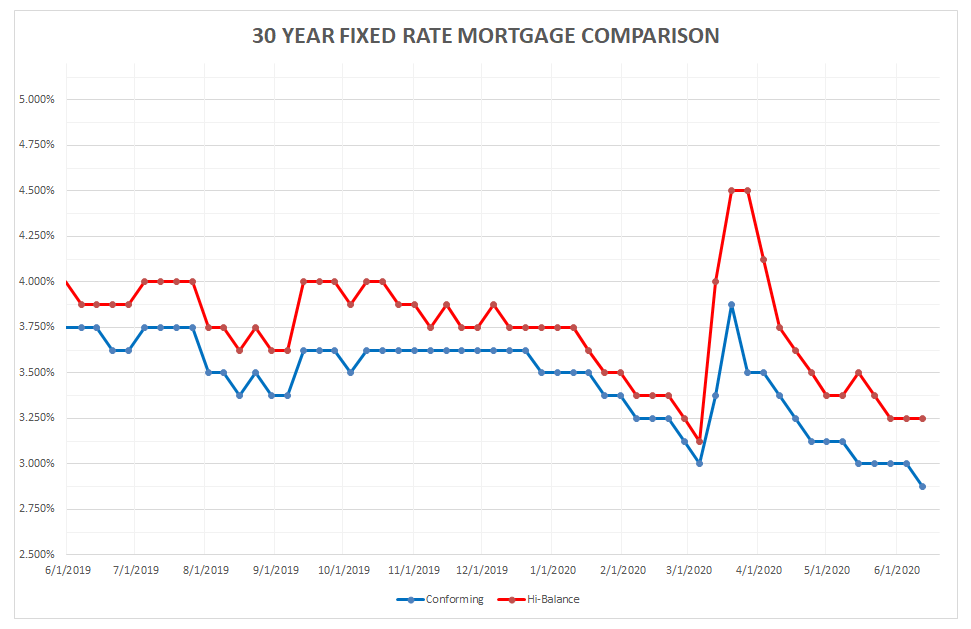
This one-eighth in rate for one-half point in cost relationship has been thrown disrupted for many reasons I will go into here (though covered in some prior WR&MU’s covering forbearances and the Fed lowering rates causing mortgage rates to increase—you can find all the WR&MU on my blog page). For many factors, the rates on no-point loans are higher relative to rates with points in the current market than the were prior to March.
Instead of the traditional rate/cost ratio from one-point to no points go from the traditional quarter-percent in rate (as seen above) to as much as three-quarters to one point. On a daily basis this ratio varies from lender to lender and transaction to transaction, but the variance between paying a points and not paying points has a great spread in interest rates that previously.
Back to our example, above the rate climbed from 3.5% to 3.75% when going from paying one point to paying no points, saving $5000 for an additional $70 per month. In the current market, depending on type of transaction, property, borrower credit, etc we have seen the no point rate climb to perhaps 4.5% with the one point rate being 3.5%. This results in a payment increase of $357 per month to “save” $5000 in costs.
For borrowers making the points/no-points decision using costs vs. savings the traditional example would entail a decision of seeing how many months it would take them to recoup the cost of the points due to the monthly savings. In the above example, the monthly savings due to the lower rate and higher points will take about six years to recoup the additional cost. If you take the $70 per month savings per month and divide into the $5000 cost the result is 71.43 months, or almost six years.
The cost per point in rate is about six years in payments to save or recoup the cost. Your decision is do you want to pay the additional funds if you will have the home, and the loan, for more than six years; or do you want to pay the higher monthly payment to not have the costs.
For the cost/savings decision, in the traditional market it may make sense to pay points. In today’s market it makes a lot more sense as the rate at no points may be near, at or above your current rate.
For those using the opportunity decision making process. They are looking at a chance to get a very low rate for a cost, that when doing the math enables them a very long time with a much lower rate. This factors in the assumption, or probability, that rates may not get this low again and wanting to take advantage of this opportunity while they can.
Whether the decision is cost/savings based or opportunity base, always run the numbers and do the math. Whether you are buying or refinancing with your mortgage ask for the cost and payment differential for higher and lower rates so you can determine the best situation for you and your family.
Naturally, I am happy to run those numbers for you, just give me a call. Or a Zoom!
Have a question? Ask me!
Economic data is having close to no impact on mortgage rates, and will not until after most of the country is “open” and businesses are operating as near as they will get to pre-Covid operations. What will this look like? Will restaurants, bars, theaters be able to operate as maximum capacity? When will this occur? Until then the economy will be unable to reach full potential and economic growth will be stunted. Knowing this, investors are making bets on ability of companies to grow profits moving through the current environment and whatever the next environment is. Poor data on retail sales, prices, employment, are not moving rates—this type of data would push rates down further. Conversely, really good news, such as last week’s employment data, will not move rates up.
The Fed took a lot of speculation out of rate markets when it announced this week that it will keeps its benchmark interest rate at its current near-zero level through the end of 2022. As well, it will continue to purchase debt from the Treasury and mortgage-backed securities from Fannie Mae and Freddie Mac. This will ensure a very stable, and low, rate environment for a long time.
Rates for Friday June 12, 2020: Conforming rates tick down from last Friday as a result of yesterday’s drop in the equity markets and the Fed announcement. Note that rates are for purchase transactions, refinance rates can vary—see commentary above. Call for details and quotes.
FIXED RATE MORTGAGES AT COST OF 1.25 POINTS LOCKED FOR 45 DAYS:
30 year conforming 2.875% Down 0.125%
30 year high-balance conforming 3.25% Flat
Please note that these are base rates and adjustments may be added for condominiums, refinances, credit scores, loan to value, no impound account and period rate is locked. Rates are based on 20% down with 740 FICO score for purchase mortgages.
I remember very little, almost nothing, of my high school graduation. Vague picturing of our gym with all the chairs, but nothing of the ceremony. I have better memories of the party afterwards that lasted all night and then being picked up by my family and going almost straight to the airport for a family trip.
I don’t think my daughter, and her fellow classmates across the country, will forget her graduation. The actual ceremony was on-line, which was neat for her school. Both my daughters attended Long Beach Polytechnic High School, which has a very many very famous alumni, several of whom recorded messages to the Class of 2020—among those speaking were several Olympians from track and field, past and present players in the NFL, and really big names like Cameron Diaz, Snoop Dog and Billie Jean Moffitt King.
Our daughter sat in her cap and gown, had her friends on facetime and they watched together—as they would have done in a traditional ceremony.
Like many schools, Poly had a “drive-thru” ceremony for the seniors. We participated and it was very moving for the whole family to drive through the campus, with teachers, staff, the band, lining the route, cheering, using noise makers, and lifting the spirits of the grads. I, and the rest of the car, lost it a bit when our daughter’s favorite teacher ran to the car and they exchanged a prolonged-teary-hug. Not the good-bye they wanted, but they made the best of the one they got.
Our daughter reminded us last night that her class was born either just before or after 9/11, they were in elementary school when the Great Depression hit and many had to move as parents lost jobs and/or homes, and have finished their K-12 education at home without proms, senior ditch days, signing yearbooks in hallways, or walking across a stage to receive a diploma.
The Class of 2020 has been tempered, but from what I have seen not hardened. They have grown up through three very tumultuous eras, and retain incredible spirits, optimism, humor and love of life. We can hope no more is tossed at them as they move on to their next adventures, be it getting jobs, going to college or the military or entering careers in sports or entertainment. I feel pretty confident that they will be able to handle whatever challenges may, or rather will, be thrown at them in the future.
Congratulations Class of 2020, you taught us a lot about resilience, friendship, optimism and what is important in life.
Have a great week,
Dennis
Past Weekly Rate & Market Updates can be found on my blog page at my website www.DennisCSmith.com/my-blog


