Weekly Rate & Market Update 5-19-17

Question of the week:  What steps should I take to protect myself following the datahacks this past week?

Answer: This is tangentially mortgage and real estate related as one of the major companies that was hacked was DocuSign. For those not familiar DocuSign is the primary technology used in the mortgage, real estate and financial services industries for consumers to “sign” applications, offers and counter offers and account paperwork electronically.

DocuSign is on the record that no documents were accessed by the hackers, however email addresses were accessed. As a result many people who have used DocuSign have received malicious emails with subjects: “Completed: docusign.com –Wire Transfer Instructions for recipient-name Document Ready for Signature” or “Completed *company name* -Accounting Invoice *number* Document Ready for Signature”. The DocuSign logo is in the header and body creating an illusion email is from DocuSign, if you click the link and download the Word document malware will enter your computer and go to work accessing information.

When you are working with a company that uses DocuSign, or other electronic enabled signing, cloud or storage services, do not open any links unless you have confirmed with the sender they have sent you the link for action. Essentially if you receive a generic email that does not address you specifically do not open it. This sounds like common sense in this day and age, however many people using DocuSign and other services are doing so and are not familiar with the protocols and processes of the service or the company with whom they are working. So verify, verify, verify before opening links on services that are new to you, and if you are a long time user be suspicious of anything not normal to your prior experience.

At this point DocuSign says that only people with DocuSign accounts, myself and Stratis Financial for example, however my concern is that in a few days or weeks we learn that the hackers were able to go a level deeper and access participants emails as well—hence my cautionary communication to everyone.

The international hacking last week shut down hospitals, financial companies and other industries around the world last week. One benefit of situations like this is they raise our awareness to be prepared and be wary—just like a minor earthquake locally or a major one not far away has us repacking our earthquake kits and replacing the five  year old canned food and kids’ shoes that are now three sizes too small.

I encourage everyone to click the links below and take some time for some computer and password maintenance. The first link is an article from CNET about 560 million passwords being exposed. A very good read to motivate you to spend some time cleaning up and changing passwords and user names and deleting old sites you no longer use.

The second link takes you to a site where you type in your email address and it will tell you if you have been breached and by scrolling down you can see what sites you many have been breached on. Think you are safe? One of the top 10 sites that has been breached in the past year is LinkedIn—do you have a LinkedIn account?

Click here for the CNET article.

Click here to see if your email has been used to breach passwords on a site you use.

Spend a few minutes and see if you have a potential issue or two—I did and discovered a few sites that I use and were hacked. I spent about ten to fifteen minutes going to my most frequently used sites, especially banking, financial, credit cards, and changed user names and passwords, easy-peasy.

Have a question? Ask me!


Words don’t have the power to hurt you. This is a fairly common saying, indicating that you choose if words will hurt you or not as they are just words. Well….this week words hurt a lot of people financially, and benefited some others. The war of words in Washington this week caused a big drop in equity markets—hurting investors, and a drop in Mortgage Backed Security (MBS) prices—assisting borrowers. There was no economic data or significant events, like an act of war or natural disaster, to cause the market moves, just words and speculation from politicians and members of the media. The net result was slightly favorable to mortgage rates as traditionally when stocks prices fall so do interest rates as investors flee the uncertainty of stocks for the certainty of bonds.

Rates for Friday May 19, 2017: The turmoil in Washington broke MBS prices out of their rut and we finish the week a bit lower than last Friday. Since the price change was not the result of data and events in the economy but rhetoric and politics I am not confident the lower rates will be long lasting and that we will float back up to the previous range.

FIXED RATE MORTGAGES AT COST OF 1.25 POINTS LOCKED FOR 45 DAYS:

30 year conforming                                            3.75%             Down 0.125%

30 year high-balance conforming                        3.875%           Down 0.125%

30 year FHA                                                      3.25%            Flat

30 year FHA high-balance                                  3.75%            Flat

Please note that these are base rates and adjustments may be added for condominiums, refinances, credit scores, loan to value, no impound account and period rate is locked. Rates are based on 20% down (3.5% for FHA) with 740 FICO score for purchase mortgages.

Hearing from agents in different markets that more inventory has been coming to market ahead of schools letting out for summer, and as a result a bit of a slow-down in offers being presented and multiple-offer situations. The information is anecdotal to these specific agents and what they are experiencing, however even with the small sample size it appears there could be an strong influx of new inventory on the market—meaning it is a great time to be in the market for your new home. Please call to go through your numbers and develop a strategy for you to purchase your new home!

Have a great week,

Dennis
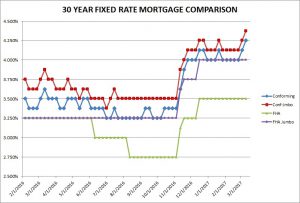
 

Weekly Rate & Market Update 5-12-17

Question of the week:  We are buying a home that has just been completely remodeled/rebuilt, should we still get a home inspection?

Answer: YES!

In case my answer was a little vague, yes, get a home inspection if you are buying a home that has been recently completely remodeled or rebuilt, I almost want to say especially if buying a home that has had extensive work done recently. (Or a brand new home from a builder for that matter.)

Let’s quickly review the home inspection and its purpose for new home buyers who have not been through the buying process yet. Once you have an offer accepted to purchase your new home one of the conditions of sale you will most likely enact is the right to have a professional inspect the dwelling. The home inspector will spend quite a bit of time in, under, on and around the structure testing all the electrical, plumbing and HVAC systems, inspecting the structure and grounds for apparent water seepage or leaks. At the completion of the inspection you will be given a very comprehensive report that details the quality of condition of all the systems and aspect of your home and note any deficiencies, concerns or items you may wish to have further inspected by a specific professional. The purpose of the report is to notify you of any work that may need to be performed to eliminate a safety issue, ensure that a specific system is working, if anything is not to code, or is deferred maintenance you will want to keep an eye on for future repair or replacement.

Once you have the inspectors list you have the ability under your purchase contract to provide the seller with a list of repairs/replacements you want the seller to perform or you will not proceed with the sale. The seller can agree to the list, part of the list or none of the list of repairs. Essentially the inspection can create the opportunity for additional negotiations between the buyer and seller.

When you are buying an existing home there is a decent chance the inspector will come up with items that s/he recommends be corrected—after all their job is to find things wrong.  Once you have the report you and your agent can determine what items are very important, what items are “it would be nice if this was fixed…” and what items are not worth potentially upsetting the transaction over, i.e. cracked electrical switch face plates or hairline plaster cracks in 80 year old home.

Many buyers expectations are that if they are buying a home that is being advertised as completely remodeled/rebuilt that everything with the home should be in perfect working order, after all the seller just spent a lot of money repairing/replacing everything that was wrong with the home and put it on the market as “like new.”** A reasonable expectation and sometimes one that some sellers count on.

The newly remodeled/rebuilt home is pretty common on the market and is most likely a “flip.” A flip is when someone purchases a property that is in distress below market value due to its condition, rehabilitates the home and then puts the property back on the  market  as a complete remodel, or “like new.” The Flipper’s objective is to make money, hopefully a lot, by selling the home for more than the cost to acquire the property, pay the holding costs of the property between purchase and sale (i.e. any mortgage costs, insurance, taxes, utilities), the rehab costs and the costs of sale. The biggest variable in the cost-profit equation is the cost to rehabilitate the property.

It is not unusual, I will not it is common because there are plenty of Flippers in the market who do not do this but enough to make it not unusual, for a Flipper to put most of their rehab money into cosmetic repairs and maintenance, masking some serious issues that can only be found with an inspection.

A very recent example occurred this week with a buyer we are working with. He purchased a flip that looked fantastic with new paint inside and out, flooring, kitchen counters, cabinets, appliances, bathrooms completely redone with tubs, toilets and sinks. Perfectly staged with nice furniture, wall hangings, etc the place looked like it was in move in condition—and our buyer was ready to move in.

Not so fast. Wisely he understood while what he could see looked great, there was a lot he could not see so he hired a professional home inspector. The inspector’s report brought forth many deficiencies that the buyer would not have been aware of until he closed escrow and  moved in. The heater was not properly installed, the electrical system was fifty plus years old and unlikely to be able to handle modern appliances and constant loads with today’s electronics, many of the “fixes” the seller had done through the rehab were not up to code. Essentially the house looked great but underneath the cosmetics it wasn’t so great.

Our client drew up a list of repairs and items to be completed before he would close escrow. The sellers did not want to spend the money and said they would not do any of the requested repairs. Our client cancelled the escrow and will receive his deposit back from escrow. He is out the cost of the inspection, however he saved himself tens of thousands of future dollars by spending several hundred dollars on the inspection.

An interesting result for the sellers, should they follow real estate law and operate ethically, because they have been made aware of the issues brought forth by the inspector, should they not complete the repairs they are obligated under California law to disclose the issues to the next buyer as part of the Transfer Disclosure Statement that almost every seller must provide a buyer of a single family residence in California. If they do not disclose the deficiencies to the next buyer that buyer may have a case in the courts to seek damages after they close escrow.

**A very good friend of mine was an inspector in California for many years, and he was very, very thorough. He had several occasions when he inspected homes that were brand new and constructed as part of a tract of homes and discovered many deficiencies, items that were out of code and issues that would come up later as the homes aged. Just because they are brand new does not mean everything in the home is perfect and that the builder did not cut corners or the work performed was of a quality to last.

Every buyer of every home should engage a property inspector to provide an objective and clinical look at the property and structures so you can have a thorough understanding of the current and potential issues with the property.

The cliché for humans is that for someone their beauty is only skin deep, the same can be said for shiny looking, “like new” homes.

Have a question? Ask me!


The price is right….or is it? We have price data for April and it is good and not as good reflection the overall economy.  The Producer Price Index for April was pretty strong, especially after the drop in March, up 0.5% for the month and 2.5% for the year (0.4% and 1.9% stripping out food and energy, the “core” rate). This is a positive number and not real favorable to lower rates. What is favorable to rates is that the Consumer Price Index rose below expectations at 0.2% (better than last month’s drop of 0.3%) in April and 2.2% for the year (core rate 0.1% and 1.9%). This is weaker than expected and shows that retailers do not feel higher prices can be supported in the market. Overall the price indexes are choppy from March to April and from producers to consumers—a sign that our economy could be in transition.

Not showing a lot of support for economic strength were retail sales in April. After strong decline in sales from February to March the expectation in a strong economy would be a strong increase in sales from March to April. A 0.2% increase is not a “strong” increase, more of a “well its okay, not great, but okay” increase. As we have been writing about for the past several months, consumers are not putting a lot of gas on the economy. Prices remain low, wages are increasing and the number of people collecting regular paychecks is increase, but there has not been a translation to cash registers with consumers spending those wages. As regular readers know consumer spending is about 60-65% of our economy, slow consumer spending does not result in a strong and growing economy. Bad news for the economy is good news for rates, okay news for the economy is okay news for lower rates.

Rates for Friday May 12, 2017: For the third Friday in a row rates are unchanged, which we like. With the economic data the past several weeks it is hard to see any economic report that will come out to jolt rates out of their current range. If we saw really strong corporate earning reports that move the stock markets up we could shift rates up, or some international event of a catastrophic nature could shift them down. With the economy floating along there is not a lot of momentum, or sentiment, to cause a big rate shift.

FIXED RATE MORTGAGES AT COST OF 1.25 POINTS LOCKED FOR 45 DAYS:

30 year conforming                                            3.875%           Flat

30 year high-balance conforming                        4.00%             Flat

30 year FHA                                                      3.25%            Flat

30 year FHA high-balance                                  3.75%            Flat

Please note that these are base rates and adjustments may be added for condominiums, refinances, credit scores, loan to value, no impound account and period rate is locked. Rates are based on 20% down (3.5% for FHA) with 740 FICO score for purchase mortgages.

Happy Mother’s Day to all the moms! I was unfortunate to lose my mother while in high school, the silver lining, if there can be, is that throughout my life I have had the benefit of several great women who have filled in some way or another the “mom” role and I am very grateful for the support, guidance and love they have given.

I am even more grateful for the Mom in our home. As a sometimes bumbling dad with two teenage daughters I am so thankful that Leslie has the relationship she does with our kids, and is able to interpret to the guy in the house so I might closer to understanding the teenage female. I am very happy as well that the girls reflect the beauty, wit, wisdom and fun-loving spirit of their mom.

There are a lot of wonderful moms out there, not looking for accolades or rewards but getting them every day as they see how their children treat others and contribute to their communities. Thanks to all of you!

Happy Mom’s Day, and have a great week,

Dennis


Weekly Rate & Market Update 5-5-17

Question of the week:  We are thinking about putting in a pool, how can we finance and what will be the impact on our home’s value?

Answer: The answer to this question is somewhat similar to the answer I give when someone contacts me to discuss a major remodel or addition to their home: before you build explore the options of buy. In other words before you commit to tearing apart your home to add another bedroom, or your yard to add a pool, see what is on the market that would replicate what your end result will be and if it makes sense and you can qualify to purchase the end result instead of build it at your current home.

Like anything else, there are two ways to pay for a pool installation: pay cash or borrow the money. How you finance the installation depends on several factors, primarily how much equity you currently have in your home.

In order to pull equity out of your home to finance your new pool you have to have equity in your home to pull out. Depending on how much equity you have will determine the options for financing the operation.

There are two basic options, and they can be blended, when obtaining equity from your home, be it for building a pool, paying for kids’ college or leveraging a second home or investment property. First is a traditional refinance in which we refinance your current mortgage and increase the balance on the new mortgage to obtain the funds needed for your pool endeavor. The amount of equity you can access depends on the loan program, however in most instances we can go up to 80% of the current value of your home (i.e. without the pool installed); if your home is worth $750,000 we can do a cash-out refinance to $600,000.

The second option is with a second mortgage, or most commonly used a Home Equity Line of Credit (HELOC). The total loan to value available will vary depending on the lender and your ability to qualify, many will go to 85% loan to value and some to 90% loan to value.

Let’s use a $750,000 home that has a current balance of $550,000. You have met with a pool contractor and after the design has been agreed upon the total cost of the installation and all amenities will be $80,000. We have two options: use a HELOC for the entire $80,000 or refinance your existing mortgage to 80% loan to value, which will provide you $50,000, and then obtain a HELOC for the remaining $30,000. When the dust settles, or rather the loans have funded you, you will have $630,000 in loans against your $750,000 home for a total loan to value of 84% loan to value.

One advantage of the HELOC is you do not pay for all the money as soon as it funds but can use the equity line as you need cash, or you can use it as a “backstop” using cash you have saved and if you have an emergency or need cash in the future you can use the equity line.

The key to being able to finance a pool installation, or home construction, is the current value of your home and what you currently owe.

Regarding the second part of the question, what is the impact of a new pool on the value of your home, if you are going to install a pool at your home is that there is a very low return on investment—in fact it might be the lowest return for any feature you can add or improve on your property. Speaking from experience, and we did not install a new pool but extensively remodeled the pool in our home when we bought it that was at the end of its life, when you install a pool you are not just having someone dig a hole, line it and then fill it with water. You will also have plumbing, electrical, hardscape and landscape, and perhaps amenities such as entertainment area with grill, media, a spa, changing/shower room, etc. In the end your home will be transformed, as will your lifestyle at home, but not without considerable cost.

For the average home the market value of a pool is from about $15,000 to $25,000, against costs that can run from around $35,000 to $100,000 or more depending on your amenities, design etc. Regardless if you have the $35,000 pool installed or go full blown luxury hotel/spa backyard, the return is very low. If you are considering adding a pool to add value I strongly suggest you buy a home with a pool instead of trying to make money installing one in your yard.

If you wish to discuss options or go through what-ifs of putting a pool in your yard, or any other home remodel/improvement project that may need financing please give me a call, I’m happy to go through the various options.

Have a question? Ask me!


It is the first week of the month, which means jobs information. The week started with how much we make and what we do with it. Monday the Bureau of Economic Analysis released Personal Income and Consumer Spending data for the month of March, and the numbers were not celebrated. Personal income for the month rose an anemic 0.2% in April, following several months of good growth for incomes. While personal income was anemic consumer spending was flat-lined in April showing 0.0% growth (for those who didn’t pay attention when percentages were covered in math class, that is zero growth) from March’s spending—which was revised to also show no increase in spending. That would be two consecutive months with consumers earning more but not spending more. The result is a little positive as it means savings rate increased 0.2% to 5.9% savings from personal income. This new is positive for mortgage rates, meaning no upward pressure and perhaps a bit of downward pressure, on rates.

The third part of the report, the PCE price index (Personal Consumption Expenditures) was the opposite of positive. Whenever there is data for prices there are two components, the index and the “core” index. The index is everything consumers buy, food, clothing, energy, movie tickets, whiskey (a perfect gift for dedicated mortgage professionals in Long Beach), the “core” index takes out food and energy prices which tend to be volatile. In April the full index dropped 0.2% and the core index dropped 0.1% for the month. The drop in the core index presents the weakest prices in almost sixteen and a half years. Overall the news is not good and combined with other economic data presents a very weak first quarter for the economy—which is positive for lower mortgage rates.

On a much more positive note the Labor Department’s jobs report for April showed a strong gain of 211,000 jobs for the month, and a drop in the unemployment rate from 4.5% to 4.4% which is the lowest reading since May 2001. Adding to tightness in the labor market was the pool of eligible workers dropping 200,000 workers. More people are working, income is rising, albeit slowing in March, but the paychecks are not being converted to spending which is troublesome looking forward since consumer spending is 60-65% of our economic activity. Today’s Labor Department report supports higher rates, however it is more than dampened by the lack of consumer spending.

Rates for Friday May 5, 2017: Rates remain stable this Friday from last, and the week before and the week before, with not enough news to create momentum up or down for rates. The one thing our industry will never complain about is stable rates.

FIXED RATE MORTGAGES AT COST OF 1.25 POINTS LOCKED FOR 45 DAYS:

30 year conforming                                            3.875%           Flat

30 year high-balance conforming                        4.00%             Flat

30 year FHA                                                      3.25%            Flat

30 year FHA high-balance                                  3.75%            Flat

Please note that these are base rates and adjustments may be added for condominiums, refinances, credit scores, loan to value, no impound account and period rate is locked. Rates are based on 20% down (3.5% for FHA) with 740 FICO score for purchase mortgages.

This section of the Weekly Rate & Market Update is generally where I put in some personal information, this week I am going to brag about the Long Beach Unified School District. Recognized for many years as one of, if not the, best “urban” school district in America, this week and next shows one way this recognition is valid. Monday morning and yesterday afternoon I helped proctor for AP exams (advance placement college-level exams that many colleges will give class credit if certain scores are met). One matrix for measuring the quality of education being provided students is college readiness of graduates, and the biggest factor in college readiness is the availability of AP exams. This week and next well over 13,000 students across the district will take AP exams in almost 30 different subjects. What’s more is these exams cost about $100 per exam, so a student taking four APs can face a pretty hefty bill. However Long Beach Unified covers almost all the cost of the exams, a student pays a fee of $15 when registering for the exam and after completing the exam is refunded $10 so the total cost is only $5. By removing this cost barrier for many students in the district LBUSD has seen a tremendous jump in the number of students taking these exams and also taking AP classes—meaning more students are exposed to rigorous academic environments similar to what they will face in college.

Families in Long Beach are fortunate to have an excellent school district that not only prepares kids for college but because of the College Promise guarantees spots through four years of college for graduates in partnership with Long Beach City College and Cal State Long Beach. While there are other excellent schools and districts in California, some may meet but none exceed the quality of education our daughters are receiving. I am proud of our district and their continued commitment to quality education.

Good luck to those students with exams still to go!

Have a great week,

Dennis


Weekly Rate & Market Update 4-14-17

Question of the week:  Weare on East Coast college tour this week and next so no question of the week.

Have a question? Ask me!

Rates for Friday April 14, 2017: Rates continue to drop on soft economic data. Producer and Consumer Price Indices both down in March (0.1 and 0.3% respectively), as well retail sales dropped in March as well. The data indicates a softening economy which puts downward pressure on rates.

FIXED RATE MORTGAGES AT COST OF 1.25 POINTS LOCKED FOR 45 DAYS:

30 year conforming                                            3.75%             Down 0.125%

30 year high-balance conforming                        3.875%           Down 0.125%

30 year FHA                                                      3.25%            Flat

30 year FHA high-balance                                  3.75%            Flat

Please note that these are base rates and adjustments may be added for condominiums, refinances, credit scores, loan to value, no impound account and period rate is locked. Rates are based on 20% down (3.5% for FHA) with 740 FICO score for purchase mortgages.

No chart this week as having issues working on it remotely via Kindle.

It is a beautiful spring day in New York City today. We arrived at 4:30 this morning on JetBlue red-eye and hope the weather holds here the next few days and then next week when we will be in Boston. But it is spring on the East Coast so ready for warm, cold, hot, sunny and wet!

I hope you have a great weekend,

Dennis

Weekly Rate & Market Update 4-7-17

Question of the week: I am confused on the appraisal process and what an AMC is, can you please explain it?

Answer: One of the first changes in the mortgage industry following the market meltdown was federal policy that prevented lenders from directly ordering appraisals, and to take it a step further preventing us from have any direct contact with an appraisal.

As a result Appraisal Management Companies (AMC) that had been around prior to 2007-8 became the source and conduit for all appraisals and communication. And while we cannot select appraisers directly we can in some instances select the AMC with whom we want to work.

How does an AMC work?

The appraisal process is designed to eliminate undue influence in property valuations, hence the inability of me to directly contact an appraiser, to further this policy appraisers are selected by what is known as “adverse selection.”

You have wisely chosen Stratis Financial for your mortgage to purchase your new home. We complete the application package and are ready to order the appraisal. We go to the AMC website and complete the property information, who to contact for access to the property, payment information etc and an order is created.

At this point the AMC needs to assign an appraisal. Most often this occurs by contacting the next appraiser on the list who is registered to work in the area where the property is located to see if they are available; if the appraiser is unavailable or non-responsive in a short period of time then the next appraiser on the list is contacted and so forth until the order is assigned.

When the appraisal report is completed it is sent to the AMC who completes an audit and quality control of the report—note this is for compliance and completion of report issues and not for valuation. Once the audit is completed and the report is found to be in compliance it is provided to us for your application package.

At this point we go through the appraisal to primarily check the value and then to see if there are any items that must be completed, for example that the property has smoke and carbon monoxide detectors per California state law, that there are no adverse physical conditions that the appraiser feels must be corrected for the value on the report to be valid.

After reviewing the report we provide you with a copy and let the real estate agents know if the value is sufficient for our transaction (meaning at or above sales price), if the value came in below sales price and if there are any corrective issues that need to be completed at the property before we will be able to get final loan approval.

Assuming all is correct with the appraisal we move on with our processing, approving and funding of your mortgage so you can move into your new home.

What if there is an issue with the property in regards to condition? If this is the case we let the agents know the issue, for instance missing smoke/CO detectors or no flooring in a kitchen that has not yet been remodeled* and work to find out when the work will be completed so we can take the next step. The next step is once the work is completed we have to contact the AMC to send the appraiser back out to the property to make sure the work has been completed and provide an updated report. This re-inspection comes with a fee (generally $150).

*Personal example: When Leslie and I sold our first home we had done some work in the kitchen and were getting ready to retile the floor. We left the tile off the floor and when our buyers came in we let them know they could select the tile we would put down, we had several samples that were in our budget. They selected the tile they wanted, we had the tile laid down and then signed off by the appraiser.

What if the appraisal is low? This is a question we have covered several times in the Weekly Rate & Market Update, most recently last month, today we will just cover the process with the AMC. If the appraisal report value is less than sales price, or what we feel value should be if our transaction is a refinance, we need to provide new and better comparable sales to the appraiser. In a purchase we notify the agents to see if they can provide us with better comps than what is in the report. We then write up a report with the comps providing our opinion as to why the comps we are providing are better to use than those used by the appraiser. We then submit the comps to the AMC who then provides them to the appraiser. If our appeal is not accepted by the appraiser we then work with the AMC to see if they agree with our argument in the appeal to see if they can convince the appraiser to take another look. If we feel very strongly that our case is strong we continue our dialogue with the AMC and if their management agrees we may have a new appraiser assigned to our property—this does not always happen but we have been successful many times in the past if we have what are evidently superior comparables to those in the report.

Ideally we would be able to go back to before the mortgage and housing market crisis and use appraisers with whom we had long standing professional relationships, but there is little chance that will be the case in the near or long term. As a result we must use the AMC process and make the best of it. Which we have at Stratis Financial.

At Stratis Financial because we fund approximately 90% of our applicants mortgages ourselves we have a relationship with one specific AMC that handles 90% of our appraisals. This allows us to have a strong relationship with the AMC for efficient appraisals and as or more importantly should there be any issues we need to have resolved.

Have a question? Ask me!

Remember, with Dennis it’s not just a mortgage, it’s your complete financial picture.

Numbers, words, action impacting rates this week. Working from least impactful to potentially most, today the employment report for March was released by the Labor Department and March saw an increase of only 98,000 jobs in March, a very low number. One explanation is the bad storms that hit the Northeast in March, another is that perhaps there is a slowing going on with employers. The bright spot on the report, that would have made headlines a year ago but not today, was the drop in the unemployment rate from 4.7% to 4.5%, the lowest level since the economic peak in 2007. The wage aspect of the report shows a lag in wage inflation, due to level of wages of many entering the job market. Overall the report is somewhat mortgage rate friendly.

Words have a big impact depending on who is saying them, and who is listening. This week the minutes of the Federal Open Market Committee were released and the most interesting part was the Fed announcing it would be unwinding its holding of U.S. Treasuries and Mortgage Backed Securities (MBS). To prop up the bond markets (inclusive of mortgages) the Fed purchased trillions of dollars of Treasury and mortgage debt after the financial crisis. Once markets stabilized and rates remained low the Fed continued to purchase bonds as holdings they had matured (i.e $10 million mortgage package paid off at maturity the Fed would reinvest the $10 million and purchase more mortgages). Currently the Fed has $4.5 trillion in bonds and mortgage debt on its balance sheet and the governors have decided the time has come to start to rid itself of the debt obligations. What this means is the primary buyer of bonds and mortgages is leaving the market. The impact on this should be higher interest rates as there will be a drop in demand, which will cause prices to drop (and rates increase) to attract investors. This will be a long term impact on rates, how big an impact depends on the private sector and other governments stepping in to pick up the Fed’s absence in the market.

As for actions, we turn to the Middle East. The Syrian governments use of chemical weapons and response from the United States, corresponding response, if any, from Russia and other nations can have a strong impact on interest rates. In times of unrest and international tensions investors undergo what is known as “flight to quality.” This means investors leave equity markets (stocks) which are uncertain and can fluctuate quickly, for stable and dependable markets and returns, which means bonds and mortgages. The safest investments for returns are U.S. Treasury debt followed closely by Mortgage Backed Securities from Fannie Mae and Freddie Mac which are backed by the U.S. government. While the returns are lower than potential returns in equities the returns are safe and better than sitting in cash. So world unrest, bad actions by international actors lead to lower interest rates in the United States.

Rates for Friday April 7, 2017: We start the 2nd Quarter with rates dipping to their lowest since November. There is plenty of news to suggest rates could/should go higher between economic news the past several weeks and the Fed pulling out of the markets. That said there is enough uncertainty that rates could be chased down depending on global events. Rates have dropped three-eighths of a percent since peaking the second week of March—perhaps it is time to take advantage.

FIXED RATE MORTGAGES AT COST OF 1.25 POINTS LOCKED FOR 45 DAYS:

30 year conforming                                            3.875%           Down 0.125%

30 year high-balance conforming                        4.00%             Down 0.125%

30 year FHA                                                      3.25%            Down 0.25%

30 year FHA high-balance                                  4.75%            Down 0.25%

Please note that these are base rates and adjustments may be added for condominiums, refinances, credit scores, loan to value, no impound account and period rate is locked. Rates are based on 20% down (3.5% for FHA) with 740 FICO score for purchase mortgages.

An interesting day today, it is my 20,000th day. Yes, 20,000 days ago I entered this life in Tulsa, Oklahoma. We are using the event as an excuse for some friends to come over for some of my favorite things, mainly barbecue, beer and whiskey. It is interesting we celebrate an annual trip around the sun and some milestones along the way (teenager, 18, 21, 30….50…75) but the days are ignored. We should celebrate the five thousand day milestones! My next milestone will be Saturday December 15, 2030 when I wake up to my 25,000th day—no doubt I’ll have some barbecue and a sip or two of something!

I hope you have a great weekend,

Dennis


Weekly Rate & Market Update 3-31-17

Question of the week: Can we make a large payment down on our mortgage and lower the payment?

Answer: Yes, probably.

I have been getting this question a lot lately, or using the option as part of consultations with clients on long term strategy with their mortgage, retirement, etc.

You have/get a mortgage of say $400,000, you are 50 years old and want to retire in 15 years and will still have a balance on your mortgage. You have a large amount in the bank and are thinking about putting down on the mortgage and possibly lower the payment. Can you do this?

This is called recasting and most lenders will allow this with certain conditions. If you put a large payment down on your mortgage you can ask the lender to reamortize the mortgage for the new balance and remaining term of the mortgage. PLEASE NOTE Before you make the payment you must contact your lender to make sure they will recast the note and lower your payment and also what their process and possible fee for the process will cost.

Just because you can put a large amount of money into your mortgage to lower the payment, or term, does not necessarily mean you should—there are many factors you should consider before you do.

First, keep in mind that it costs money to get money out of your home. Depending on your situation you may find that you need some or all of the money you paid into your mortgage to have it recast, now you have to qualify, have costs and possibly a higher interest rate to get money you already had in cash.

Second, what is your current interest rate and what is the expectation of return on the money if you retain it until you need your home paid off, possibly when you retire? You may be net neutral and if that is the case you may want to keep your funds working where they are getting compounding returns rather than paying down your mortgage while you are still working and getting deduction for the interest.

Finally, if you are considering a major paydown of your mortgage I strongly suggest you consider obtaining and equity line of credit. Should you need a large amount of money in the future but it is not accessible since you have transferred liquid savings into illiquid equity a line of credit will enable you to access the needed funds.

A couple of things that are hard to do in life are lose and keep off weight, save money and pay off debt. When paying a large amount of your saved money into your mortgage you are faced with the dilemma of saving versus reducing debt. Before you do consider all the different options for the short, and especially the long, term and what your needs may be in the future.

If you need help with the decision please do not hesitate to contact me.

Have a question? Ask me!

Remember, with Dennis it’s not just a mortgage, it’s your complete financial picture.

A good week for economic data geeks, with plenty of reports released for February’s economic data. The most surprising of the reports was the Consumer Confidence report released on Tuesday by the Conference Board which had the highest reading since December 2000—two economic cycles ago. The strongest support is in income expectations, over 20% see their income increasing in the next six months and only 7% see their income declining. The strong consumer confidence data is interesting as usually strong confidence leads to strong consumer spending, but spending has been lagging. Independent of other factors such a surge in confidence would be negative for mortgage rates since it usually predicts strong consumer spending, which is 60-70% of our economic activity and strong economic activity usually drives rates higher.

Data released today for Personal Income and Outlays is very interesting in light of the confidence report in that personal income in February maintained its strong 0.4% growth from January, but personal spending grew only 0.1%–indicating that Americans are earning more but spending less faster than their income is growing, especially on services which held back total consumer spending in February. Reflecting the slower growth in spending prices in February also increased only 0.1%, though year over year prices increased a healthy 2.1% largely due to lower prices last year than stronger prices this year. The data has mixed impact on interest rates as higher income should lead to higher income leading to higher rates, but….lower spending impacts rates to the downside.

Gross Domestic Product for the 4th Quarter had its final revision and the number crunchers increased the data upward from 1.9% to 2.1% growth in the final quarter of 2016. Leading the revision upward was consumer spending in the 4th quarter. This revision puts either a bit more confusion or a bit more clarity on the February spending data. Why the slow down after a fairly strong 4th quarter of spending? It’s evidently not income, it’s not confidence, what is it? Perhaps consumers buying the 4th quarter tapped them out going into the first quarter of 2017 and what we are seeing is a deep breath before they start buying again. The GDP revisions were expected so there is minimal impact on mortgage rates.

Rates for Friday March 31, 2017: As expected with the economic data this week there is some downward pressure on rates, not enough to break out downward but some softness. After a brief spike earlier in the week we saw mortgage rates drift back down to last Friday’s levels. We are in a market where it appears lenders are hanging on a bit to higher rates before moving down to where they should be to correspond with the pricing in the secondary markets. Rates are great for buying or refinancing!

FIXED RATE MORTGAGES AT COST OF 1.25 POINTS LOCKED FOR 45 DAYS:

30 year conforming                                            4.00%             Flat

30 year high-balance conforming                        4.125%           Flat

30 year FHA                                                      3.50%            Flat

30 year FHA high-balance                                  4.00%            Flat

Please note that these are base rates and adjustments may be added for condominiums, refinances, credit scores, loan to value, no impound account and period rate is locked. Rates are based on 20% down (3.5% for FHA) with 740 FICO score for purchase mortgages.

I often tell people that I love my job, especially when I tell people they just bought a new front door. Well we are looking for a new front door this weekend….literally. Leslie has wanted to replace our front door for some time and the time has come to visit the various stores to see what is happening in the door market. Between door shopping and the basketball tournament I think it’s time for my least favorite activity of the year—collecting all my information for tax preparation, blech.

I hope you have a great weekend,

Dennis


Weekly Rate & Market Update 3-24-17

Question of the week: What exactly is mortgage insurance? Is it something that is mandatory for purchasing property or just the property I am buying?

Answer: With the increase in the purchase market and more first time buyers coming to market it is time to revisit mortgage insurance. Though making a comeback, piggy-back mortgages transactions which can avoid mortgage insurance are being evaluated differently in the current market than in years past—especially with the recent and future increases in the Prime Rate.

Mortgage insurance defrays some, perhaps all, of the cost to a lender if a loan goes into default and foreclosure. Depending on the loan type and initial loan-to-value (LTV) of the mortgage, the lender will require certain amount of coverage from mortgage insurance.

For FHA mortgages the full amount of the mortgage is covered and all FHA mortgages require two forms of insurance premium be paid, an upfront premium that is added to the loan amount and a monthly mortgage premium.  Recently FHA changed it guidelines so all new FHA mortgages require the monthly premium be paid for the life of the loan. Keep in mind the minimum down payment for FHA is 3.5% for the maximum loan amount of $625,500. With that much leverage risk it is not surprising that FHA has mortgage insurance to off-set some of the costs should the loan go into foreclosure.

For Fannie Mae and Freddie Mac mortgages, also known as conventional or conforming mortgages, mortgage insurance is required on all mortgages that have a loan to value greater than 80% of the property value; i.e. if the value of the home is $400,000 and your mortgage is greater than $320,000 you will be required to have mortgage insurance. This is for all conforming mortgages, regardless of refinance or purchase, condo or single family detached home.

For conforming loans the vernacular is PMI, or Private Mortgage Insurance, as the insurance is made by a privately held company. For FHA the vernacular is MMI and/or UMIP for Mutual Mortgage Insurance or Upfront Mortgage Insurance Premium; FHA mortgage premiums are collected by the federal Department of Housing and Urban Development—it is a government insured mortgage.

For PMI the premium varies on the loan to value of the mortgage, type of mortgage and borrowers’ credit scores. The higher the LTV, i.e. the lower your equity or down payment on a purchase, the higher the coverage required by the lender and therefore your mortgage insurance premium. The coverage goes from 30% for loans with LTV between 90.01% to 95% to 25% for 85.01to 90% and 12% for 80.01% to 85%. The greater coverage required for your mortgage the higher your PMI premium will be.

As well the higher your credit score the lower your premium will be.

What does 25% coverage mean? If a mortgage is covered by PMI with 25% coverage then if the mortgage goes into default the PMI company will pay the lender up to 25% of the mortgage amount to cover costs and losses due to the foreclosure. Note that after missed interest payments, legal fees, filing fees, plus the potential loss in loan principal because of a foreclosure is often much greater than 25%, depending on current market conditions.

Other loans also may have mortgage insurance depending on the product and lender. Some banks are offering our clients on “jumbo” mortgages, greater than $625,500 conforming loan limit, with no mortgage insurance for loans with LTV greater than 80% up to 90%. They “self-insure” the loan by charging a much higher interest rate than a mortgage with 80% loan to value, but there is no separate underwriting or payment.

Veterans obtaining a VA mortgage also have a version of mortgage insurance, called a “funding fee” that is added to the mortgage amount.

For PMI borrowers there are a few options as to what type of premium to use to pay for the mortgage insurance requirement.

Have a question? Ask me!

Remember, with Dennis it’s not just a mortgage, it’s your complete financial picture.

A bit of a slow news week for market moving data, especially after last week with plenty of market moving data plus the Fed rate increase. Of importance this week is housing sale activity for February. Nationally sales dropped 3.7% in February, but were still up 5.4% from February 2016 and the median price nationally has 7.7% in the past year to $228,400. More locally the California Association of Realtors reports that statewide home sales dropped 4.7% in the month and are up 4.9% from last year with the median price dipping a bit in February from January to $478,790—though that is still up 7.6% from 2016. Even more locally, LA County saw sales drop 8.8% from January and prices decline 7.7% for the month as the median price dipped from January to $470,000 in February, which is 5.7% higher than last February’s median price. Orange County bucked the trend a bit with sales down only 0.9% from January (up 0.3% for the year) and a slight increase in the median price to $745,000, matching the 5.7% annual price increase seen in LA County. Overall the news is mortgage rate neutral.

Rates for Friday March 24, 2017: After all the excitement last week Mortgage Backed Securities (MBS) rebounded this week, moving inversely to the equity markets. When MBS prices rise mortgage rates drop—think of a see-saw with rates on one side and price on the other. As a result rates have slipped down a little more this week to where they were at the end of February.

FIXED RATE MORTGAGES AT COST OF 1.25 POINTS LOCKED FOR 45 DAYS:

30 year conforming                                            4.00%             Down 0.125%

30 year high-balance conforming                        4.125%           Down 0.125%

30 year FHA                                                      3.50%            Flat

30 year FHA high-balance                                  4.00%            Flat

Please note that these are base rates and adjustments may be added for condominiums, refinances, credit scores, loan to value, no impound account and period rate is locked. Rates are based on 20% down (3.5% for FHA) with 740 FICO score for purchase mortgages.

I really enjoy live theater and older musicals, give me a Rogers & Hammerstein show or soundtrack and I’m pretty happy (or almost anything with Doris Day, Fred Astaire, Gene Kelly…). This weekend we are going to see “An American In Paris” and I am looking forward to the music of the Gershwin’s wrapped around the story.

Our theater trip is a good diversion as well since with tonight’s games still to be played I have lost two Final Four teams (Duke, Arizona) and my winner (Duke) from the NCAA tournament—I have a feeling many other brackets are also a bit broken with four #1 and #2 seeds bounced and three more in action tonight, I know a lot of UCLA Bruin fans are hoping another two seed goes town tonight with they play Kentucky.

Have a great week, I hope your brackets are going stronger than mine,

Dennis


Weekly Rate & Market Update 3-17-17

Question of the week: What happens if my appraisal comes in low?

Answer:  This is a topic that has been covered before but needs revisiting from time to time, especially in the current environment where many homes are selling over their list price with multiple offers. (If you missed last Friday’s Weekly Rate & Market Update I covered what price you should offer, link here)

If an appraisal comes in below the value required our first action is to see if we have comparable sold properties we can use to appeal the value in the report. Most often for an appeal to be successful we will need to use comparables that the appraiser did not use and justify why the comparables we want to use are better than the comparables the appraiser did use. On rare occasions we have been successful in appealing the adjustments an appraiser made to the comparables in the report for condition, size, etc—but the adjustments the appraiser used must be very apparently wrong.

If our appeal is denied and the value stands, what are the options available?

If your transaction is a refinance with a low appraisal there can be many ramifications due to loan to value and available programs, mortgage insurance, pricing changes or inability to complete your transaction.  Because there is no price point or other party to negotiate with your options are pretty much dictated by the program guidelines for the mortgage you are using. In other words your options are limited to the nature of the refinance and program requirements.

If your transaction is a purchase transaction and the appraisal comes in low you have four basic options.  We will assume you have a purchase price of $425,000 and your appraisal comes in at $400,000, and our appeal was denied or there was insufficient data for an appeal.

One of the primary guidelines for pricing is the loan to value, what percentage of the value is the loan amount.  For lending purposes the loan to value is based on the lower of the purchase price or the appraised value.  In the instance above the loan to value will be based on $400,000 not $425,000.  This means if you were putting down 20% on $425,000 you wrote your offer to purchase the property with a loan of $340,000.

When your appraisal comes back with a value of $400,000 you have gone from a loan to value (LTV) of 80% to a LTV of 85% if you retain the loan amount of $340,000.

Option 1:  You agree to pay $425,000.  If you retain your loan amount of $340,000 you will have the same down payment, $85,000; however you will now have a loan that requires mortgage insurance since it is greater than 80% LTV.  This will add to your monthly payment, how much depends on the type of mortgage insurance you choose (next week our question of the week is about mortgage insurance).  Or if you choose you can increase your down payment by $20,000 to $105,000; this will bring your loan amount down to $320,000 and 80% of the value of the appraisal.  Note:  If you were putting 25% down or more originally you would not have to worry about additional down payment in order to avoid the mortgage insurance as your loan to value would still be under 80%.

Option 2: Seller agrees to lower the price to the appraised value of $400,000, you put 20% down on the $400,000 ($80,000) and we adjust our loan amount to $320,000 and we move on with the transaction.

Option 3: You and the seller meet somewhere between the appraised value of $400,000 and the original sales price of $425,000. This option may require you to make some additional down payment to avoid mortgage insurance as your loan to value based on the appraisal would still be over 80%, or you would have mortgage insurance since the loan to value of your original loan amount of $340,000 is more than 80% of the appraised value.

Option 4: You refuse to pay more than the appraised price and the seller refuses to take less than the original sales price.  Transaction is off, seller puts the property back on the market and you start looking at property again.

When the market is rising, there are multiple offers bidding prices over list price and a scarcity of comparable sales, i.e. the current market in many areas, appraisals values can lag the market. With sales setting new market highs in a neighborhood it is challenging for an appraiser to find comparables and be able to make the necessary adjustments from prior sold properties to the recently sold property being appraised. As a result low appraisals may be an issue on some transactions, if it becomes an issue on yours these are your options.

Have a question? Ask me!

Remember, with Dennis it’s not just a mortgage, it’s your complete financial picture.

One of the more active weeks for important economic data, little of which  mattered since the Fed raised the Discount Rate on Wednesday. The rate increase was priced into mortgage rates and when the announcement was made Mortgage Backed Securities (MBS) staged a strong rally (lower rates). With the guess work finished, the rate going up 0.25% instead of 0.50% investors bought bonds and stopped the upward pressure on mortgage rates.

The other data that would normally be rate movers but had minimal impact this week in the shadow of the Fed announcement would normally push rates higher—strongly. Prices for producers and consumers climbed in February, with PPI up .3% for the month and 2.2% from last February, while CPI rose 0.1% for the month and 2.7% over the past year. The price increases are at the upper limit of the Fed’s desired inflation target, supporting not only the rate increase on Wednesday but also the projected two more Fed rate increases later this year.

Rates for Friday March 17, 2017: As mentioned the MBS market jumped after the Fed rate increase on Wednesday breaking the downward trend of the past few weeks. With the change in direction we look to see if this is a temporary correction or a trend that could provide slightly lower rates, or no movement for the near future. With a sudden break in direction the market has some instability—which is always a reason to lock in when you can.

FIXED RATE MORTGAGES AT COST OF 1.25 POINTS LOCKED FOR 45 DAYS:

30 year conforming                                            4.125%           Down 0.125%

30 year high-balance conforming                        4.25%             Down 0.125%

30 year FHA                                                      3.50%            Flat

30 year FHA high-balance                                  4.00%            Flat

Please note that these are base rates and adjustments may be added for condominiums, refinances, credit scores, loan to value, no impound account and period rate is locked. Rates are based on 20% down (3.5% for FHA) with 740 FICO score for purchase mortgages.

For many years this update would be coming to you from Las Vegas where my friends and I spent the first days of the NCAA basketball tournament. While the same group is still in the same pool (I think we started it around 1984 my senior year in college), the annual pilgrimage to Vegas has been replaced by work, family and inability to handle three to four nights in Las Vegas—at least for me.

Thankfully technology has evolved for NetHeads like myself so we can stream games live on at our desks while looking like we are productive (the official NCAA streaming site has a “Boss Button” in the corner of the screen one can hit to take the game down and put up an innocuous page that looks like you are working).

I have Duke over North Carolina in the final, when there are a lot of teams that can win I default to teams that know how to win it all. Whoever wins I know we will have many exciting games and great stories the next few weeks.

Thank you to everyone for the kind words following last week’s update.

Happy St. Patrick’s Day and have a great week.,

Dennis

Weekly Rate & Market Update 3-10-17

Question of the week: What price should we offer?

Answer: Ask any real estate agent what is the hardest question they are asked and this will be the answer. You have looked at several homes and found the one you want to buy, how much do you offer the seller?

My quick answer, what it will take to get the home within your ability to qualify.

We are conditioned to want to find a bargain, to get something for less than its value or what a seller is asking for their product or service. Our first big purchase is usually a car—who has every paid sticker price for a new car? We expect to get “a deal” and negotiate for a lower price. Buying an appliance? How often has the salesperson said, “if you buy today we can knock down the price….”

We go to CostCo, Target, Walmart, Marshall’s to save a few bucks. We purchase three packs of chicken thighs because they are on sale for 30% less than they were the week before.

Planning a vacation we go on-line to websites that offer lower airfares, hotels and rental cars. We purchase books, clothes, laptops, shoes, on-line for the convenience and to save a few more bucks. We want to see our favorite sports team and go to a site that sells tickets in the secondary market looking for a discount.

We shop, we look for what we feel are bargains. We love to tell people how much we paid for something—less than market value or what they paid for the same thing.

When we look at purchasing the most expensive product we have ever purchased, our home, we have ingrained in us to get the best deal.

Back to our question, how much should you offer for the home you want to buy?

On the one hand you would like to get a bargain, why pay the seller what they are asking?

On the other hand you want to get the home, it is what you have been looking for, but how much is “too much.”

This question is easier for an agent to answer in a buyers’ market—the seller does not have many offers and is probably willing to negotiate. It is a little harder to answer when the market is balanced with a decent amount of inventory and active buyers in the market. The question becomes harder in a sellers’ market when many (most?) listings have multiple offers. Which is the market in Southern California for the past year or so.

It seems if you offer list price you may be over-bid by another buyer and you are back looking again. If you over-bid and the seller takes your offer you feel as if you could have purchased it for less—or you worry that the home will not appraise for the sales price you and the seller have agreed upon. More to the point, it is psychologically very difficult for us to pay more for something than the asking sales price.

Back to my answer: pay what will get you the home you desire within your ability to qualify.

I have seen clients lose homes that they felt was perfect for them because they wanted to try to save three, four, five thousand dollars on a sales price. That home today is probably worth 30-40% of what it sold for several years ago. I have clients still in the market after having starting to look last year because they want “a deal.” With prices climbing over 5-6% over much of Southern California their “deal” was buying a home last year.

There rarely a correct answer as to what your initial offer can be. If you do not offer enough and do not get the home you want then you are upset because you missed the opportunity. If you make an offer and it is accepted you may feel like you left “dollars on the table.”

Don’t. Don’t think you left anything on the table. Be glad that you were able to reach an agreement with the seller so you can purchase a home for you and your family to enjoy for years and years to come. Ask any happy homeowner if they feel they overpaid for their home, and most will tell you they did not—even if they felt like they did at the time.

You are buying a home. Not a plane ticket, not headphones, not five pounds of onions, not a car. A home. So buy it.

[email protected]

Remember, with Dennis it’s not just a mortgage, it’s your complete financial picture.

Plenty of positive economic news this week, which means negative news for lower interest rates. The week started with the Gallup US Spending measure in which consumers self-report their daily spending. February’s daily spending, $101 per day, was the highest for February since 2008. A sign of positive consumer sentiment, since consumer spending is 65-70% of our Gross Domestic Product, the news was interest rate negative.

Even more negative and causing a big drop in Mortgage Backed Securities prices (lower MBS prices means higher rates) Wednesday morning as the ADP payroll report showed an increase of 298,000 private jobs in February. This was the largest single month increase since October 2015 and one of the largest gains for this report since the recession ended in June 2009. The news solidified the Fed raising rates next week and started some speculation that perhaps instead of the standard 0.25% increase the Fed Discount rate may be increased 0.50%. The bond markets (which includes mortgages) opened significantly lower on Wednesday following the report.

It is not uncommon for the Department of Labor monthly report to be at odds with the ADP report, it does not happen all the time but often enough so that when it does it is not a surprise. The DOL report this morning however reinforced the ADP report showing an increase of 235,000 jobs throughout the economy and a drop in the unemployment rate to 4.7%. Within the good news of the report for job seekers was more good news. The decrease in unemployment was not directly related to a decrease in those seeking work, the participation rate increased and hourly wages showed an increase as well. All the news double-solidified the Fed rate increase next week.

Rates for Friday March 10, 2017: After several weeks of stable rates we see them increase for the second week in a row. Is this trend that will continue or is the market finished pricing in next week’s Fed rate increase and starting to price in the next one? There is upward pressure on rates and unless they hit some resistance at the current level we can see a bit more upward drift. Those who have been floating waiting for lower rates are getting further behind. I maintain my advice: lock your rate when you are able through your escrow period.

FIXED RATE MORTGAGES AT COST OF 1.25 POINTS LOCKED FOR 45 DAYS:
30 year conforming 4.25% Up 0.125%
30 year high-balance conforming 4.375% Up 0.125%
30 year FHA 3.50% Flat
30 year FHA high-balance 4.00% Flat

Please note that these are base rates and adjustments may be added for condominiums, refinances, credit scores, loan to value, no impound account and period rate is locked. Rates are based on 20% down (3.5% for FHA) with 740 FICO score for purchase mortgages.

3-10-17

Regular readers of the Weekly Rate & Market Update know that I always include a personal note to conclude the report. This morning I was intending to comment on our split family weekend as Leslie takes off to the desert with her friends from high school—a very well deserved few days away from me and the girls to relax and have fun with her friends getting some much needed Leslie-time. I guess I just commented on that.

I thought about leaving it at that but we had a sudden event last night that has made our day rather rough. Around midnight we were awoken by our dog having some issues and we heard him fall in the bathroom. Leslie and I got up and found him lying on the floor in distress. As we patted and loved on him he quickly passed away. We suspect a heart attack or stroke that may have been a result of his lupus that we thought was in remission.

Harrison was a wonderful dog. All who had met him always commented on his handsome looks, which we know he heard and relished, his calm demeanor and how sweet he was. Our home our hearts are emptier without our big dog. It was a perfect relationship between dog and family—we were so lucky to have him and he was lucky to have us.

Back to our question of the week, this is our home, I don’t care that several people told us we probably overpaid for it almost twenty years ago, our children, pets, family, friends, visitors do not care what price we paid they, and us, are just grateful we have this home to fill with love and wonderful memories.

If you have a dog take an extra walk with him or her this weekend for me and Harrison.

This one is for Harry,

Dennis

Weekly Rate & Market Update 3-3-17

Question of the week: Why do you think mortgage insurance is good?

Answer: We have had a lot of conversations lately with buyers, and current homeowners who are refinancing, about mortgage insurance. A good part of the conversation is communicating that mortgage insurance is not a bad thing, in fact it is very good because it is an enabler.

Why is spending money on an insurance policy that does not protect you a good thing? Because that insurance policy enables you to accomplish your objective.

Client wants to purchase a home for $500,000, has terrific income, low debt but not a lot of funds for down payment and closing cost—has about $30,000. To avoid mortgage insurance the client either needs $50,500 down and can purchase with a “Piggy-Back” second trust deed which will either have a high or adjustable interest rate, or will need $100,000 to have no second mortgage nor mortgage insurance. Either option will require more time to save money as home prices and rates presumably increase during the period it will take to increase savings.

Or….the client can purchase with a mortgage product that has mortgage insurance, either a high-balance conventional mortgage with 5% down or FHA with 3.5% down payment. Because the client will not have enough money to cover down payment and closing costs if using a high-balance conforming mortgage s/he will either have to have the seller participate in paying closings costs or take a higher interest rate for the lender to pay the costs.

To compare the two:

The high balance option would have a payment for the principal and interest on the loan and mortgage insurance of approximately $2790 per month and would spend $25,000 in cash.

The FHA client would have a payment for principal interest on the loan and mortgage insurance of approximately $2766 and would spend approximately $20,000.

Is mortgage insurance bad? Not for this client as it enables the client to purchase a home they would not otherwise be able to buy for lack of funds.

Similar examples can be seen for homeowners who wish to refinance out of adjustable rate mortgages, pay off an outstanding debt or consolidate their primary and second mortgages in front of rising rates on equity lines. Perhaps they do not have the necessary 20% equity to avoid mortgage insurance, but when examining the numbers for payments with the mortgage insurance we find it is advantageous for them to refinance with a new mortgage and mortgage insurance.

If you goal is to purchase a new home, or to refinance your existing home to improve your financial position today or in the future, and you do not have the funds or equity sufficient to avoid mortgage insurance you have to options: not purchase or refinance your home, or embrace mortgage insurance for what it enables you to do.

Never hesitate to call me, or have your friends or family call, to run numbers on “what if…” scenarios. You may not think you have enough money or equity to accomplish your objective, but perhaps with mortgage insurance we discover you can accomplish it.

[email protected]

Remember, with Dennis it’s not just a mortgage, it’s your complete financial picture.

A lot of data this week. Durable goods, GDP, Personal Income and Outlays, Fed governors speaking…all impacted rates this week and the impact was to push Mortgage Backed Securities prices lower, which means rates go higher. The biggest factors were increase in Personal Income and the Price Index which gave very strong support to the Fed increasing the Fed Discount Rate later this month. Further supporting this increase were comments from members of the Federal Reserve board indicating that a rate increase is all but done.

Rates for Friday March 3, 2017: With conforming rates increasing for the first time in five weeks, we have a rising rate environment, not only from the economic data and comments from the Fed but the markets’ reactions to President Trump’s State of the Union speech. Investors have been taking money out of bonds (higher interest rates) and putting them into the equity markets, causing the Dow do bust through 21,000 for the first time. The environment is volatile but the momentum is to higher rates. Lock your rate when you can through your escrow period—and perhaps a little beyond to prevent a potentially costly rate extension should something happen to delay closing.

FIXED RATE MORTGAGES AT COST OF 1.25 POINTS
30 year conforming 4.125% Up 0.125%
30 year high-balance conforming 4.25% Up 0.125%
30 year FHA 3.50% Flat
30 year FHA high-balance 4.00% Flat

Please note that these are base rates and adjustments may be added for condominiums, refinances, credit scores, loan to value, no impound account and period rate is locked. Rates are based on 20% down (3.5% for FHA) with 740 FICO score for purchase mortgages.

3-3-17

No more predictions…though I did call the Super Bowl, I missed wildly on the Oscar for Best Movie even after the gaffe announcement.

I was thinking we would have a sunny and rain-free weekend but it looks like we will get some showers in Southern California this weekend. I need to crawl around my gardens for several hours to pull the abundance of weeds that have thrived in our winter weather and apparently I need to do this Saturday with more rain possibly coming Sunday.

If it is raining Sunday and you are thinking of buying a new home—go house hunting Sunday! Take advantage of all this wet weather to see if your potential new home has any leaks, if water pools where it shouldn’t on the property, and how the property in general handles rain. It may help you make a decision.

Have a great week,

Dennis