Question of the week: What kinds of loans do you and your company handle?
Answer: This is a common question I am asked when meeting people, be it in a casual social setting or with professionals in other industries.
The broad answer is: almost any mortgage on residential property for one to four units in the State of California.
More specifically Stratis Financial excels at working with our clients to fund the following types of mortgages:
Conventional: By far the most mortgages funded every year for residential mortgages in the United States. Broadly referred to as “conventional,” these are mortgages that are underwritten and approved to the guidelines as set forth by Fannie Mae and/or Freddie Mac. Once mortgages approved under these guidelines are funded they are sold by the lender in bundles of tens of millions of dollars to either Fannie or Freddie. While very similar with their guidelines, each of these agencies have some slight differentiation that dictates a loan can only be approved under one of their guidelines or the other. For instance in many instances Freddie Mac may only require the most recent year of Federal income tax returns for income verification for a self-employed borrower, whereas the guideline for Fannie Mae is two years of tax returns.
Conventional mortgages have two different loan tiers, labeled conventional and high-balance, which have different loan amounts, pricing and some different guidelines for qualifying and approval. These are the loans I put in the WR&MU rate quotes below. The maximum loan for single family residences for 2018 is $453,100, the maximum loan limit for “high-cost areas,” aka high-balance loans, for 2018 is $679,650. It is important to note that while Los Angeles and Orange County are considered high-cost areas, other counties in Southern California are not and have varying maximum loan amounts; for instance the maximum loan amount for Fannie or Freddie in Riverside County is $453,100 and in San Diego $649,850 in 2018.
The loan limits are established by the Federal Housing Finance Agency (FHFA) and can be adjusted annually. New loan limits for 2019 have not yet been announced, usually the loan limits for the following year are published in late November—you can be sure I will have the new limit announcement in the WR&MU the Friday we are made aware if the limits are changed.
Conforming mortgages can be used for one to four unit properties for primary residence, second homes and investment properties, different guidelines will apply depending on property use. As well fixed and adjustable rate programs are available.
Jumbo: Also referred to as non-conforming. These loans vary greatly from lender to lender as far as underwriting guidelines, loan amounts and pricing. Many lenders will start their jumbo loan programs at $453,101—just over the conforming limit—and go to several million dollars. The higher your loan amount the lower the loan to value you will have to have. For instance a lender may fund a loan up to one million dollars with a maximum loan to value (LTV) of 80%, another lender may fund up to $1.5 million with a maximum LTV of 80%. With a low LTV, say 60%, some lenders may have maximum loans of two million dollars, others may go up to ten million, or higher.
Most lenders in our market do not retain their jumbo mortgages but sell them to investors after funding, it is the investors who create the guidelines and determine the loan limits. Because different lenders use different jumbo investors we are able to fit specific criteria for clients to the jumbo programs available through different lenders.
A rule of thumb for jumbo loans is that the underwriting guidelines are stricter, how much stricter depends on the investors. As an example, one program may require any income to show it has been paid on a monthly basis for six months or more, say for payments from a retirement account, whereas another lender may use the annual distribution from the account, or show that an automatic payment has been set up. Reserve requirements, property features, income calculations, and other quirky guidelines differ from lender to lender and from Fannie and Freddie that may help one borrower or hurt another.
Another rule of thumb is that jumbo loans are higher priced than conforming; however this is not always the case. Not infrequently we will find a jumbo program that has a lower rate than other lenders high-balance conforming rates, when this is the case we ensure that the clients meet the more restrictive guidelines of the jumbo program and if so we lock them in at the lower rate and fund the jumbo mortgage. It makes no difference to the borrower that they do not have a Fannie Mae or Freddie Mac loan, especially if they are able to save money on a lower interest rate or cost of the mortgage.
Jumbo mortgages can be used for one to four unit properties for primary residence, second homes and investment properties, depending on investor, different guidelines will apply depending on property use. As well fixed and adjustable rate programs are available.
FHA: The original 30 year fixed rate mortgage for homeowners in the United States. The Federal Housing Administration was created in 1934 as part of the National Housing Act that established the Department of Housing and Urban Development (HUD) as part of President Franklin D. Roosevelt’s New Deal agencies, also referred to as his Alphabet Soup. The New Deal Agencies were created by Roosevelt as part of his plan to pull the nation out of the Great Depression and besides HUD and FHA included the Securities and Exchange Commission (SEC), National Labor Relations Board (NLRB) and many other more specific purpose agencies such as the Tennessee Valley Authority (TVA) and national agencies like the Public Works Administration (PWA).
Homeownership prior to the Depression was very low and most homeowners had short term mortgages held by banks. The terms of the mortgages were very much in favor of the lenders and as a result foreclosure was relatively easy and could occur quickly, often with only one missed payment. The Depression caused a significant percentage of homeowners to lose their homes and farms to foreclosure.
The purpose of FHA was to insure mortgages funded by banks and lenders to encourage and enable lending to potential homeowners. It created 30 year mortgages, which resulted in lower monthly mortgage payments and established guidelines that made foreclosure a more difficult process for lenders to enable homeowners to recover from a brief set-back and retain their homes.
FHA still does not fund or purchase mortgages, instead the agency insures mortgages against default provided the mortgages follow the underwriting guidelines established by the agency.
Guidelines for FHA mortgages are generally more lenient than for conforming or jumbo mortgage products, especially for down payment requirements, income to debt ratios for qualifying and use of co-borrowers and gifts for assisting in qualifying. Looser guidelines mean riskier loans, but because the mortgages are fully backed by the United States government lenders are willing to make these loans at rates very near, often below, conforming lending rates.
The insurance the mortgages are paid by the borrower in two manners. There is the upfront mortgage insurance premium that is added to the loan amount at closing, plus a monthly mortgage insurance payment that is paid for the life of the loan. This adds to the cost of the loan, which depending on the rate markets could cause it to be more expensive than a conforming mortgage, however due to the looser guidelines it is often the best opportunity for many families to purchase or refinance their home.
It is important to note that the loan limits for FHA mirror those of Fannie Mae and Freddie Mac.
FHA mortgages can be used for one to four unit properties for primary residence, second homes and investment properties, depending on investor, different guidelines will apply depending on property use. As well fixed and adjustable rate programs are available.
VA: Congress passed the Servicemen’s Readjustment Act of 1944 and signed into law by Roosevelt. The law is more commonly known as the G.I. Bill and among the many benefits included in the Act was the establishment of the VA loan to enable active duty members of the military and qualified veterans to purchase homes with no down payment.
Like the FHA, the Veterans’ Administration does not fund mortgages but does insure them, which is why lenders will provide mortgages to those eligible with no down payment. The insurance, known as the funding fee, is added to the loan amount which would result in a loan above the value of the property, or if agreed upon the seller may pay the funding fee for the borrower. Due to the ability to finance the funding fee over the period of the loan a VA mortgage of the same amount and interest rate will have a lower monthly payment than a FHA mortgage.
There are similarities to FHA in guidelines for VA loans; however the biggest difference in the qualifying guidelines is that VA is not dependent on the debt-to-income ratio for loan approval. Residual income is the underlying guideline for VA loan qualifying. Instead of having a hard debt-to-income ratio of 50% of your gross income for total housing payment and debt obligations, the VA uses a minimum residual income amount for qualifying if necessary.
For instance in qualifying for a mortgage the applicant may have a debt-to-income of 55%, above most loans qualifying limit. However using residual income calculations the new housing payment including taxes and insurance, federal and state withholdings and payment for debt obligations, including but not limited to car and student loans, credit cards, alimony and/or child support are added up and subtracted from the applicant’s gross income. Depending on the amount of residual income the veteran can be approved. The amount of residual income required depends on the where the property is located and the number of family members; a single veteran purchasing in eastern Georgia will have a $441 residual income requirement whereas family of four in Southern California will have a $1003 requirement.
There are some criteria to be eligible for a VA loan, primarily the veteran must be honorably discharged from the service. There is a calculation for the maximum eligible loan amount based upon the entitlement available to the applicant from the VA. If a veteran has not used any of his or her entitlements the maximum loan amount, if qualified, could exceed one million dollars—there would be a down payment required, but significantly less than what would be required for FHA, conventional or jumbo loans for the same property.
VA loans are only available for the purchase or refinance of the veteran’s primary residence. In some instances a second property can be purchased using a VA mortgage, but it is a rare set of circumstances that would allow this.
VA loans can be used to purchase 2-4 unit properties as well as single family residences as long as the veteran will be occupying one of the units. Different guidelines may apply regarding loan amount calculations. As well fixed and adjustable rate programs are available.
Non-Qualified Mortgage: Also known as Non-QM, non-traditional, asset-based, or hard money, these loans practically disappeared following the passage of Dodd-Frank in 2010. The Wall Street Reform and Consumer Protection Act, commonly known as it Dodd-Frank after its sponsors Senator Christopher Dodd and Representative Barney Frank, was enacted following the 2008 housing and mortgage market melt downs.
One of the provisions of the law is that residential mortgages must meet certain guidelines to be considered a “qualified residential mortgage”. Among the qualifications are that the borrower must show evidence of income to support repaying of the mortgage; note not cash or assets, but evidence of income, the loans not be amortized for more than 30 years, do not have total points and fees in excess of 3% of the loan amount and cannot have interest only or negative amortization features.
These guidelines was in response primarily to the proliferation of no-income-verification mortgages that were funded by banks and lenders and either held in private portfolios or for the bulk of such mortgages purchased by Fannie or Freddie. The other factors such as negative amortization and interest only features in loans certainly contributed to the ease of credit that created the market collapses, but were secondary to the stated income mortgages as the primary cause.
If a lender funds mortgages that do not meet the guidelines of the qualified mortgage (QM) rule then the lender must retain at least 5% of the loans they sell into the secondary markets. This 5% rule creates a risk-retention factor for lenders in the Non-QM sector, or mandating they have some skin in the game.
Over the past few years we have seen an exponential growth in the number of Non-QM programs and lenders in the market offering loans using bank statements or other methods to determine ability to qualify for mortgages. Qualifying income is not the only reason these products are utilized for residential borrowers, others include issues with credit, subject property or chain of title and ownership history that do not meet the guidelines for conforming or jumbo products available. These loans are often part of a long term plan of obtaining funds for the purchase or refinance of a property with the intention to replace with a conventional or jumbo mortgage with more favorable rates or terms in the future.
Due to the considerably looser underwriting guidelines and the retention requirements for the loans these mortgage products have higher interest rates than conforming and jumbo mortgages.
Non-QM mortgages can be used for one to four unit properties for primary residence, second homes and investment properties, depending on investor, different guidelines will apply depending on property use. As well fixed and adjustable rate programs are available.
Stratis Financial has many other mortgage and home loan products available depending on the needs of property owners. If we do not offer a product, or I feel we are not competitive with a product, I routinely refer out to other lenders who have those products and meet the service levels we require for our clients.
What is your mortgage need? If you are uncertain please give me a call to discuss your needs and we can determine the options available for you.
Have a question? Ask me!
A few economic bits of news this week that investors key off of when making decisions which could impact mortgage rates. Consumers charged less in September than in August but borrowed more. For the fifth month out of the last eight, credit card use declined, which can be of some concern if the reduced credit card purchases result in lower consumer spending—which accounts for 65-70% of our nation’s economic activity. Total consumer debt continues to grow, at a slower rate than prior months but still growing, however much of the borrowing is for long term purchases such as vehicles and homes. The other somewhat significant piece of news was the release of the Producer Price Index for October. If investors digested their news like many individuals do, i.e. just read the headlines without reading the details, they would have sold, sold and sold mortgages and bonds today causing interest rates to spike. The headline was that wholesale prices jumped in October for the highest increase in the PPI since 2012, climbing 0.6% for the month. Reading into the data we see that the increase was primarily due to higher gas prices. When the “core” rate of wholesale inflation is examined, with gas and food stripped out of the index, the rate of increase drops to 0.2% for the month, which is what investors expected. Year over year the wholesale inflation rate is 2.9%, up 2.6% from September.
The Federal Reserve met this week. As expected there was no change in interest rates, what most followers of the Fed were interest in was the statement following the meeting regarding policy and future expectations. The statement on the economy was pretty much the same as it has been, mentioning the positive job growth and economic growth and that the Fed expects to gradually increase the federal funds rate in the future. Absent some major change in the economy from its current path, or a major non-economic event, we can expect the Fed to increase rates by one-quarter of one percent (0.25%) in December and then three times in 2019.
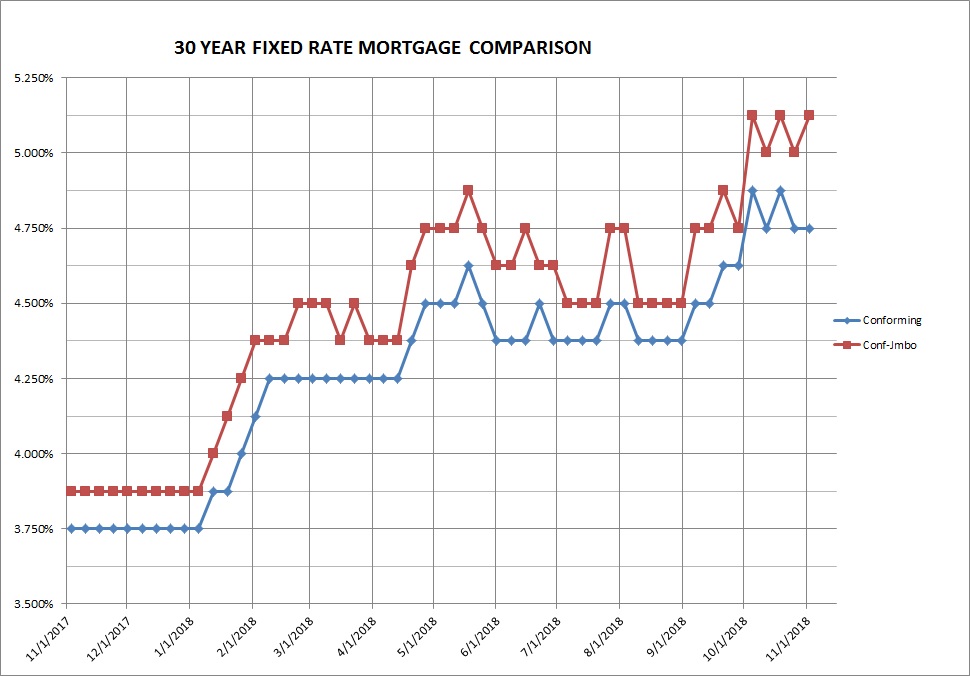
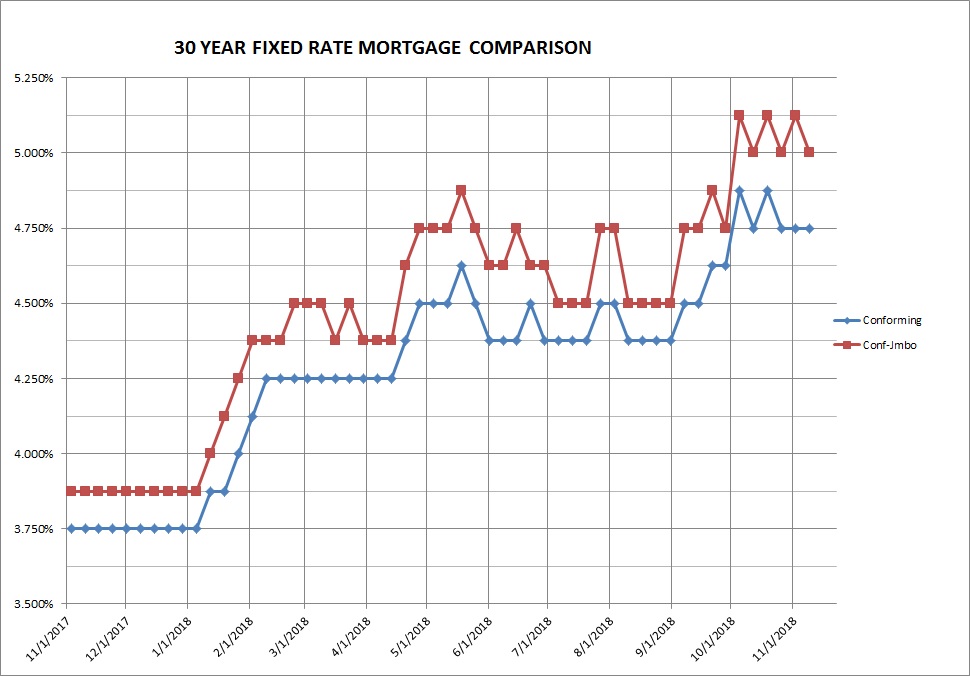
Rates for Friday November 9, 2018: Mortgage rates bounced around a bit this week but we finish with the conforming rate being flat from last Friday and the high-balance rate declining one-eighth (0.125%). Rates have been within a tight range of one-eighth of a percent for the past six weeks, any news positive or negative could prompt a break out of to higher or lower rates. In other words we continue to have a volatile somewhat unstable rate market.
FIXED RATE MORTGAGES AT COST OF 1.25 POINTS LOCKED FOR 45 DAYS:
30 year conforming 4.75% Flat
30 year high-balance conforming 5.00% Up 0.125%
Please note that these are base rates and adjustments may be added for condominiums, refinances, credit scores, loan to value, no impound account and period rate is locked. Rates are based on 20% down with 740 FICO score for purchase mortgages.
Another milestone in the Smith household as our youngest passed her driver’s test and drove herself to school on Tuesday instead of taking the bus. It also has resulted in the big car shuffle as she took my 2006 Pilot, I am now in the 2010 Odyssey and Leslie moves into what was our oldest daughter’s 2001 Infinity until we decide it is time to get her a more recently manufactured set of wheels. We’re not real big on buying new cars in our family on a very frequent basis.
Have a great week, and drive carefully—especially around Bixby Knolls!
Dennis
Past Weekly Rate & Market Updates can be found on my blog page at my website www.DennisCSmith.com