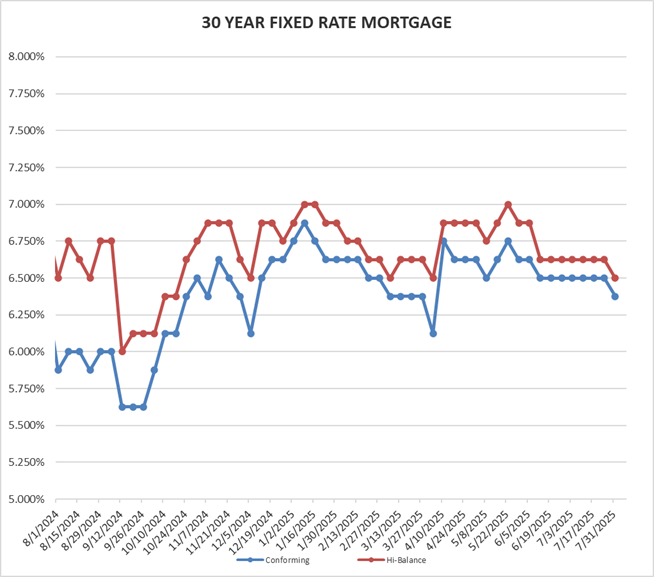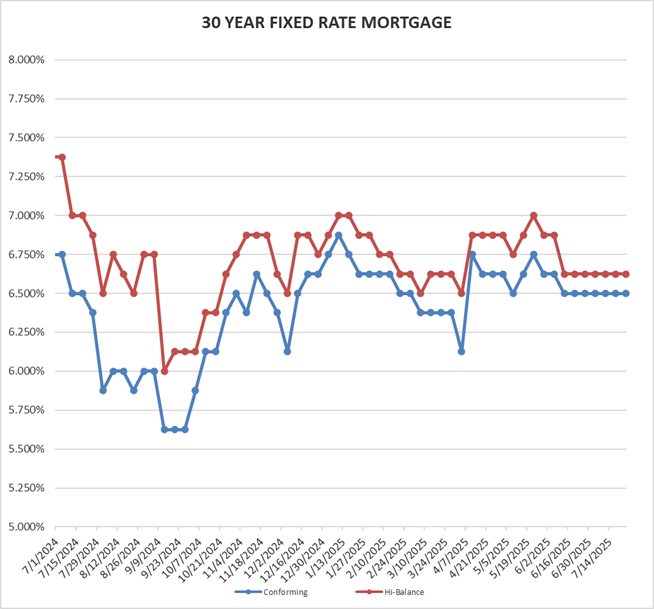
Will the federal government shutdown impact the timing of my loan approval or closing?

Question of the week:  Will the federal government shutdown impact the timing of my loan approval or closing?

Answer: It’s like I jumped into my DeLorean DMC-12 and dialed up 2018 instead of 1955 with this question.

You likely recall that the last federal government shutdown occurred for 35 days, from December 22, 2018 to January 25, 2019.

Short, and ambiguous, answer to the question: For the majority of mortgage applicants, probably not. For some, probably.

Depending on what type of mortgage, or what services are required to close, you may experience delays during the shutdown.

 If you are in a rural area and obtaining a USDA, or perhaps waiting for FHA to approve a condominium complex in which you are purchasing or refinancing one of the units, you will likely experience delays waiting for approval from federal agencies.

For borrowers with properties in areas that required flood insurance, which is available only through the National Flood Insurance Program (NFIP), there will likely be delays if the NFIP cannot issue or renew policies.

At the beginning of the 2018-19 shutdown the NFIP lost authority with the budget impasse, FEMA announced it would not renew or issue new policies.  After extreme pressure from Congress, insurance industry, and real estate industry, FEMA switched positions and announced NFIP would continue issuing and renewing flood insurance policies. They were able to do this as Congress had passed a short-term reauthorization for NFIP through May 2019, ergo it had authority to issue policies.

Unfortunately for those who will need federal flood insurance to close mortgages, the is no authorization for NFIP that extended beyond September 30th. If your loan requires flood insurance, absent some action by FEMA or Congress, your closing will likely be delayed until some action is taken.

One requirement for many mortgages is verification of your income by a review of your tax transcripts as filed with the IRS, especially if you are self-employed. For this process, we use IRS Form 4506-T.

During a government shutdown the requests for a copy of your returns are not processed. Having experienced such delays in the past, in recent years lenders have eased the burden by allowing some work arounds to the Form 4506-T requirement, typically a copy of the cancelled check or other proof you paid taxes owed on the tax returns provided, or a copy of a bank statement showing the deposit of your refund that matches the refund on your tax returns provided.

Government insured loans, such as VA or FHA, are not impacted by the shutdown as the processing and underwriting is performed by private companies and not government agencies. While Fannie Mae and Freddie Mac are quasi-government agencies they are operated as private companies and are unaffected by the shutdown.

The primary area of impact during government shutdowns, once flood insurance is authorized, are inquiries for loan issues in which a response is required from either VA or FHA. It is very rare that a situation arises in which a lender will require a response from either of the agencies in order to approve a loan, but they do arise from time to time and any such cases arising during the shutdown will likely face delays until someone is available to reply.

In a broader view, the impact of the shutdown on mortgages is the impact it may have on the economy and subsequent impact on interest rates.

Fundamentally, if there is an impact on rates it would be for rates to decline. A very prolonged shutdown could result in negative economic impact and regular readers of the WR&MU know that poor economic performance usually leads to lower interest rates.

Have a question? Ask me!

Not much to report, with no reports. The shutdown has shutdown government agencies that provide economic reports that are used by investors, agencies, banks, the Federal Reserve, to make decisions. Today, the first Friday of the month, is when the Bureau of Labor Statistics would be releasing it Monthly Employment Situation Report for September. Depending on the number of new jobs added to the economy, rates could move up or down, the Fed may decide to move its benchmark rate, or not. With no report everyone is left guessing, or waiting. If the shutdown continues into the month there will be no data on CPI, GDP, personal income and spending, or any economic activity tracked by the government.

Historically, the response to a shutdown is lower rates as investors pull money from riskier investments, like stocks, and undergo a “flight to safety,” investing in fixed rate assets like Treasury bonds, and mortgages.

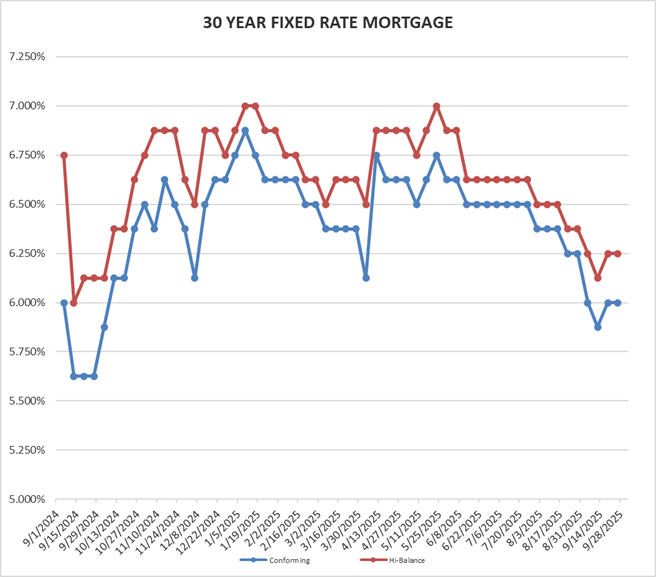
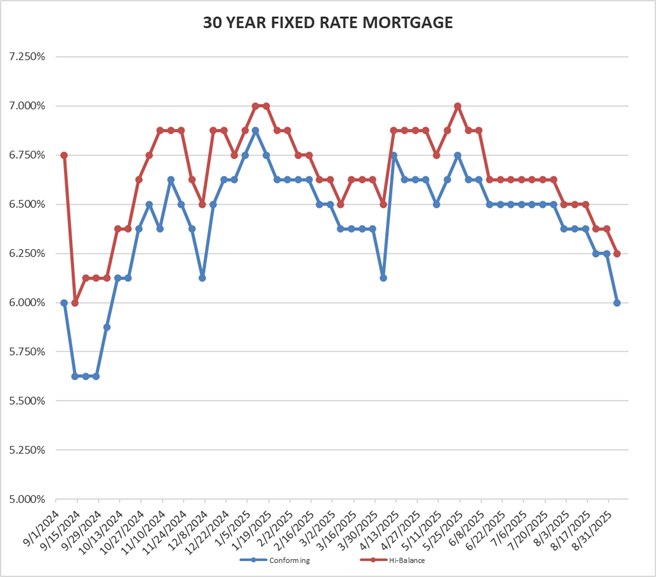
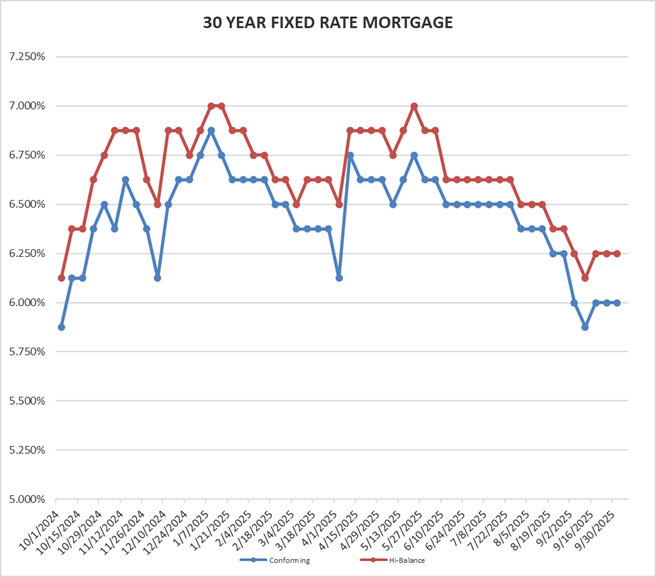
Rates for Friday October 3, 2025: We are flat again from Friday to Friday as investors try to read tea leaves in a cup of coffee.

FIXED RATE MORTGAGES AT COST OF 1.25 POINTS LOCKED FOR 45 DAYS:

30 year conforming                                            6.00% Flat

30 year high-balance conforming                      6.25%  Flat

Please note that these are base rates and adjustments may be added for condominiums, refinances, credit scores, loan to value, no impound account and period rate is locked. Rates are based on 20% down with 740 FICO score for purchase mortgages.
Likely no WR&MU next Friday as will be leaving for a trip to East Coast bookended with seeing daughters in New York and Baltimore.

In the meantime, I leave you with this, Go Phillies!

How do we handle physical issues with home we are buying?

Question of the week:  How do we handle physical issues with home we are buying?

Answer: Last week we spoke about seller disclosures of known physical deficiencies with a the property they are selling; more specifically when a disclosure is not required.

As a buyer, what are your options when your home inspection report details some fairly significant* issues that need correcting?

*Significant being a key word. Every inspection will turn up some issues with all homes—even new construction. As a buyer, cracked swith plates, sticking windows, inoperable garage door opener, are fairly insignificant and should not stand in the way of your home purchase.

In the standard purchase contract, there are a series “outs,” also known as contingencies. The buyer has a certain number of days to remove contingencies for loan approval, appraisal-value, and physical inspection. During the contingency periods the buyer can cancel the transaction with no recourse due to failure to get loan approval, insufficient value, and/or issues with the property.

Most often, when a physical inspection report has somewhat serious issues with the property that causes a buyer to have some misgivings about continuing the transaction, a request is made to the seller to either correct the issue, or provide an adjustment to the transaction to cover the cost of the buyer to cure the defect. If the seller is unwilling to do so, the buyer can then decide to continue the transaction, or cancel and have the initial deposit refunded.

“Adjustment to transaction” can mean adjusting the sales price, or providing a credit to the buyer at closing. Typically, a credit is more advantageous when it comes to freeing up cash for using later for repairs.

Physical inspection shows shoddy plumbing from prior owner’s DIY work to replumb part of the property, that is not only up to code, but on the brink of major failure and leaks. The buyer gets an estimate from a plumber for $15,000.

Buyer can either continue the deal and pay to fix plumbing themselves, ask the seller to lower the sales price $15,000, ask for a credit of $15,000, ask the seller to use buyer’s plumber to correct the plumbing, or cancel the transaction.

Seller can either accept one of the curative options, or say no and cancel the sale.

Property is in escrow for $1,000,000. Buyer is purchasing with 20% down.

If seller agrees to lower the price $15,000, the new sales price is $985,000.

Buyer was putting down $200,000 at a million-dollar sales price; 20% of $985,000 is $197,000. The reduction in sales price saves the buyer only $3,000 in cash.

If the seller credits $15,000 to the buyer, the buyer saves $15,000 in cash. Clearly, this is the better option for the buyer.

How the credit is worded is very important.

If the escrow amendment for the credit states that the credit is for the repair of plumbing, the lender will very likely require an inspection of the plumbing and the appraiser to address the impact on value. As well, if the lender accepts the credit, it will most likely require an estimate from a licensed plumber for the cost of repair, and the funds be held in escrow to be paid to the plumber once the work is completed and signed off by the appraiser or inspector of the lender’s choice.

If the credit is for buyer’s closing costs, within limitations, the lender will accept the credit.

What are the limitations?

The credit cannot exceed the actual closing costs (including pre-paid costs for taxes, insurance, HOA dues, etc).

Second, depending on the loan-to-value (LTV), the credit cannot exceed a certain percentage of the sales price. For loans that are 90% or greater, the credit cannot exceed 3% of the sales price, 90.1% to 75% limit is 6%, if 75% or less LTV the limit is 9% of the sales price.

In our above scenario the $15,000 credit for a $1,000,000 purchase with an 80% LTV is well within the limits.

What if the cost were higher? What if the seller agreed to a 6% credit, $60,000? But the buyer’s costs were only $30,000?

The seller would not get full cash value for the additional $30,000 credit, but the buyer can use the funds to buy down their interest rate, say from 6% to 5.125%, which would cost $30,000 in points for the rate buy-down.

At 6% for an $800,000 30-year mortgage, the payment is about $4800 per month, at 5.125% the payment is about $4350 per month, a savings of $450 per month, $5400 per year.

Yes, it will take about five and a half years to recoup the entire $30,000 credit with the lower payment. However, there is additional costs savings that will likely accrue as the buyer will not be paying the costs to refinance once, or twice, possibly three times to get down to a 5.125% rate in the future. With the estimated “hard” cost for refinances at around $5000, takes almost another year off the time to recoup the $30,000 credit in cash.

If you are buying a property that has some issues that need to be addressed, it is almost always better to get a credit for closing costs from the seller rather than a reduction in sales price. That said, before requesting a price reduction or credit, do the math with your loan originator (me) to ensure the best value for covering your future repair costs.

Have a question? Ask me!

A week of positive economic news:

  • The estimate for the 2nd quarter GDP was revised upward from 3.3% to 3.8% as consumer spending was much higher than originally estimated; as well very strong investments in software and hardware for artificial intelligence and spending on intellectual property research and development surged. The growth was the strongest quarter in two years.
  • The Fed’s preferred gauge of inflation, the Personal Consumption Expenditures index (PCE) rose slightly in August, within expectations, up 0.3% for the month and 2.7% for the year. Core inflation (absent energy and food) was up 0.2% monthly and 2.9% annually. The numbers show continued resistance of inflation to meet the Fed’s 2% annual inflation objective. A good sign for the Fed, and consumers, is that the cost of goods most impacted by tariffs rose only 0.1% last month after dropping in July. Pushing inflation is cost of services, which continue to rise month after month.
  • Personal incomes increased 0.4%, once again outpacing inflation, while consumer spending increased 0.6%, far outpacing inflation (spending is based on dollars spent not units, so 0.3% inflation would increase spending by about 0.3% if economic transactions were the same month to month in regards to units purchased in goods and services).

What’s it all mean? Stronger economic growth and consumer spending may put a damper on Fed rate cuts in the future. Inflation has not bent towards the Feds target, but has not been increasing significantly. While the general consensus leans to two more rate cuts this year, economic data for the coming months may result in only one rate cut this year with a second in 2026. Key word “may.”

Rates for Friday September 26, 2025: Rates are flat from last Friday as economic data did not supply and reasons for buying or selling enough in the markets to have any impact.

FIXED RATE MORTGAGES AT COST OF 1.25 POINTS LOCKED FOR 45 DAYS:

30 year conforming                                            6.00% Flat

30 year high-balance conforming                      6.25%  Flat

Please note that these are base rates and adjustments may be added for condominiums, refinances, credit scores, loan to value, no impound account and period rate is locked. Rates are based on 20% down with 740 FICO score for purchase mortgages.

Enjoying a quick get-away weekend in the desert. It’s a dry heat, but still, it is heat. Thankfully “cool” enough to not be overly oppressive by the time we are off the course by noon after early morning tee times!

Anecdotally, have noticed more For Sale signs on houses lining courses and throughout the valley than in previous visits in the past year or so.

Why did the seller not disclose issues with home we purchased?

Question of the week:  Why did the seller not disclose issues with home we purchased?

Answer: Hopefully because they were not required to under California law.

California Civil Code requires that sellers of most residential property types (residential properties with five or more units are exempt) complete a Transfer Disclosure Statement. The purpose of the TDS is to disclose items included with the property, if any are non-operational, known material defects to the property, as well as soil or water issues, noise or nuisances, non-permitted areas, and other items that may be detrimental or cause potential problems for a buyer.

Under California law, the following sellers of properties that would otherwise require a TDS are exempt:

Court-Ordered sales –probate, bankruptcy, foreclosure

Fiduciary sales –trustee or conservator, if the fiduciary did not occupy or own the property in a recent time period

Transfers between co-owners or family –between spouses, parent-to-child, as part of a divorce

Estate administration –executors or administrators selling as part of an estate settlement

Government entities –sale by local, state, or federal government

Whether or not an agent is representing a seller, i.e. a For-Sale-By-Owner, a TDS must be provided to potential buyers for eligible transactions.

It is also important to note, that if the seller is using an agent to represent them in their sale, the agent is also required to complete the TDS based on their knowledge of the property based on communications with the seller, personal visual inspection, and reasonable due diligence if is there appears to be a noticeable issue that may impact the property’s value or desirability. Such items may include water stains on a ceiling, fence with neighbor that obviously encroaches on subject property, airport noise, etc.

If, as a buyer, you purchase a property and an issue comes up that clearly should have been provided on the TDS you have recourse.

You may demand the seller, and/or agent’s broker, pay for repairs to your specification, or otherwise remediate the issue.

If the issue cannot be remediated, such as airport noise or a next-door neighbor that is extremely noisy, aggressive and known to continuously disrupt the seller and other neighbors—such as multiple police interactions, negative personal interactions and threats, excessive barking dogs—civil action can be taken for damages or rescission of the sale.

As a seller, failure to properly disclose issues to a buyer can result in not only actual damages, but compensatory damages for repair costs, diminished property value, or emotional distress. If non—disclosure is found to be fraud, punitive damages may also apply.

As for agents that are found at fault for inadequate disclosure on a TDS, they may face disciplinary action from the California Department of Real Estate, include suspension or revocation of their license. As well, agents may also face financial penalties.

As a buyer, after receiving a TDS, it is very prudent to note any items listed that may cause you an issue as property owner, or potentially as a seller in the future—such as unpermitted improvements—and investigate the possible cost to correct, if possible.

With every purchase transaction, buyers should engage a licensed property inspector to thoroughly inspect the property and its systems. Ensure the inspector has a copy of the TDS before the inspection.

One final, and very important point, if an exempt seller is made aware of issues, material or non-material, to a property as a result of being provided a report from an inspector, they are legally obligated to disclose the issues discovered and presented to them. Failure to do so will be a breech of the Civil Code and subject to the same possible repercussions as if they failed to disclose on a TDS, even if exempt when initially putting the home on the market.

Example, and the reason for the Question of the Week, recently we had a client enter into escrow for a 2-on-a-lot being sold by the children of their parent’s estate. None of the children had lived on the property for decades.

There was no TDS as the sale was exempt. The buyer’s physical inspector noted significant issues with foundations, roofs, electrical and plumbing systems. The buyer presented the report to the listing agent to present to the sellers and requested significant concessions in price and credits for fees to off-set most of their costs to correct the major issues.

The seller’s denied the request and the deal was cancelled.

Moving forward the seller and agent must disclose to potential buyers the issues brought to light by the inspector’s report.

Have a question? Ask me!

Retail sales had a strong month in August. For the third month in a row retail spending had strong increase from the prior month, up 0.6% from July. As with prior months, auto sales increased as in prior months, however, taking auto and gas sales from the data, retail sales increased 0.7% for the month. It needs to be noted, that a factor in the increase in sales is inflation as retail sales data is dollars transacted, not units sold.

A positive sign for the economy, is that restaurant spending increased 0.7% for the month and is up 6.6% over last year for the past three months. Restaurant spending is a very good indicator of consumer expectations as people eat out more often, or have food delivered, when they are confident in their economic circumstances and future.

Normally this data would put upward pressure on rates. However, the data was released on Tuesday and everyone was primarily concerned with Wednesday’s event—the Federal Reserve announcement regarding its benchmark interest rate. The Fed did not disappoint as it lowered the Fed funds rate by the expected 0.25%. Moving markets to some extent was the implication that the Fed would lower rates again at its October and December meetings.

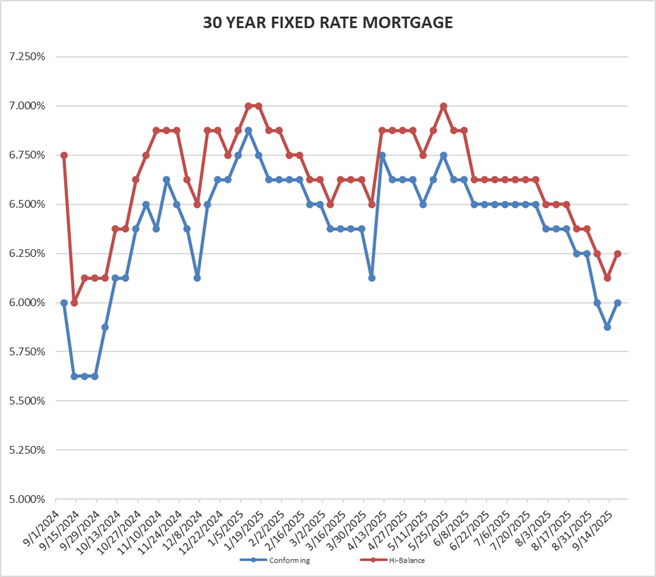
Rates for Friday September 19, 2025: Mortgage rates did not react too much to the Fed announcement as it was already priced into investor decisions. Today rates pushed up from last week as investors re-balanced portfolios.

FIXED RATE MORTGAGES AT COST OF 1.25 POINTS LOCKED FOR 45 DAYS:

30 year conforming                                            6.00% Up 0.125%

30 year high-balance conforming                      6.25%  Up 0.125%

Please note that these are base rates and adjustments may be added for condominiums, refinances, credit scores, loan to value, no impound account and period rate is locked. Rates are based on 20% down with 740 FICO score for purchase mortgages.

For many years in my office, I had a statement I printed on my wall. It is one we should all try very hard to abide by in all times, but very much so today.

“Listen not with the intent to reply, but to understand.”

To many discussions, interactions, especially those on social media, are between parties that do not try, and more importantly do not care, to understand what the person(s) they are interacting with is trying to convey.

Do not try, nor care, to understand how and why they have that opinion.

Do not try, nor care, to understand the background, environment, values, ethics forming their basis for opinions and ideas.

Everyone has much in common with everyone they meet, starting from their discussions and interactions can move forward if understanding, instead of “winning” or “gotcha-ing,” is the intent.

Be kind, be understanding.

What impact does the Federal Reserve have on mortgage rates?

Question of the week:  What impact does the Federal Reserve have on mortgage rates?

Answer: Nerd alert—I got a bit too involved in this topic, my econ major came out. Towards the bottom I hope I simplified it for those looking for the Cliff notes version.

For most of its history the Federal Reserve had a very tangential impact on mortgage rates for home buyers and owners.

As discussed in the WR&MU, and elsewhere, the only interest rate the Fed controls is the Federal funds rate—which is the rate banks charge each other for overnight loans to cover reserves.

This rate trickles through the banks and into the financial system as if they are paying more or less for borrowing so will their clients. As well, the prime rate charged by banks typically moves in the same direction and amount as the Fed funds rate.

Investors use the comments by the Fed on what they believe the economy will be doing and guess if they will raise or lower rates, and then invest accordingly. These expectations result in their decisions on whether to buy or sell stocks, bonds, and mortgages.

For the last several decades, mortgage rates have been established in the open markets as investors bid on Mortgage-Backed Securities (MBS). These securities are bundles of mortgages that are packaged by lenders who sell direct to market, or for the vast majority, sold directly to Fannie Mae or Freddie Mac. Fannie and Freddie (GSEs) then package into bigger bundles and sell their MBS in the open market.

The bidding on the MBS determines mortgage rates. Higher MBS prices mean lower rates; lower MBS prices mean higher rates.

Mortgage rates are dependent on the market for Mortgage-Backed Securities.

Investors bids on MBS are directly correlated to the other options they have for their money. The investment instruments most like MBS are issued by the United States Treasury in short- medium- and long-term bills and bonds. If the Treasury is paying more to borrow money, investors will want mortgagees to pay more to borrow money, and vice-versa.

In any market, supply and demand determine prices. High demand against limited supply raises prices, low demand against high supply lowers prices, low demand-low supply and high demand-high supply generally keeps prices stable.

The only news from the Fed that is main-stream is its Fed funds rate and if the Fed will be raising or lowering the rate. Never, or very rarely reported, is how big the Federal Reserve is.

The charter for the Federal Reserve is to support maximum employment with minimal inflation—a difficult balancing act. For most of its history the Fed had primarily done this by using the funds rate. According to economic principles, higher rates would slow economy, lower inflation but increase unemployment; lower rates would stimulate economy, increase employment and prices.

In the 21st Century we have seen the Fed become much more aggressive in the trying to fulfill its charter by becoming very active in financial markets.

In response to the real estate and mortgage markets collapse in 2008 at the onset of the Great Recession, the Fed began a policy of “Quantitative Easing.”  It began to buy trillions of dollars of fixed rate investments in an effort to lower rates in the markets and stimulate the economy.

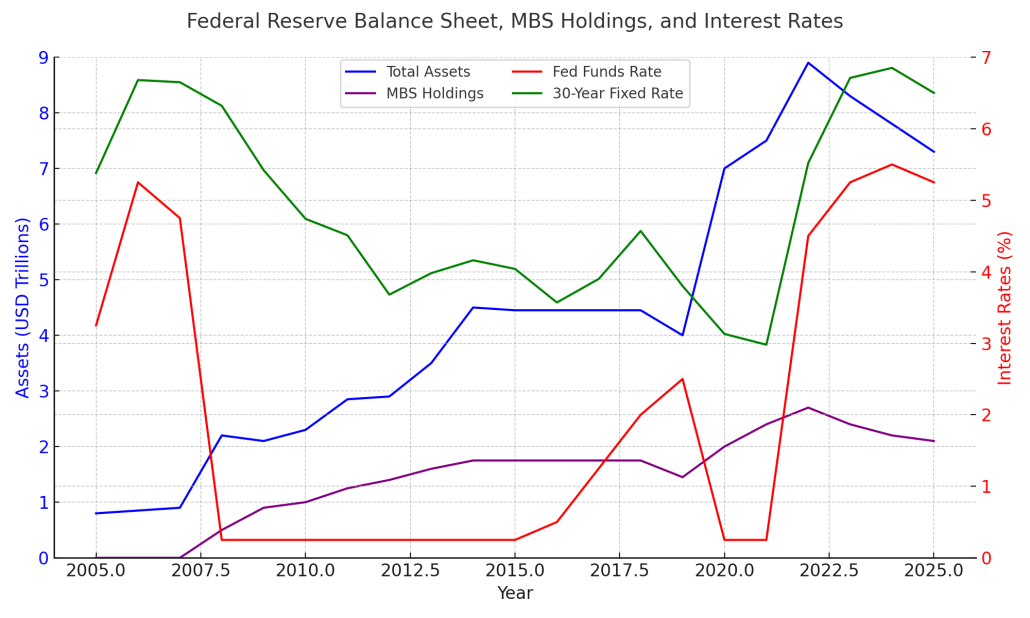
Prior to the recession, in 2007, the Fed’s balance sheet was $900 billion dollars, virtually all of was Treasury bills and bonds.

Within one year the balance sheet increased to $2.2 trillion an increase of almost 2.5 times. As well, to prop up the mortgage and real estate markets, the Fed began buying MBS in 2008 with a purchase of $500 billion.

In 2007 the Fed funds rate was 4.75%, by the end of 2008 it was 0.25%, the largest drop in history in one year.

While the Fed funds rate remained at 0.25% until 2016, the balance sheet did not. The Fed kept purchasing Treasuries and MBS until it held a total of $4.5 trillion of the assets, including $1.75 trillion of MBS.

During this time, while the Fed funds rate remained flat, the 30-year fixed rate dropped from 6.65% in 2007 to a low of 3.68% in 2012. The primary cause was the Fed purchasing almost every conventional mortgage funded during the time frame.

In 2014 the Fed stopped actively buying new holdings, but reinvested the proceeds from Treasuries and MBS that were paying off to keep its balance sheet stable through 2018.

From 2017 to the pandemic in 2020, the Fed raised its fund rate from 0.25% in 2015 to 2.5% in 2019. In 2019 the Fed stopped reinvesting proceeds from Treasuries and MBS into more of each and its balance sheet began to shrink. During this time mortgage rates were fairly stable, increasing from 3.9% to a high of 4.57% back to 3.8%.

During the pandemic the Fed once again lowered it funds rate to 0.25% and began purchasing Treasuries and MBS. Rates dropped from 3.8% in 2019 to a low of 2.98% in 2021.

In 2022 as inflation spiked, the funds rate jumped from 0.25% in 2021 to 4.5% in 2022, reaching 5.5% in 2024. Spiking as well was the balance sheet with reached a peak of $8.9 trillion in 2022, including $2.7 trillion in mortgages.

Today the Fed fund rate is at 5.25%, it holds $7.3 trillion of Treasury debt and MBS ($2.1 trillion). The Fed funds rate is the same it was in 2006, when the 30-year fixed rate was 6.68% and the Fed held $850 billion in Treasuries, and no mortgages. Almost one decade later, the only change in these parameters is the dollar amount of investments the Fed holds and the price of real estate both climbed dramatically.

By purchasing $8.0 in Treasury debt and MBS from 2007 to 2022, the Fed was the demand in the market for those assets, pushing out most private and institutional investment. Higher demand means higher prices, means lower interest rates.

Where did the Fed get $8.0 trillion from 2007 to 2022 to purchase all those mortgages and Treasury debt? It created it.

The Fed does not print money, instead it electronically increases the reserve balance of a bank where it buys Treasuries or MBS. 

Because the Fed created $8.0 trillion dollars, almost $5 trillion from 2019 to 2022, more money was flowing in the economy, which fueled inflation, and the need to lower rates.

Cliff Notes:  While mortgage rates are influenced somewhat by the Fed funds rate as investors react to expectations for what the Fed, and economy, may do in the future; also having a major impact the last two decades has been the Fed’s buying trillions of dollars of Treasury debt and mortgages. These purchases had a dual effect of pushing rates down, but also creating environment during Covid when all the extra money it created caused very high inflation—which it then tried to fight by raising rates.

Looking at the chart below, you can see that the green-line (mortgage rates) somewhat follows the red-line (fed funds rate) until the end of the pandemic. At that time mortgage rates more closely followed the total amount of assets held by the Fed as it created trillions of dollars and pushed prices up.

Looking ahead, as the Fed begins lowering its benchmark fed funds rate later this month, is what impact will the size of the Feds holdings have on the economy and rates. If it actively sells Treasuries and MBS, it can pull money out of the economy, slowing it and lowering inflation and rates. Or it can let the total amount of its holdings slowly decline by not reinvesting funds when mortgages and Treasuries pay off.

A lot of focus on the Fed rate moves overshadow the major impact the Fed has in it ability to create, or take away, money from the economy.

Have a question? Ask me!

Prices went up in August. The Consumer Price Index increased 0.4% in August, 2.9% from last August; both the monthly and annual rates were higher than July’s CPI. Even though CPI prices went away from the Fed’s 2% target, a rate cut by them next week is expected as an increase was expected, and expectations are that the Fed’s preferred inflation gauge, the Personal Consumption Expenditures index will be more benign.

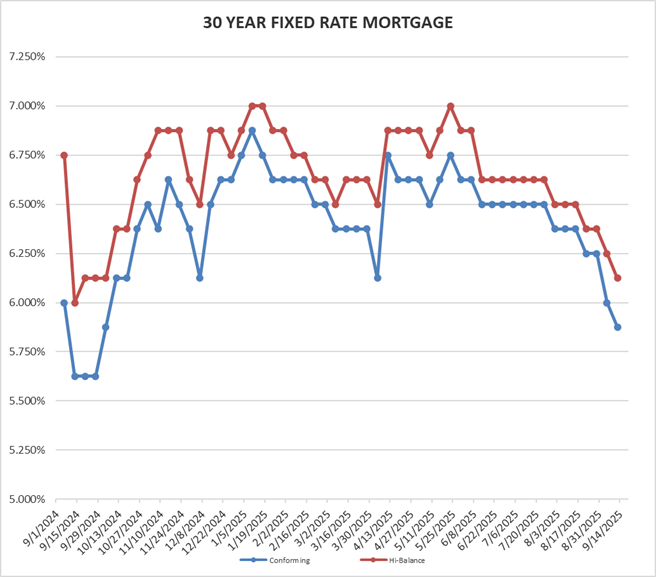
Rates for Friday September 12, 2025: Rates continue to slide down week to week, back to first step in the spike last September after rates had hit their lowest rate since December 2022.

FIXED RATE MORTGAGES AT COST OF 1.25 POINTS LOCKED FOR 45 DAYS:

30 year conforming                                            5.875% Down 0.125%

30 year high-balance conforming                      6.125%   Down 0.125%

Please note that these are base rates and adjustments may be added for condominiums, refinances, credit scores, loan to value, no impound account and period rate is locked. Rates are based on 20% down with 740 FICO score for purchase mortgages.

On Tuesday California celebrated its septaquintaquinquecentennial, or for those who prefer short cuts, our dodrans bicentennial (Latin for three-quarters of the way to 200).

For those who did not get past mille in Latin class, Tuesday was the 175th anniversary of California being admitted as the 31st state in the union.

In our 175 years we have had four state capitals, San Jose (1850-51), Vallejo (1852-53), Benicia (1853-1854) and Sacramento since 1854.

Our population has increased from 92,597 at statehood to 39.6 million today. As our population grew, so too did our desire for more local control, expanding from originally 27 counties to 58 today—with San Bernardino being the largest in the nation, larger than nine states.

Happy Birthday to us!

Are we breaking the law?

Question of the week:  Are we breaking the law?

Answer: I hope not!

This question came from long time client Tomas. He called in a panic as over the years, decades?, he has purchased several homes, some of which he retained when buying a next home.

His panic was due to the Department of Justice investigating several very high-profile politicians and others for mortgage fraud stating those being investigated had sign owner occupancy statements on multiple loans stating the subject property(s) would be their primary residences.

The investigations are for mortgage fraud as technically you cannot have more than one primary residence.

The high profile, and highly covered, investigations have worried Tomas as he currently has two properties that have loan documents the he signed stating they would be his primary residence, prior to the rate drop during Covid he had three such mortgages.

My answer to Tomas was, “no you need not be worried.”

How can this be?

Because for each of the mortgages he signed the intent to occupy affidavit, and he did occupy the properties as his primary residences.

This question has come up from time to time through the years with clients who purchase homes, get an owner-occupied mortgage, and then purchase another property and want to keep their current property. “Do we have to refinance the mortgage?”

No, because the did occupy the property. The owner occupancy affidavit does not state that the loan is callable and must be paid off or you are in default if at some point in the future you no longer occupy the property.

Tomas purchased his first property sometime in the early 2000’s. After several years, his family had out grown the home and they had the ability to purchase a new home and not have to sell their first home. He purchased his next home and rented out his first home.

A few years later, they moved to Orange County, purchasing a new home and once again keeping their current home and renting it out.

At this point Tomas has three properties, all of which have mortgages that have loan documents stating the properties will be owner occupied.

Covid hits and rates drop considerably. We refinance Tomas’ two prior properties with non-owner-occupied mortgages, and his Orange County home with an owner-occupied mortgage.

Earlier this year, Tomas and his wife, now grandparents, downsized to a smaller home near their home in Orange County and purchased it with an owner-occupied mortgage. Their daughter and family moved into their home and they have retained the refinanced mortgage due to its low payment and interest rate.

Currently Tomas has three mortgages for which he is obligated, two owner occupied mortgages and one non-owner-occupied.

Tomas did not commit mortgage fraud, and cannot be successfully prosecuted for mortgage fraud as in every instance in which he funded an owner-occupied mortgage he fulfilled his intent to occupy the property.

A question that comes up with some looking to obtain a more favorable mortgage is, “if I purchase this home with an owner-occupied mortgage how long to I have to occupy the property?”

This is akin to asking how long will it take for my ice cream to melt and drip all down the cone and onto my hand.

It depends on many circumstances, but you want to be very sure your hand doesn’t get sticky because it is a federal crime that if fully prosecuted and sentenced can result in up to 30 years in prison and fines up to one-million dollars, depending on the severity and if other crimes are involved.

Over the years I have run into a few instances where we helped borrowers whose lenders were calling loans due for non-occupancy.

In one instance, we had an active military member who was transferred overseas not long after purchasing his home with a VA mortgage. Providing his transfer papers and dates sufficed to enable him to retain the mortgage and rent to home out until his overseas duty was completed.

In another instance, a client’s company was purchased and he as transferred to the East Coast not long after purchasing their home. Again, correspondence regarding the transfer, letter from employer it was either move or lose his job, satisfied the lender.

In the mortgage business the approach is guilty until proven innocent. Underwriting is adverse, you have to prove you make the money you make, the funds you have are sourced and legitimate, the property is sufficient collateral, beyond all reasonable doubt.

When it comes to investigating if a borrower has fulfilled the intent to occupy the same holds true, prove beyond a reasonable doubt you did intend and fulfill the obligation.

Do not create reasonable doubt, fulfill your intent to avoid serious consequences.

Have a question? Ask me!

It’s going down. I’m not talking about the social media being filled with pictures of anything pumpkin spice. I’m talking about the Federal Reserve’s benchmark interest rate. The jobs data for August was released today and it pretty much guaranteed a rate drop by the Fed in two weeks. As well, the data has brought into discussion if the Fed may cut by 0.5% (one-half of one-percent), instead of the typical 0.25% (one-quarter of one-percent) that is more typical.

Why? The Labor Department reported that only 22,000 total jobs were created in the economy last month. Leading the way in creating more jobs, as they have been for several months were the education/health care (16,000 jobs) and leisure/hospitality industries (17,000 jobs). Large net losses in employment were professional/business (-17,000) and government (-16,000).

Knocking but no answer. The unemployment rate was 4.3% for the month, the largest since 2021, however the primary reason for the increase from 4.2% was more people looking for work. Looking but not finding as more businesses are not filling empty positions.

The bright spot in the data was wages showing an increase of 0.3% for the month and up 3.7% from last August, both outpacing inflation.

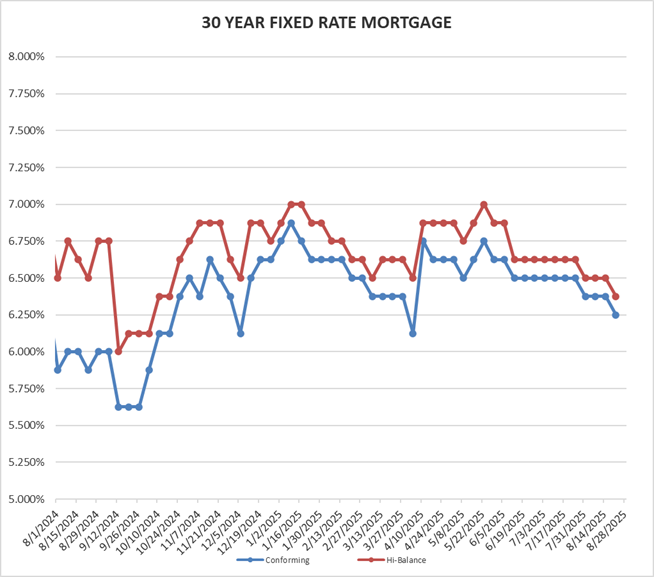
Rates for Friday September 5, 2025: Rates drop to their lowest since October on the jobs numbers.

FIXED RATE MORTGAGES AT COST OF 1.25 POINTS LOCKED FOR 45 DAYS:

30 year conforming                                            6.00%  Down 0.25%

30 year high-balance conforming                      6.25%   Down 0.125%

Please note that these are base rates and adjustments may be added for condominiums, refinances, credit scores, loan to value, no impound account and period rate is locked. Rates are based on 20% down with 740 FICO score for purchase mortgages.

“Thirty Wonderful” was the tag Leslie put on her social media post of a picture from 31 years ago yesterday of a much younger Leslie and Dennis in wedding regalia holding up our glasses for a toast.

I definitely hit the marital jackpot, and being able to watch the Eagles get by the Cowboys as we ate chicken sandwiches with beer as our anniversary dinner just upped the amount of the jackpot I have hit.

Those concerned about the lack of celebration, we will have a nice evening out this weekend to properly celebrate the past 31 and what is to come in the next.

Will mortgage rates come down because of what the Fed did today?

Question of the week:  Will mortgage rates come down because of what the Fed did today?

Answer: Yes, they did.

There was no “action” today be the Fed, but a significant event.

Today is the annual Jackson Hole Economic Policy Symposium hosted by the Federal Reserve Bank of Kansas City. Is JHEPS the acronym?

The main event of the symposium every year is a speech from the Chair of the Federal Reserve. This is likely Fed Chair Jerome Powell’s last JHEPS headline speech as President Trump has made no secret he will appoint a new chair for the Fed when Powell’s term is up in the spring of 2026.

Heading into this morning’s session, and Powell’s speech, markets were eagerly waiting to here if he supports lowering the Fed’s benchmark interest rate.

As usual with such speeches from Fed chair’s, it took a little reading of tea leaves to see what Powell supports; this is because Fed-speak can, and does, have major impact on markets globally.

This morning Powell opened the door for a rate cut, but did not step through it, and left room for the door to be shut on a rate cut.

Congress set a dual mandate for the Federal Reserve, promote conditions that result in the highest possible sustainable level of employment, and keep inflation low and predictable.

These two mandates are economically in conflict as high unemployment creates higher income, therefore more spending, which leads to more demand, and higher prices.

Because of the dual mandate, and the major economic swings we have had from the Great Recession, and then a decade after it ended Covid, the Fed has been walking a tight rope as it has enacted policies to stimulate, and then cool off, the economy.

Today, Powell spoke about part one of the mandate, the labor market. He said it might be softening enough to rein in inflation that is being pushed by tariffs. After spending the past year keeping its benchmark rate steady, stating the strong labor market and uncertainty about inflation did not warrant a change, it appears that the chances for a rate cut in September is pretty high.

In Fed speak, “the balance of risks appear to be shifting…it is a curious kind of balance that results from a marked slowing in both the supply and demand for workers.”

Summation, the economic outlook “may warrant adjusting our policy stance.”

Back to our question, with the door open, rates are certainly responding as the chances of a rate cut by the Fed indicates lower rates for other fixed rate instruments, such as mortgages.

That said, how much impact over time is not yet know as mortgage rates are not set by the Fed, but investors do consider the Fed’s moves when determining what interest rates they require for their investments.

During the current easing policy with the Fed lowering its rate starting in July 2023, we have seen mortgage rates decline, but not with the same rate of decline as the Fed’s rate.

So, today’s comments by the Fed did have an immediate impact on rates as they hit their lowest since the first week of April, which at the time was a four-month low; only to be followed by a 0.75% (three-quarters of one percent) jump in rates the following week after Trump’s initial tariffs declaration.

Moving ahead, mortgage rates movement will continue to be set by investors as they interpret economic data that has impacts on the labor market and inflation.

Have a question? Ask me!

Rates for Friday August 22, 2025: Slow week for economic data as all eyes and ears where focused on Jackson Hole and today’s speech by the Fed Chair. As mentioned, rates at a four-month low.

FIXED RATE MORTGAGES AT COST OF 1.25 POINTS LOCKED FOR 45 DAYS:

30 year conforming                                            6.25% Down 0.125%

30 year high-balance conforming                      6.375% Down 0.125%

Please note that these are base rates and adjustments may be added for condominiums, refinances, credit scores, loan to value, no impound account and period rate is locked. Rates are based on 20% down with 740 FICO score for purchase mortgages.

A weekend we have been looking forward to a while is here. Our youngest is coming home for a visit on Sunday. As they age and create their adult lives, the opportunities to see them becomes more scarce, and precisous.

Are the courts making new residential construction cheaper?

Question of the week:  Are the courts making new residential construction cheaper?

Answer: Yes.

Going back to the late 1980’s, Federal Circuit courts, and the Supreme Court, have backed individuals in their suits against government agencies that have agreed to permit building in exchange for fees or extraction of land.

In 1987 in Nollan v California Coastal Commission, the Supreme Court ruled in Nollan’s favor when they disputed the CCC demand that Nollan give approximately one-third of their beach front property to the State of California in exchange for their approval for Nollan to remove a small bungalow on the property and build a single-family residence.

Seven years later, SCOTUS ruled in the plaintiff’s favor in Dolan v Tigard (OR) when the City of Tigard was requiring Dolan to cede property along a creek that bordered the property and make a greenbelt for public use in exchange for permitting Dolan to expand their store and pave their parking lot.

Last year, SCOTUS ruled in favor of the plaintiff in Sheetz v El Dorado County when Sheetz wanted to build a small pre-fabricated home on his property, but the County wanted Sheetz to pay $23,240 for “traffic mitigation” due to increased traffic on the road due to his property.

In the first two causes, the Court based its decisions on the Takings Clause of the Fifth Amendment, “Nor shall private property be taken for public use, without just compensation.” Approving the building permits do not reach the bar of “just compensation” as the costs for the permits were not roughly proportional to the costs imposed on the community for the new development.

For Sheetz, the question was if there is a distinction between legislative and administrative land-use conditions. The Court ruled there is no distinction, in either case whether permit conditions are imposed by legislation or individual administrators, the conditions must meet the “just compensation” bar, which the court defined as “roughly proportional.” El Dorado County could not show the single-family residence Sheetz built would cost the County $23,240 in road degradation and excess traffic.

Two weeks ago, Yu v. City of East Palo Alto was filed in the U.S. District Court for Northern California. Yu is challenging East Palo Alto’s housing ordinance, which requires developers to either pay a large fee or designate units as affordable housing—requiring the designated units be rented to those deemed qualified for affordable housing.

The Ye family resides in a home in East Palo Alto and own a vacant lot next door. They applied for permits to build a single-family unit, as well as an Accessory Dwelling Unit (ADU); their intention was to use the three dwellings on the two properties for extended family housing, including their daughters and parents.

Because the permit is for the building of multiple units, the City requires the Ye’s to either rent their ADU to non-family tenet eligible for low-income housing, in which case the property cannot be left vacant as East Palo Alto has an ordinance that rental units cannot be vacant for more than six months; or pay a $54,871 fee to the City’s affordable housing department. The latter, ironically, is meant to increase the amount of housing available in East Palo Alto—where the median sales price in June as $1.2 million.

The Ye’s are basing their case on the rulings in Sheetz, which was based on Nollan and Dolan. Regardless of the District Court’s ruling, the chances are fairly strong the loser will appeal to the Ninth Circuit Court of Appeals, and then case could then be appealed again to the Supreme Court.

Depending on the Ninth Circuit’s decision the Supreme Court may once again hear a case that has as its basis private property rights versus government’s ability to take property, or money, without just compensation. If that is the case, the probable decision will be in Ye’s favor.

Cities, Counties and States are on notice that their extraction costs for permits, beyond what is reasonable and normal, are subject to litigation, and possibly losing court cases resulting in loosing fees and possibly property they have acquired due to proportional costs imposed on developers, and individuals, that are in excess of just compensation.

With so many ADUs, major home remodels, and additions having been built, and that are going to be built, the cases above could result in the costs to add more homes, apartments, condos and rental units to our housing stock a lot less expensive to build.

Ironic to those who do not fully grasp economics, lower costs to build, regardless of where those funds are designated, will increase the number of units available to own and rent. More supply leads to lower housing costs, or in worst case slower increases in prices.

I have mentioned the Sheetz and Ye cases to a few people in the past couple of weeks who are undergoing some construction. One example are friends Craig and Melanie who own a second home in San Luis Obispo County. They recently had their permits cleared to build a 600-foot addition and make some exterior changes to patios and balconies. In order to get the permit, they paid a reasonable fee to the building department for inspections, etc; however, they also had to pay over $3000 to the County for their library fund. This does not seem to be proportional to the construction they are doing, nor does it seem like just compensation for a permit as how is the connection made between adding square footage to an existing dwelling and libraries?

If you, or anyone you know, is going through a construction product, be aware of these cases to mention to any agency looking to extract unjust compensation for the permission to build!

Have a question? Ask me!

Is the shoe dropping? Every week, month since the beginning of the year with almost every economic report there is commentary, “it appears the impact of President Trump’s tariffs have not yet hit….” This week the Consumer Price Index for July showed that overall inflation was steady from June, up 0.2% for the month, are rising 0.3% from May to June, and matching June’s year-over-year inflation of 2.7%. The first shoe dropping possibly showing tariffs impacting consumers was the 3.1% year over year increase in “core” inflation (energy and food extracted from data), last month the annual increase was 2.9%. With the core index rising so much it shows other goods and services purchased rose as a whole rose over 3%–significantly higher than the Fed’s 2% target.

Was that the other shoe? The Producer Price Index, costs for wholesalers goods pass through before getting to consumers, jumped 0.6% in July and rose 3.3% for the year, one-percent higher than June’s 2.3% annual increase. With such an increase in prices wholesalers are paying, how much can they retain and not pass along to consumers? Next month’s data will let us know.

Still moving, though. Retail sales are still steady, increasing 0.5% from June’s healthy 0.9% growth, with auto sales being a big contributor to the increase—again. Auto sales are approximately one-fifth of retail sales, and they increased a very strong 1.6% in June. A notable decrease in retail sales were big box and electronics stores, as well as restaurants. The latter is seen as a gauge of consumer sentiment as going out to eat is a luxury that won’t be had if in, or foreseeing, tough times. So far this year restaurant sales have been up and down with no clear trend—consumers are confused as to what is coming.

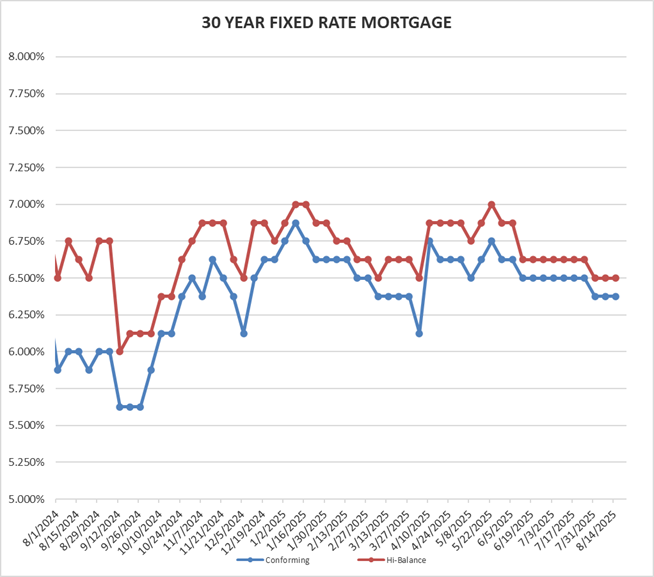
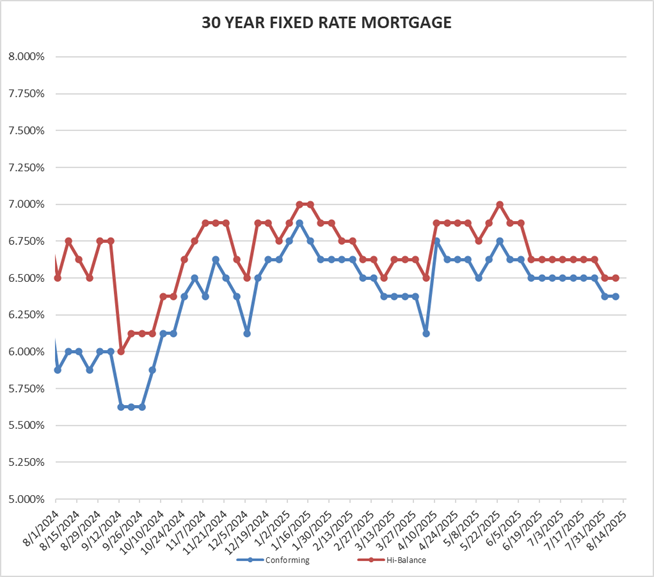
Rates for Friday August 15, 2025: Rates were trending lower this week, but bumped today on the high PPI data. That said, we are flat for the second week in a row.

FIXED RATE MORTGAGES AT COST OF 1.25 POINTS LOCKED FOR 45 DAYS:

30 year conforming                                            6.375% Flat

30 year high-balance conforming                      6.50%   Flat

Please note that these are base rates and adjustments may be added for condominiums, refinances, credit scores, loan to value, no impound account and period rate is locked. Rates are based on 20% down with 740 FICO score for purchase mortgages.

There may be some major market movement on Monday, depending on what happens in Alaska today and over the weekend as President Trump is meeting with Russian President Putin to discuss ending the war between Russia and Ukraine. If positive, the talks can lead to Trump bringing Ukraine President Volodymyr Zelenskyy into negotiations, hopefully leading to an end of hostilities.

The world has its eyes on Alaska, and these leaders, with the hope in the near future peace will be had.

Is the market cooling?

Question of the week:  Is the market cooling?

Answer: According to my Magic 8-Ball, and statistics from the California Association of Realtors, most likely.

Markets by Goldilocks, if the market is cool there is more supply than demand, if the market is hot there is more demand than supply, if the market is just right there is balance between supply and demand.

The past several years has seen considerably more demand than supply, as a result prices have soared.

In the last sixty-six months, from January 2020 just before the pandemic, through June 2025 the median priced home in Los Angeles County increased 46% (up from $617,250 to $903,650); Orange County saw an incredible 72% increase in median price ($855,000 to $1,470,000). Statewide the median price climbed from $525,160 to $899,560, a 62% rise.

Prices for LA County, up 8.2% from May and 1.6% year-to-year, Orange Country, 3.6% higher for the month, don’t reflect a “cooling” market; though the .1% price decline from May and June 2024 statewide does.

Prices are the final data point for sales, leading to sales and closings are properties on the market and properties in escrow pending closings. This data affirms the 8-Ball’s response.

Statewide unsold inventory, homes active on the market, is up 26.7% from last year, which equates to 3.8 months of inventory at the current sales rates. In the Southern California region inventory is at 3.9 months.

In hot markets homes do not stay on the market very long. Statewide the average days on the market is up 33.3% from last year at 24 days from listing to sale (not closing), in Southern California the average days on the market is 27.

Southern California led all regions with an increase in sales from last June, up 1.9%, statewide sales dropped 0.3%, the third month in a row year-over-years sales have declined across California.

After several years with sales prices exceeding listing prices, in Southern California and across the state, sales prices are below list price; selling at 99.3% statewide and 99.2% in Southern California.

Pending sales, properties under contract and off the market but not yet closed, are down 6.4% to the lowest level since the beginning of the year.

Active listings, i.e. market supply, are at their highest since June 2019, when mortgage rates hit their lowest mark 3.625%, since January 2018. Listings are up 42.5% across California and up 47% in the Southern California region.

It should be noted that the Southern California region, defined as Imperial, Los Angeles, Orange, Riverside, San Bernardino, San Diego and Ventura Counties, greatly influence the statewide statistics. The region accounted for 43% of all sales in the state in May, next closest at 22% were the Central Valley and San Francisco/Bay Area.

Number of sales and median prices are not directly linked. We have seen historically low sales with historically high prices as demand far outweighed supply. During Covid we saw very high sales volume and rising prices as homes were snatched up as move-up buyers flooded the market with supply and demand.

Moving forward we will likely see sale an increase in sales and, depending on the market, prices increasing in smaller amounts, staying the same, or slightly declining, as inventory sits and more buyers come to market.

Have a question? Ask me!

Rates for Friday August 8, 2025: After all the data last week, investors took a deep breath this week and rates are flat from last Friday. With new tariffs now in place for most trading partners, investors will be looking closely at prices and jobs, perhaps over or under reading data which could lead to some choppy times ahead.

FIXED RATE MORTGAGES AT COST OF 1.25 POINTS LOCKED FOR 45 DAYS:

30 year conforming                                            6.375% Flat

30 year high-balance conforming                      6.50%   Flat

Please note that these are base rates and adjustments may be added for condominiums, refinances, credit scores, loan to value, no impound account and period rate is locked. Rates are based on 20% down with 740 FICO score for purchase mortgages.

On Wednesday I was proud to join fellow Long Beach Rotarians at Long Beach City College where after our lunch we filled 750 bags with either food or hygiene items in about 25 minutes. These bags will go in the food pantry at the college for students who are facing housing and or food insecurity.

In January we will duplicate the effort at Long Beach State.

Called “Feeding the Future,” the Rotary Club of Long Beach has been assisting both schools since 2019 and have positively impacted thousands of students with food, hygiene products, supplies, gift cards, and their knowing people care about them and support them in their pursuit of higher education.

In addition to supporting students as CSULB and LBCC with our Feeding the Future projects, our club’s scholarship foundation is the number one donor of scholarships to LBCC and the second largest scholarship benefactor to CSULB, over the year over 5,000 scholarships totaling over $6,000,000 have been granted to students at the two institutions.

September is National Student Parent Month. As part of this Long Beach City College will be hosting “September Showers” to assist their students parents, with donation bins at their two campuses if you care to participate. Suggested donations items are baby wipes, diapers, unused toys and unused clothing.

If you wish to financially support their effort click here for your generous contribution.   

Is there a tax advantage to owning rental property outside of California?

Question of the week:  Is there a tax advantage to owning rental property outside of California?

DISCLAIMER: I am not an accountant, CPA, or licensed tax preparer. Please consult with your accounting/tax professional for your particular situation.

Answer: No.

After last week’s WR&MU regarding possibly retaining your home in California if you live out of state, it seems appropriate to cover investment property owned, and sold, out of state.

In 2015 the U.S. Supreme Court ruled that two states cannot tax the same income. This was a big case for the Northeast as it is not uncommon for people to live in one state and work in another due to the proximity of major cities to other states. Consider Washington D.C. which is on the border of Maryland and Virginia, New York City has workers that regularly commute from Connecticut and New Jersey, and Philadelphia that draws workers from New Jersey and Delaware.

Prior to the Supreme Court decision, someone who lived in New Jersey and worked in New York City would pay city, county and state income taxes for each of the tax jurisdictions where they worked and lived.

After the ruling, most states altered their income tax laws to tax residents’ income earned out of state by off-setting the taxes they had paid on their out-of-state income against their in-state income.

If you live in California and have taxable income of $150,000, this puts you in the 9.3% tax bracket. You own investment property in Arizona that nets taxable income of $25,000 per year; this income is taxes at 2.59% in Arizona.

In addition to your federal income and State of California tax returns, you will need to file a non-resident tax return in Arizona.

On the Arizona return you will file $25,000 net income from the property and pay $647.50 in income taxes ($25,000 x 2.59%).

On your California return you would file your return showing the $25,000 net taxable income, and the $647.50 paid to Arizona. Your income tax payable to California would be $1677.50:

$25,000 income x 9.39% CA tax rate = $2325.00

CA tax $2325 – AZ tax paid $647.50 = $1677.50

Your total taxes would be the same as if you owned a rental property in California that had net taxable income of $25,000.

Another wrinkle for investment property owners is selling investment property in California executing a 1031 tax differed exchange with the purchase of an investment property in another state.

A 1031 exchange enables an investor to sell an investment property and transferring the net proceeds to the purchase of another property. This enables the property owner to differ the capital gains on the sale of the property to a future sale. There is no limit on how many times you can execute a 1031 exchange transferring capital gains to another investment. Note this is over-simplified and should not be used as a basis for your decision to exchange property to differ capital gains; consult your tax professional.

In 2015, you sold a property in Long Beach, California that was initially your primary residence you had purchased in 2008 and converted to a rental property in 2012. At the time of the conversion in 2012 the property was worth $400,000. The property sells in 2015 for $750,000, your net proceeds after paying off the mortgage and closing costs are $400,000. Going through the required process, you transfer the $400,000 to a duplex in Denver that you purchase for $800,000.

In 2025 you sell the Denver property for $1,200,000.

Each year you have included the Denver property on your California income tax return, to report the income and taxes paid in Colorado, as well to show that you have not sold the property

When you sell the property in 2022, you decide to take the proceeds, i.e. you are not executing another 1031 exchange.

Because you are taking the proceeds, California is going to “claw back” the capital gains tax owed on the gains realized in California between when you converted the property to a rental and sold it to transfer the proceeds to purchase the property in Denver. The basic calculation is to deduct the cost basis from the net proceeds. In this case $750,000 less $400,000 is non-adjusted capital gains subject to tax in California.

There are many reasons people have for purchasing rental properties in other states, know that by doing so you are not avoiding the California State Franchise Tax Board by doing so.

One more time, all the above is for purposes of providing examples in a broad and general sense. Tax laws, both federal and state, are very complex and to properly calculate your tax obligations it is strongly suggested your work with a tax professional to prepare your returns. None of the above statements should be used as a basis for you to prepare taxes or make decisions that have tax implications, they are intended to provide basic information and a basis for questions and discussions you may want to have with your tax preparer before making any final decisions to buy, sell, exchange real estate.

Have a question? Ask me!

A very busy week for journalists who cover the economy. Data on economic growth, inflation, personal income and spending, and jobs were all released. Let’s take a look:

  • Gross Domestic Product grew 3% in the 2nd quarter, up from a 0.5% contraction in the 1st quarter. The growth was not as good as it sounds as it was only positive because of a tremendous drop in our trade deficit.
  • Last quarter GDP was negatively impacted by a surge in imports (added to GDP), this quarter, GDP was boosted by 5% due to a significant drop in imports. If trade was neutral GDP for the quarter would be -2%.
  • Combining 1st and 2nd quarter data, GDP grew by 1.25% in the first half of the year, below average for economic growth.
  • For the quarter consumer spending, 65-70% of our economy, grew 1.4%, up from the first quarters anemic 0.5% growth. Much of the spending increase was due to Americans buying more cars to avoid tariffs, these one-off purchases are not sustainable to GDP growth.
  • The rate of inflation dropped from 3.7% in the first quarter to 2.1% in the second quarter.
  • GDP data shows that the worst of the trade wars may be behind us, what they do not show is what shape the economy is in moving forward to support sustained growth, or if it will slow.
  • The Personal Consumption Expenditures, the preferred inflation gauge for the Federal Reserve, decreased very slightly from May to June, dropping from 0.320% to 0.256%; if rounded to 3.0 and 3.0 there was no change.
  • Year over year PCE rose 2.6% in June, higher than May’s yearly increase of 2.4%.
  • More importantly for the Fed, the core rate (energy and food stripped out of data) remained well above the Fed’s 2.00% target, growing 2.8% year over year.
  • Personal incomes kept pace with inflation, also increasing 0.3% in June. Personal spending also increased 0.3%, essentially flat in unit sales from May to June as the data is on dollars in sales—which increased the same amount as prices.
  • To quote MarketWatch, the labor market is eroding. Only 73,000 jobs were added to the economy in July and the unemployment rate increased from 4.1% to 4.2%. Compounding the poor new-hires data was revision of jobs numbers for gains in May and June to almost zero.
  • A bright spot in the report was despite the pittance of new hires, for those working hourly wages increased 0.3%, keeping pace with inflation.

No data was the other news this week. No data as the Fed, as expected, did not raise its benchmark interest rate at its meeting on Wednesday. That announcement was expected, what was not expected was that two of the voting governors voted against the others and voted for a rate reduction. Part of this could be political, knowing that President Trump will be replacing current Federal Reserve Chair Jerome Powell when his term is up next year and perhaps showing Trump, they are willing to follow his lead on what to do with rates.

Going into Friday’s Labor Department report, economic data supported the Fed’s decision to not lower rates, and put a little pressure on perhaps increasing rates if inflation continued its upward pace. However, Fed Chair Powell has often stated that they were closely watching labor markets in their decision making. No job growth and rising unemployment can be major factor in whether the Fed does cut rates in September.

Rates for Friday August 1, 2025: Rates were headed lower early in the week, however Trump’s tariff declarations yesterday and today’s jobs report clawed back some of the gain. That said, rates go down week to week to the lowest they have been since early April.

FIXED RATE MORTGAGES AT COST OF 1.25 POINTS LOCKED FOR 45 DAYS:

30 year conforming                                            6.375% Down 0.125%

30 year high-balance conforming                      6.50%   Down 0.125%

Please note that these are base rates and adjustments may be added for condominiums, refinances, credit scores, loan to value, no impound account and period rate is locked. Rates are based on 20% down with 740 FICO score for purchase mortgages.

One of the biggest agonies of technology is replacement technology. I went through a lengthy and frustrating process of converting a new laptop from my steadily dying 5-year old laptop that served me well (as have all the Lenovo ThinkPads I have had over the years).

The frustration was loading Outlook. The unit came with Windows 11, as well as update Office software. After many attempts to sign in, giving up several times after being in a one-hour plus wait line to “live chat” with someone from Microsoft, you can’t call anyone anymore. Friendly tech-guru Steve quickly let me know to download “classic” Outlook and get rid of the “new-improved” version Microsoft has in their bundles.

Lo and behold instant success. Hearing from other IT folks as I download industry specific software, their first comments were “download classic Outlook, don’t use the new one.”

If  you are getting a new computer, load the classic Outlook for seamless transfer of your accounts and data!

If we move out of state should we retain our current home?

Question of the week:  If me move out of state, should we keep our current home?

Answer: Maybe.

We have written around this subject before, most recently in June 2023. Over the past several years we have had a lot of clients who have moved out of California for a variety of reasons, primary economic.

One common refrain we have all heard from those who have moved out of state is, “we got so much more home for a lot less than we sold our home for…”

This is not surprising as the median home price in California is almost $900,000, second highest in the nation (behind Hawaii) and some of the most popular states for relocation from the state have median prices of $307,000 (Texas), $406,000 (Tennessee), $433,000 (Florida), and $445,000 (Arizona).

Factor in income tax rates and cost of living, and economically and the result is close to 1.5 million people relocating from California to other states from 2020 through 2024.

Many relocators are homeowners. While many adjust to their new environments, more than quite a few return to California for various reasons from culture to weather to missing family and friends.

Reverse migration shock is a real thing.  You sell your home in Long Beach in July 2022 for $800,000, netting $400,000 after your mortgage with a $1600 payment is paid off, and purchase a home in Boise for $560,000. After three years, you miss the “bigness” of Southern California, the milder weather, and your mother in-law and want to move back to Long Beach.

Can you?

Your home in Boise is valued at $580,000, but because you purchased with mostly cash you will net approximately $350,000 from the sale.

A home in your old neighborhood is selling for $1,000,000. With the $350,000 down payment your mortgage of $650,000 will have a payment of $4000.

When you sold your prior home in Long Beach your property taxes, due to Proposition 13 were $4500 per year; taxes on the new home will be close to $13,000 per year.

Can you afford to purchase the home you sold three years ago? Depending on other debt and circumstances, you will likely need close to $180,000 a year in income to qualify.

What if you kept your prior home in Long Beach and rented it?

You likely would have had less money for a down payment on your new home in Boise, therefor a higher monthly payment. Because the rental income on your Long Beach home would very likely be much higher than your mortgage and property taxes, the additional net income would likely cover the difference in your mortgage payment in Boise if you put a large down payment into the home from the sale of your Long Beach property and the higher payment due to the lower down payment.

Moving back, you would retain your current mortgage payment and your property tax basis, though your annual payment would be somewhat higher.

If you sold your home in Long Beach and then move back you will pay approximately $67,000 per year for your mortgage and property taxes.

If you had retained your Long Beach home, you move back in with an annual cost for your mortgage and property taxes of $25,000. A savings of $42,000 per year.

Note The California State Franchise Tax Board is very aggressive pursuing income earners who leave the state for taxes—especially if you move and retain what was your primary residence. If you do this keep very clear records of utility payments, bank accounts, bills, ensure you file a Schedule E for the rental of your California home, and most importantly keep your tax preparer informed on everything.

Speaking of tax preparers, capital gains regulations state that if you live in a home in two of the prior five years and sell the property you can claim the $500,000 exemption for married couples ($250,000 for single filers) against capital gains.

If you really like Boise and wish to stay, you have a just under a three year window to sell your Long Beach property and receive the capital gains exclusion. You lived in the property from 2007 when you purchase the home until July 2022 when you moved to Idaho and established a new primary residence. If you sell the property before July 2025, you will receive the capital gains exclusion. If you sell after that the exemption is gone and your capital gains taxes are considerably higher.

If you want to do the math on relocating to another state please give me a call to run the numbers and what-ifs for you to do so.

Have a question? Ask me!

Rates for Friday July 25, 2025: Not a lot of major economic news impacting rates this week. The biggest market news was political as the Trump Administration confirmed 15% tariffs on Japanese imports, and scuttlebutt has the same rate may also apply to European and other trading partners. Rates maintain a very steady course week to week.

FIXED RATE MORTGAGES AT COST OF 1.25 POINTS LOCKED FOR 45 DAYS:

30 year conforming                                            6.50%    Flat

30 year high-balance conforming                      6.625%   Flat

Please note that these are base rates and adjustments may be added for condominiums, refinances, credit scores, loan to value, no impound account and period rate is locked. Rates are based on 20% down with 740 FICO score for purchase mortgages.

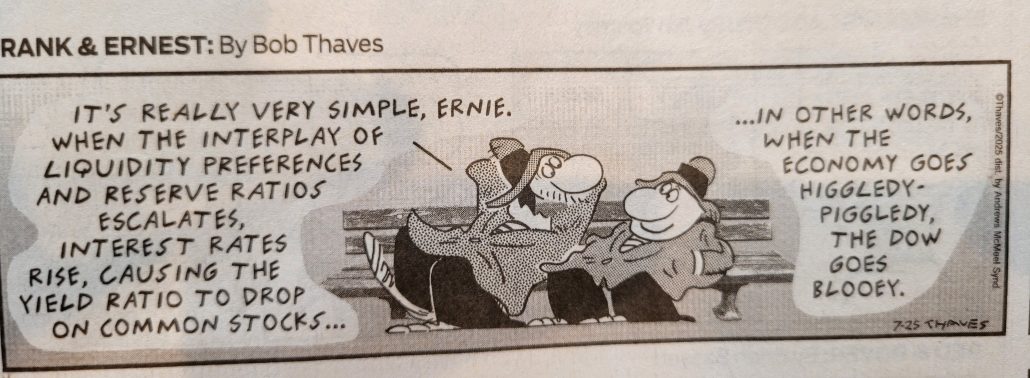
I realize that at times (often?) my writing on economics, markets, what impacts what and why, can get a bit confusing. Frank and Ernest provided clarity on between the economy and interest rates in today’s funny papers.