Is it true President Trump may change the mortgage market?

Question of the week: Is it true President Trump may change the mortgage market?

Answer: Yes.

In December the WR&MU covered some changes in the industry for 2025, not mentioned was a major change that will impact the mortgage, and therefore the real estate market, if enacted.

Some background.

As part of the legislative responses to the Great Recession that started with the meltdown of the mortgage and real estate markets starting in 2007, President George W. Bush signed The Housing and Economic Recovery Act of 2008. The Act established the Federal Housing Finance Agency (FHFA), which in turn announced it was taking over the Federal Nation Mortgage Association (FNMA—Fannie Mae) and the Federal Home Loan Mortgage Corporation (FHLMC—Freddie Mac), combined known as Government Sponsored Entities (GSEs).

This move was made as both GSEs had become illiquid as investors stopped purchasing their mortgage-backed securities (MBS) in the secondary market, thus freezing the industry. By establishing conservatorships by which the FHFA would direct the running of the two GSEs to regain solvency, re-establish trust in the MBS market, and enable the mortgage, and therefore real estate, market to recover.

As part of the agreement, the U.S. Treasury invested over $200 billion in the GSEs and extended credit to them so they would be solvent and operating. At the time they had over $5.1 trillion in debt and MBS. Essentially the United States government was backing the MBS issued by Fannie and Freddie; in other words, creating a guarantee for investors in their mortgage securities that they would be repaid if borrowers defaulted.

In short, the MBS issued by Fannie and Freddie had the backing of the U.S. government, just like the debt issued by the Treasury Department. Historically, because they are backed by the U.S. government, Treasury bills and bonds are considered the safest investment in the world. Ergo, with the same backing, MBS from Fannie and Freddie became equally, or very close to equally, as safe.

The original intention was that eventually the GSEs would exit their conservatorships and become independent entities traded as public companies, rolling back to their status pre-2008 and the establishment of the FHFA.

Sixteen years later, the GSEs have more than repaid the loans and bailouts from the Treasury, they are still operating under the FHFA. For several years, into the end of the Obama Administration, many have been calling for the conservatorships to end.

With Trump coming into office, it appears that a primary issue for his administration is to separate the GSEs from the government. While it may not happen this year, the consensus is that the separation will occur during this administration.

When, not if, separation occurs, it will have an impact on the mortgage industry. First, with MBS issued by Fannie and Freddie no longer backed by the federal government, how more return will investors require than if they invest in Treasury bills and bonds? The higher the risk the higher the return, how much higher is the risk for mortgages made to homeowners and investors in domestic real estate?

Accordingly, the expectation is that mortgage rates will increase due to the termination of the FHFA conservatorships. Note that investors anticipate events, so when it becomes very certain that the termination will occur investors will start behaving accordingly putting upward pressure on rates before the actual split.

As part of its conservatorship, the FHFA has imposed guarantee fees (g-fees) on the GSEs. Since Fannie and Freddie guarantee the payment of principal and interest for those purchasing their MBS, there is a fee that is charged per loan to cover the guarantees. These fees cover losses and administrative fees, as well as a return on capital, i.e. profit.

Over the years, the FHFA has increased g-fees, and added more g-fees that lenders must pay to Fannie and Freddie, which of course are added to costs for borrowers. While borrowers generally do not pay the g-fees directly, they are paid in terms of higher rates to absorb the fees.

One benefit to borrowers, and the mortgage markets, should be the elimination of g-fees when the GSEs separate from FHFA. The average base g-fees mandated by FHFA for single-family mortgages is currently 61 basis points (0.61%) which amounts to approximately three-eights (0.375%) to one-half (0.50%) of one percent to the mortgage rate.

Absent any reaction to investors with the elimination of guaranteed payments, the elimination of g-fees would result in a reduction in interest rates.

Several years ago the FHFA mandated that lenders increase the fees charged for second home and investment property loans, what is not known is if the GSEs will lower, or eliminate, these higher fees when they become independent entities; my guess is they will not.

Because they no longer have a backstop against losses, another unknown for post-breakup is underwriting criteria. Will the GSEs tighten their criteria or approval? Loosen some criteria that was required by FHFA? Or leave their guidelines essentially the same? One factor in this decision could be the feedback they get from major buyers of their MBS and their expectations for return vis-à-vis risk due to any changes.

One more impact that an end to FHFA’s conservatorships may have is the cost of mortgage insurance. For the past decade plus the cost of private mortgage insurance (PMI) has been historically cheap, due in part to the federal backing of MBS. While foreclosures have been historically low. Since peaking in 2010 they have been declining almost every quarter since. This certainly has had an impact on the cost of PMI, as has tighter underwriting guidelines as a result of the GSE conservatorships, with FHFA mandating the tightening, and rising property values.

Depending on changes that the GSEs make once they are independent of their fees to lenders, and underwriting guidelines, mortgage insurance costs may (should in my opinion) increase for borrowers.

While it is fairly certain that the Trump Administration will extricate Fannie Mae and Freddie Mac from their conservatorships and being subject to FHFA directives, less certain is the total impact this will have on home loan borrowers and the mortgage and real estate markets. My presumption is that rates will be higher, and guidelines a bit tighter for conventional mortgages.

Schedule an appointment to discuss your options if you are considering purchasing a new home or property or refinancing an existing one and want to know the mortgage options available to you. 

Have a question? Ask me!

As expected, the Federal Reserve’s Federal Open Market Committee (FOMC), which determines policy for the Fed’s interest rate moves, did not lower its benchmark interest rate at its meeting this week. Furthermore, Fed Chair Jerome Powell stated that the Fed is not in a hurry to cut the rate in the near future—meaning a cut in March is off the table. As this was expected, the non-move had no impact on rates.

Hot December despite cold fronts. A big jump in personal spending in December helped push 4th quarter economic growth to a 2.3% rise in GDP, following a 3.1% increase in the 3rd quarter. For the year GDP grew at 2.8%, the third year in a row the economy grew at 2.5% or higher. A 4.2% increase in personal spending in the quarter, the highest since the first quarter of 2023, was the primary factor for the GDP increase as consumer spending is 65-70% of our economy. Personal spending was up 0.7% in December, following a strong 0.6% increase in November, as consumers outspent their incomes which showed a 0.4% increase for the month.

Incomes did outpace inflation in December, as the Personal Consumption Expenditure index rose 0.3% in December, the most since April, a 2.6% pace year after year. The PCE is the Fed’s preferred inflation index for determining rate moves, and the core index (energy and food stripped for data) is its preferred part of the PCE; the core index had a rather benign 0.2% increase for the month and a 2.8% for the year. Inflation continues to be resistant to the Fed’s 2% target, the 2.1% rate in September is the closest the economy has come to the target. The one-half percent increase since September is not positive for interest rates. Looking ahead, the Fed is forecasting inflation to be 2.5% in 2025.

Looking ahead, it is my belief that the Fed lowering rates this year is becoming less likely given the economic data over the past several months. Instead, we may need to consider the Fed increasing rates as continued consumer spending, strong economic growth, a firm labor market, are not conducive to lower inflation.

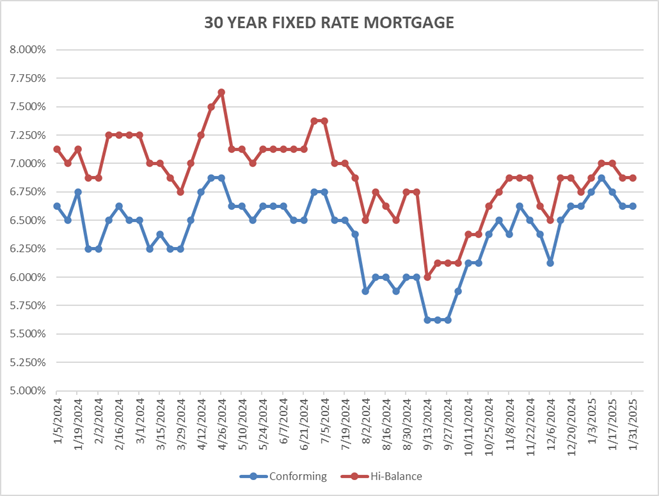
Rates for Friday January 31, 2025: I was in New York on personal family business last Friday and unable to get out the WR&MU, but rates had dropped from the prior Friday. Despite the economic news this week, rates are flat from last Friday.

FIXED RATE MORTGAGES AT COST OF 1.25 POINTS LOCKED FOR 45 DAYS FOR PURCHASE TRANSACTIONS:

30-year conforming                             6.6275%      Flat        

30-year high-balance conforming        6.875%        Flat      

Please note that these are base rates and adjustments may be added for condominiums, refinances, credit scores, loan to value, no impound account and period rate is locked. Rates are based on 20% down with 740 FICO score for purchase mortgages.
Leslie and I are back to being empty nesters. Our oldest and her boyfriend went back to Boston after spending Christmas week with us. The youngest, who flew in the week before Christmas, left today to go back to Brooklyn. Her prolonged stay was a result of her having finished her classes, and her senior year, in December.

It will take a bit to get used to the change in energy, meal schedules, and pop culture education.

If you per chance know of any openings for a bright, witty, smart, young woman looking for a job in New York City referrals are very appreciated!

If our home is completely or partially destroyed, what can we do?

Question of the week:  If our home is completely or partially destroyed, what can we do?

Answer:  Similar to after a significant earthquake, the wildfires in Southern California have homeowners wondering what if….

What if our home is destroyed, or unlivable, due to a natural disaster, fire, or other reasons? What can we do?

The primary factor in what you can do is to examine your risk mitigation, i.e. your insurance coverage.

There are three different policies that cover damage to your home from various factors, depending on your coverage and policy will present the options you have if your home is severely damaged.

If you have a mortgage, your lender will require a homeowner’s policy to protect their collateral for the loan. Your homeowner’s policy will have your lender listed as “loss payee,” meaning any funds that are distributed by your insurance company will list the lender as a payee on the funds. Meaning, they have to co-endorse any check.

This is to ensure that you either rebuild the property and therefore regain the value of the lender’s collateral; or that you sign the proceeds over to the lender to pay off the loan balance, with any funds remaining going to you. If your loan balance is more than the amount of the insurance payment, you then must decide to either continue making payments on the mortgage, or walk away and let the lender foreclose on the remaining balance.

Your options: rebuild, repay, or release, the property, depends on many factors, among them loan balance, loan payment, after value of property if rebuild. The last factor, after value, will largely depend on your neighborhood and area and what other property owners decide to do with their damaged properties. Are you the only one rebuilding? What is being reconstructed around you?

With the new California law that bypasses local building regulations, if you are in a designated area, primarily within a “major transportation corridor,” you, or your neighbors, can build multi-family dwellings on single-family lots. Will your neighbors sell their properties for land value to developers who will put a 4-unit property next door to you? Will neighbors decide to walk away, leading to a lot of foreclosures on vacant lots or severely damaged properties, that will be purchased by developers?

What is best in the long run for you and your family? Rebuild, repay, or release? Will you rebuild your home, or something else, with the funds from the insurance company? Will you use the funds to payoff off the mortgage and then determine what to do with your free and clear property? Or will you release the property to the lender, having the loan foreclosed and moving on?

Do you have earthquake insurance? Many property owners with a large amount of equity do, those with little equity do not; this is mainly because of the high premiums and high deductibles for earthquake insurance—how much are you paying to protect how much value?

Earthquake insurance is not mandatory by most lenders, therefore if you do have it you do not need to list the lender as loss payee. Because of this, if you home is damaged in an earthquake you can determine to what extent you want to repair/rebuild, versus taking the funds and moving on—leaving your mortgage behind for the lender to foreclose. Because the lender is not part of the claim payment, your net proceeds after your deductible could be large enough to purchase a new home with cash or a sizeable downpayment that would mitigate a higher interest rate due to a foreclosure—depending on where you are buying.

If you do not have earthquake, but your home catches fire as a result of broken gas line or other factor, and your home sustains fire damage, you may (should? Check with your agent) be able to make a claim on your homeowner’s policy covering fire damage.

Homeowners in certain areas who have mortgages are required to have flood insurance. If you do not have flood insurance and your home and property is damaged by water that comes up from the ground, i.e. a flood, your homeowner’s policy will not cover the damage—which is why lenders require flood coverage if your home is located in a federal flood zone. Because the coverage is required as part of your mortgage, the lender is listed as lost payee and you will have the same decision process as if your property was severely damaged by fire regarding rebuild, repay, release.

A decision does not need to be made immediately. Review your policy(s) with your agent to determine what coverage you have beyond rebuilding/repairing your property. Your policy should have replacement housing coverage, paying for “like” housing for you and your family for up to two years. This should free up funds so you can continue to pay your mortgage while you make your decision, and if rebuilding hopefully cover your housing until construction is complete and you can return to your home.

Your mortgage company may give you time as well. While there is no clause in standard mortgage contracts that requires lenders to provide you with a forbearance due to your inability to occupy your home as a result of a disaster, some (many?) may voluntarily provide you with a forbearance for a certain time frame, perhaps up to six months. A forbearance suspends mortgage payments and interest accrual, adding the missed payments to the end of your mortgage. I.e. if you have 240 months left on your mortgage and it is due to be paid off in January 2045, and you are provided a 6-month forbearance with payments to continue in July, your mortgage will still have 240 payments left but will be scheduled to pay off in July 2045. 

Losing a home is similar in many respects to losing a family member. There is grief, which must be gone through to fully heal. However, when you are likely to be grieving the most, soon after the loss, you must deal with details and paperwork that are time consuming, frustrating, and push your ability to grieve aside. Taxes, permits, credit obligations, housing, even utilities, and mail, and more have to be dealt with as the world continues to turn and day-to-day responsibilities must be met.

Knowing what coverages you have from your insurance policy is a priority if your home is damaged. Not only to be able to assist you in determining your options, but also to provide some peace of mind knowing you are covered for some potentially major expenses.

Finally, our culture is one of finding “bargains,” getting the “best deal,” looking for a lower price for an item or service. Insurance coverage is not an area to look for a deal, which can come with reduced coverage when you need more. In the coming months, unfortunately, too many homeowners going through tremendous loss may discover the good-deal insurance is not such a good deal.

Schedule an appointment to discuss your options if you are considering purchasing a new home or property or refinancing an existing one and want to know the mortgage options available to you. 

Have a question? Ask me!

Inflation data had a positive impact on interest rates this week. The Consumer Price Index showed a 0.4% increase in December, a 2.9% for the year, with the core rate (energy and food removed from data) grew 0.2% for the month and 3.2% for the year. While the numbers are higher than the Federal Reserve target of 2% inflation, investors reacted positively as the core rate, the primary inflation measure for the Fed, was the lowest increase in six months and the year-over-year rate dipped from 3.3% in November. The data allayed some concerns that instead of lowering its benchmark interest rate later this year it may actual increase the rate.

Cash registers were ringing in December, with retail sales up 0.4% from November’s very robust 0.8% increase in sales. Year over year, retail sales grew up 4.0%, well above the CPI rate of inflation. While December’s increase in sales was due in part to heavy discounts from retailers to entice customers, consumers were spending at a rate to give the economy momentum into 2025, portending another year of economic growth.

While inflation may be cooling, the key word is “may,” consumers are not feeling any great relief for their wallets and pocketbooks. Since January 2020 nominal inflation is up 23%. The primary cause is the amount of money circulating in our economy due to federal spending and the Federal Reserve’s monetary policy. Since 2019 federal spending is up 52% and the deficit has grown by $849 billion, resulting in our federal debt to grow by 50% since 2020. With the spending and borrowing increasing, and interests climbing due in large part to the Federal Reserve hiking its benchmark interest rate, the interest payments on our national debt is almost three times higher today than it was five years ago. How much is it? Three billion dollars a day. A Day. That amounts to $1.095 trillion dollars a year, just in interest payments.

Looking ahead, with so much debt being issued to pay for our government spending, and in part to cover interest payments, the prospects for significantly lower rates in the coming year are slim.

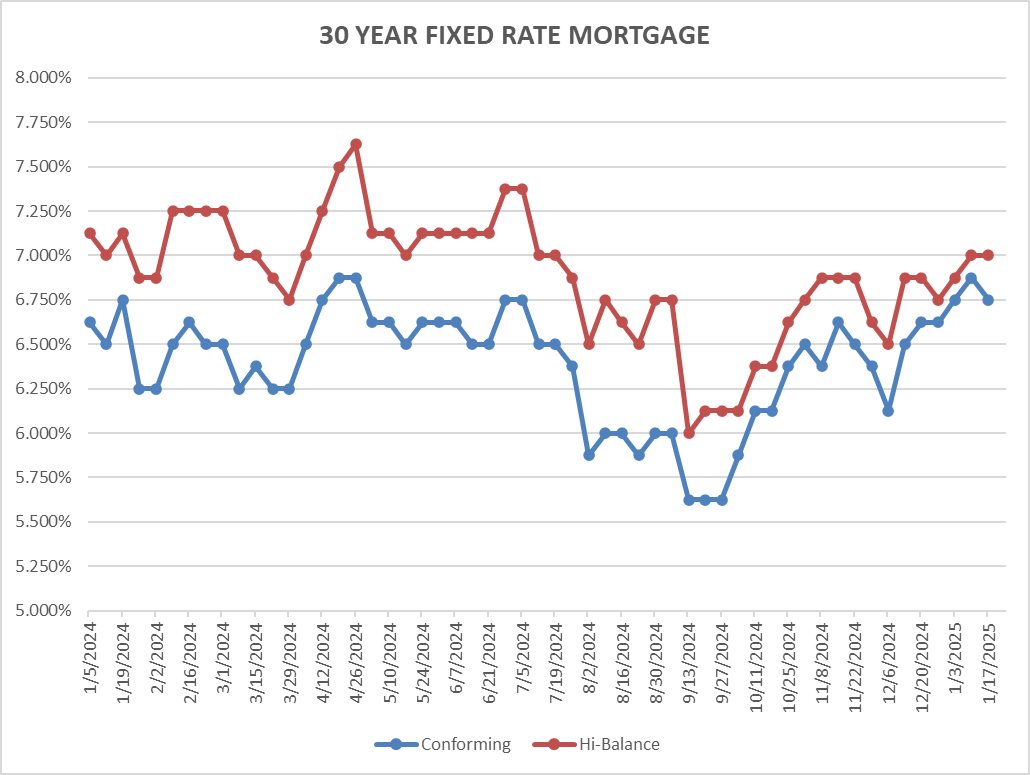
Rates for Friday January 17, 2025: Rates dropped week to week for the first time in six weeks as investors reacted positively to the CPI data. Whether the downward trend continues is what matters.

FIXED RATE MORTGAGES AT COST OF 1.25 POINTS LOCKED FOR 45 DAYS FOR PURCHASE TRANSACTIONS:

30-year conforming                             6.75%          Down 0.125%        

30-year high-balance conforming        7.00%          Flat      

Please note that these are base rates and adjustments may be added for condominiums, refinances, credit scores, loan to value, no impound account and period rate is locked. Rates are based on 20% down with 740 FICO score for purchase mortgages.

Thankfully, the weather has been cooperating the last few days to assist the firefighters in Southern California as a marine layer has formed. The Eaton fire is 65% contained and the Palisades fire is 32% contained as I write this. Firefighters, and residents, are holding their breaths for the coming week as high temperatures and winds are expected Monday.

Everyone is looking forward to the fires getting knocked out and the recovery process able to begin.

Have a great week,

Dennis

What are some impacts that the Southern California Wildfires will have on housing in the region?

Question of the week:  What are some impacts that the Southern California Wildfires will have on housing in the region?

Answer:  Taken singularly either the Palisades or Eaton fires would be historic in scope of damage to natural habitats and structures lost.

The Palisades fire as of this morning has burned over 20,000 acres, for perspective the city of San Francisco is approximately 30,000 acres. The Eaton fire covers 14,000 acres, or almost the size of Manhattan Island in New York City.

Almost 180,000 people have put under mandatory evacuation orders so far. This is the equivalent of evacuating the entire city of Ontario (California not Canada).

The fires in the Southland have destroyed more than 10,000 structures. Most of the structures are homes and apartments, displacing tens of thousands of people.

The current damage estimate is over twenty-five billion dollars, with estimated economic impact exceeding $50 billion.

The impact of these fires will be felt throughout the region for a long time.

One impact that immediately comes to mind is property insurance. As is well known, the insurance situation in California has been untenable for many years (essentially since voters decided to have an elected insurance commissioner). Major carriers have pulled back, or out of, coverage in the state, forcing many property owners to get coverage under the California FAIR Plan or ‘non-admitted” carriers who are not backed by California Insurance Guarantee Association (CIGA), which acts like the FDIC does for bank accounts but for insurance policies backing up to $500,000 in claims should an insurer declares bankruptcy or depletes its reserves.

With tens of billions of potential claims being paid due to the wildfires, and not counting any claims from future events this year, what will be the response to insurance companies in a market already inadequately covered due to past claims in high risk areas and inability to have increase premiums sufficient to the risk and costs approved by the commissioner’s office.

Anticipate more non-renewals and fewer new policies issued in the state, further burdening the California Fair Plan. In March the California Department of Insurance warned that a major disaster could make the FAIR Plan insolvent. If the FAIR Plan has insufficient funds to cover claims other insurers must step in to cover the gap based on their share of the market. Very important to note, insurers can pass the costs onto their customers.

Per the Wall Street Journal, the estimated coverage by the FAIR Plan in Pacific Palisades is $5.9 billion; per the article the Fair Plan has approximately $700 million cash on hand to pay claims.

Look for your insurance premiums to increase.

With thousands of families, perhaps tens of thousands, being displaced there will be a significant increase in demand for housing, rental and homeownership. Combined with the elimination of thousands of homes and apartment units reducing supply, the region will likely see an increase in rents and home prices.

Higher costs for home improvements and remodels. Wood, glass, drywall, cement, flooring, plumbing, electrical, counters, cabinets, roofing material, appliances, garage doors, look around your home and office and imagine one thousand structures needing all the same material in then next few years. Demand for home building supplies during Covid as home remodels surged straining supply lines and pushing costs higher and delivery times longer. Expect the same to occur starting later in the year and to continue for quite a while.

If you are considering a remodel, you may want to get your plans into city or county planning offices before the flood of plans being submitted for fire damaged properties. As well, even if plans are not approved, consideration may be given to purchasing appliances, sinks, etc that are part of your plans and put in storage. The storage costs may be lower in the end than higher costs for those items if you wait.

Finally, the airborne smoke and ash from the fires are considerably more toxic than from traditional forest fires. Forest fires have organic matter in their airborne detritus. Due to the amount of metal, plastic, rubber, etc that has been burned with all the buildings and structures, the airborne smoke and particulates are toxic and can, will, cause long-term respiratory issues for many.  

There are two impacts that I am hopeful will result from the catastrophic fires we are experiencing.

First, that governing agencies will engage in forestry management, including, but not limited to, systematic and consistent controlled burns and the removal of underbrush, dead wood and other fire enhancers throughout wilderness and forested areas.  

Second, that the funds from Proposition 1, passed by voters in 2014, will go beyond allocation and become funding for their purpose of building water capture and storage systems throughout the state. Approximately $6.4 billion was available for spending but less than one-third has so far been spent. Keep in mind the allocation of funds from a decade ago will likely not go nearly as far as intended due to increase costs over the past decade while projects sat waiting for approvals, permits and other bureaucratic “necessities.”

Schedule an appointment to discuss your options if you are considering purchasing a new home or property or refinancing an existing one and want to know the mortgage options available to you. 

Have a question? Ask me!

Extremely strong finish. This may be too light of an emphasis on the data released today by the Department of Labor for December’s job market. Expectations from Wall Street were that the economy would add 155,000 jobs last month. That was off by more than 100% as 256,000 jobs were added. As well, the unemployment rate was expected to remain the same, at 4.2%, but dropped to 4.1%; despite 243,000 new job seekers in the market. The news was extremely not mortgage rate friendly.

The entirety of the report had one small glimmer that could be seen as rate friendly, the average wage increased 0.3% for the month, slightly lower than November’s 0.4% wage increase. December’s data concluded a year in which 2.2 million jobs were added in 2024, two times the estimates made for the year at the end of 2023. For the 75% of job creation occurred in three sectors: healthcare, leisure and hospitality, and government.

Reactions were fast and big to the data as stocks dropped in prices and bond rates climbed as investors see the strong job market as pushing the Federal Reserve off any cut to its benchmark rate later this month, and increasingly unlikely to cut at it following meeting in March.

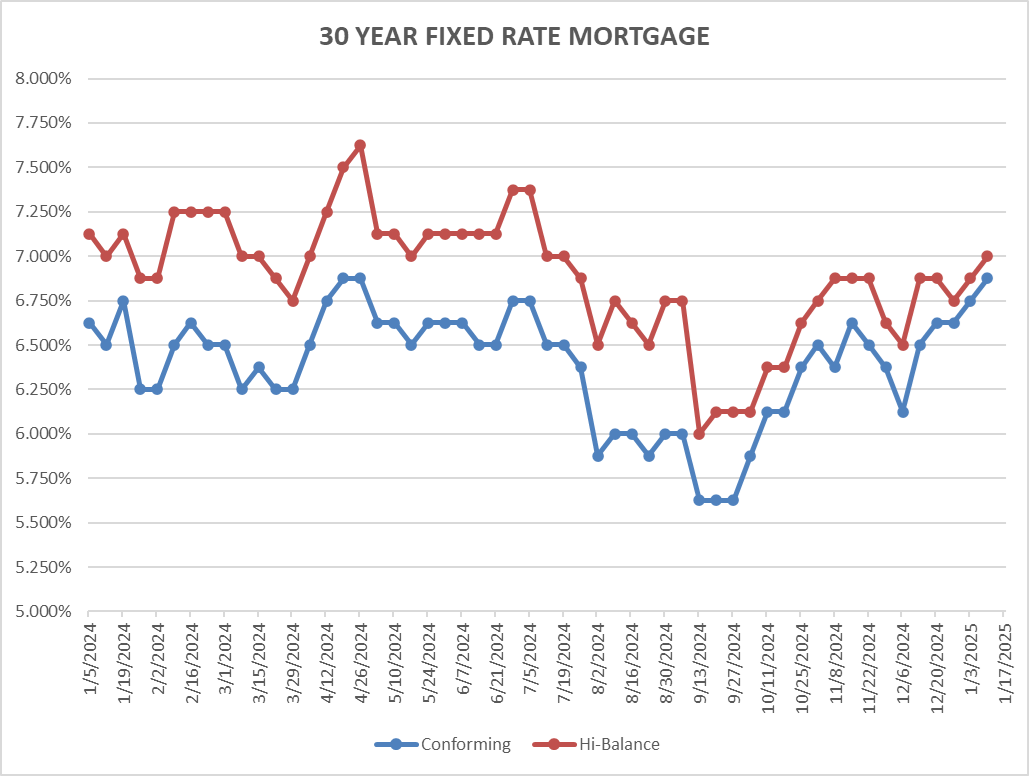
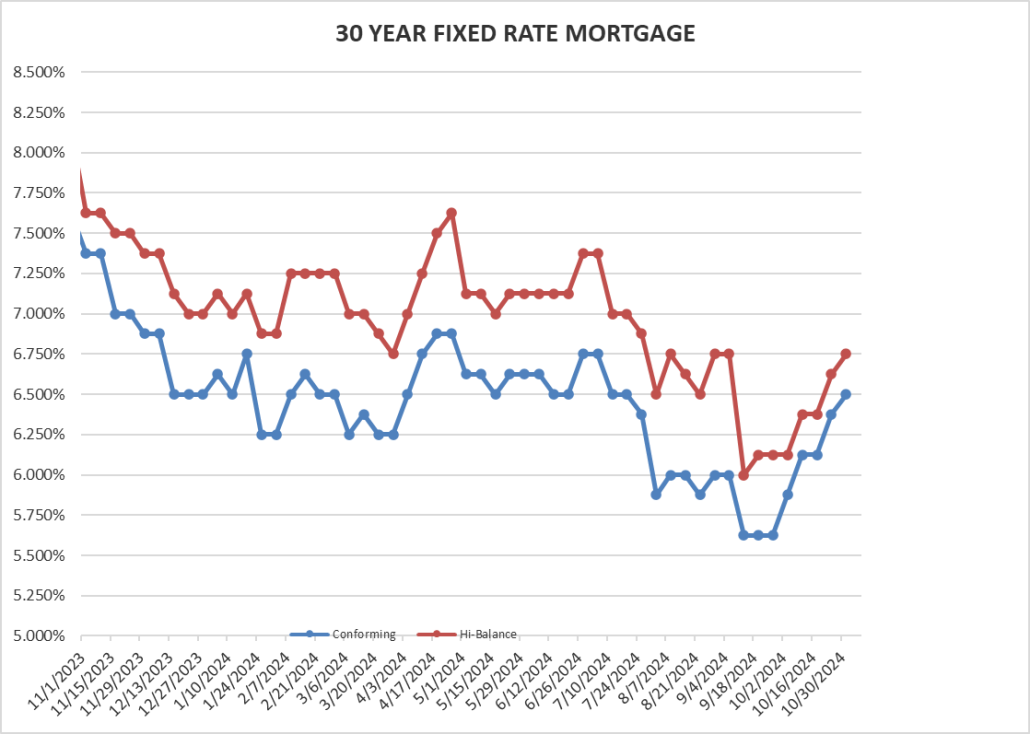
Rates for Friday January 10, 2025: Rates have been climbing since the start of the year, higher the first Friday of the month/year than the last Friday of 2024, and higher again today. Rates are at their highest since the first week of July, and up 1.25% since they hit their most recent low at the end of September.

FIXED RATE MORTGAGES AT COST OF 1.25 POINTS LOCKED FOR 45 DAYS FOR PURCHASE TRANSACTIONS:

30-year conforming                             6.875%        Up 0.125%        

30-year high-balance conforming        7.00%          Up 0.125%      

Please note that these are base rates and adjustments may be added for condominiums, refinances, credit scores, loan to value, no impound account and period rate is locked. Rates are based on 20% down with 740 FICO score for purchase mortgages.

Southern California is immense, Los Angeles County is larger than the combined area of Delaware and Rhode Island. Population wise, the County would rank 11th most populated state, between Michigan and New Jersey.

Despite the size, it seems everyone I have spoken to in the last few days has family and/or friends who have been evacuated from, or lost, their homes due to the fires.

In this space of the WR&MU over the years I have included a link to the donation page for disaster relief for the American Red Cross for disasters in other parts of our nation. Today I include the link hoping you will donate some amount, not donation is too small, to enable the Red Cross to assist our families, friends, neighbors, fellow Southern Californians, with food, water, shelter and comfort.  

Thank you for clicking here to make your donation.

Have a great week,

Dennis

What next for the economy and real estate?

Question of the week:  What next for the economy and real estate?

Answer:  When the Federal Reserve began increasing its benchmark interest rate in March 2022 when inflation jumped to 9.2%, up almost 3% from December 2021, it announced it was going to be increasing rates to bring down inflation and would continue to do so until inflation hit the Fed’s target rate of inflation of 2%.

At the time the Federal Funds rate (what banks charge each other to borrow money), was 0.25-0.50% (the Fed rate is always a one-quarter of one-percent range). The Fed systematically increased its rate until July 2023 when it hiked the rate to 5.25-5.50%, at which point inflation had fallen to 3.2% on an annual basis. Stating that inflation was heading in the right direction, and not wanting to choke off economic growth and harm employment markets, the Fed paused rate hikes.

In September of this year, commenting that inflation was cooling and wanting to support economic growth, the Fed lowered its bench mark rate 0.50%, announced a few more cuts in 2024 and likely would cut up to five times in 2025.

This week the Fed did lower its benchmark rate, by 0.25%, to 4.25-4.5%. However, with the announcement of the rate cut, Fed Chair Jerome Powell announced that there would probably be only two rate cuts in 2025 as the economy, and inflation, were a bit more robust than the Fed felt comfortable with if rates were to go even lower.

Markets did not react favorably to the news and interest rates popped and stocks prices dropped having priced into their buy-sell decisions earlier in the year a decline of about 1.0-1.25% in the Fed Funds rate in 2025; Powell’s comments foretell perhaps only a 0.50% rate reduction.

Supporting fewer cuts in 2025, Powell said, was the expectation that inflation in 2025 to be 2.5%, up from estimated 2.4%. While he feels that rates are high enough to lower inflation, he feels the rates are low enough to not push unemployment higher.

Keep in mind, as has been written in the WR&MU for many, many years, good economic news moves rates higher, bad economic news moves rates lower.

That said, this week economic data for November was a bit mixed but supportive of the Fed’s plan moving forward for fewer rates cuts next year.

Our economy is driven by consumer spending, making up 65-70% of the economy. In November retail sales were up a very strong 0.70% from October, which was also strong. New vehicles drove the increase in sales spiking 2.6% from October, taking auto sales out of the data and retail sales still increased a decent 0.20% for the month. A downside in the data was a drop in restaurant sales, down 0.4%, dining out is a sign of consumer confidence as if uncertain about their future families will cut dining out from their budgets.

More strong data came with the second revision to GDP for the 3rd quarter, prior data estimated the economy grew at a rate of 2.8%, on Wednesday the estimate was raised to 3.1% growth for the quarter. Current estimates for 4th quarter growth are at 3%; if this is true then it will be the first time, ex-pandemic, that the economy has grown 3% or more for three straight quarters since 2014.

Retail sales and GDP data were not positive to markets as strong growth means higher rates, and supported higher rates in 2025 than previously expected.

Cooling some of the heat from the sales and growth data was the Personal Consumption Expenditures (PCE), which is the Fed’s preferred gauge of inflation. Surprising everyone, the index showed prices rose only 0.1% in November, the lowest increase in three months. Year over year the index rose from 2.3% to 2.4%, away from the Fed’s target, but overall the news was welcome by markets as if the trend continues it cracks a bit of an opening in the Fed’s intentions for next year to perhaps have more than two rate cuts.

The economy is growing at a robust rate, consumers are buying goods and services, wages are outpacing inflation, and employment is steady. And, a big and, it looks like inflation, if not dropping is stabilizing. Absent a major event there is no reason to see moderate to strong growth continuing.

All of this news does not support lower rates, but neither does it support rates climbing in the future—i.e. stable rates for some time. Looking ahead, I see rates near 6.5% into the 1st quarter next year, and perhaps beyond.

Home sales had their biggest year over year in three years in November due to increase in supply. That said, it is the second straight year of slow sales; previously owned home sales in 2024 will very likely be at their lowest level since 1995.

Home sales are almost entirely dependent on interest rates, and as been discussed in prior WR&MU, the lack of homeowners reticent, more like fully resistant, to selling their homes with mortgages near 3% to purchase a new home with a mortgage has been a primary factor in low home sales. No inventory leads to no home sales.

Looking forward, with the economy likely not contracting enough to push interest rates significantly lower, there cannot be an expectation for a large increase in inventory from move up homeowners. With the lack of inventory, supply and demand will keep upward pressure on prices.

If you are waiting for lower rates to purchase a new home, you better be ready to move quickly on any dips because as a long-term prospect you may be waiting a long time. If you are waiting for lower prices, the wait is very likely longer—or non-existent absent a major event.

Schedule an appointment to discuss your options if you are considering purchasing a new home or property or refinancing an existing one and want to know the mortgage options available to you. 

Have a question? Ask me!

Rates for Friday December 20, 2024: The cumulation of this week’s data and Fed news pushes the conventional rate a bit higher from last Friday.  

FIXED RATE MORTGAGES AT COST OF 1.25 POINTS LOCKED FOR 45 DAYS FOR PURCHASE TRANSACTIONS:

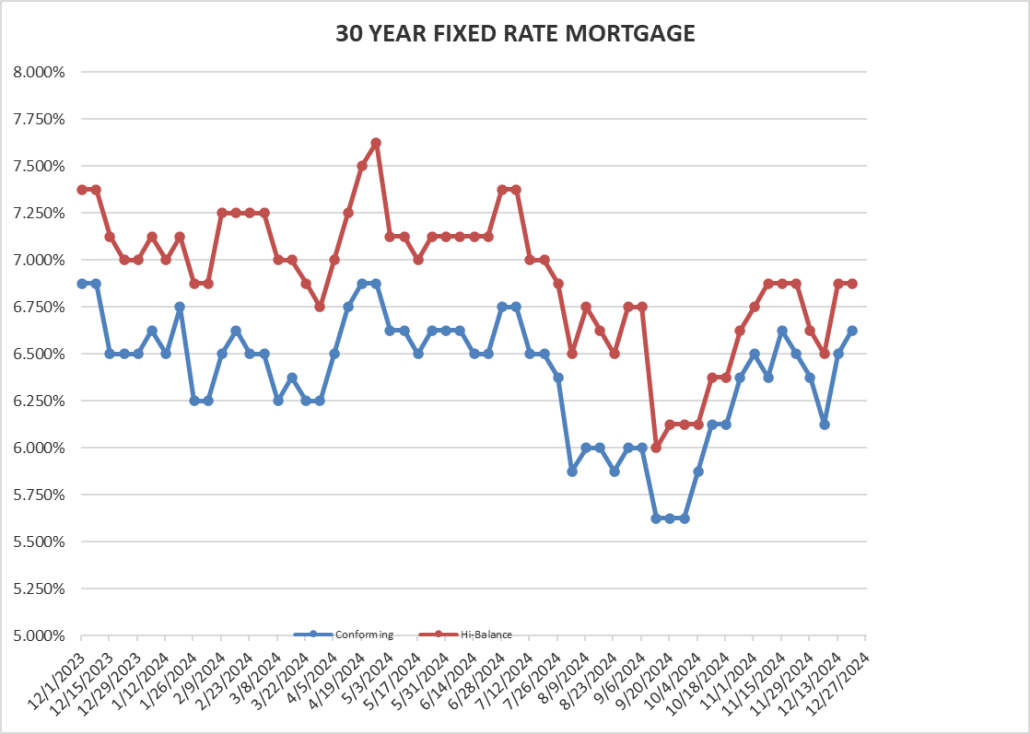
30-year conforming                             6.625%        Up 0.125%        

30-year high-balance conforming        6.875%        Flat      

Please note that these are base rates and adjustments may be added for condominiums, refinances, credit scores, loan to value, no impound account and period rate is locked. Rates are based on 20% down with 740 FICO score for purchase mortgages.

‘Tis the season for our family to be together. Our youngest, who finished her college classes and career on Monday, flew in from New York on Wednesday, and our oldest with boyfriend in tow arrives tonight from Boston. Last week I sent them the 10-day forecast showing mid-70’s for them, both replied enthusiastically. On Wednesday the younger left cold and rainy, today the elder is leaving in the snow.

California girls very happy to get California weather.

I hope you and your families have merry Christmases and happy Hanukahs.

Have a great week,

Dennis

What are some changes in the industry for 2025?

Question of the week:  What are some changes in the industry for 2025?

Answer: Perhaps the most significant change is an annual event, the change in the maximum loan limits for conventional and FHA mortgages. The Federal Housing Finance Authority (FHFA) sets the maximum conforming (Fannie Mae and Freddie Mac loan limits based on the House Price Index which tracks the average increase in home values nationally. Adjusted for incomes and inflation, the HPI usually increases from year to year, but there have been some years in the past when it declined, and as a result so do the maximum loan limits. While Fannie and Freddie are under the direction of the FAHA, FHA is under the Department of Housing and Urban development but uses the FHFA limits.

In the past, pre-2008 Great Recession and housing market melt-down, FHA set their own loan limits—generally lower than the conforming limits. Besides the conforming loan limit, FHFA also sets the ”high-balance” limit for homes in high-cost areas; originally for Alaska and Hawaii, the high-balance limit also applies to high-cost counties such as Los Angeles and Orange. Prior to the Great Recession and restructuring of home financing with the Dodd-Frank Act, there was no separate high-balance limits for counties and loans above the conforming limit had to use “jumbo” or non-traditional mortgage products.

For 2025 the loan limits have increased a bit over 5.2% to $806.500 for conforming and $1,209,750 for high-cost areas (high-balance loan limit is 150% of the conforming loan limit).

Today to qualify for a $806,500 loan with a payment of $5098 you will need income of approximately $14,500 per month with a rate of 6.5%; last year for the same loan amount, because it was “high-balance” limit, the rate was 7.125%, the payment $5434 and qualifying income of approximately $15,525, about 7% more than needed this year due to higher loan limit. Note the rate is based upon parameters below, 20% down and 740 FICO score, a higher credit score, or lower loan-to-value will result in a lower rate and payment.

Insurance is changing for 2025. After seeing major changes in home coverage policies, from none available to higher premiums, 2025 should show more friendly changes. Farmers Insurance recently announced they see the state’s insurance market improving and as a result is increasing the number of homeowners insurance policies they will issue in the state and expand coverage to condos and other types of housing.

This is good news as chances are other insurers should follow Farmers, thus expanding more affordable insurance options for homebuyers. That said, State Farm is still the biggest insurer in the state and no news has come from them regarding their plans for 2025.

For the “non-admitted” insurance market (from insurers no licensed by the state but allowed to write policies to cover risks admitted carriers will not cover) more competition has entered the market which has softened some premium options for those forced into this higher-priced market.

Condo sales as a whole will continue to be challenging in 2025, mainly due to insurance coverage. Fannie Mae, Freddie Mac and FHA have been reducing the number of approved condominium homeowners’ associations where they will lend, primarily because of what they determine to be inadequate insurance coverage. Due to the significantly higher costs to replace and rebuild damaged properties, many HOAs insurance policies have not kept up with the higher costs. As a result, they have been dropped off eligible condo lists due to the risk posed to lenders, and ultimately Fannie, Freddie and FHA, should there be a major event and property loss.

For condo sellers, and listing agents, it is highly recommended before putting units on the market to determine if the complex is on or off eligibility lists for lenders. If they are off the list determine why and if the reason is correctable; is it a need to re-apply with updated information, or are there other factors that may require significant action by the HOA to regain eligibility.

For condo buyers it is highly advisable when you make your offer to have your lender check to see if the unit is eligible for the type of financing you are using. If not, determine why and is it something that can be corrected during escrow—such as updating HOA information for the lender.

Finally, 2025 will be the first full year with the new broker compensation regulations that went into effect earlier in 2024. Will sellers be willing to include compensation for the buyer’s agent in their sales price? Will buyer(s) need to compensate their agent out of their own pocket? Will more, or fewer, agents be willing to sign one-time-show contracts with buyers? Will more or fewer homebuyers, and sellers, contract for reduced services from agents to assist with transactions?

The market is still sorting many of these issues out, and with continued slow sales there has not been a significant number of transactions to establish market “norms” between agents and clients it may take a while for there to be an established set, or sets, of what is expected in terms of service, compensation, and who pays who what.

With rates continuing to be at, or above 5.5% for most of 2025 we should see a slow down in the increase in home prices for the year—note “slow down in the increase” not “decline.”

Schedule an appointment to discuss your options if you are considering purchasing a new home or property or refinancing an existing one and want to know the mortgage options available to you. 

Have a question? Ask me!

A bit hotter than expected. That sums up inflation data this week. November’s Consumer Price Index increased at the highest rate in seven months, up 0.3%. While what was expected from Wall Street forecasters, that it was the highest since the Spring brought some concern. Year over year inflation increased from 2.6% in October to 2.7% in November. For the fourth month in a row the “core” (volatile food and energy costs stripped from index) rose 0.3%, with the core rate unchanged at 3.3%. A big part of the increase was vehicle prices, likely due to increased demand from those needing to replace cars and trucks that were lost during October’s hurricanes. One positive note for November is that housing price increases cooled off for the month. Not as good was a 0.4% jump in medical costs for the second month in a row.

Pundits opined (pundited?) that expectations for the Fed should not change based on the inflation data—it will lower its benchmark rate next week. However, the markets did not seem in sync with the pundits. Fixed rates markets dropped throughout the week (lower prices mean higher rates) with no news other than inflation data that should be market moving. One reason could be that while the expectation is that the Fed will lower rates next week, rate cuts in 2025 are less certain. Will the Fed stick to a plan of two to three cuts? Or will there be a long pause to see how inflation and job markets moving.

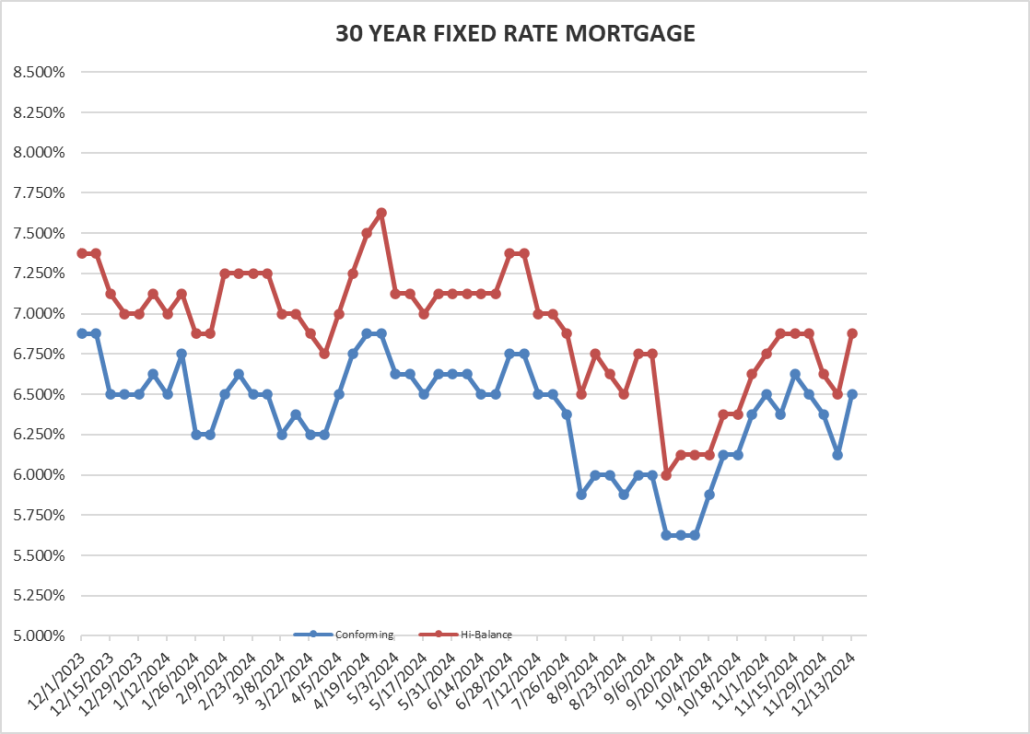
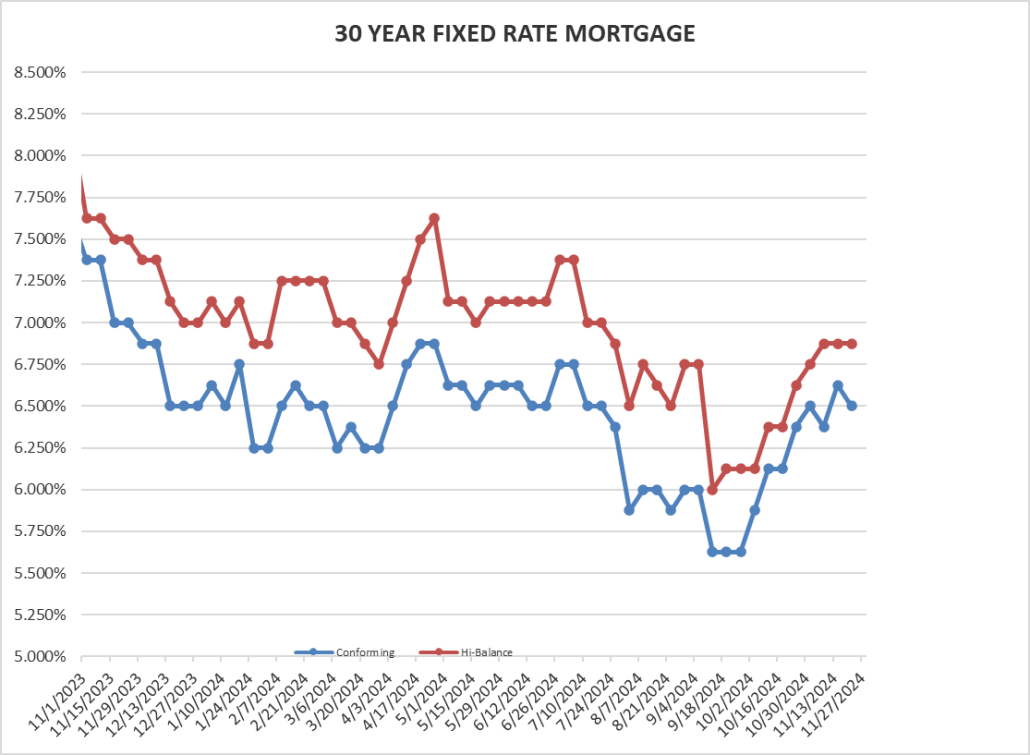
Rates for Friday December 13, 2024: Rates have their biggest week-to-week increase since last October when they hit their highs for the current cycle (7.875%). Up 0.375% for the week, rates are at their highest since July. Long-term rates have been drifting down, and this could be a short-term spike, but as we close out the year volatility is my expectation.

FIXED RATE MORTGAGES AT COST OF 1.25 POINTS LOCKED FOR 45 DAYS FOR PURCHASE TRANSACTIONS:

30-year conforming                             6.50%          Up 0.375%        

30-year high-balance conforming        6.875%        Up 0.375%        

Please note that these are base rates and adjustments may be added for condominiums, refinances, credit scores, loan to value, no impound account and period rate is locked. Rates are based on 20% down with 740 FICO score for purchase mortgages.

When is too soon? When is it too soon, and when have you waited too long to get a Christmas tree? Go too soon and it starts to dry out before New Year’s. Wait too long and your choice of trees has been reduced dramatically and you risk your choices being somewhat Charlie Brownish.

This is the internal debate as to get a tree over the weekend, or wait until sometime next week.

Have a great week,

Dennis

What time of year is it?

Question of the week:  What time of year is it?

Answer: ID theft and credit card scamming season!

Greatly tempering the benefits of the internet and e-tail are the risks of identity theft and compromised credit accounts. There are tens of thousands of shops around the world spending all day every day probing, prying, and breaking through firewalls to obtain data.

From cellular carriers, to department stores, to casinos, to federal governments, the mining of data to sell to bad actors is a very lucrative business. How lucrative? It is estimated that telemarketing fraud alone will exceed $40 billion dollars this year.

“Hello, am I speak to Dennis? This is Kevin calling regarding your Medicare coverage…” Hey Kev, I’m getting older but not yet your target age.

If you are on social media you have likely seen a significant spike in posts and ads for goods and services marketing to holiday shoppers. Some, daren’t say “many,” are legitimate retailers. Many…

You see a post for a really neat jacket with the logo of your husband or brother’s favorite sports team at a great price. You click through to a site that has apparel for almost every team, professional and college, at very low prices. You gear up and are able to knock off crazy Aunt Susan the misguided Cowboys fan, and your dad the life-long suffering Jets diehard, plus many other relatives.

Your checkout, pay $400 for all the goods to knock out most of your gift list, free-shipping! And wait. After getting no information following the initial purchase confirmation, you call a service line, get told it has shipped. You know the rest of the story. No goods, card has been charged and unless your credit card company has a very good reimbursement plan you are out $400.

More harmful is a stealing of your identity, name, address, social security number, bank account information. With this information scammers can get a home loan and buy a house, purchase a car, in some cases sell a house. There are several companies that offer identity protection, with different assurances and reimbursements depending on the plan you provide. Most of these start with monitoring credit reports, especially inquiries by working with the credit reporting agencies to prevent any inquiries without you lifting the “stop” on the inquiry.

Earlier this year a major site, National Public Data was compromised and almost three billion personal records “may” have been exposed. National Public Data provides background checks, storing all the information provided to initiate the check, and the information found.

 There are different sites that will inform you if your records have been breached, some using only your name, address, phone number or email; others can go deeper, but you have to determine if you feel comfortable providing your social security number.

A quick check site is DataBreach.com.

What can you do?

First and foremost, go to optoutprescreen.com and click the “opt-out” option—unless you want your information sold when an inquiry is made for a home loan, credit card, auto loan, student loan…

We use this service for our clients before running credit reports, typically about 5-6 days before as it takes a few days for the credit bureaus to be notified. Selling information on who is making inquiries for credit is a very lucrative business for the three major credit bureaus. Over the past five to seven years the bureaus became very aggressive selling data to lenders in m any industries that includes phone, address and emails, so they can solicit potential customers that have already made an inquiry for the type of credit they extend.

Research different companies that offer identity theft protection and choose one that fits your budget and amount of risk you would like to defer.

DO NOT just click and buy! If you see a really good bargain on a social media site do some research. Google the company, “is bestsportsjerseys.com a legitimate site?” “Complaints/reviews….” It is better to waste $15 more for crazy and misguided Aunt Susan’s Cowboys’ jersey than have $400 stolen.

I feel I don’t have to but I must say, never sign up for anything off a cold call. Over the years I have been amazed at how many clients have answered my call and within minutes are giving me all their personal information for a loan, social security numbers, bank accounts, income. Yes, I lead by say, “Your agent asked me to call…” but never has someone said, “thank you for calling let me confirm with her and call you back.”

Finally, the vast majority of telemarketing fraud and internet fraud it perpetrated on seniors—this is why Kevin calls about my Medicare, I’m within some years, a few, okay three, for eligibility so they cast the net. Have conversations with your parents regarding identity theft, and more importantly wiping out bank and retirement accounts by relationships established on line or over the phone.

As well, most of those scammed have admitted feeling lonely and glad they had a friend who cared about them. Visit and call your parents.

Tis the season, be joyful, but alert.

Schedule an appointment to discuss your options if you are considering purchasing a new home or property or refinancing an existing one and want to know the mortgage options available to you. 

Have a question? Ask me!

Not enough to deter the Fed. November’s employment data was released today showing 217,000 new jobs were created last month. While a nice gain in new jobs, following only 36,000 jobs added the prior month due to the Boeing strike and two major hurricanes, a large increase in new hires was expected. New jobs did not satisfy the number of new job seekers as the unemployment rate in November ticked up from 4.1% to 4.2%. Also showing health in the job market was hourly wages increasing a very healthy 0.4%, outpacing inflation. While the data shows that employment is still healthy, it does not appear strong enough to cause the Federal Reserve to drop its benchmark interest rate in a few weeks.

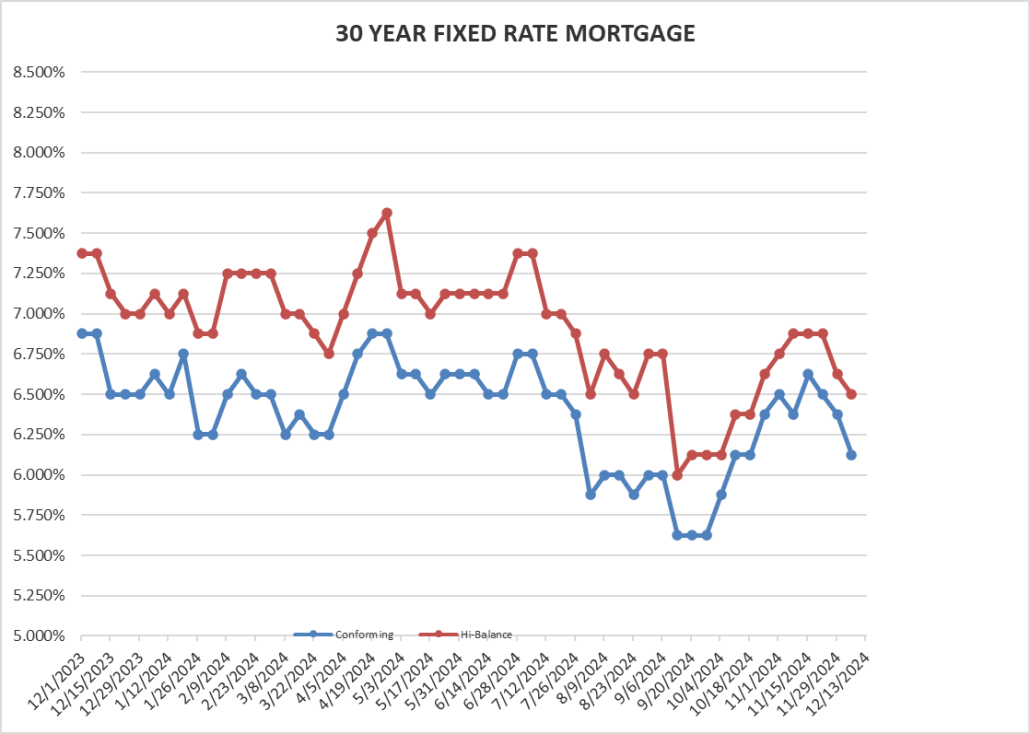
Rates for Friday December 6, 2024: After peaking in mid-November following a steady increase since September, rates continue to decline on decent but not great economic news, slowing inflation, and the Fed easing rates.

FIXED RATE MORTGAGES AT COST OF 1.25 POINTS LOCKED FOR 45 DAYS FOR PURCHASE TRANSACTIONS:

30-year conforming                             6.125%        Down 0.25%        

30-year high-balance conforming        6.500%        Down 0.125%        

Please note that these are base rates and adjustments may be added for condominiums, refinances, credit scores, loan to value, no impound account and period rate is locked. Rates are based on 20% down with 740 FICO score for purchase mortgages.

It’s that time of year in Southern California where we walk around our homes with very poor insulation in hoodies and sweats, and walk around outside in shorts and t-shirts.

I have long said, there is no place as cold as Southern California once the temperature drops below sixty-degrees.

Have a great week,

Dennis

What’s happening in the housing market?

Question of the week:  What’s happening in the housing market?

Answer: October saw the biggest increase in month-to-month home sales in California in the past 40-months, up 4.7% from September and up 9.5% from last year. With the increase in sales came an increase in the statewide median home price ($888,740) by 2.4% from September and 5-8% higher than a year ago.

More locally, LA and Orange County also saw large increases in sales, but drops in median prices from September.

In Los Angeles County home sales were up a whopping 23.1% from September and 10.9% for the year. The $956,200 median sales price was down 0.4% from the prior month, but up 7.0% from 2023; the monthly decline was the fourth drop from month-to-month this year.

Further south, in Orange County, sales surged 12.3% from September and were 14.8% higher than 2023. The $1.35 million median sales price was 3.4% lower for the month, but up 5.9% year-to-year; it was the second month in a row for a decline in the median price and the third decline in the past four months. Orange County’s median price hit a high in June of $1.45 million.

The jump in sales in October is directly attributed to the drop-in interest rates in September—buyers locking in rates in September when entering purchase contracts and closing in October.

Some statistics nationally for home buyers sees a significant change in who is buying homes.

First time buyers are at a record low of 24% of the market. Single women consist are 20% of first time buyers (FTB), more than twice the number of single men.

Another all-time low was seen in the home buyers with kids under the age of 18, only 25% of the market.

Traditionally the median FTB are in their late 20’s. With the increase in prices and rates, the median age from 2023 to 2024 has risen to 38 years old. That is ten years of wealth creation in homeownership being missed by those in their 20’s who traditionally would be entering the housing market.

Showing the lack of move-up buyers in the market, the average of a home seller has been 63 years old, up more than 10 years from prior markets cycles.

Regarding wealth creation, American homeowners have $35 trillion in equity, that is almost 28% higher than our national GDP in 2023, and twice the equity in homes prior to the 2008 crash. The average amount of equity nationwide is $315,000, up from pre-Covid equity of $186,000.

Move-up buyers have been noticeably absent from the market, a major factor in rising prices, and equity growth. The data does not support an significant increase in move-up buyers as 70% of homeowners with a mortgage have a rate under 4.5%, 25% under 3%. Hard to decide to sell you home and see your mortgage rate go up, possibly double.

Note that 40% of home owners own their homes free and clear.

The housing market responded as expected to rates dropping in September when they hit their lowest rates in two years.

As commented on in prior editions of the WR&MU, the economic and political environment do not portend a significant drop in rates in the near, or medium, future absent a significant event domestically or globally. The question to be answered is when will interest rates, prices, and potential buyers’ incomes and funds available for purchase, converge so that home sales increase.

With unsold inventory at 3.1 months and median days on the market at 25 days, both up 25% from a year ago, we could see a softening of the market in the early part of 2025 that could move more homes—depending on rates and if prices do soften, how much.

Schedule an appointment to discuss your options if you are considering purchasing a new home or property or refinancing an existing one and want to know the mortgage options available to you. 

Have a question? Ask me!

Rates for Friday November 22, 2024: Not a lot of rate impacting economic new this week. As result fixed rate markets (bonds, mortgages) moved a bit sideways this week. The result is conforming rates are down this Friday following last week’s spike.

FIXED RATE MORTGAGES AT COST OF 1.25 POINTS LOCKED FOR 45 DAYS FOR PURCHASE TRANSACTIONS:

30-year conforming                             6.50%          Down 0.125%        

30-year high-balance conforming        6.875%        Flat      

Please note that these are base rates and adjustments may be added for condominiums, refinances, credit scores, loan to value, no impound account and period rate is locked. Rates are based on 20% down with 740 FICO score for purchase mortgages.

Off and on through the past several years I have written in a journal, The Gratitude Journal. It is described as the 5-minute journal for “more happiness, positivity, affirmation..” And when engaged in the thought and reflection in the morning and evening it does fulfill those promises.

As we approach Thanksgiving, I have re-surfaced my journal after taking a too long of a break and realize, again, I have much for which to be thankful and grateful. It is my hope has you gather for Thanksgiving with family, friends, whomever, you too have an abundance of people, circumstances and surroundings to fill you with thanks and gratitude.

Happy Thanksgiving,

Dennis

What was the result of the housing related ballot propositions?

Question of the week:  What was the result of the housing related ballot propositions?

Answer: In September I wrote about propositions on the California ballot that were housing related and my positions on them. For those not following closely, here are the results. So far; as of 9:30 this morning there are 1,429,504 “estimated total ballots remaining”.

Per California law, the state has until December 13th to certify all results. So, the results below could theoretically change in the next four weeks.

Proposition 5 would change the constitutional requirement of a two-thirds voter approval to only fifty-five percent approval needed to pass local bonds and taxes for affordable housing and infrastructure. I was against the measure, as were 55.5% of Californians. The current results will hold even if every one of the remaining ballots votes in favor of Prop 5.

Proposition 33 would repeal the Costa-Hawkins Rental Housing Act of 1995, thereby eliminating limits to rent control ordinances for cities and counties. I was against the proposition and so were 60.5% of voters. Like Prop 5, the current results are beyond the reach of the remaining ballots to change the result.

One other proposition that I did not include on my list of housing impacted measures was Proposition 32 which would increase the minimum wage in the state. If passed Prop 32 would have impact on housing costs and HOA dues as it would increase the costs of home construction and maintenance. Current results show the Proposition being defeated with 51.1% voting against. The difference as of this morning is almost 300,000 votes, so there is still a chance this proposition may pass, if 60.5% of the remaining ballots are in favor of Prop 32. Probability is against this happening, but there is also the probability that it may.

Schedule an appointment to discuss your options if you are considering purchasing a new home or property or refinancing an existing one and want to know the mortgage options available to you. 

Have a question? Ask me!

Positive for economy is negative for rates. That is a general economic principle, one that is on display this week. October’s Consumer Price Index data matched September’s showing a 0.2% increase, with a 0.3% gain in the “core” data (energy and food removed). It was the fourth straight month the full index increased that amount, and the third straight month the core index as increased 0.3%. Year over year CPI is up 2.6%, up from last month’s reading of 2.4%, and the core index remains at 3.3% year over year. The year over year index increased for the first time in seven months. The primary factor in keeping inflation in its current range is housing. Housing costs were 65% of the price increase in the data, up 4.9% from last October. Higher costs are slowing for renters and home buyers, from 5.4% rate 6-months ago and 6.7% last year, however slower increases are not lower costs, just less high. Not positive for mortgage rates.

Consumers are still ringing cash registers at a steady pace. Retail sales in October were a strong 0.4% in October, and September’s sales were twice what was previously reported. Retail sales are one-third of consumer spending, and a strong signal as to economic strength and consumer sentiment. Consumers feel confident in their current financial position, job security, and future as evidence by a 1.6% increase in new auto sales (if uncertain of your future you likely will not enter into an auto loan contract). Restaurant sales are another indicator of how secure families feel in their financial stability as dining out is a discretionary expense that is quickly eliminated from many family budgets when times are tough, sales increased 0.7% last month. Also not positive for inflation rates.

Besides economic data showing sticky inflation data not moving to the Federal Reserve’s 2% inflation target, and retail sales portending a very strong 4th quarter for consumer spending and GDP, rates were influenced by Fed Chair Jerome Powell, and other members of the Fed’s Board of Governors, making statements indicating the Fed may slow the pace of its rate cuts. Signals to investors and markets to maybe not price lower rates into their investment strategies.

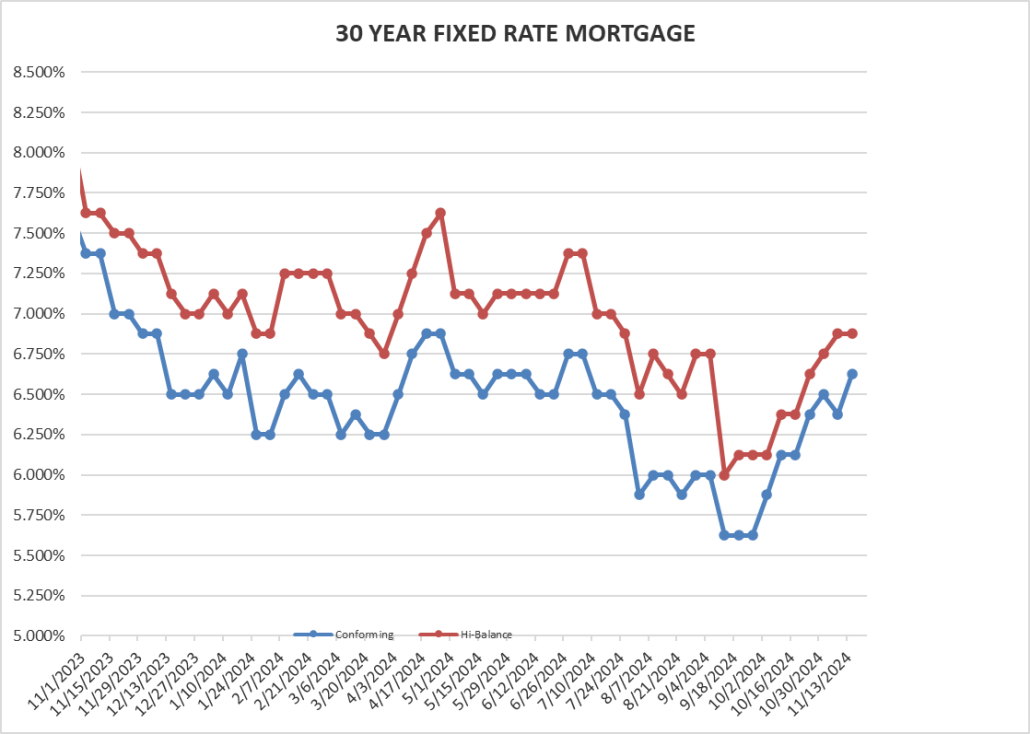
Rates for Friday November 15, 2024: After rates dropping for the first time since mid-September, rates continued their upward movement this week, with the conforming rate at its highest since my birthday in early July (reminder for your calendar for next year…).

FIXED RATE MORTGAGES AT COST OF 1.25 POINTS LOCKED FOR 45 DAYS FOR PURCHASE TRANSACTIONS:

30-year conforming                             6.625%        Up 0.25%        

30-year high-balance conforming        6.875%        Flat      

Please note that these are base rates and adjustments may be added for condominiums, refinances, credit scores, loan to value, no impound account and period rate is locked. Rates are based on 20% down with 740 FICO score for purchase mortgages.

Tuesday afternoon was a great mental health day for me. For the first time in just over a year (375 days to be more precise), I put a peg in the ground and hit a golf ball on a golf course. Since having both knees replaced, I have hit balls on the driving range, but Tuesday was the first time playing a round, well half a round as we teed off late and darkness pushed us off the course. What a pleasure to find my ball in the rough, hit it out of the sand onto the green, miss a 15-foot putt by mere inches, repair a ball mark after a well struck 9-iron on the green.

For golfers reading, the challenge moving forward is knowing my distances on different clubs, and getting used to having my drives being less as far as before when they were less as far are before.

My results far exceeded my expectations, and I can see the day drawing nearer when I will be able to walk 18-holes with my push cart looking for my ball. The wait was worth it as both knees are a lot better than they were before the surgeries.

Can we save on taxes by making some home improvements?

Question of the week:   Can we save on taxes by making some home improvements?

Answer: Yes!

Two years ago the WR&MU question was, “Should we get solar panels?” In the answer federal tax credits were covered, at the time of the writing the credit was expiring in 2024, however Congress extended the credit to 2032.

In addition to a tax credit for solar panels, the federal tax code also has an Energy Efficient Home Improvement Credit. This credit allows credits of 30% up to $3200, through 2032, for qualified energy-efficient improvements to your home.

Claims are allowed for various energy efficient improvements, including but not limited to exterior doors, windows and skylights, heat pumps, and water heaters. There are limits as to the maximum credit allowed per unit and overall for each type of improvement, for instance the limit is $200 per door with a total of $500.

As well, for those meeting established efficiency standards, the Energy Star rating, appliances are also eligible for credits. Refrigerators, dishwashers, washing machines, dryers, water heaters and HVAC systems are all eligible if they meet the criteria.

Keep in mind a tax credit is a direct reduction of taxes owed for the year claimed, not a reduction of taxable income. For instance, if your total tax liability for the year is $20,000 and you have $3200 in energy efficient improvements and $5000 for solar installation, your tax liability is reduced to $11,800. 

As opposed to a tax deduction, where the total of $8200 lowers your taxable income by that amount.

Did you do any home improvements or remodeling in 2024? Make sure you save those receipts, and if any Energy Star appliances were purchased have the labels and manufacturer certifications.

Note, per the IRS website, for Energy Efficient Home Improvements after 2024 for each item (door, window, etc) the item must have been produced by a qualified manufacturer and you report the PIN for the item on your return.

Final note, we mentioned three different programs, each with their own regulations for eligibility: solar, Energy Efficient Home Improvements, and energy efficient home appliances. Check with your CPA or tax preparer for eligibility of your expenditures and amount available for possible federal tax credits.

Schedule an appointment to discuss your options if you are considering purchasing a new home or property or refinancing an existing one and want to know the mortgage options available to you. 

Have a question? Ask me!

The result was fully expected, after the meeting of the Federal Open Market Committee of the Federal Reserve announced it was lowering its benchmark rate by 0.25%. In a news conference after the announcement Chairman Jerome Powell stated that the effects of high prices are still being felt and it will take time for wages to outpace inflation enough for people to feel better about their financial condition.

Other comments from his presser: Our national debt is on an unsustainable path. The Fed’s monetary policy remains “tight,” meaning it anticipates more rate cuts. While on the right path, lower, one report on inflation was higher than expected; regarding rate cut in December, “By December…one more employment report, two more inflation reports and lots of other data, and we’ll make a decision.” Which could foretell a pause in cutting its benchmark rate.

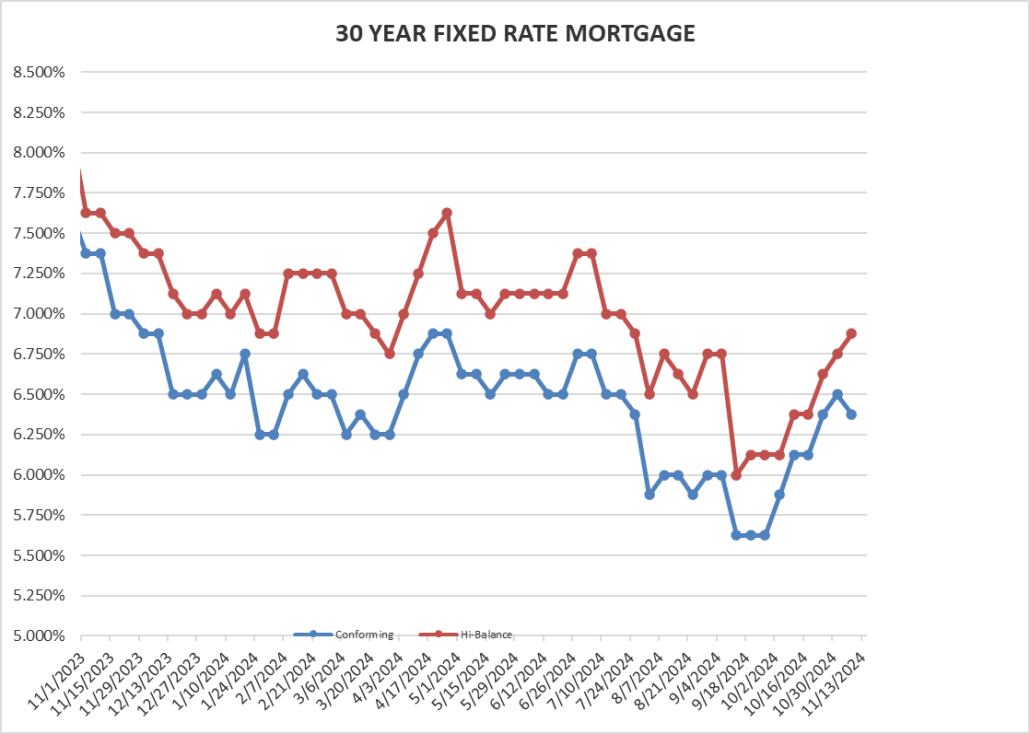
Rates for Friday November 8, 2024: With the Fed rate cut fully priced into the mortgage rate market for several weeks, the only impact on rates was the election; which produced the standard volatility pre- and post-election. Rates dipped yesterday and today as investors sort out the implications of the results for the President, Senate and House of Representatives, with many investors buying on the large drop in mortgage prices (higher rates) of the past several weeks. As a result, conforming rates drop from last Friday for the first time since mid-September.

FIXED RATE MORTGAGES AT COST OF 1.25 POINTS LOCKED FOR 45 DAYS FOR PURCHASE TRANSACTIONS:

30-year conforming                             6.375%        Down 0.125%        

30-year high-balance conforming        6.875%        Up 0.125%      

Please note that these are base rates and adjustments may be added for condominiums, refinances, credit scores, loan to value, no impound account and period rate is locked. Rates are based on 20% down with 740 FICO score for purchase mortgages.

At the 11th hour of the 11th day of the 11th month in 1918 fighting stopped between Germany and the Allied Forces after an armistice was signed in Compiègne, France. While the Treaty of Versailles that formally ended the war would not be signed until six months later, the armistice effectively ended the “war to end all wars.” 

In 1919, President Woodrow Wilson declared that November 11th would be Armistice Day. On the first Armistice Day besides the parades and speeches to celebrate, there was a brief suspension of business at 11 a.m. In 1938, Congress made Armistice Day a federal holiday.

In 1954, after World War II and the Korean War, acquiescing to Veterans service organizations who had been lobbying for quite some time, Congress amended the 1938 Act, exchanging “Armistice” for “Veterans.”  November 11th became a day to honor all veterans of all wars.

I feel it is fitting that our national election day is held days before Veterans Day, honoring those who have served to preserve our liberties, freedom and democracy regardless of who has been elected to serve in our Executive or Legislative branches of government.

Deep gratitude and appreciation for all our veterans who have served our nation, and their families who have endured through their time served, not just on our holiday on Monday, but every day.

How is the economy?

Question of the week:   How is the economy?

Answer: Strong.

The final economic data before our national and local elections next week show a strong economy, incomes outpacing inflation, slower inflation, and consumers still spending.

The economy grew at strong 2.8% in the 3rd quarter, a bit slower than 2nd quarters 3.0%, but at a pace that supports a good job market and consumer spending.

Regarding the job market, as expected, today’s employment data for October is one that is easy to ignore, and should be. Employers added a net 12,000 jobs for the month; a number that ordinarily would foretell a down turn in the economy. Ordinarily a two significant hurricanes that result in tremendous damage, loss of life and shutting down of regions of the country do not occur within ten days of each other, while also having a major strike by workers of one of the largest employers in the country.  Absent these events, speculation may say that employment growth was strong or weak for the month.

Consumer spending is 65-70% of our nation’s economy. The 4th quarter of the year began with consumers still spending, increasing spending from September by 0.5% in October. Year of year consumer spending was up; 3.7%, well above the rate of inflation. Supporting continued strength in consumer spending is personal income. Workers earned 0.3% more in October than the month before, and year over year have seen their income increase by 3.0%.

Personal Consumption Expenditures (PCE) is the preferred gauge of inflation for the Federal Reserve when determining its policies. In September PCE showed a 0.2% increase in prices from August and a 2.1% increase from September 2023; down from 2.3% the month before.

The Fed digs a bit further into the PCE data for its decision making, using the “core” rate, which strips out food and energy costs. Due to lower gas prices not in the data, the core rate showed a 0.3% growth month-to-month and a steady 2.7% annual growth. The core rate is sticky primarily due to housing prices remaining high.

The overall data supports the Fed enacting minor rate cut(s) in the near future as overall inflation is slowing. However, with wages, spending and growth all showing moderate to strong growth, the potential for inflation increasing seems more likely than the economy slowing towards recession.

From my viewpoint, there is little data supporting mortgage rates declining in any significant manner before the end of the year—absent some major event.

Schedule an appointment to discuss your options if you are considering purchasing a new home or property or refinancing an existing one and want to know the mortgage options available to you. 

Have a question? Ask me!

Rates for Friday November 1, 2024: Mortgage rates end October the way they started—going up—reaching their highest levels since mid-July.

FIXED RATE MORTGAGES AT COST OF 1.25 POINTS LOCKED FOR 45 DAYS FOR PURCHASE TRANSACTIONS:

30-year conforming                             6.50%          Up 0.125%        

30-year high-balance conforming        6.75%          Up 0.125%      

Please note that these are base rates and adjustments may be added for condominiums, refinances, credit scores, loan to value, no impound account and period rate is locked. Rates are based on 20% down with 740 FICO score for purchase mortgages.

When the match-up for the World Series was known, my text thread with four others that all met in August 1980 on the campus of Pitzer College exploded with “let’s go to game 1!” Two of them are LA area local and Dodger lifers, the others are Dodgers are our second favorite team. When the first text came across, I did some quick research and said I was tapping out on going as the lowest price seat at that time for five together was $1300. Quickly the plan changed.

Let’s watch game six together, our home as game central with one friend from San Francisco and another from Houston, staying Friday to Sunday. A great college reunion, and play off baseball!

As you are aware, the Yankees less than Little League play in the top of the 5th inning Wednesday night blew our view plans and put the World Series trophy in Los Angeles.

Not to be deterred from our plans, we are still on for a weekend together, sort of “Big Chill” without the funeral, the romantic underpinnings, or the fancy-injury-inducing sports car.

We will be watching a World Series game six however. Thanks to technology, we can watch one of the greatest games in Series history, game six between the Cincinnati Reds and Boston Red Sox in 1975.