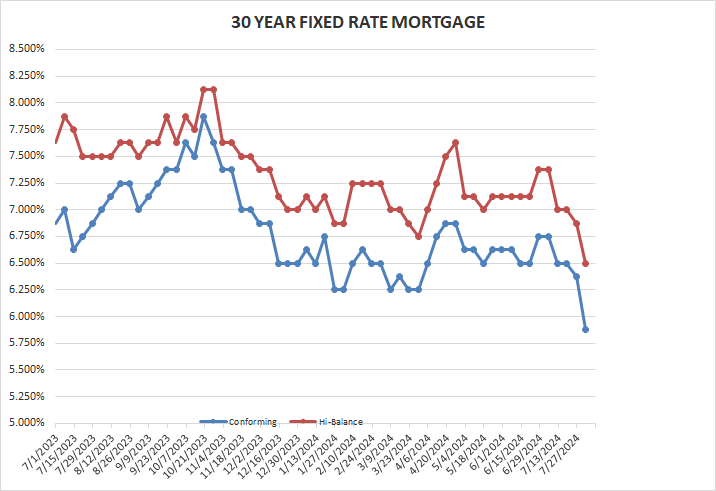
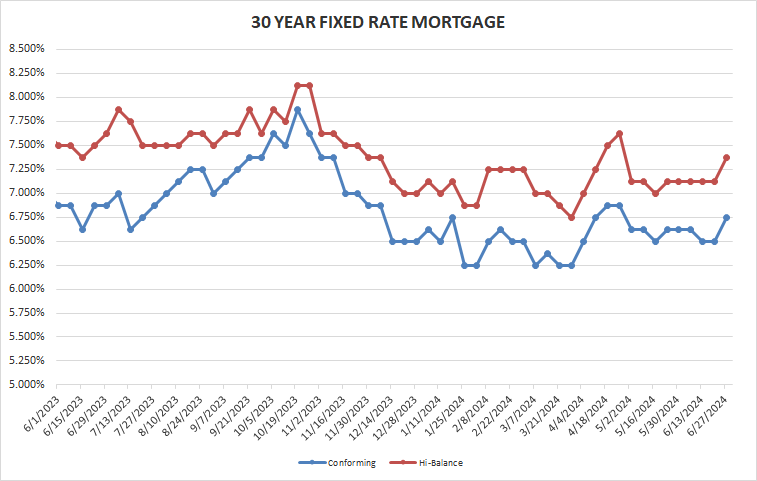
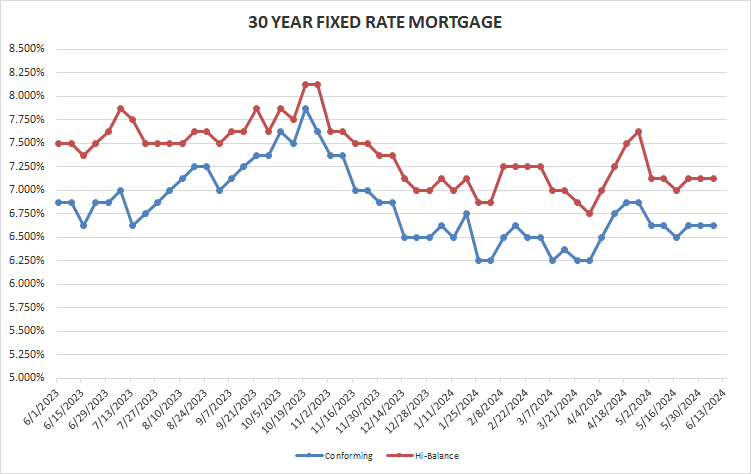
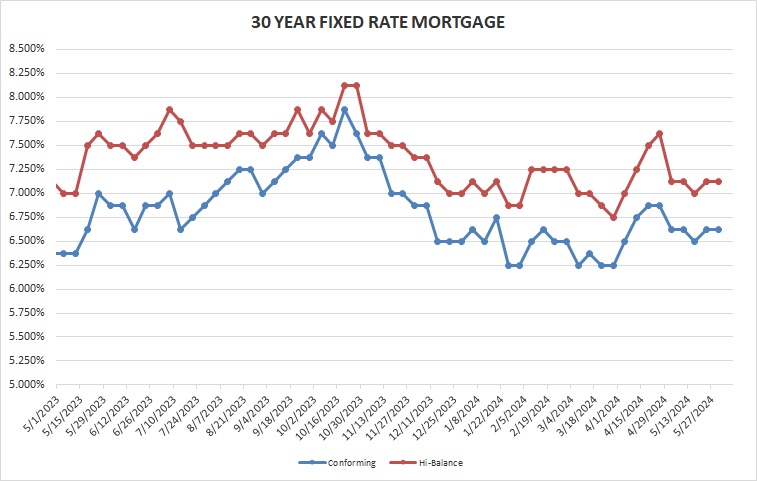
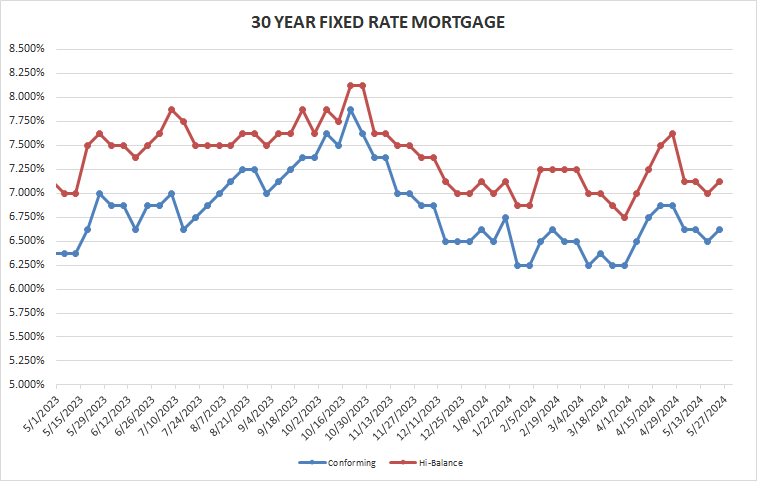
Mortgage rates have their largest Friday to Friday rate drop since August 2009, a one-half of one-percent drop (0.500%), as determined by the WR&MU inputs (1.25 origination points, 740 FICO, 80% loan-to-value, purchase mortgage in Long Beach); and their lowest level in 18-months.
How much further will they drop in the somewhat near future? Let’s define that period of time as the next three months, taking us to the election.
Before we put forth our guesstimate, let’s look at why rates have plummeted this week.
Yesterday the Federal Reserve Open Market Committee (FOMC) announced it was not changing its benchmark interest rate. Following the announcement Fed Chair Jerome Powell had a news conference in he said without actually saying that the Fed will very (very) likely cut rates at its September meeting. As economic data in the past month or so pointed to a probable rate cut, some data created some doubt and some investors thought “possible” instead of “probable,” Powell’s comments led to markets pricing in a September rate cut.
The first Friday of every month is circled on everyone who follows the economy as it is when the Labor Department releases data for the jobs markets for the prior month. Strong job growth means strong economy, inflationary pressure, economic growth.
Contrarily, weak job growth means a slowing economy, lack of inflationary pressure, and concerns for a shrinking economy; i.e. recession.
After June added over 200,000 jobs, the consensus for the July report was 185,000 workers added to payrolls. The estimates were not close as the Labor Department reported only 114,000 new jobs in July and that the unemployment rate climbed to 4.3%, the highest level in about three years.
Without hesitating to read past the “one-hundred fourteen thousand,” investors reacted by selling stocks (prices drop) and buying fixed rate investments such as bonds and mortgages (prices rise causing rates to fall). I pictured the trading floors resembles this scene from one of the best movies to ever explain how markets work, Trading Places.
The jobs data appears to guarantee a Fed rate drop in September. The data also brought into the market the question of how much would the Fed lower rates? Prior to this morning the markets had just about fully priced a one-quarter of one-percent (0.250%) rate cut by the Fed next month. What appears to be priced into the market today is a one-half of one-percent rate cut.
Over the past year or so there have been Fed critics who feel its resistance to lower rates is harmful to the economy and pushing it into recession. If the jobs data is not a “one-off” (see below) and a trend, a recession in the very near term is possible, or likely; in which case larger rate cuts by the Fed will ensue.
Was the July jobs data a one-off? Was it a blip and in August we will see a spike in job growth from July’s very low number?
There is some disagreement as to how much of an impact Hurricane Beryl in early July had on the jobs data, just about the same week that the Labor Department uses to collect its job data. The Labor Department in the report stated Beryl had “no discernible effect on the national employment and unemployment data for July.”
Really? During the survey week for the employment report over a million customers in Houston were without power, that includes businesses that could not open, and many that have still not been able to open. It includes hundreds of thousand workers who could not get to work, or unable to leave their families. Unemployment claims spiked in Texas. By its own estimate, the Labor Department said 461,000 people were unable to work because of the weather in July. Considering July is typically a strong hiring month for temporary workers, shutting down one of the major urban areas of the United States limiting not only current workers from earning paychecks but also preventing employers from hiring.
Add me to those who think that July’s employment data is a bit of a one-off due to Beryl and other extreme weather, and wildfires. If this is the case, August should see a rebound in new hires to between 175-200,000 jobs. We’ll see.
As to rates between the beginning of August and the beginning of November; I think rates can down to 5.50%, perhaps a few days, or weeks a bit below that number. Do I think rates will drop to 5.00% by then? I do not. While consumers are slowing their spending, wages are still outpacing inflation, up 3.6% for the year in July, and the increase in the unemployment rate was due to more people entering the job market, not getting laid off.
Of course, a lot can happen in the three months. Turmoil, uncertainty, catastrophe, war, has a tremendous impact on rates—of which there is a lot going on in our nation and abroad.
Nice cover in case rates do drop more than you estimate.
Schedule an appointment to discuss your options if you are considering purchasing a new home or property, or refinancing an existing one and want to know the mortgage options available to you.
Rates for Friday August 2, 2024: As mentioned above, rates are down to their lowest level since February 2023 due to the largest Friday to Friday drop in fifteen years.
FIXED RATE MORTGAGES AT COST OF 1.25 POINTS LOCKED FOR 45 DAYS FOR PURCHASE TRANSACTIONS:
30-year conforming 5.875% Down 0.500%
30-year high-balance conforming 6.500% Down 0.375%
Please note that these are base rates and adjustments may be added for condominiums, refinances, credit scores, loan to value, no impound account and period rate is locked. Rates are based on 20% down with 740 FICO score for purchase mortgages.
We agreed that it was a tie. No, not the final result of some Olympic event, the contest between Sammy the Dog and I.
Last week’s WR&MU mentioned in this space that Leslie was leaving for New York to help our daughter and her roommate move into a new apartment in Brooklyn after two years in East Harlem. I speculated that Sammy and I were wondering who would miss her the most. It was a tie.
He moped about more than I did, but he didn’t have to watch Jeopardy! alone, or ask “what should we do for dinner?” to get some guidance.
Speaking of the Olympics, I have a hard time following when there is a large time difference. I don’t know what is live, what is pre-recorded, and now with streaming where to find what events.
I do have circled on our calendar the dates and times for the Women’s Track 1500 next week as my mom’s cousin’s granddaughter, Nikki Hiltz, who won the U.S. Olympic Trials in Oregon last month, will be racing. For many years when we lived near Philadelphia and then New York, we spent holidays with each other’s families, and I have remained close to them. It’s pretty exciting to be able to cheer on someone you know at the Olympics—even more so if they share some DNA!
Go Nikki! Go USA!
https://www.denniscsmith.com/wp-content/uploads/2024/08/rates-drop.jpg330480Dennis C Smithhttps://www.denniscsmith.com/wp-content/uploads/2024/06/dennis-c-smith2.pngDennis C Smith2024-08-02 12:04:132024-08-02 12:04:14How far will rates drop?
Question of the week: What types of mortgages are available?
Answer: Before we get into more specific types of mortgages on the residential market, almost every type of mortgage has two options, fixed rate or adjustable rate. Actually three, as there are hybrids that are a bit of both.
Fixed rate mortgages have the same interest rate for the life of the loan. In most “normal” markets, fixed rate products generally have higher rates than adjustable rate products. The primary advantage of a fixed rate loan is you know what your payment will be throughout the loan.
Adjustable rate mortgages (ARMs) come in many varieties as to how often and how much the interest rate on the mortgage will adjust. Some adjust every six months, others annually. Lenders must disclose to borrowers at application, and with loan documents, not only when the rate will adjust, but also the maximum amount the rate can adjust per adjustment and over the life of the loan. Industry standard for most ARMs are maximum 2% increase per year (or 1% per six months) and 5% for the life of the mortgage.
Example, a one-year ARM with 2/5 caps that has start rate of 6.25% will be fixed at that rate for the first year, at the end of year one the maximum rate can be 8.25%, over the life of the loan the maximum rate can be 11.25%.
The adjustable in an ARM rate is based on an index that adjusts on a regular basis and the borrower has the ability to easily look up the rate. Common indexes are the SOFR (secured overnight financing rate), and 6-month or 1-year U.S. Treasury Bills.
The total rate on the mortgage when it starts adjusting is the index plus a margin that is fixed throughout the term of the loan. Example, today’s SOFR rate is 5.34%, if the margin on the loan is 2.75% and you funded your one-year ARM a year ago with a start rate of 6.25%, the fully-indexed rate for the adjustment would be 5.34% + 2.75% = 8.09%. Your adjustment in 2025 cannot exceed a 2% increase, so the maximum rate can be up to 10.09%.
Hybrid ARMs are loans that are fixed for longer period of time than one year. Typically available are 3-, 5-, 7-, and 10-year products whereby the initial rate is fixed for that number of years and then the rate becomes adjustable. One big difference between a traditional ARM and a hybrid ARM is that the maximum adjustment at the first adjustment (when loan transitions from fixed to ARM) is the lifetime cap. For instance, if you funded a 5-year ARM in July 2019 with a start rate of 4% and with same index and margin as above, your rate for the next twelve months will be 8.09%, and increase of 4.09%. If rates climb over the next year, the maximum rate on your loan cannot exceed 9% due to the lifetime 5% cap over the initial rate of 4%.
Those are mortgage products that are differentiated by the stability of the interest rate, and payments, for your loan. Here are various products that are differentiated in underwriting guidelines, loan limits, and eligibility among other factors.
Conventional, or Conforming, mortgages describe loans that are underwritten to the guidelines established by Fannie Mae or Freddie Mac. The vast majority of these mortgages are 30-year fixed, though ARMs are available. These mortgages are the Wonder Bread of the mortgage industry as approximately 70% of total mortgages funded in the United States every year are conventional. These loans have two loan limits. The base loan limit nationwide in 2024 is $766,550. For some parts of the country the maximum loan limit is $1,149,825—these are termed high-balance loans, and have a higher interest rate (see weekly rate chart).
The guidelines are fairly similar for both standard and high-balance mortgages in regards to how to calculate qualifying income for salaried, self-employed, retired, etc borrowers. Depending on loan amount, borrowers can put as little down as 3%.
Jumbo, or non-conforming, mortgages generally follow must of the conforming underwriting guidelines, but have much higher loan limits that are generally based on the percentage of the sales price as down payment. For instance, some lenders may fund up to $2 million loan with 20% down, other may max out with 20% down at $1.5 million.
An example of different underwriting guidelines, depending on other factors, some underwriting requirements for a self-employed borrower may require only the most recently filed federal tax return to qualify income. Most jumbo guidelines require two years returns, and will average the income between the two years. If you filed taxes for $125,000 in 2022 for your self-employed income and $185,000 in 2023; for a conventional loan if the income verification is most recent tax return, your income is $185,000 ($15,400 per month). For jumbo loan, averaging the two years of income, the amount is $155,000 ($13,000 per month). Using 33% of income for your housing payment, the difference is almost $800 per month that can be used for your mortgage qualifying—more than $100,000.
Government mortgages, the general term for FHA and VA mortgages, generally have looser guidelines than conventional loans, and the rates can be more attractive.
For FHA mortgages, the primary reason most loan originators recommend a conventional mortgage instead of a FHA mortgage is because of the higher mortgage insurance costs. For conventional mortgages with loan amounts greater than 80% of the sales price, the mortgage insurance is fairly inexpensive, and have opportunity to be removed when certain conditions are met. Mortgage insurance for FHA loans have an upfront fee added to the loan amount as well as a monthly payment that stays in place through the life of the loan.
VA, or Veteran’s Administration, loans are restricted to borrowers who are active in the military or have been honorably discharged with benefits. Misunderstood by many in the real estate industry (i.e. too many agents discourage sellers from accepting offers with VA financing as they perceive the loans are hard to close), VA mortgages have fairly easy qualifying for applicants in regards to debt to income ratios, and can finance very large loan amounts with little to no down payments. As an example, depending on location, a veteran may be able to purchase a $1.25 million home with no down payment.
The rates on VA loans are lower than conforming rates, and while there is no mortgage insurance, there is an upfront “funding fee” of up to 3.3% of the loan amount that is added to the loan depending on down payment, if any, how many times the Veteran has utilized their VA loan benefits, and whether loan is for purchase or refinance.
Limited income qualifying mortgages are available, most typically for self-employed borrowers. These mortgage products usually are used for borrowers where tax returns are not used for income qualifying. Instead of tax returns lenders will use most recent year’s 1099, or bank statements, to determine income.
For these loans the lender will use a formula to determine to calculate expenses to determine qualifying income. For some bank statement programs, the lender will average the deposits over the period of time, average the debits, and the result will be qualifying income.
Depending on lender, there are programs that use 3-, 6-, 12- or 24-months of statements to determine qualifying income. The fewer statements used, the higher the interest rate.
One advantage these mortgages can have, beside avoiding producing tax returns that may have disproportionate amount of expenses to income, is that they can often be underwritten faster as negotiating with underwriters, appealing to management for exceptions, etc can be avoided.
Construction loans, are what they say, they finance construction. Construction can be a new home from foundation up, or a major remodel. These loans require a lot of documentation, and typically take longer to approve and fund than most other loans. Trying to stay out of the weeds, application file, besides the standard items for employment, income, credit, funds to close, etc., will need to provide a detailed cost estimate for intended construction, information on the licensed contractor, an appraisal that provides current market value and the estimated value when construction is completed based on the scope of the work done.
Loans are funded in stages. The initial funding is for the purchase of the property, then the lender releases funds to and escrow account that will release the funds to the contractor upon completion, and inspection, work completed.
For instance, you are buying a property for $750,000, putting 20% down, and have construction costs of $250,000 to remodel the property, and the completed value of the property is estimated to $1.2 million. The lender approves a total loan amount of $850,000.
At closing the lender funds $600,000, the deal closes and construction begins. After the contractor has completed necessary demolition and framing, a request if put in for $35,000. An inspector signs off on the work and the funds are sent to the escrow account to pay the contractor. A few weeks later the walls and cabinets are completed and a request for $80,000 is made, signed off on and funded. This happens until the project is complete and the local authorities sign off on final permits and occupancy when the final funds are released to the contractor.
Reverse mortgage, in my opinion the most misunderstood financial product available to consumers. You likely have seen Tom Sellek promoting reverse mortgages while watching Wheel of Fortune or reruns of The Golden Girls; but what are they?
Reverse mortgages are tailored to those 62 years old, or older, with some exceptions. The primary purpose for reverse mortgages is to enable seniors to stay in their current home, or purchase a new one (yes! You can use a reverse mortgage to purchase a home.) without having a mortgage payment.
Instead of paying a mortgage payment every month and reducing your mortgage balance, a reverse mortgage accrues the interest owed on the mortgage and increases your mortgage balance.
The mortgage balance is determined by the age of the youngest borrower and the value of the property. The younger the borrower the lower the mortgage amount.
If you, or your parents, have a $400,000 balance on a mortgage funded ten years ago at 4% with a payment of $2300 per month, the current value of the home is $900,000. Income is down to social security payments of $4300, so tapping into retirement accounts to fund other expenses, travel, entertainment etc. The funds from the retirement account are taxed by the state and federal governments, which is effectively about 25%.
Instead of paying the $2300, you fund a reverse mortgage. With no mortgage payment there is either no need to pull funds from retirement every month, or a lot less is needed. Instead of paying taxes for living expenses, you are using your equity to eliminate your housing payment and reduce the income needed every month.
The biggest concern we hear about reverse mortgages is, “we don’t want to lose our home.” Except in certain extenuating circumstances, foreclosure on a reverse mortgage is extremely unlikely. Even if the balance due on the mortgage exceeds the value of the home, the lender cannot foreclose and make the borrowers move.
It is my opinion that more people in retirement, or heading into retirement, take at least a look at the reverse mortgage option as part of an overall financial examination.
Second mortgages, are loans that are placed as liens on your home after your current mortgage has funded. There are two types of loans considered second mortgages, fixed and equity line.
A fixed second mortgage has a fixed term, interest rate and payment. Terms are generally for 10-, 15- or 20-years, fixed rate mortgages have rates higher than primary mortgages, and depending on the rate environment, higher than what the current rate on an equity line will be.
An equity line, or Home Equity Line of Credit (HELOC) has a maximum amount that can be borrowed and has an adjustable rate based on the prime rate. HELOCs offer tremendous flexibility as the minimum payment is often interest only, and is based on the amount outstanding on the loan, not based on the maximum amount available—just like a credit card operates. Like a credit card, you can pay the balance down to zero at any time and eliminate payments (though many HELOCs do have a nominal annual fee).
Because of their flexibility, ease of qualifying and relatively low costs compared to traditional mortgages, HELOCs are useful tools for home remodeling and other projects, debt consolidation, short-term cash needs that may come up over the years.
While the above cover much of the mortgage market, there are other products available that get more “nichey” which is why it is important you consult an experienced mortgage professional at the beginning of your home search, or considering refinancing to obtain cash for any reason.
Schedule an appointment to discuss your options if you are considering purchasing a new home or property, or refinancing an existing one and want to know the mortgage options available to you.
While not the biggest unexpected announcement this past week, the Bureau of Economic Analysis release of GDP for the second quarter vied for second or third place. With expectations of around 2.1% growth in the economy in the 2nd quarter the announcement that the economy grew at a fairly strong 2.8% pace, doubling 1st quarter GDP of 1.4%, was a surprise. Pushed by a 2.3% annualized growth in consumer spending over the quarter, which would have been higher were it not for the computer hacking that slowed car sales in June, the data pushes out the prospective time frame for when the economy may slow enough to be close to, or in, recession. A few signs that the economy may slow in the 3rd quarter was a slow down in business spending and a drop in consumer spending on services—typically an area where most discretionary income is spent. While the Federal Reserve is still likely to drop its benchmark rate in September, the data does put a bit of a head-tilt on prognostications.
As mentioned above, consumer spending grew in the 2nd quarter, in large part because of the 0.3% increase in spending in June—which, as mentioned, would have been higher had auto dealers been able to process more car sales. Consumer spending is 65-70% of our economy, and strong spending keeps the economy have steady growth, and raises barriers for inflation to ease. What may slow spending, and economic, growth is sluggish growth in incomes, up only 0.2% in June, and a drop in the personal savings rate to 3.4%. Consumers will stop, or at least slow, dipping into their savings, slowing their spending, unless incomes catch up to inflation and consumers’ need to by essentials.
The Fed’s preferred inflation index, the Personal Consumer Expenditures (PCE) was positive for a Fed rate cut as it increased only 0.1% in June, and was up 2.5% year over year, down from 2.6% the month before. The all important “core” index (food and energy stripped from data) was up 0.2% for the month, and was also up 2.6% over the past year.
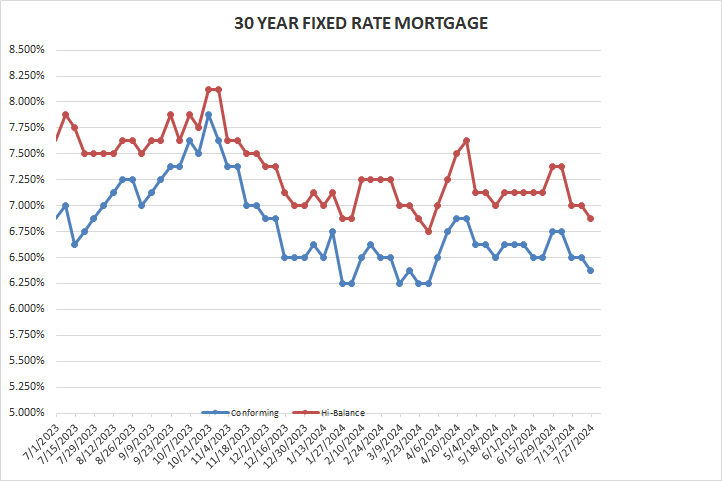
Rates for Friday July 26, 2024: With the PCE showing a slow down in inflation, strengthening the chances of a September rate cut, we see rates tick down from last Friday.
FIXED RATE MORTGAGES AT COST OF 1.25 POINTS LOCKED FOR 45 DAYS FOR PURCHASE TRANSACTIONS:
30-year conforming 6.375% Down 0.125%
30-year high-balance conforming 6.875% Down 0.125%
Please note that these are base rates and adjustments may be added for condominiums, refinances, credit scores, loan to value, no impound account and period rate is locked. Rates are based on 20% down with 740 FICO score for purchase mortgages.
I’ve spent the past week working with my daughter and her roommate to secure a new apartment for them in Brooklyn. They have to be out of their current apartment where they have lived with two other roommates for the past two years by the end of the month. Challenges include finding a place this is affordable, in a somewhat decent area, and enables a move in not later than August 1st. All the challenges were met, with leases signed and deposits made, not without Dad experience more than a little stress considering he’s about 2800 miles away with a 3-hour time difference waiting for others to execute contracts and make decisions. Much like homeowners going through escrow….
Leslie is headed to the Big Apple tomorrow morning to help them move, and spend some time with our daughter, and a friend of hers (Leslie’s) that moved to Connecticut several years ago.
The dog and I will be staring at each other wondering her misses her most.
https://www.denniscsmith.com/wp-content/uploads/2024/07/mortapp.png397784Dennis C Smithhttps://www.denniscsmith.com/wp-content/uploads/2024/06/dennis-c-smith2.pngDennis C Smith2024-07-26 13:34:172024-07-26 13:34:18What types of mortgages are available?
Answer: Anywhere from twenty to thirty dollars to about $250,000.
Two-hundred fifty thousand dollars for an area rug? Were not buying a rare Persian carpet!
One of my favorite books to read to the girls when they were young was “If You Give a Pig a Pancake.” The story takes us through what happens when you give a pig a pancake, and syrup, she’ll get sticky and want a bath, and the bath with bubbles, the bubbles make a mess…By the end of the book the house is a mess.
Recently I told Leslie we should write a DIY book, “If you buy an area rug for your den….” The rug will make the couch, love seat and recliner look dated. The new furniture doesn’t match the book cases, end tables, entertainment center very well.
Since we are redoing the fixtures, what if we took out this wall and converted the bedroom behind it to a bar and entertainment room that opens to the patio….
Before you know it your fifty-dollar rug from Home Depot has resulted in meetings with designers and contractors and you have transitions from a little home improvement to a full-on remodel.
Our question of the week is follows up with, “how can we control a remodel?”
While it may sound cliché, the two biggest issues home remodel projects are they are always over-time and over-budget. Not all of the overs are on the contractors. Not infrequently when speaking with clients during, or after their remodel, they admit to responsibility for the extended time line and costs as once the project starts, they begin to make some changes to the original bid.
Something as small as wanting to change the hardware on drawers and cabinet, can lead to extended time to source the new materials; and while going from up twenty-dollars per piece may not seem like a lot per piece, if you need thirty pieces that adds $600. But…perhaps the appliances you chose do not match the new handles and nobs. And the cabinets need to be a bit lighter in color.
The $600 additional for nobs and handles has added $15,000 to your budget.
The above scenario is pretty close to what one of my clients went through last year during their remodel. Their kitchen, however, does look fantastic.
Before you buy the area rug, or look at new appliances, determine the very top end, non-negotiable budget.
Once your budget is established, determine how you will pay for it. The most popular, and suggested, method is to obtain a Home Equity Line of Credit (HELOC), with a limit a bit above your top end budget*. If you get a HELOC, or other financing, there must be a discussion on the cost and your monthly income and expenses, as well as plan to pay off the loan.
A general rule for your budget and bids, when meeting with contractors and they ask “what is your budget,” tell them it is about 10-15% below your top end budget. You budget $100,000, tell contractor $85,000-$90,000.
When getting bids, ask about the impact of inflation and supply on the products you will need for your remodel. Are the supplies readily available? If not, how long will they take to be available? Is the price locked in on those items when we pay our deposit for the work? If not, when will price be locked in so that we can adjust our cost expectations?
When going through the small details, make sure they match what your vision is. If possible, see the hardware and paint, tile, wood, appliance colors, patterns and designs together. Modern design programs are able to generate what your kitchen, room, will look like with the choices you made. If possible, print out pictures of from the program of different walls and areas and put them up in that room to get a bit of a feel for what it will look and feel like.
In your budget, take into consideration new furniture, appliances, floor covering, that may be need to complete your desired result.
Finally, avoid changes to your original bid for the work to be done that may result in costlier materials, hardware, rewiring or piping, etc.
*Over the years we have had my WR&MU that address HELOCs that may be of interest if you are considering a remodel, or accessing funds for any other purpose.
With the prime rate at 8.5% today, and likely to go lower in September when the Fed lowers its benchmark interest rate, the primary plan for many using HELOCs to remodel is to keep an eye on interest rates to determine when it will be advantageous to refinance their current low-rate mortgage and their HELOC into a new loan. The rate will very likely be somewhat higher than the current mortgage, however the math on payments and paying down the mortgages usually shows the new mortgage at a higher rate is more advantageous.
If you would like to discuss the options for financing your new, and very expensive, area rug, please click below to schedule a time for us to talk.
Schedule an appointment to discuss your options if you are considering purchasing a new home or property, or refinancing an existing one.
Not economic news, but mortgage industry news that impacts those in process with a mortgage, or those looking to get pre-approvals. You may be aware of the major outages impacting airlines, hospitals, banks and other businesses around the world yesterday and today. Also impacted is the one of the primary software programs used by the mortgage industry. As a result, originators, processors, doc drawers, underwriters, funders are not able to access client files to move loans through the process—or fund. No one knows how long this issue will take to resolve, so for those in the process our counsel is patience, try not to stress and make sure everyone is communicating for extensions, etc as needed.
No advance notice. So said Jerome Powell, Chair of the Federal Reserve, to Congress on Monday when discussing a possible cut to the Fed’s benchmark rate and when it may occur. Not wanting to influence markets one way or the other, Powell made it clear the Fed was meeting-to-meeting as to when, and how much, it may cut rates. With that said, many who were speculating on a rate cut at the Fed’s September Federal Open Market Committee meeting (group that establishes the rates) are postulating that perhaps the cut will come at its meeting at the end of July.
Maybe putting September into play instead of July was the retail sales data for June. The total retail sales for June were flat from May’s sales. However, with gas prices down, and auto sales depressed due to a cyber attack on the industry’s primary software by a group looking for ransom, sales of non-gasoline and autos jumped. Taking away just auto sales, retail sales were up 0.4% strip away gasoline purchases as well and sales were up 0.8%. Since consumer spending is 65-70% of our economy, a large jump in sales generally does not lead to a slowing economy, slower inflation, or soft employment. All of which the Fed would like to see when lowering rates.
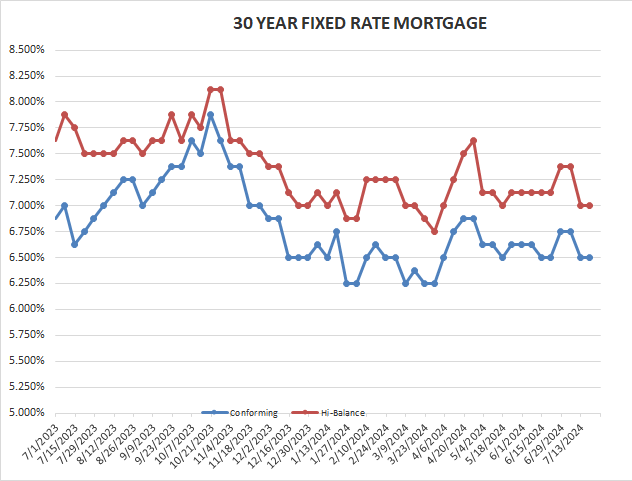
Rates for Friday July 19, 2024: Rates are flat from last Friday, the same may not be said next week as investors digest data on inflation and personal income and spending—that may be seen as creating environment for the Fed to make a move on rates.
FIXED RATE MORTGAGES AT COST OF 1.25 POINTS LOCKED FOR 45 DAYS FOR PURCHASE TRANSACTIONS:
30-year conforming 6.50% Flat
30-year high-balance conforming 7.00% Flat
Please note that these are base rates and adjustments may be added for condominiums, refinances, credit scores, loan to value, no impound account and period rate is locked. Rates are based on 20% down with 740 FICO score for purchase mortgages.
A lot of famous people have passed away in the past week or so, Shelley Duvall, Richard Simmons, Dr. Ruth Westheimer, Shannon Doherty.
Of the recent passings, the one that had me going down memory lane the most was Bob Newhart dying yesterday. His original, eponymous, 1970’s television show broke some barriers, mainly the first time a husband and wife were seen sharing the same bed, and introduced him to millions of people who were not familiar with his stand-up comedy.
One of the best final episodes in television history was for his series “Newhart” in which he is an inn keeper in Vermont surrounded by bumpkins, including Darryl and his other brother Darryl. The final scene (spoiler alert 30+ years later) was Bob waking up in bed next to his co-star in his 1970’s sitcom, Suzanne Pleshette, letting us know the whole series was a dream he had. Genius comedy.
Reading his obituary in the Wall Street Journal I was amazed to learn that his first comedy album (remember those?), “The Button-Down Mind of Bob Newhart” released in 1960 was the first comedy record to be number one on the Billboard 200. It won the Grammy for best album, merely beating out Frank Sinatra, Nat “King” Cole and Harry Belafonte.
Also in 1960 he released a follow-up album, “the Button-Down Mind Strikes Back!” For two weeks both albums were one-two on the Billboard 200, a feat not accomplished again until Guns N’ Roses in 1991. At the same 3rd Annual Grammy Awards that his first record won Best Album Grammy, “Strikes Back!” won Grammys for Comedy Performance and Spoken Word.
Not the 30-second video, or reel, we have become accustomed to capturing our attention spans, here are two classic routines by Newhart, guaranteed to make you laugh:
https://www.denniscsmith.com/wp-content/uploads/2024/07/Final-Budget-and-Materials.jpg8531279Dennis C Smithhttps://www.denniscsmith.com/wp-content/uploads/2024/06/dennis-c-smith2.pngDennis C Smith2024-07-19 12:36:562024-07-19 12:36:57How much is an area rug?
Title insurance is in the news this week as the Biden Administration is investigating the title insurance industry and the relationship between the cost of the insurance to consumers and the risk to the insurance companies.
Earlier this week a roundtable at the Treasury Department that included title insurance officials, consumer advocates and others to examine the issue. The meeting is an extension of the Consumer Financial Protection Bureau’s investigation into “junk fees” in mortgage closing costs, which included fees from other industries, including title insurance.
What is title insurance and why do you need it?
Without going deep into the weeds, as is my norm, here is what I hope is a simple explanation.
When there is a property sale with a mortgage there are two title insurance policies that are issued.
One policy, that is typically paid for by the seller, protects the new owner should any claims against their title arise in the future. Claims could include someone claiming they have ownership rights and the property should not have been sold, perhaps a divorce or probate sale in the past. The boundaries of your property are covered, a neighbor builds a wall on what they think is the property line, and it is not, or an easement for rights of way for ingress and egress, such as the power company or other utility, on the property may have limits, exclusions, or may have changed over the years.
The ownership, the physical boundaries, and right to access are insured by the title company, any disputes that arise later that may cost you money for correction or loss will be covered by your policy.
If there is a mortgage as part of the purchase transaction, or if you are refinancing, the lender requires a title company policy that insure that the only liens that will be against the property will be those disclosed prior to closing by the title company. This policy is paid for by the buyer, or homeowner is a refinance.
Prior to closing the title company will provide the lender with a preliminary title report that shows liens for taxes, perhaps a homeowners’ association if applicable, and other entities that will be on the title at closing. If there are current mortgages, loans, judgments, back taxes, etc that are currently on the property, the title insurance is guaranteeing to the lender this will be paid at, or before closing, and will not be on the title after closing.
The lender is very concerned about this because they do not want a lien holder filing a claim and requesting payment or it will foreclose on the property that has priority over the lender if there is a foreclosure resulting in the lender losing a lot of money.
As well, with a purchase, the lender will require the policy insuring the buyer will have complete ownership and control of the property as that is the person(s), or entity, that they are funding for the purchase.
The answer to your question is, if you are buying a home with a mortgage, yes, you will need title insurance—two separate policies, one paid for by the seller and one by the buyer.
If your are buying a home without a mortgage, you do not need the policy that protects the lender, and if you want to risk it, you do not need the policy insuring your ownership and rights after closing—though it is highly suggest your do have the seller provide this policy.
If you are refinancing, you will need the policy insuring that the only liens on the property after closing are those disclosed in the preliminary report.
The issue that is being investigate by the federal government is primarily the policy the buyer pays for that insures against future liens on title that pre-date the closing date.
The typical home sale for existing homes, i.e. not new construction, has gone through several sales and refinances over the years. Each of the transactions has had many title insurance investigations and policies issued guaranteeing rights of ownership and lien holders. The contention that is being investigated is because of all the prior policies have guaranteed the title, why are large premium costs being charged for new policies, especially for a refinance.
Studies that are being used by the government show that the amount of payouts by insurers amount to around 3% of total premiums, showing the cost of the policies is not in step with the risk the companies are taking. As such, the costs to consumes for title insurance should be lower.
Fannie Mae is working on a pilot program that will waive the title insurance requirement on refinance transactions that are considered low risk.
Real estate, mortgage and title insurance companies are awaiting the final determination by the CFPB that could, probably will, result in regulations regarding title insurance fees—as well as fees in mortgage transactions.
Until then, if you are buying or refinancing your home you will need title insurance.
Schedule an appointment to discuss your options if you are considering purchasing a new home or property, or refinancing an existing one.
I don’t want to signal anything, but…Federal Reserve Chair Jerome Powell had two days of testimony before Congress this week, leading with not wanting to provide any signals about cutting rates. He then went on to say that continuing softening of inflation, and that looking at the labor market it has cooled; both of which portend the Fed lowering its benchmark interest rate in September. Markets liked his not signaling an rate cuts, their reaction was pricing in a rate cut in September.
Supporting rate cuts in the near, and longer term, was Thursday’s Consumer Price Index report for June that showed prices dropped month to month for the first time since May 2020, prices in the index being 0.1% lower than in May. Year over year CPI was up 3.0%, after being 3.3% in May. Core prices (stripping food and energy from the data) was up 0.1% from May and up 3.3% from June 2023. The primary factors for the negative prices from May are gas prices dropping 3.8% and used vehicles down 1.5%. Good news for those looking for housing, rent increases are slowing nationwide.
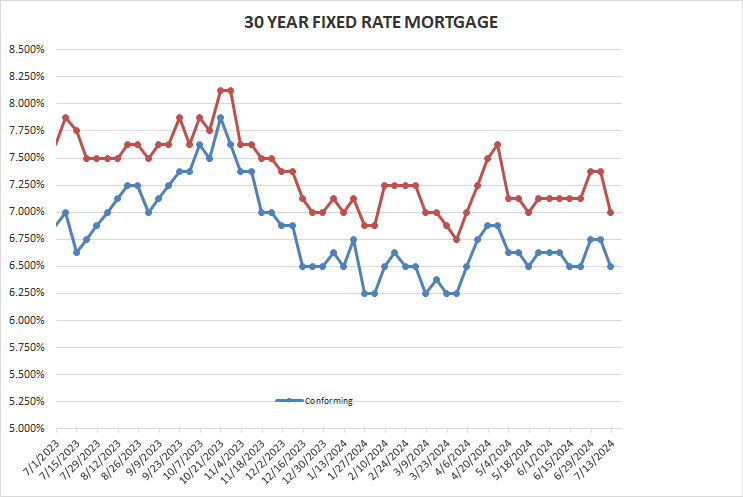
Rates for Friday July 12, 2024: Rates last Friday were consistent from the week before, not so this week as rates had their largest week to week decline since May.
FIXED RATE MORTGAGES AT COST OF 1.25 POINTS LOCKED FOR 45 DAYS FOR PURCHASE TRANSACTIONS:
30-year conforming 6.50% Down 0.25%
30-year high-balance conforming 7.00% Down 0.375%
Please note that these are base rates and adjustments may be added for condominiums, refinances, credit scores, loan to value, no impound account and period rate is locked. Rates are based on 20% down with 740 FICO score for purchase mortgages.
The Smith household is back to “normal,” which is empty-nesting after having our girls home for a few weeks. We are at that stage that we love having them home, but also happy when they go to pursue their own lives.
Back to watching Jeopardy! and other shows we like…
https://www.denniscsmith.com/wp-content/uploads/2024/07/Title-Insurance-Blog-Post-Image.jpg6081080Dennis C Smithhttps://www.denniscsmith.com/wp-content/uploads/2024/06/dennis-c-smith2.pngDennis C Smith2024-07-12 11:41:142024-07-12 11:41:16Do we need title insurance?
Question of the week: What is happening with home sales?
Answer: Depending on the area, sales are a mixed bag. Some areas are seeing higher sales and lower prices, others showing higher sales and prices, some are showing lower sales and higher prices.
Let’s dig into some data from the California Association of Realtors numbers from May.
Statewide the median price climbed to an all-time high in May to $908,040. The climb in the statewide median has been largely due to upper end home sales growing as to the percentage of overall sales—particularly the $2 million and up properties.
The median price was up 0.4% from April’s $904,440 and up 8.7% from the $835,250 median price. Sales were down 1.1% from April and 6% from 2023, indicating there is still a lack of supply in the market.
Looking locally to where most of the WR&MU readers are located…
For the sixth time in the last eight months, the median price home in Los Angeles County dropped from the prior month, to $811,610 in May from $825,970 in April. That represents a 1.7% decline; however, May’s median is 9.0% higher than May 2023 median price of $744,770. Indicating an increase in the first-time buyer and more affordable home sales, the median price declined from April but the number of sales increased by 11.7%. Year over year May’s sales were down 2.6% from last year. The data indicates a growing supply in the market compared to the number of buyers.
Note for local agents in Long Beach area (who I interact with the most) thinking, “supply is still lacking to demand, most homes on the market have multiple offers. The imbalance is too little homes for too many buyers.” The data is for all of Los Angeles County, from Lancaster to Long Beach, from Hermosa Beach to Pomona.)
Orange County also saw an increase in “lower” priced sales in May as its median price declined for the first time since October 23, 2023, dropping from $1,440,000 to $1,422,500. The month-to-month drop is 1.2%, year over year the median price is up 13.2% from last May’s $1,256,500. Sales in the OC went up 11.9% for the month and 12.2% from last May.
Interest rates continue to constrain the move up market, which continues to limit supply and therefore backs up available homes on the market from top to bottom. Many families wanting a bigger, or smaller, home are very reticent to sell their home with a 3% mortgage with a $2400 payment to purchase a home with a 7.0% mortgage with a $4500 payment.
With anticipation of the Fed lowering its benchmark interest rate in September, and rates soften a bit in anticipation, and mixed economic data over the past several months indicating a slowing economy, those want-to-sell homeowners may soon be coming to market—on both the sell and buy sides, thereby increasing supply and demand.
What are your move up options in today’s market? Schedule an appointment to discuss your options.
Murky data this week, murky enough to push rates higher. The final revision to the 1st quarter GDP pushed economic growth to 1.4% after last month’s estimate of 1.3%. The increase was a blip on investors’ screens and no impact on rates. What was interesting in the revision however was the final data on consumer spending showing an increase of only 1.3%, the lowest in two years.
Of greater impact on rates, was the strong personal income increase of 0.5% for the month, up from a .03% increase in April. While personal incomes popped, consumer spending increased 0.2%. The 0.3% gap between earnings and spending indicates that while inflation is pushing wages higher, it is also having consumers pare back on their expenditures. The jump in wages spooked investors as the data can create more inflation as employers raise prices to cover wages.
The final data release of the week was the Personal Consumption Expenditures Index (PCI), the Federal Reserve’s favored inflation index. May’s PCI was flat for the month after a 0.3% increase last month. Year over year, the index increased 2.6%, down from April’s 2.7%. The “core” data (stripping out energy and food due to their volatility), showed a .1% monthly increase, the lowest in seven months, and an increase of 2.6% from last May, a decline from April’s core PCI of 2.7%. With wages significantly outpacing inflation, and spending slowing, we are in a period where it appears the economy could go in a few directions. Mostly, as always, dependent on what consumers decide to do with their increase in income—consumer spending being 65-70% of our economy. Spend the increased incomes spurs the economy, and likely inflation; save the extra money and slow spending and the economy.
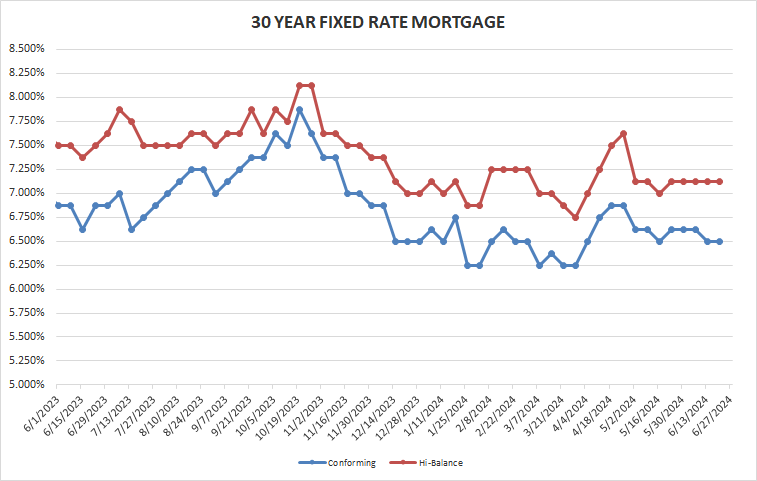
Rates for Friday June 28, 2024: Rates jump this week to their highest levels since April. Part of the jump is the economic data, part is investors pulling out of markets ahead of the holiday week.
FIXED RATE MORTGAGES AT COST OF 1.25 POINTS LOCKED FOR 45 DAYS FOR PURCHASE TRANSACTIONS:
30-year conforming 6.75% Up 0.25%
30-year high-balance conforming 7.375% Up 0.25%
Please note that these are base rates and adjustments may be added for condominiums, refinances, credit scores, loan to value, no impound account and period rate is locked. Rates are based on 20% down with 740 FICO score for purchase mortgages.
There will be no WR&MU next week due to the Independence Day holiday, and day off to celebrate another trip around the sun for yours truly.
Thanks to everyone who replied to last week’s WR&MU with their own baseball stories and heroes. While football may get more attention and television viewers, baseball is still America’s game—at least for me!
Question of the week: What is happening with home sales?
Answer: Depending on the area, sales are a mixed bag. Some areas are seeing higher sales and lower prices, others showing higher sales and prices, some are showing lower sales and higher prices.
Let’s dig into some data from the California Association of Realtors numbers from May.
Statewide the median price climbed to an all-time high in May to $908,040. The climb in the statewide median has been largely due to upper end home sales growing as to the percentage of overall sales—particularly the $2 million and up properties.
The median price was up 0.4% from April’s $904,440 and up 8.7% from the $835,250 median price. Sales were down 1.1% from April and 6% from 2023, indicating there is still a lack of supply in the market.
Looking locally to where most of the WR&MU readers are located…
For the sixth time in the last eight months, the median price home in Los Angeles County dropped from the prior month, to $811,610 in May from $825,970 in April. That represents a 1.7% decline; however, May’s median is 9.0% higher than May 2023 median price of $744,770. Indicating an increase in the first-time buyer and more affordable home sales, the median price declined from April but the number of sales increased by 11.7%. Year over year May’s sales were down 2.6% from last year. The data indicates a growing supply in the market compared to the number of buyers.
Note for local agents in Long Beach area (who I interact with the most) thinking, “supply is still lacking to demand, most homes on the market have multiple offers. The imbalance is too little homes for too many buyers.” The data is for all of Los Angeles County, from Lancaster to Long Beach, from Hermosa Beach to Pomona.)
Orange County also saw an increase in “lower” priced sales in May as its median price declined for the first time since October 23, 2023, dropping from $1,440,000 to $1,422,500. The month-to-month drop is 1.2%, year over year the median price is up 13.2% from last May’s $1,256,500. Sales in the OC went up 11.9% for the month and 12.2% from last May.
Interest rates continue to constrain the move up market, which continues to limit supply and therefore backs up available homes on the market from top to bottom. Many families wanting a bigger, or smaller, home are very reticent to sell their home with a 3% mortgage with a $2400 payment to purchase a home with a 7.0% mortgage with a $4500 payment.
With anticipation of the Fed lowering its benchmark interest rate in September, and rates soften a bit in anticipation, and mixed economic data over the past several months indicating a slowing economy, those want-to-sell homeowners may soon be coming to market—on both the sell and buy sides, thereby increasing supply and demand.
What are your move up options in today’s market? Schedule an appointment to discuss your options.
Murky data this week, murky enough to push rates higher. The final revision to the 1st quarter GDP pushed economic growth to 1.4% after last month’s estimate of 1.3%. The increase was a blip on investors’ screens and no impact on rates. What was interesting in the revision however was the final data on consumer spending showing an increase of only 1.3%, the lowest in two years.
Of greater impact on rates, was the strong personal income increase of 0.5% for the month, up from a .03% increase in April. While personal incomes popped, consumer spending increased 0.2%. The 0.3% gap between earnings and spending indicates that while inflation is pushing wages higher, it is also having consumers pare back on their expenditures. The jump in wages spooked investors as the data can create more inflation as employers raise prices to cover wages.
The final data release of the week was the Personal Consumption Expenditures Index (PCI), the Federal Reserve’s favored inflation index. May’s PCI was flat for the month after a 0.3% increase last month. Year over year, the index increased 2.6%, down from April’s 2.7%. The “core” data (stripping out energy and food due to their volatility), showed a .1% monthly increase, the lowest in seven months, and an increase of 2.6% from last May, a decline from April’s core PCI of 2.7%. With wages significantly outpacing inflation, and spending slowing, we are in a period where it appears the economy could go in a few directions. Mostly, as always, dependent on what consumers decide to do with their increase in income—consumer spending being 65-70% of our economy. Spend the increased incomes spurs the economy, and likely inflation; save the extra money and slow spending and the economy.
Rates for Friday June 28, 2024: Rates jump this week to their highest levels since April. Part of the jump is the economic data, part is investors pulling out of markets ahead of the holiday week.
FIXED RATE MORTGAGES AT COST OF 1.25 POINTS LOCKED FOR 45 DAYS FOR PURCHASE TRANSACTIONS:
30-year conforming 6.75% Up 0.25%
30-year high-balance conforming 7.375% Up 0.25%
Please note that these are base rates and adjustments may be added for condominiums, refinances, credit scores, loan to value, no impound account and period rate is locked. Rates are based on 20% down with 740 FICO score for purchase mortgages.
There will be no WR&MU next week due to the Independence Day holiday, and day off to celebrate another trip around the sun for yours truly.
Thanks to everyone who replied to last week’s WR&MU with their own baseball stories and heroes. While football may get more attention and television viewers, baseball is still America’s game—at least for me!
https://www.denniscsmith.com/wp-content/uploads/2022/12/house-tax.jpg500750Dennis C Smithhttps://www.denniscsmith.com/wp-content/uploads/2024/06/dennis-c-smith2.pngDennis C Smith2024-06-28 12:27:552024-06-28 12:27:57What is happening with home sales?
Question of the week: What does “borrower paid” mean?
Answer: In the July 16, 2021 WR&MU we answered, “What are points and do we have to pay them?” For those not wanting to click, points are the upfront cost of a mortgage, the higher the points the lower the rate; conversely the lower the points the higher the rate.
When pricing a loan with lenders, mortgage brokers use a pricing engine from the lender. One of the many factors we input to get rates is a pull down that asks “Lender Paid” or “Borrower Paid.”
This query is in regards to the points on the loan. If the lender paid option is chosen, the rate is higher, and the originating broker cannot charge any origination points. If borrower paid option is chosen, the borrower will have different rate and cost options—the lower the rate the higher the costs, the higher rate the lower the costs.
In the WR&MU referenced in the opening sentence above, one of the options for not paying points is having the seller give a credit to the buyer at closing which will cover the points for the buyer (borrower) to buy down the interest rate on their mortgage. If this is the case the pricing factor for the loan will be “borrower paid” to buy down the rate.
Moving forward, “buyer paid” will be written into some sales contracts between buyers and sellers. In this case the buyer paid refers to the commission for the real estate agent representing them in the transactions (known as the selling agent.” This reason for this was covered in the November 17. 2023 WR&MU, which covered a court case that resulted in a major change in the real estate industry regarding sales commissions and who needs to pay who.
Everything is negotiable in a real estate purchase, price, credits, fees to affiliated businesses involved in the transaction, commissions. When writing your offer to purchase your new home consider if paying a higher price and receiving credits from the seller to cover some of your costs, fees and commissions, may be a better “deal” for you than paying a lower price and covering all those costs yourself.
If you, or someone you know, is thinking of purchase a new home, schedule an appointment on the link below to go through your options looking at total funds needed to close versus monthly payments for your mortgage.
To schedule an initial meeting by phone or Zoom, click here for my calendar, please feel free to forward to a friend or family member!
If you are the average American, in May you bought a new car, spent less on gas, went out to eat less often, and did not go to retail stores as often, as you did in April. This, according to the retail sales data released earlier this week that showed over all retail sales were up only 0.1% from April, which had it retail sales adjusted to show a decline of 0.2% from sales in March. Keeping the total sales data positive was an increase of 0.8% in auto sales from April, balanced a bit by a continuing drop in gasoline prices (down 0.8%, anecdotally, I paid $4.499 for premium yesterday). The 0.4% drop in restaurant sales is a very strong indicator of the impact inflation is having on families as going out to eat is perhaps the number one discretionary spending option.
Taking auto sales out of the data, retail sales declined 0.1% in May. Considering that retail sales data are based on costs at the register and not the number of units purchased, and the core CPI showed inflation at 3.4% in May, one can extrapolate that “units sold” were down about 3.5% in May.
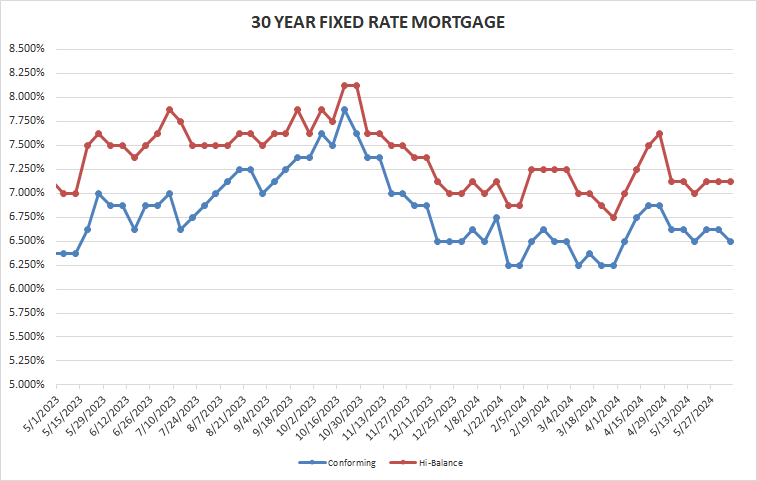
Rates for Friday June 21, 2024: Retail sales did give a bit a boost for the interest rate markets of bonds and mortgages, which results in lower rates, as the data supported a slowing economy which leads to lowering inflation which leads to the Fed cutting its benchmark interest rate. However, the gain was short lived as investors had already priced in a rate cut by the Fed, rates from last Friday remain flat.
FIXED RATE MORTGAGES AT COST OF 1.25 POINTS LOCKED FOR 45 DAYS FOR PURCHASE TRANSACTIONS:
30-year conforming 6.50% Flat
30-year high-balance conforming 7.125% Flat
Please note that these are base rates and adjustments may be added for condominiums, refinances, credit scores, loan to value, no impound account and period rate is locked. Rates are based on 20% down with 740 FICO score for purchase mortgages.
For my generation, and a generation or two older, our legends and heroes are leaving us. Basketball legends, especially here in Southern California, Jerry West and Bill Walton passed away in the month. This week one of my heroes, and definitely my mom’s, Willie Mays, died.
Willie was, a bit arguably but not much, the greatest baseball player in the history of the game. I say a bit arguably as for many years, especially in arguments with Mom, I put forth Henry Aaron—who was my favorite along with the great Johnny Bench.
Both Mays and Aaron started their professional careers as teenagers playing in the Negro League before their contracts were purchased from their teams by the New York Giants and Milwaukee Braves.
Mays could do it all, hit, run, hit with power, field and throw, and he did each of those as well or better than anyone. Mays ended his career with 660 home runs, Aaron with 756. I saw an interview, which unfortunately I am unable to find to link, where both May and Aaron were with Roy Firestone who brough up home runs. Both of the greats said they each could have had more home runs, but often all the team needed was a hit to score a runner on base. They put winning and their teams ahead of personal statistics and records.
One final note on Mays that changed the history of baseball. In 1950 when Mays was with the Birmingham Black Barons a scout for the Boston Red Sox had a deal with the owner of the Black Barons to purchase Mays’ contract for $4500. However, the owner of the Red Sox Tom Yawkey declined to make the deal, according to George Digby the scout, he was told, the Red Sox owner and front office “already made up their minds they weren’t going to take any black players.” Not only did the Red Sox not sign Mays, but years earlier they passed on signing Jackie Robinson; who broke the major league color barrier with the Giants rival, the Brooklyn Dodgers, resulting in many pennants won over the Giants.
Not long after the Red Sox passed on Mays, the New York Giants purchased his contract for $10,000. The Red Sox would not break their segregated line up until 1959, twelve years after Jackie Robinson played his first game for the Dodgers.
Baseball historians can only wonder how many World Series titles the New York Yankees would not have won in the ‘50’s and ‘60’s if Willie Mays had played in Boston with first Ted Williams and then Carl Yastrzemski in the outfield with him, and offering protection in the batting line up.
Poignant that last night the Giants played the St. Louis Cardinals at Rickwood Field, in Birmingham, the same field where Mays played and the oldest professional baseball stadium in the country. Mays was to be part of the ceremonies for the game. He was celebrated and honored last night, as were many players from the Negro Leagues who never had the opportunity to play in the major leagues.
One final note, Major League Baseball announced earlier this month that the records and statistics of players in the Negro Leagues would be incorporated into those of the Major League players, resulting in some changes as to career leaders in several categories.
https://www.denniscsmith.com/wp-content/uploads/2023/06/purchpower-scaled.jpg17062560Dennis C Smithhttps://www.denniscsmith.com/wp-content/uploads/2024/06/dennis-c-smith2.pngDennis C Smith2024-06-21 13:19:442024-06-21 13:19:45What does "borrower paid" mean?
Answer: This simple question covers many areas, let’s explore a few.
First, a reiteration of my moving my mortgage career from Stratis Financial to United American Mortgage—hence the new email address for the WR&MU. I am slowly settling in to new software, systems and personnel after 25 years working with my co-owners and others at Stratis.
Second, in our industry “moving” involves relocating your home. Success in our business means families are moving. Many clients over the years have heard me say that the down side of our successfully funding a mortgage for a family to purchase their new home is that they have to move.
Ugh.
Last night at the Rotary Club of Long Beach annual President’s Dinner I was seated next to fellow Rotarian Cheryl and we were trading stories about moving. We quickly agreed that moving stinks. There are other words but we’ll stick with stinks.
Over the years when discussing moving I have relayed to clients the most common process that I have learned from my own experiences; five times before finishing high school encompassing three states and a foreign country, then about eight times between college graduation at 21 and purchasing first home when 31.
Your offer is accepted and you have a timeline to close and move. You buy boxes and commit to going through your “stuff” and separating keep or toss-donate into separate piles, boxes. After a few days of work, kids, etc you stop the process with a few boxes and garbage bags filled for tossing or donating.
The weekend before you need to move your attitude is “pack everything, we’ll sort when we unpack.” The result is boxes in each room of your house with about 20-30% more “stuff” packed than you need.
Everything is moved into your new home. You find the necessary “Kitchen” box in bedroom #2, unpack the box, and follow this triage system for bathrooms, kids’ rooms, your own room.
The first weekend you are in your home you rearrange the furniture, make multiple runs to Target, Home Depot, Ralph’s to get new mops and brooms, sponges, detergent, shower curtains, wastebaskets, new bedding for kids’ rooms as they are more grown up than the theme in prior bedrooms, gardening tools, extension cords, make-shift fencing for yard for your dog, butter, milk, eggs, bread, condiments you tossed instead of moving
Beer and wine.
You spend the first weekend doing all these basics, looking for different items you need in various boxes.
The following week you tell the kids no screens until homework is completed and at least one of their boxes in their rooms are unpacked. After Wednesday this goes by the wayside as they have soccer and ballet and homework. And you are exhausted.
The second weekend between soccer games and ballet recital you start to go through boxes left with the non-essentials, putting items away in the closet or cupboard you decide to use for those items. A toss-or-donate pile starts to grow.
Late Sunday evening you agree to “put the boxes that are left in the garage and we’ll get to them later…”
Some reading the WR&MU have had those “will do later boxes” unopened in their garages from when they moved…six months?…a year?…X years…ago.
Moving stinks.
Here is a process that I recommend, but probably won’t follow when we next move (which I am already dreading even though we have zero plans to move at anytime in the somewhat near or medium future from a home we have been in for 25 years).
If you can, start culling the toss-donate items as soon as you decide you are going to move, especially if you are selling your home and buying. The bigger the task the more we like to put it off, such as “we’ll sort after we move.” Go through one room, closet, cupboard, section of the garage at a time for an hour, possibly two if you getting into the process. As the saying goes, the best way to eat an elephant is one bite at a time.
Keep a notebook, or pad of paper that everyone has access to for putting down important notifications that need to be made once your move is official
For me, the priority is getting a new tag for the dog (or cat) with the new address. Pets don’t understand boxes all over their home, then going to a new place with odd smells, unfamiliar yard. Some will try to find their way back to the old home, or find a way out, start following their nose around the new neighborhood and not no how to get back to you. Go to PetSmart or other pet store and make a tag and put on a new collar as soon as you know your address, put the collar with you essentials bag so it goes on Phideaux as soon as you get to your new home.
Other notifications and changes due to the new address are address in phones, driver’s licenses, kids’ schools, voter registration, social security, health insurance, MediCare if applicable, and every bank, credit card, auto or student loan account, newspapers, magazines, your parents (seeing if you are still reading).
Moving stinks, but the notification part is a lot easier as you can do most of it on-line.
Finally, long time readers of the WR&MU are aware that AI is not used for the preparation, or creation, of the weekly missives—as evidenced by spelling and grammatical errors, awkward and/or missing phrases or words, etc.
Which leads to a tip of the hat to former LBFD Captain Keith who congratulated me on move to Philadelphia. His comment had me proof read, after sending, the bottom section of last week’s WR&MU when I omitted that we moved to Philadelphia area from Oklahoma when I was in grade school; what I wrote reads as Leslie and I have packed up from Long Beach to move closer to our daughters. Not the case!
To schedule an initial meeting by phone or Zoom, click here for my calendar, please feel free to forward to a friend or family member!
The not good news is good, for rates. As long-time WR&MU readers know, bad news, even not good news, is good for lower rates. This week we received inflation data that showed the Consumer Price Index in May showed no increase in prices—the first time in two years there has been no change. Year over year prices increased 3.3%, down from the 3.4% increase in May from April. The “core” CPI data (strip out food and energy from data) rose 0.2% from April and 3.5% from last May, down from 3.6%. The 3.5% increase in the core rate is the lowest increase in three years. A 2.8% drop in gas prices was the primary driver of the lower prices. Slowing inflation improves the chances of a rate cut from the Federal Reserve.
Also, positively not good, if that makes sense, was an increase in first-time filers for unemployment claims from last month. The weekly filings totaled 242,000, up from 229,000 last week. When the Fed started to raise rates and aggressively pursue a credit tightening path to lower inflation, it stated it understood the policy may put the economy into recession and raise the unemployment rate to 5% or higher. The increasing weekly claim filings offer evidence higher rates are impacting the labor market and higher unemployment.
Amidst the data was a press conference. Federal Reserve Chair Jerome Powell offered some hope, not a lot but some, that perhaps a shift is occurring within the Fed regarding rates. Last month Powell indicated that the Fed may cut its benchmark rate once this year, or as data dictates, specifically mentioning a weaker labor market. This week Powell said that the Fed is keeping a close eye on the labor market but also inflation, and that if both weakened quickly the Fed would move quickly with a rate cut. As well, Fed officials now see only one rate cut or two was a close call.
Rates for Friday June 14, 2024: As expected with the data from the week, the conforming 30-year rate is lower this week.
FIXED RATE MORTGAGES AT COST OF 1.25 POINTS LOCKED FOR 45 DAYS FOR PURCHASE TRANSACTIONS:
30-year conforming 6.50% Down 0.125%
30-year high-balance conforming 7.125% Flat
Please note that these are base rates and adjustments may be added for condominiums, refinances, credit scores, loan to value, no impound account and period rate is locked. Rates are based on 20% down with 740 FICO score for purchase mortgages.
Father’s Day is different when you have adult children that live on the other side of the country. No ties made out of construction paper with flowers drawn in crayon, or chocolate chip pancakes. But there will be phone calls, which this year will be talking about their coming visit. Father’s Day will be next Sunday when both of our girls will be home for a long visit.
My dad passed away ten years ago, and I have been quoting him frequently over the past week when meeting with clients and people at my new brokerage that I will be working with. My dad taught me several things, one was to treat everyone the same no matter their station in life, how much wealth they have or don’t have, what they look like or who they like.
The other is something he told me when I was a few years out of college and I was visiting him in San Francisco, “I’d rather lose a friend telling the truth than get one by not.” As you can imagine, dad was very honest with everyone. Some appreciated it, some did not. Those who did enjoyed a strong friendship and loyalty.
Through my career that has been my guiding principle. I have lost potential clients over the years telling them that what they wanted to buy was not possible, or fiscally prudent. But more often, much more, I have gained clients that appreciate the honest assessment of their financial abilities, scope of price and mortgages that work for them. My concern is not the day you purchase your home, but two, five, seven…years after you have purchased the home; was it the right decision for how your life has unfolded.
https://www.denniscsmith.com/wp-content/uploads/2024/06/moving-1.jpg329488Dennis C Smithhttps://www.denniscsmith.com/wp-content/uploads/2024/06/dennis-c-smith2.pngDennis C Smith2024-06-14 13:12:592024-06-14 13:13:01Moving?
Answer: Parent passing away, divorce, vacation home with family member, college, medical bills, credit card and other debt, are some of the scenarios when we are contacted by clients looking for assistance to obtain a large amount of funds.
In the past five years home prices in California have rocketed up. From June 2019 to April 2024 (most recent data available from the California Association of Realtors) the median home price statewide have increased 48%, in Los Angeles County the median price is up 38%, and in Orange County the five year increase is a staggering 71%.
This increase in home values has created almost hundreds of billions of dollars of equity for homeowners.
Equity can be used to payoff debts, settle legal actions, or improve the value of property. In other words, equity can be converted to cash to be used in any manner desired.
Equity is mostly converted to cash with either a long-term mortgage or a Home Equity Line of Credit. Each has their advantages and disadvantages depending on the reason for the funds, long-term plans, and ability to repay.
For mortgages we will use a standard 30-year fixed mortgage for our examples. The rate and payment are fixed for the term of the mortgage and the guidelines used will be those set forth by Fannie Mae. This is the Wonder Bread of mortgage products.
A HELOC, is a loan that is secured by the property, is in second position to an existing mortgage (meaning in foreclosure is gets paid after costs of the foreclosure, the government for taxes owed if any, and the primary mortgage). HELOCs are similar to credit cards, there is an maximum credit limit, with the exception of a possible annual fee, payments are based only on the outstanding balance—so if no balance no payment, and there is a minimum payment based on the balance—typically interest only.
Where HELOCs differ from most credit cards is the rate is adjustable. HELOC rates are based on the prime rate and move up and down as the prime rate moves.
A very big advantage the HELOC has over a traditional mortgage are the significantly lower credit costs. The primary disadvantages are the rate is usually higher than the fixed rate mortgage, and the adjustable rate as borrowers do not know what their rate and payment will be in the future. Note, the prime rate almost always moves up or down when the Federal Reserve raises or lowers its benchmark rate. With the Fed signaling it is pretty certain it will not raise rates in the future, those with HELOCs are fairly safe in assuming their rates will go down in the future (see economic recap below).
For traditional mortgages pulling equity out of a home is known as a cashout refinance. A cashout refinance has a fairly significantly higher interest rate than a rate and term refinance that is used to lower the rate and payment on a mortgage with not funds being distributed to the homeowner.
However, when equity is pulled out of a home to settle a legal matter and funds are paid directly to the other party as a settlement the transaction is priced as a rate and term refinance and not a cash out. This applies to pulling funds out to settle and estate or a divorce.
Sara and Frank are getting divorced after 10 years. They own a home that is worth $1 million and they have a mortgage of $500,000. As part of their division of assets in their divorce decree, Sara will retain the home if she removes Frank from the current mortgage and pays him $200,000.
If it was just paying him the $200,000 Sara may want to get a HELOC as their current mortgage rate is 3%. However, she needs to get him off the current mortgage so she applies for and qualifies a $700,000 mortgage at a 6.5% rate. Her payment will be about $4400 per month, however the $2000 per month in support payments from Frank bring the payment to close their current mortgage payment.
Another common legal settlement is the family home. Mrs. Miller passed away, the family home she has lived in for the past fifty years is valued at $1,000,000, there is a balance of $300,000 on a reverse mortgage taken out several years ago to pay off her mortgage and provide monthly income to pay for home care. Her children Jack, Jill and Jane are the beneficiaries of her estate that includes not only the home but an IRA with about $300,000 and other liquid assets totaling about $100,000. Jack and Jill live a distance from the family home, while Jane lives not far away and would like to keep the home. In the division of assets, the total of the IRA, other liquid assets, and net equity is about $1.1 million. Each child is to receive approximately $367,000.
Jane proposes that her siblings split the IRA and other liquid assets for $200,000 each, and she pays them another $167,000 for their share of ownership in the family home.
Jane refinances for a total of $634,000 at a rate of 6.5% with the proceeds of the mortgage, after the reverse mortgage being paid off, going directly to Jack and Jill or to the estate to distribute. Each of the children has benefited close to equally from mom’s estate.
A further bonus for Jane is due to Proposition 19, because she will occupy the home, she will also inherit her mom’s property tax base.
Pulling equity out to pay off other debt changes what instrument to use for two reasons. One, there will be no change in title or need to remove a party from the mortgage. Two, because the transaction will need to be a cash out refinance the rate will like be higher than a rate and term refinance.
Because of this, depending on the amount needed, and the current rate on the primary mortgage, the homeowner may find a HELOC is a better option.
Consider Barry and Betty who have a home valued at $1 million, they have a 30-year fixed rate mortgage with a balance of about $465,000 with a payment of $2100 and a rate of 3%. Over the past several years they did a lot of small home improvement/remodeling projects in their home, and each had some significant medical situations; the result is they have about $75,000 in credit card debt costing them about $1500 per month in just the minimum payments.
Option one is to refinance their mortgage and debt for a total of $540,000 at a rate of 7.00%. This will give them a payment of about $3600 per month, about what they are paying now.
Their other option would be to get a HELOC with a maximum amount of $250,000* with a rate of the prime rate plus one-half of one percent (0.50%) for a current rate of 9.00%. The interest only payment on the balance would be $563 per month, however, by making this payment the balance never gets paid off.
If the current payments to the credit cards of $1500 per month is paid on the HELOC, at the current rate the balance will be paid off in about five years. However, with rates likely to be going down over the next few years, the rate on the HELOC will drop, accelerating the payoff of the balance.
Using the HELOC and paying the current credit card payment the amount is paid off in 5-years, whereas using a 30-year mortgage the amount is carried proportionally over 30-years, not to mention another four years have been added to the mortgage, which is about $170,000 in payments.
A question some may be thinking, “if rates are going down, can’t the 30-year mortgage be refinanced to lower the payment?” Yes, it can, however in doing so costs will be incurred, and the length of the mortgage extended.
Whether extending the term of the mortgage matters or not is a different question for another WR&MU.
*Since not paying for unused amount available on the HELOC, it makes sense to get more than needed in case something comes up in the future so you don’t need to go through process and expenses of getting another HELOC.
Using home equity to payoff debt can be a problem if, like we saw in the mid-2000’s, homeowners begin to use their homes as credit cards, constantly pulling out equity to payoff debts for credit card debt used for consumer goods, trips, boats, cars, other “toys.” However, for unusual, or one-time situations, using equity for debt consolidation can be a beneficial financial move.
To schedule an initial meeting by phone or Zoom, click here for my calendar, please feel free to forward to a friend or family member!
Yes, no? Another pogo-stick week as investors got good news (for rates) then not as good news. Early in the both the Canadian and European Central Banks lowered their benchmark interest rates by 0.25% based on economic conditions in their regions. This combined with labor data showing an increase in unemployment claims, and a decrease in job openings, gave support to the Fed lowering its benchmark rate this year, with some saying two rates cuts by the end of the year.
From “yes” to “no.” A wet blanket was thrown on the lower rate expectations today with the Labor Department’s release of May jobs data. The expectations were that 185,000 jobs were added to the economy for the month, somewhat missing the mark when the data showed 275,000 new jobs in May. Also in the report was the average hourly wage increased 0.4% for the month and 3.9% year over year—both higher than inflation. One concern I have in the data is that the second highest sector adding jobs is local, state and federal government positions—my concern is that these jobs do not add to economic growth but instead to government spending and debt that is paid for by the private sector. The report reversed gains in mortgage securities (lower rates) from earlier in the week.
Rates for Friday May 31, 2024: As a result of today’s data, rates are the same for the third week in a row.
FIXED RATE MORTGAGES AT COST OF 1.25 POINTS LOCKED FOR 45 DAYS FOR PURCHASE TRANSACTIONS:
30-year conforming 6.625% Flat
30-year high-balance conforming 7.125% Flat
Please note that these are base rates and adjustments may be added for condominiums, refinances, credit scores, loan to value, no impound account and period rate is locked. Rates are based on 20% down with 740 FICO score for purchase mortgages.
Yesterday was the 80th anniversary of D-Day. Eighty years before D-Day, June 1864, the Civil War was approaching its tipping point, in part because of the Battle of Cold Harbor, part of General Grant’s attempt to take Richmond, the capital of the Confederacy. The two week battle was brutal with over 12,000 Union casualties and almost 5,000 Confederates killed or wounded. General Lee and his troops repelled the Union attack, a victory that would be Lee’s last against the Union Army.
Eighty years later American soldiers would again fight a brutal battle in a prolonged war fought to free millions from oppression. Thankfully, due to those who fought these battles 80 and 160 years ago, we remain a free nation and a beacon to the world shining a light of liberty.
One final note, eighty years before the Battle of Cold Harbor, on June 3, 1784 the Congress of the Confederation established the United States Army on June 3rd(put into power with the Articles of Confederation, replacing the Continental Congress and in place until 1789 with the ratification of the Constitution).
This being the often personal section of the WR&MU, since our move to the Philadelphia area, where we could ride bikes to Valley Forge National Park, I have had a lifelong interest and in American history, particularly the “war eras” of the Revolution-Constitution, Civil War and World War II, they come together in our update this week.
https://www.denniscsmith.com/wp-content/uploads/2023/07/454-4545567_suggestions-to-avoid-blunders-when-listing-your-home.png656669Dennis C Smithhttps://www.denniscsmith.com/wp-content/uploads/2024/06/dennis-c-smith2.pngDennis C Smith2024-06-07 13:25:292024-06-07 13:25:30How do we pay off ________?
Answer: When purchasing a new home, the amount you need to close the transaction is more than just the down payment. In addition to the down payment there are closing costs.
Loan costs, escrow and title fees, inspection and appraisal, home owner’s insurance premium, if you are having an impound account funding taxes and insurance payments to establish the account.
Usually, the closing cost that is the largest are the “points” on the loan. Briefly, points are the cost of the loan for the interest rate you are getting, the higher the points the lower the rate and vice versa (a detailed look at points in the WR&MU from July 2021 here).
For many first-time buyers have enough for a minimum down payment, but come up short to cover all the closing costs. There are a few options to purchase the home with the amount of cash available.
More money in the form of a gift from a family member, or tapping a retirement account—such as a loan from your 401(k), are traditional methods to cover cash short falls, however if they are not available there are a couple of other options.
One is to have your lender run your ability to qualify for a higher interest rate that would reduce the amount of points you have to pay.
Another, is to put in your purchase offer having the seller credit you for a certain dollar amount to cover your closing costs.
Why would a seller do this?
To sell their home.
From data I have been looking at homes are staying on the market a bit longer than earlier in the year. Is it lack of buyers, abundance of sellers, or sellers having priced above the market for what buyers are willing to pay, or can afford.
How it works.
A home is listed for $700,000. You have about $45,000 for down payment and closing. Your down payment with 5% down is $35,000. Your estimated closing costs total about $25,000 for loan, escrow, title, impound account, etc.
You write your offer for $700,000 with request the seller pay $20,000 in closing costs.
If the seller accepts your offer, they are essentially selling the home for $680,000. They counter your offer saying they will pay the closing costs if you pay $720,000 for the home. You can counter the counter, but for simplicity of explanation, you accept the counter.
The impact for you is that your down payment has gone from $35,000 to $36,000, and your remaining closing costs are around $5000.
“But our loan payment will go up.”
True, but not significantly, if the loan rate and points are the same.
At $700,000 with 5% down with a rate of 6.75% your payment would be $4313.
At $720,000 with 5% down the payment is $4436; a difference of $23 to save $20,000.
However, you did not have the funds to close at $700,000 with 5% down, to cover the $15,000 shortage in cash you entered the transaction with (your $45,000 available less $35,000 down payment and $25,000 costs), would require you to have a higher rate to offset closing costs, about 2.5% of the loan amount. Currently, that rate is not available, if it was it would likely be close to 8%.
In essence, to purchase a home in the $700,000 price range, with $45,000, you will need financial assistance from either a gift or accessing retirement or other accounts, or having the seller contribute so they sell their home and you buy yours.
To schedule an initial meeting by phone or Zoom, click here for my calendar, please feel free to forward to a friend or family member!
Some positive rate news the last two days, enough to counteract rates moving higher to start the week. Reminding that negative, or even not good, economic news puts pressure for rates to go lower, we had not good news yesterday and today. Yesterday GDP for the 1st quarter was revised from its initial estimate of 1.6% growth down to 1.3%. The revision was due in large part to lower the estimate of consumer spending for the quarter to 2% growth from prior estimate of spending increasing 2.5%.
Speaking of consumer spending, April’s estimate for consumer spending showed an increase of 0.2% from March, the lowest month to month increase in three months; portending that inflation is starting to strongly impact American consumers spending habits. Interesting to the spending increase is that it was lower than the increase in personal income, up 0.3% for the month, matching inflation for the month. Interesting because if incomes are higher and spending is lower the result should be an increase in savings.
The Personal Consumer Expenditures (PCE) is the preferred inflation index for the Federal Reserve. For April the PCE was up 0.3%, the core rate (the key data for the Fed as it strips out food and energy from the overall data) was up 0.2%, the lowest increase in the core rate since December. Year over year inflation was flat from April up 2.7% overall and 2.8% for the core.
Rates for Friday May 31, 2024: The teeter then totter mortgage rate market resulted in rates being flat this Friday from last.
FIXED RATE MORTGAGES AT COST OF 1.25 POINTS LOCKED FOR 45 DAYS FOR PURCHASE TRANSACTIONS:
30-year conforming 6.625% Flat
30-year high-balance conforming 7.125% Flat
Please note that these are base rates and adjustments may be added for condominiums, refinances, credit scores, loan to value, no impound account and period rate is locked. Rates are based on 20% down with 740 FICO score for purchase mortgages.
I felt like a teenager this week. No I wasn’t my 16-year old, heavily pimpled, scrawny kid in the middle of a one foot growth spurt in three years with a tendency to crack wise in class, self.
On Wednesday I told Leslie I could drive myself to my doctor’s appointment so the bone doc could check my progress four weeks after my right knee replacement. She said she would go along just in case I wasn’t able to safely get there and back once I had to move my foot between brake and accelerator.
I managed to make the round trip with no incidents. When we arrived home Leslie let me know I had passed my test, I could get my license and drive unaccompanied moving forward.
Able to drive a car in Southern California means freedom.
https://www.denniscsmith.com/wp-content/uploads/2022/12/house-tax.jpg500750Dennis C Smithhttps://www.denniscsmith.com/wp-content/uploads/2024/06/dennis-c-smith2.pngDennis C Smith2024-05-31 11:33:012024-05-31 11:33:02What is a seller credit?
Answer: I have affiliated my California Department of Real Estate Broker’s license and my National Mortgage Licensing System license with United American Mortgage.
Based in Costa Mesa, UAM has been operating for thirty years, has excellent management and support staff for loan originators and their clients. I chose UAM for several reasons, flexibility with my part in the loan process, wide range of products to offer clients, ability to focus more on my financial advisory business, and experience.
Experience has many meanings. One is wisdom and proficiency gained over time, of which UAM has plenty.
Another is direct involvement with a person or entity. Which I, and many of my clients, have had over the years as I have referred them to a friend of my who has worked at UAM for several years. Chasse, my friend, has assisted my referred clients with commercial transactions, residential transactions out of state, or residential transactions where he had available loan programs the client needed that were not available to me.
Our relationship has been formalized this week so it will take a few days to get me up and running completely on their system, but I will be open for business for any mortgage needs, information or conversations you, your friends or clients may need.
Thank you in advance for your continued support, and most importantly your trust in working with you on your personal business as well as the trust you put in me when referring others.
To schedule an initial meeting by phone or Zoom, click here for my calendar, please feel free to forward to a friend or family member!
Rates for Friday May 24, 2024: There was no economic news to move rates this week, however there were several public speaking engagements by members of the Federal Reserve which did have some impact on rates. The consistent message from the Fed governors was that there appears to be a chance the Fed may lower its benchmark rate this year, but likely only one time, instead of several times as previously hinted at, and expected by the markets. As a result, there was a slight bounce in mortgage rates from last Friday.
FIXED RATE MORTGAGES AT COST OF 1.25 POINTS LOCKED FOR 45 DAYS FOR PURCHASE TRANSACTIONS:
30-year conforming 6.625% Up 0.125%
30-year high-balance conforming 7.125% Up 0.125%
Please note that these are base rates and adjustments may be added for condominiums, refinances, credit scores, loan to value, no impound account and period rate is locked. Rates are based on 20% down with 740 FICO score for purchase mortgages.
Before you head off for the three-day weekend, open your address book and change my email for mortgage business to [email protected], it is easy to do with a few clicks!
Enjoy the long-weekend and the unofficial start of summer!
https://www.denniscsmith.com/wp-content/uploads/2024/05/parachute.png444620Dennis C Smithhttps://www.denniscsmith.com/wp-content/uploads/2024/06/dennis-c-smith2.pngDennis C Smith2024-05-24 12:54:062024-05-24 12:54:07Where have you landed?