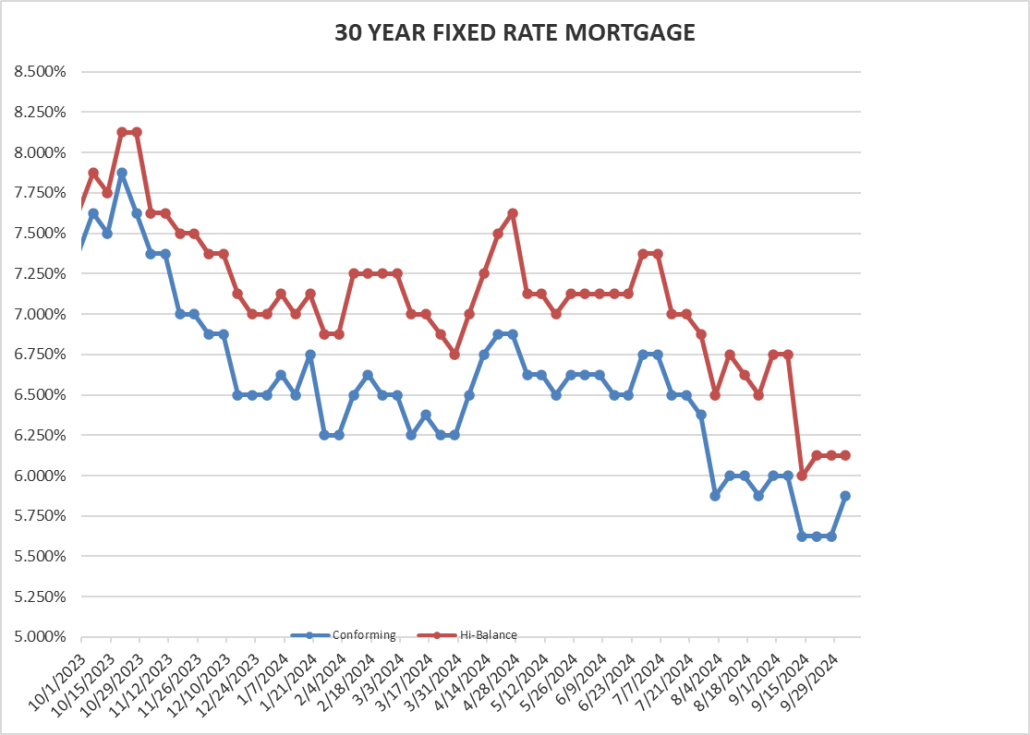
How will election impact mortgage rates?

Question of the week:   How will election impact mortgage rates?

Answer: Minimally.

Every four years the media for every sector of the economy runs articles on “what happens to _________ if X or Y is elected?” Automotive, travel and leisure, financial services, real estate, shoes, pets, toys and games…and mortgage.

Historically, going back many, many elections, there has been negligible movement in mortgage rates following an election. There have been some immediate responses in the days following the election as investors move money in or out of equities, bonds, cash, but very often rates revert to their pre-election range, waiting for economic data that foretells what rates may do in the future.

Looking past the short and medium term following the election, mortgage rates should move the same way regardless of which candidate wins.

Why? Because both have presented economic proposals that, if actually enacted, will increase the deficit. Higher deficits mean more borrowing by the government to fill the gap between spending and revenue. More borrowing means debt issued by the Treasury Department, that competes with mortgages for investors.

What happens when the government issues a lot of bonds to finance large spending packages? Rates go up. Unless… the Federal Reserve jumps into the market and buys an extremely large percentage of the government debt issues and funded mortgages.

Not only are the proposals presented deficit growers, but they are also inflationary. Tariffs, raise prices. Forgivable loans. Tax free income. Direct payments. All either limit supply or increase demand, depending on the sector of the economy affect is inflationary.

What happens when inflation increases? As we have seen, rates go up.

 Most campaign promises from the very top of the ticket need help from lower on the ticket to become law and policy; which is why I have always been averse to one party controlling all three houses, both in Congress and the one on Pennsylvania Avenue. This limits the ability of one party to control all fiscal policy. If one party does have that ability, we can likely expect economic policy that will be more likely to keep rates relatively high, or higher.

Unless…policies, geopolitics, natural disasters, or other factors result in economy falling into recession. In which case rates would remain stable or decline depending on severity of recession and where rates are when it begins and ends.

More likely to impact rates than who is sworn in on January 20th are the decisions of the Federal Reserve. What movements, and how big, will they make? More importantly is the debt issued by Treasury, Fannie Mae and Freddie Mac.

Currently the Fed owns over $7 trillion of Treasury and mortgage debt, down from almost $9 trillion in 2022. If the Fed accelerates “unwinding” its balance sheet, i.e. selling assets, that increase supply and push rates higher. If the Fed buys more assets, sucking up available supply, rates will go lower. If the Fed does nothing, and lets their balance sheet decline as bonds and mortgage pay off, rates will be minimally impacted, if at all.

If you are making your decision on November 5th based on interest rates, you can flip a coin as whoever wins will likely have the same impact.

Schedule an appointment to discuss your options if you are considering purchasing a new home or property or refinancing an existing one and want to know the mortgage options available to you. 

Have a question? Ask me!

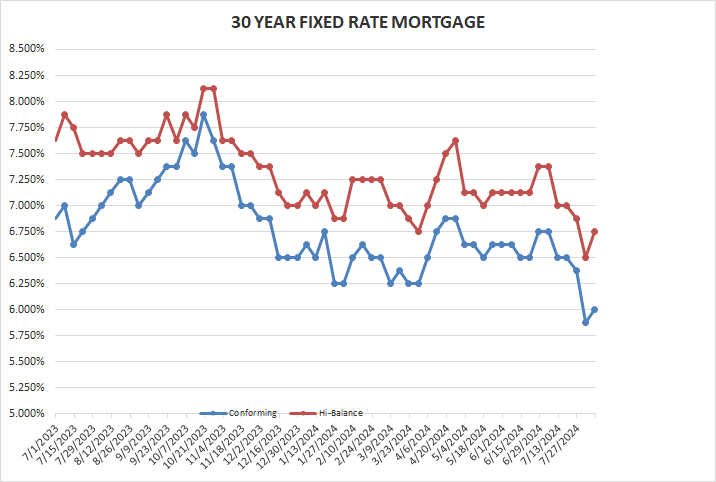
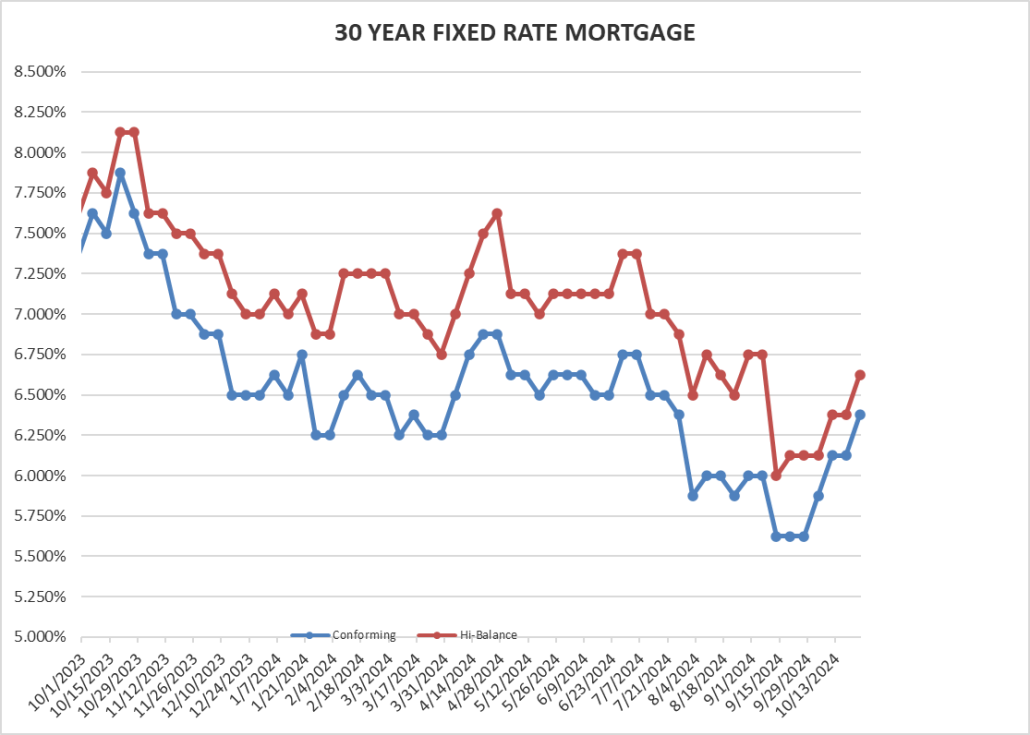
Rates for Friday October 18, 2024: Very little economic news this week, but rates are on the rise. As you may have noticed, we had no WR&MU as traveling home from our trip, but rates were stable from the Friday before. Not so much this week as investors jockey to try to predict November 5th. However, even more jockeying as they come to consensus that the Fed’s rate reduction program will likely be lower and slower in the coming months following the large cut last month. Rates spike this week, the conforming rate at its highest since the end of July.

FIXED RATE MORTGAGES AT COST OF 1.25 POINTS LOCKED FOR 45 DAYS FOR PURCHASE TRANSACTIONS:

30-year conforming                             6.375%        Up 0.25%        

30-year high-balance conforming        6.625%        Up 0.25%      

Please note that these are base rates and adjustments may be added for condominiums, refinances, credit scores, loan to value, no impound account and period rate is locked. Rates are based on 20% down with 740 FICO score for purchase mortgages.
I. Love. Baseball.

Something long-time readers of the WR&MU are aware, but just in case wanted to affirm my affinity for America’s Past time. While disappointed (understatement) my Phillies couldn’t hit with runners on base and lost to the Mets, very happy the Dodgers are playing in the World Series in their stead. Also, very happy that they are matched up with the Yankees for the 12th time in World Series history.

The last time the two teams met in the Series was 1981, the third time in five years. That season was magical and historic for the Dodgers, and baseball. It was the season that Fernando Valenzuela made his debut in the major leagues. And what a debut it was.

Prior to Fernando became Fernandomania, there was not a lot of positive emotion in the Los Angeles Mexican and Latin American communities due to the Dodgers, and City of Los Angeles, displacing businesses and thousands of residents in Chavez Ravine and scraping their homes and stores to build Dodger Stadium. As you might have guessed, had you not known before, Chavez Ravine was a very heavily populated with Hispanic families.

Fernando’s exploits and success resulted in those communities becoming lifetime, generational, Dodger fans. As one tribute I heard said, for decades the soundtrack in Dodger Stadium was through hundreds, thousands, of transistor radios as fans listened to Vin Scully call the game (I was one when I went—I also kept a scorecard). In 1981 there was a dual soundtrack with Hall of Fame announcer Jaime Jarin providing the Spanish language broadcast.

In the spring of 1981, I was a freshman at Pitzer College in Claremont. Naturally I was following the Dodgers, and other teams, through spring training and was aware of Fernando, but not aware of what we were about to experience. My best memory is shortly before breaking training camp in Vero Beach, Florida, manager Tommy Lasorda announced his starting rotation. Pitching opening day was long time Dodger Jerry Reuss, making the rotation was Fernando. In those days teams had 5-man pitching rotations. I don’t recall where Fernando was in the rotation but because it was every fifth game fans could determine when he was pitching.

One morning my roommate Steve and I went to the Sears in Pomona, which was, and in part still is, a large Hispanic community. Old timers reading this will recall Ticketron, similar to today’s TicketMaster. Sears had a deal with Ticketron and they had a walk-up window outside the Sears store in Pomona.

We arrived around the opening of the store and there was a long line, fifteen, twenty, men in line, jeans, boots, cowboy hats on many, evident of Hispanic heritage. Most of them had the pocket Dodger season schedules handed out by Union 76. Walking by I could see some of the schedules and they had every 5th game circled, showing when Fernando would be pitching in Dodger Stadium. I have to believe that after Fernando filled in for Reuss on opening day at the last minute to start his amazing start to his career with a win and a complete game, that because that changed the rotation, many of those men, and others, were back in line at Ticketron with every fifth game circled so they could watch one of the greatest pitchers in Dodger history. Fernandomania was underway.

Very sad that Fernando will not be at Dodger Stadium tonight, my bet would be he would through out the ceremonial first pitch, as he did in the 1981 Series, beating the Yankees with a complete game. He will be there in spirit, and the tens of thousands of fans in attendance will show their appreciation with a long, and deserved, ovation for the man who change the fabric of the game in Southern California and everywhere else the game is played.

What is driving the housing market?

Question of the week:   What is driving housing market?

Answer: The Millennial Generation. In 2019 millennials (defined as born 1981 to 1996) surpassed baby boomers as the largest living adult generation. Today millennials are between 28 and 43 years old.

Nationwide, first-time homebuyers are overwhelmingly in their late twenties and early thirties; due to higher home prices in Southern California the first-time homebuyer age gets pushed a bit higher.

Looking at data from August, approximately 55% of government backed and conventional purchase mortgages funded were to first-time buyers, according to Intercontinental Exchange, who specializes in data services. That is the highest percentage of the market for first-time buyers going back to 2014.

What continues to drive the market on the supply is predominantly death and divorce. Heirs and beneficiaries are putting the family home on the market after the death of parents. Divorcing couples are selling homes to split their equity and go their separate ways. Also adding to local markets are empty nesters selling to down-size, and families moving out of the area or state.

What remains a drag on housing supply are move-up buyers, reticent to sell their homes with mortgage rates in the low 3’s, or lower, for a mortgage with a rate near, or over 6%, almost doubling their housing cost.

With the buyers holding back from entering the market due to higher rates, millennials who have been on the sideline of the market have been able to accumulate more funds for their home purchase; many keeping pace with rising prices and higher down payment needs.

Stereotypes of millennials include their preference to travel and spend on experiences rather than “things,” and propensity to save better than other generations. As they enter the prime first-time buyer age, many are able to leverage their savings into down payments.

Generations enjoy poking fun and stereotyping other generations. For homeowning boomers who have been poking fun, or feeling exasperated by, millennials in their workplaces, neighborhoods, or families, be thankful for their tendencies that may drive you a bit crazy as they are able to purchase your home when you decide to put it on the market.

Oh, and get ready for more of them to be your neighbors as they the most likely generation to purchase the home next door!

Schedule an appointment to discuss your options if you are considering purchasing a new home or property or refinancing an existing one and want to know the mortgage options available to you. 

Have a question? Ask me!

Last week surprised to the upside, this week we are again surprised with higher than expected data. The Consumer Price Index was released this week and it showed prices increased 2.4% from last September, expectations were a 2.3% increase after August prices showed a 2.5% change. Core prices (fuel and food taken from data) increased 3.3% in September after a 3.2% increase in August. While prices are significantly higher than the were in January 2021, the rate of inflation is at the same level.

Digging into the data, food prices had their biggest one month increase since January. Energy costs dropped 4.1% for the month—portending lower heating costs this winter. For retirees, the Social Security Administration has announced a 2.5% increase in payments for 2025, tracking the inflation rate, the increase is the lowest in four years.

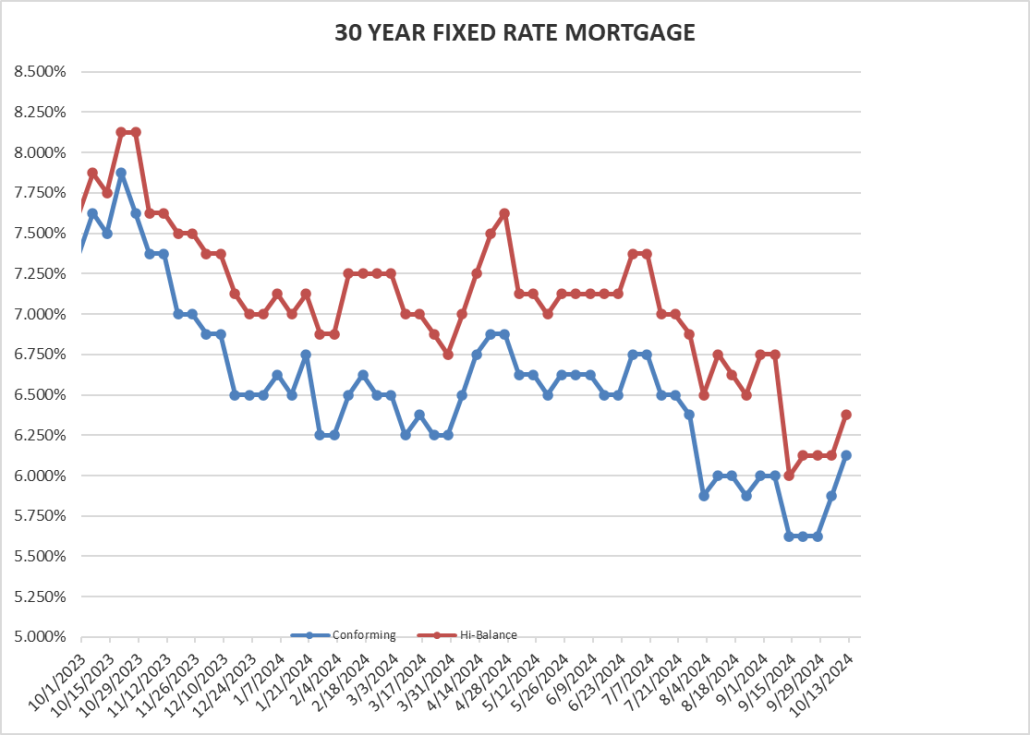
Rates for Friday October 11, 2024: Sticky inflation numbers, combined with last week’s strong jobs data, comments from members of the Federal Reserve Board of Governors regarding moderation in lowering rates, has pushed mortgage rates higher again this week. Rates are at their highest since August.

FIXED RATE MORTGAGES AT COST OF 1.25 POINTS LOCKED FOR 45 DAYS FOR PURCHASE TRANSACTIONS:

30-year conforming                             6.125%        Up 0.25%        

30-year high-balance conforming        6.375%        Up 0.25%      

Please note that these are base rates and adjustments may be added for condominiums, refinances, credit scores, loan to value, no impound account and period rate is locked. Rates are based on 20% down with 740 FICO score for purchase mortgages.

The WR&MU is coming to you from Brooklyn, we are here visiting our youngest after visiting our oldest in Boston. Before heading home we are detouring through Montreal and Quebec City for some exploring and enjoying the beautiful fall foliage in the Northeast region

Another plea in the “personal” section of the WR&MU to assist in recovery efforts for not only Helene but also Milton which added to Florida’s challenges.

Integral to these efforts, as always, is the American Red Cross. I implore you to make any size donation by clicking here. Thanks to everyone who clicked and donated last week, and to those who will do so this week.

What is a “No Doc” loan?

Question of the week:   What is a “No Doc” loan?

Answer: Back in the old days…. No documentation loans were somewhat prevalent in the market. Too prevalent in the early-2000’s which was a large factor in the mortgage and real estate industry melt down that dragged the economy into the Great Recession.

Today the number of no-doc programs available are increasing, but not to the extent of the early 2000’s, primarily because Fannie Mae and Freddie Mac are not offering the version of no-doc programs they were approving and then selling in the secondary market as the same risk as full documentation loans.

“No-doc” covers a wide set of programs that have one similarity, they do not require traditional methods of verifying an applicant’s income. In traditional, full documentation loans, borrowers are required to provide proof of income. Depending on your how you earn your income, documentation can be paystubs, W-2’s, federal tax returns, corporate tax returns, asset statements showing income from investments, award letter from Social Security Association or pension fund. Documentation that verifies you have history and consistency of income and its source.

Pricing on no-doc loans is determined as with all mortgage pricing, the two primary factors are your credit score and the loan-to-value of the mortgage (LTV is the percentage down payment from 100%; i.e. if you put down 20% the LTV is 80%). The higher your score the better the rate. The lower the LTV the better the rate.

No-doc programs have different ways of determining qualifying income to determine if you have the ability to repay your applied for mortgage.

Stated-income loans are as defined, you state your income. There is no verification of the source or amount reported to the IRS. You provide bank statements to show fund available for down payment and closing costs, typically reserves after close of escrow are require as well.

Bank statement loans look at one or two years of bank statements, either personal or business depending on if you are self-employed. The underwriting policy is to add up your deposits and then use a factor to determine your expenses, the result is qualifying income. This is a popular program for self-employed borrowers, especially if they have had a large growth in revenue, or have not yet filed tax returns for the prior year. Depending on programs, bank statement loans have better rates than stated income loans as gross income is being calculated using the deposits.

Not as prevalent, but available from a few lenders, are true no-doc loans that require large down payments, very high credit scores, and have higher rates. Often these loans require pledge of assets, such as a trust deed on another piece of real estate.

There are several no-doc loan programs currently available that offer rates that are very competitive with conventional mortgages, resulting in a substantial increase in volume for lenders.

Schedule an appointment to discuss your options if you are considering purchasing a new home or property, or refinancing an existing one and want to know the mortgage options available to you. 

Have a question? Ask me!

Not nearly what was expected. Markets look forward to the first Friday of every month for job data for the prior month. With the Fed in rate cutting mode, today’s data was highly anticipated as an indicator of when and how much the Fed may next cut its benchmark rate. The consensus on Wall Street was an increase in 150,000 new jobs in September. The Department of Labor today announced that 254,000 new jobs were created last month. Not only did the September data come in much higher than expected, but the estimates for July and August. For the second month in a row the unemployment rate has declined, from 4.2% to 4.1%. A strong labor market is good for the economy, but not so good for those, the Fed, working to lower inflation. The news was not mortgage rate friendly.

Rates for Friday October 4, 2024: The conforming rate jumps from last Friday, not only on the labor report, but also on concerns about the conflict between Israel and Iran escalating.

FIXED RATE MORTGAGES AT COST OF 1.25 POINTS LOCKED FOR 45 DAYS FOR PURCHASE TRANSACTIONS:

30-year conforming                             5.875%        Up 0.25%      

30-year high-balance conforming        6.125%        Flat

Please note that these are base rates and adjustments may be added for condominiums, refinances, credit scores, loan to value, no impound account and period rate is locked. Rates are based on 20% down with 740 FICO score for purchase mortgages.

It is estimated that Hurricane Helene dropped approximately 40 trillion gallons of water across the South. That is enough water to fill Lake Tahoe, equivalent to over six hundred days of water flowing over Niagra Falls.

We have all seen the devastation to many areas, particularly western North Carolina and other parts of Appalachia. Leslie and I drove through the area two summers ago, going from Nashville to Asheville, North Carolina, where we spent several days. The town is completely unrecognizable, and we cannot imagine what certain parts of the area where we ate lunches or had a beer, must be like today.

There are many areas where people are completely isolated as rescue responders are still working to gain access and provide aid and relief.

The region needs a tremendous amount of assistance to recover, restore and rebuild their homes and communities—many of which will never be rebuilt.

Integral to these efforts, as always, is the American Red Cross. I implore you to make any size donation by clicking here.

What are your positions on housing related ballot measures in California?

Question of the week:   What are your positions on housing related ballot measures in California?

Answer: Ballots will be mailed soon to Californians for the November elections. On the ballots there are two propositions that directly impact property owners and cost of housing in the state.

Proposition 5 if passed will, for local bonds and taxes for affordable housing and public infrastructure, change the current constitutional requirement that two-thirds of voters approving to fifty-five percent needed for approval. If passed this will result in more local governments using the lower threshold to pass qualifying bonds and tax measures, pushing the cost of these projects from all tax payers to property owners.

I will be voting “no” on this proposition for many reasons.

First and foremost, since the beginning of this century our local, county and state governments have passed bonds, measures, and budgeted expenditures amounting to tens of billions of dollars meant to make housing more affordable with a primary focus on reducing homelessness. Where has this money gone? There has been no accountability of the funds collected and spent to show any results toward the intended goals.

Second, voted indebtedness and direct assessments on our property tax bill (Long Beach) amounts to over twenty-five percent of our bill. This is with the current two-thirds requirement to increase property taxes. Every time a new ballot measure comes up for infrastructure or bonds it sold as, “it will only increase your tax bill by $X per thousand dollars of assessed value.” It seems small until you do the math on how many hundreds of thousands of dollars you are assessed. It adds up.

Third, supporters of this proposition say it will shift spending priorities from the state to local governments. It does not shift priorities; it makes it easier for local governments to shift responsibility from themselves to voters while giving them access for more funds that can be used for non-infrastructure projects in their budgets that may not be a priority for local voters.

Finally, be wary when government gets involved in “affordable housing” fiscal policies. If it is easier to increase property taxes they will go up as some measures will get 55.1% of the vote. Property owners who have tenants will pass those tax increases along to their tenants over time—increasing to cost of housing. For those with non-residential tenants, those tenants will pass costs of their higher leases to customers and consumers.

Where is the accountability for the billions spent on affordable housing in the state? How is raising taxes supportive of lower housing costs?

Proposition 33 repeals the Costa-Hawkins Rental Housing Act of 1995. Costa-Hawkins exempts certain residential units from rent control ordinances and allows landlords to increase rents to market values on rent controlled units when they become vacant.

This proposition takes away any limits to rent control ordinances for cities and counties. For instance, if passed, the Long Beach city council could pass and ordinance limiting rent increases to 3% per year for occupants and allow only a 5% increase for new tenants when the unit becomes vacant; regardless of how long the prior tenant occupied the rent-controlled unit, nor the funds needed to improve the unit after the vacancy.

Rent control is a primary goal of many elected officials throughout the state, as many feel that it improves housing affordability. Rent control, under current regulations due to Costa-Hawkins, is beneficial only to current tenants. When controlled units are vacated landlords lease those units at market rents, which are scarce due to the lack of mobility from tenants in rent-controlled units. Over time, due to the scarcity, rents tend to rise faster in rent-controlled areas than non-rent controlled.

Passage of Prop 33 will lead to a decline in the value of residential units as stricter rent control measures are passed. This will lead to a decline in property taxes, which will likely be filled with local measures on ballots to raise property tax rates (see Prop 5 above).

Investors have been increasingly wary of California residential income property ownership over the past several years. Actions by local and county governments during the pandemic that enabled tenants to live rent free in their units for a year or more, pushing for rent control ordinances, mandates for affordable housing construction as part of developments, have reduced the profitability of residential income, Prop 33 will make the state even less attractive.

Passage will reduce construction of new units, creating more scarcity of all housing, pushing housing prices and rents higher. The exact opposite of what the supporters of Proposition 33 desire.

Schedule an appointment to discuss your options if you are considering purchasing a new home or property, or refinancing an existing one and want to know the mortgage options available to you. 

Have a question? Ask me!

Heading in the right direction. That is the inflation news this week as the Personal Consumer Expenditures price index increased only 0.1% in August. The PCE is the preferred inflation index for the Federal Reserve and the low monthly increase; and a year over year decline in the index from 2.5% to 2.2% inches inflation closer its two-percent target rate. The “core” rate (food and energy stripped out) also had a mild 0.1% increase, but the year over year rate increased from 2.5% to 2.7%. With energy prices dropping this month due to lower crude prices the core rate is expected to be lower this month. The overall news in mortgage rate friendly.

Rates for Friday September 27, 2024: Benign economic news keeps rates stable from last Friday.

FIXED RATE MORTGAGES AT COST OF 1.25 POINTS LOCKED FOR 45 DAYS FOR PURCHASE TRANSACTIONS:

30-year conforming                              5.625%        Flat

30-year high-balance conforming        6.125%        Flat

Please note that these are base rates and adjustments may be added for condominiums, refinances, credit scores, loan to value, no impound account and period rate is locked. Rates are based on 20% down with 740 FICO score for purchase mortgages.

My favorite season is upon us. I love the fall, the cooler weather, the softer sunlight, baseball playoffs, football seasons underway…enjoy the season!

Why didn’t rates go down when rates went down?

Question of the week:   Why didn’t rates go down when rates went down?

Answer: Because the Federal reserve does not control mortgage rates, or any other rates besides the federal funds rate.

The federal funds rate is the rate banks charge each other to loan money overnight.

Why would a bank lend, or borrow, from another bank overnight?

If one bank is short on its cash reserves requirement, and another bank has reserves in excess of the requirement, the flush bank can lend the bank with the deficit enough money to cover its reserve.

The group within the Fed that sets the fed funds, or the benchmark, rate, the Federal Open Market Committee, lowered the rate 0.50% (one-half of one percent). At close of business on Tuesday that rate was 5.25% to 5.50%. After Wednesday’s cut by the Fed of the fed funds rate, the rate on that overnight loan is 4.75% to 5.00%.

No interest rate in the world attracts as much attention as the fed funds rate. Movement by the FOMC to raise or lower the rate is preceded by weeks, often months, of speculation of when the move will be made, how much the move will be, how many moves in the same direction before a pause. Over the past few decades the FOMC has become the primary influencer of markets worldwide as investors try to anticipate all of the above and trade ahead of any rate changes.

Yes, other events, such as a pandemic, a war, energy crisis, etc, influences markets. Those are one-off events that are often unpredictable. Whereas FOMC committee meetings are held on a regularly scheduled basis. Every month, or more frequently, the Federal Reserve Board of Governors, from whom member of the FOMC are selected, meets. The minutes of the meetings are released to the public, the Chair, currently Jerome Powell, makes statements, holds press conferences, and testifies before Congress, detailing what the Governors see happening in the economy, if there is too much strength or inflation in the economy (portending higher rates), or if there is too much weakness, high unemployment, lack of consumer spending (lower rates).

Reading these tea leaves provided on a regular basis by the Fed, along with the constant economic data released showing inflation, labor participation, wages, consumer spending, imports and exports, manufacturing, and a myriad of other factors that make up an economy, investors and governments around the world make decisions in anticipation if rates for banks in the United States will be paying more or less to borrow money overnight.

Back to the question please.

Do you want the stereotypical parent answer, “because…?”

From the fed funds rate banks adjust the rates they charge their borrowers, from auto loans to commercial real estate, to credit cards, and the rates they pay depositors for savings accounts, certificates of deposit, etc.

The overwhelming majority of mortgages are funded through Fannie Mae or Freddie Mac. Their rates are determined by what investors are willing to pay to purchase mortgages from the Siblings in the form of Mortgage-Backed Securities (MBS). Fannie and Freddie will package millions of dollars of mortgages into bundles that they then sell on the open market. Because MBS pay a fixed rate return and have maturity dates, they track with other fixed rate investments, more specifically bonds, even more specifically U.S. Treasury issued bonds.

If investors anticipation of where rates are headed in the future determines if they are buying or selling their fixed rate investments, therefore causing those rates, including mortgages to go up or down.

After that background, if investors see rates going down in the future, why did mortgage rates not drop, and drop a lot with the feds half-point rate cut?

For a few reasons. Primarily, because Wednesday’s rate cut has been priced into the market for quite some time. Since the Fed cut its rate, and that is what investors thought would happen, there is no need to react.

However, priced in was a one-quarter percent (0.25%) rate cut, and the Fed cut was one-half percent (0.50%), so why was there no drop with the higher rate cut? Many investors thought the cut may be a half-point, so part of the higher rate cut was priced in.

The somewhat weird reason is that looking long term, investors are speculating as to how far the Fed will cuts its benchmark rate. Will it drop it to 3.00-3.25%? 4.00-4.25%? Somewhere in between?

Somewhat consensus projections are that the Fed will lower its rate to 4.00-4.25% by the end of the year, another half a percent, and to 3.25-3.5% by the end of 2025.

With the large rate cut Wednesday, the projections are that the Fed will make fewer rate cuts in the future to reach their supposed targeted rates. Because there are fewer rate cuts to come pricing in those rate cuts will come in the future are economic data and information from the Fed and its members becomes known. If inflation suddenly takes off, if labor markets tighten up with large scale hiring and growing wages, those rate cuts will be pushed into the future.

In the short term, mortgage rates should not have a large, or sharp drop, as the markets digest this week’s cut by the Fed. As the consequence of the rate drop is seen by the data on the economy, i.e. that inflation continues to decline, albeit at a slower rate, and employment steadies or contracts more slowly, mortgage rates should start moving back down.

This correlation between mortgage rates staying stagnate, or going up, after a rate cut by the Fed is not unusual and has more frequently than not after cuts.

Looking ahead, with the expected rate cut through the end of this year, and for all of next year, by the Fed lowering its benchmark rate by 2.00%, starting with Wednesday’s cut, mortgage rates should trend lower over this time. Likely not matching the 2% reduction the Fed will be making, but half that amount or a bit more. There will be some blips along the way, but absent any major unexpected events, domestically or internationally, the trend should be slowly lower for mortgage, and other, interest rates for debtors and savers.

Schedule an appointment to discuss your options if you are considering purchasing a new home or property, or refinancing an existing one and want to know the mortgage options available to you. 

Have a question? Ask me!

Quieter stores, bars and restaurants throughout the country in August as retail sales were up only 0.1% for the month, after 1.1% growth in July. Part of the slower pace was decrease in inflation, much of it was less spending in stores and restaurants. Retail sales are about one-third of consumer spending, which accounts for 65-70% of our economy. Slower retail sales, especially in August when back to school shopping and summer vacation spending is a driver for many retailers, is an indicator that 3rd quarter GDP growth should be lower than last quarter’s 3.0% growth.

Rates for Friday September 20, 2024: As mentioned, the conforming rate is flat from last Friday and the hi-balance rate up slightly.

FIXED RATE MORTGAGES AT COST OF 1.25 POINTS LOCKED FOR 45 DAYS FOR PURCHASE TRANSACTIONS:

30-year conforming                              5.625%        Flat

30-year high-balance conforming        6.125%        Up 0.125%

Please note that these are base rates and adjustments may be added for condominiums, refinances, credit scores, loan to value, no impound account and period rate is locked. Rates are based on 20% down with 740 FICO score for purchase mortgages.

Long time readers of the WR&MU are aware that I am a big fan of baseball, “big” might be too passive an adjective.

Yesterday was an amazing for baseball. For those unaware, Dodger Shohei Ohtani has been chasing “50-50,” for the last month. Fifty home runs and fifty stolen bases in the same season has never been done.

It was thirty-six seasons ago that the Oakland A’s Jose Canseco became the first do make the 40-40 club. In August Shohei became the sixth member of the 40-40 club when he stole his 40th base in the 4th inning, then hit a doubly dramatic home run for his 40th of the season. Doubly dramatic in that it not only was his 40th, but it was a grand slam in the bottom of the 9th inning for a walk off victory for the Dodgers.

His 40-40 game was dramatic with the walk off homer. It pales in comparison to his game yesterday, many calling it the greatest game by any hitter in the 155 years of professional baseball.

Shohei started the game in Miami against the Marlins with 48 home runs and 49 stolen bases. He was perfect at the plate, six at bats, six hits. In the 1st inning he stole his 50th base of the season. In the 2nd inning he stole his 51st.

He had half his 50-50. In the 6th inning he hit his 49th homer of the season to left field. The next inning he made history with a homer to right field. He put a cherry on the sundae, a bow on the present, in his final at bat in the 9th with his 51st home run of the season.

Perfect at the plate, two stolen bases, three home runs, ten runs batted in, seventeen total bases. Never before in baseball history has a player amassed all those stats in one game. Each of which is a dominant one game performance. Combined and they are the best ever.

Not only did he become the first, and likely only ever, member of the 50-50 club, Shohei also set the records for most home runs in a season and most RBI in a single game for the 141-year-old Dodger franchise.

Oh, historic night came part of the Dodgers complete drubbing of the Marlins (20-4) which clinched a playoff spot for the Dodgers as they look to finish the season winning their division and possibly having the most wins in baseball to have home field advantage in the playoffs.

Every fan of the game, regardless of which team the support, is tipping their cap to Shohei and a most remarkable night.

Can we pay off debt to qualify?

Question of the week:   Can we pay down debt to help qualify?

Answer: Yes.

But before you start paying off credit obligations know how much and what needs to be paid down, or off, so you do not pay more than you need to in order to qualify—and leave yourself with less cash for closing.

As well, it is better to a have plan before you open escrow on your new home, and even better if you have that plan before you start looking.

With some exceptions, mainly court ordered spousal or child support, the debt payments we will use for your loan qualifying will be those that show on your credit report. Your credit report will show the mandatory minimum payment for each account, this is the amount we will use.

I bring up that last statement as often when doing a quick initial pre-qualification without a credit report I ask clients what their credit card payments are and they will give what I feel is a large number, “about one-thousand a month.” When probing further, I learn this is the amount they are paying, but their minimum payments are actually $250 per month.

Using $250 per month as opposed to $1000 is a big difference in qualifying loan amount.

As a rule, most credit card companies’ minimum payment is 2% of the outstanding balance. When calculating how much to pay down on credit cards to ensure qualifying, that is the calculation we use to determine the balance, and therefore the monthly payment, we will need.

After housing, the largest payment most families have are car payments. Because of this, if we are able to eliminate a car payment we can leverage into a much higher mortgage amount. Before you go pay off your car before you start looking for your new home, know that for conventional mortgages you do not need to pay off the balance to eliminate the payment from your mortgage qualifying.

Installment loans, which includes car and student loans, that have ten or fewer payments remaining will not be included in qualification calculations. If your car loan payment is $750 per month, the payment will not count if the balance is $7500 or less.

Note lease payments cannot be eliminated unless you can show you no longer have the car or the payment. If you trade it in for a lower lease payment we will use the new lease.

When is the best time to lower balances to improve your qualifying? Ideally before you find a home and we start your mortgage application, but not too long before as credit reports are valid for 60-days before they have to be refreshed and updated.

After paying down your balances we will need a credit report showing the new balances. If we have already run a credit report to use for calculating balances and minimum payments, we will need to run an updated report to show the lower balances and payments.

Here is a quick example:  Fred and Martha have $25,000 in credit card balances with $500 in minimum payments. They also two car payments, one for $650 with a balance of $12,000 and another for $480 with a $7,000 payment. Their monthly income is $15,000 per month.

They want to purchase a home for $1 million and have $225,000 from the sale of their prior home to purchase their new one.

The payment for mortgage, taxes and insurance is about $6000 per month, or 40% of their gross income, their monthly payments are 11% of their monthly income if 11% for a debt-to-income ratio of 51%. We would like to get to 45%. Which means we need to eliminate $900 in payments.

Paying off the credit cards costs $25,000 and eliminates $500 in payments leaving us $400 short. Leaving them with $200,000 for their purchase.

Paying down the $650 payment auto loan to $6500 and the $480 payment auto loan to $4800 eliminates both those payments, $1130, and costs only $8200 ($12,000 – $6500 = 5500; $7000 – $4800 = $2700). Leaving them with $216,800 for their purchase.

Often when we are paying credit down and off to lower payments, we are also targeting certain accounts and balances to also improve credit scores. If this is the case for Fred and  Martha we may target some credit cards as well.

Schedule an appointment to discuss your options if you are considering purchasing a new home or property, or refinancing an existing one and want to know the mortgage options available to you. 

Have a question? Ask me!

How much? That is the question all the econ kids are asking after Wednesday’s Consumer Price Index data for August was released. How much with the Fed cut its benchmark interest rate next week, 0.25% or 0.50%. The CPI data was a bit mixed as total CPI dropped 0.2% in August and was 2.5% since last August, the lowest inflation rate since early 2021. The “core” rate, which strips out food and energy due to their price volatility and is the data most important to the Fed in it decisions, rose 0.3% last month, the highest increase since March and year over year the core rate was a 3.2% increase in prices.

Why mixed? A rate cut next week is as certain as the Kansas City Chiefs beating the local high school team. What has not been certain is how much the rate cut will be. There has been some support for the larger rate cut from those who feel the Fed will want to get ahead of the economy if slowing to prevent a “hard” landing into recession. The stickiness of core prices to come down lessens the chance for the larger rate cut.

Holding prices up is most families’ primary expense: housing. Rents and home prices continue to increase over much of the country, preventing the core price index from slowing. Looking forward, this trend is likely to continue as lower interest rates will not ease home prices as demand will increase as rates drop without a corresponding increase in supply to slow prices, or cause prices to drop.

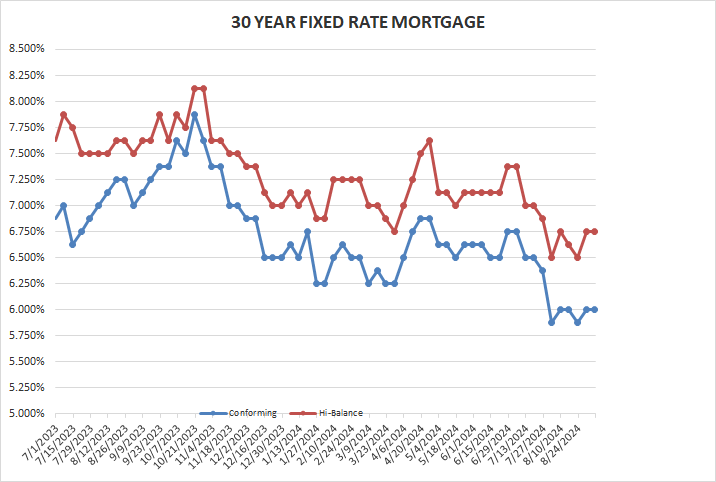
Impact on mortgage rates is significant, as rates this week are their lowest since two years ago this week. Regardless of whether the Fed drops its rate by one-quarter or one-half a percent next week the result should not have a negative impact on mortgage rates.

Rates for Friday September 13, 2024: The conforming rate drops three-eighths of one percent this week (0.375%) to, as mentioned, its lowest level since September 2022.

FIXED RATE MORTGAGES AT COST OF 1.25 POINTS LOCKED FOR 45 DAYS FOR PURCHASE TRANSACTIONS:

30-year conforming                              5.625%        Down 0.375%

30-year high-balance conforming        6.00%          Down 0.75%

Please note that these are base rates and adjustments may be added for condominiums, refinances, credit scores, loan to value, no impound account and period rate is locked. Rates are based on 20% down with 740 FICO score for purchase mortgages.

For some mathematical reason the 13th of the month is more likely to fall on a Friday than any other month. Which is strange that it is the combination of the two that is, to some, bad luck and a reason to stay under the covers all day.

Friday the 13th is so scary there are two names for it, paraskevidekatriaphobia or friggatriskaidekaphobia. Both look like who ever typed them fell asleep with their fingers on the key board.

Happy Friday the 13th to you, knowing something positive will happen to you today!

How long do we have to stay with our agent?

Question of the week:   How long do we have to stay with our agent?

Answer: As you are likely aware, the real estate industry changed dramatically on August 17th. As of that date, sellers are no longer obligated to include paying a buyer’s agent (the selling agent) as part of a sale and a listing agreement with the listing agent. Sellers may choose to do so, but it is not longer a standard part of the boilerplate listing agreement provided by Realtor associations across the country.

With this no longer part of the listing price, many buyers will be negotiating with selling agents to represent then in the home buying, and closing, process. Buyers can pay their agents directly at close of escrow, or they may ask the seller to pay their agents as part of the sale transaction.

For as long as I can remember, the California Association of Realtors had a buyer-broker agreement available for agents to use whereby buyers would agree to have an agent be their exclusive agent in any home they decide to purchase. While the agreement has been readily available, it was not used very often.

The purpose of the contract was to protect an agent who may have spent a lot of time researching and showing properties to clients looking for the right match, only to have a phone call late Sunday night, “Jill, we were driving home from brunch and walked into an open house, we really loved it. We told the agent we were working with you, but she said if we used her as our agent the price would be lowered two-percent and the seller would pay $10,000 in our closing costs. Sorry, but it was just too much money for us to walk away from.”

Yes, this happened. (Aside, such calls happen in the mortgage industry as well…)

With the new compensation rules in effect, with no guarantee that a seller will be paying the selling agent commissions, agents representing buyers are using buyer-broker agreements to establish representation and compensation.

Due to the new landscape in the industry regarding agent compensation, there are many different approaches agents are taking in regards to the agreements they make with their homebuying clients.

The main factors are revocability, exclusivity, duration, and compensation.

Some of the contracts are revocable by either party at any time or after a specific period of time. Listing agreements have expiration dates, at which point a home seller may decide to relist a property with a different agent. The revocability clause in buyer-broker contracts will enable buyers to cancel a contract before its expiration date if certain conditions are not met.

As defined, exclusivity requires a buyer to compensate the agent whether the agent represents them or not in the purchase a home. This protects an agent if the circumstances above with the Sunday evening phone call occurs.

Time frames and revocability are significant aspects of the agreement. Some buyers are signing a single-property agreement with an agent. If they are not under a representation agreement with an agent and walk into an open house, or see a For Sale sign in front of a house, and wish to see the property and negotiate for a purchase. They may decide the do not want an longer term exclusive agreement with the agent, but agree to representation and compensation on the specific property. If their offer is not accepted, and the buyers liked how the agent represented them despite the outcome, they may decide to sign a more binding agreement for the agent to find their new home.

The compensation aspect of the agreement is likely where negotiations will differ from buyer to buyer and agent to agent. Some agents will agree to flat fees based on what services they will perform. The more services the higher the fee. Others will base compensation on a percentage of the sales price of the property.

An example of a transaction that would have been very unlikely before August 17th. Dennis and Leslie have been thinking about moving and buying a new home. They see an open house in the neighborhood they like, after walking through they tell agent Fred they are interested in making an offer.

Fred asks if they are in a representation agreement with another agent, to which they answer no. The sales price is one-million dollars, they are looking to purchase with 30% down from the sale of their home, which they agree to list with Fred at 2% commission with buyer to pay their own agent. Fred indicates the seller of the open house will not pay buyer’s agent commission. Because Fred had spent no time researching and showing homes, and realizing Dennis and Leslie can obtain another agent to represent them in their sale and purchase, he agrees to a flat fee of $15,000 to represent them in the purchase.

Historically, Fred is reducing commissions that traditionally had been paid for representing Dennis and Leslie on their sale and purchase, however, in the new environment, he recognizes that signing up two transactions in one meeting that walked in off the street, he has had a good Sunday.

Another scenario, is Dennis and Leslie want to move and contact their neighborhood agent Kelly. They agree to have Kelly represent them in the sale of their home and purchase of a new home. They sign 100-day exclusive representation contracts agreeing to pay Kelly and any agent representing a buyer of their home 2% each, and pay Kelly 2% on the representing them on their purchase. They sell their home and purchase a new one with Kelly being compensated under their agreements for the transactions.

Back to our question of the week: how long do you have to remain with your agent after you have signed the buyer-broker agreement. In the above example, the answer is 100 days. Unless you can provide evidence that the agent you have signed an agreement with has not fulfilled their portion of the agreement, you must pay that agent for any home you purchase during the 100-day period. However, that will likely change after January 1st if a bill passed by the California Legislature is signed by Governor Newsome.

The bill will require all buyer contracts to expire automatically after three months, unless both sides agree to extend the agreement.

Further, the contracts must detail agent compensation, services provided for the compensation, when the compensation must be paid, and terms for ending the contract prior to the automatic expiration date.

Note further, any contract with a real estate agent is with the agent’s employing broker. As such, if a buyer is not satisfied with the representation, or effort, they are receiving, they can request to work with a different agent in the brokerage.

It is a whole new world for agents, buyers, sellers, and lenders as we must work with buyers as to how to pay their agents if compensation is not included in the sales price.

Schedule an appointment to discuss your options if you are considering purchasing a new home or property, or refinancing an existing one and want to know the mortgage options available to you. 

Have a question? Ask me!

It’s Friday, it’s Friday, First Friday of the month…which means jobs, jobs, jobs. The eyes of the world have been focused on today for the past several weeks as the first Friday of every month is when the Labor Department releases employment data from the prior month. Last month’s release showed a tremendous drop in new jobs, wondering if an anomaly, or a trend, focus was on today’s data release. A very weak jobs report could portend a “hard” landing for the economy, i.e. recession, indicating the Fed has had rates too high for too long. A strong report would indicate that the economy is strong, inflation will be extremely sticky, Fed rate cuts would be less in frequency and amount.

So, what did we get? Just right? Job growth in July was 142,000 new jobs, “soft” was the word the Wall Street Journal’s MarketWatch used to describe the report. While the most jobs added in a month since May, it was still below the 161,000 new jobs forecast. Construction, education and health, and leisure and hospitality sectors added the most jobs. Retail and manufacturing sectors had the biggest job losses. Unemployment fell to 4.2%, from 4.3%, the first decline in 5-months, mostly attributed to people who could not work in July returning to work in August.

Mixed signals came from wages increasing 0.4%, 3.8% from last August; both outpacing the July Consumer Price Index (August’s CPI will be released next week). Stronger wages support higher consumer spending, which supports a stronger economy—or if not stronger a “soft” landing of the economy following the Fed’s attempts to push inflation down and slow the economy with its benchmark interest rate. That strong signal is tempered by a weak signal as job data for June and July were revised lower, as a result the June through August period had the slowest 3-month job growth since 2020 and the early months of the pandemic.

Rates for Friday September 6, 2024: While away last week rates popped a bit, and this week are flat from last Friday as investors see today’s data as supporting a 0.25% rate cut by the Fed, and see a 0.50% cut as less likely—the former has been priced into the market for some time.

FIXED RATE MORTGAGES AT COST OF 1.25 POINTS LOCKED FOR 45 DAYS FOR PURCHASE TRANSACTIONS:

30-year conforming                              6.00%          Flat

30-year high-balance conforming        6.75%          Flat

Please note that these are base rates and adjustments may be added for condominiums, refinances, credit scores, loan to value, no impound account and period rate is locked. Rates are based on 20% down with 740 FICO score for purchase mortgages.

Wow! What a great vacation Leslie and I had cruising the Alaskan Inner Passage and spending a few days before and after the cruise in Vancouver. A return visit to Vancouver is on our must-do list.

The timing of our trip was a joint present to ourselves to celebrate our 30th anniversary, which has this past Wednesday.

I have thoroughly enjoyed my career in the mortgage industry, the primary reason I am so glad I chose it as a career is that it led to me meeting Leslie, who was working for the Long Beach Association of Realtors when we met.

Affiliates in Action was committee within the Association that consisted of those in affiliated real estate industries, title, escrow, lending, inspectors, etc. The group did a lot of community service and fundraising events that engaged affiliates and real estate agents in the community. Leslie was the Director of Communications for the Association and the staff member assigned to the committee to take minutes, create agendas, etc.

 Through my mom and her mom, volunteering was instilled in us at a young age. I am so grateful for them as it led me to volunteer with Affiliates in Action, which led me to Leslie, which led to a wedding in the backyard of our first home, which led to…. thirty years and counting!

Volunteer in your community, it will change your life!

Are homes more affordable than last summer?

Question of the week:   Are homes more affordable than last summer?

Answer: No. And maybe yes.

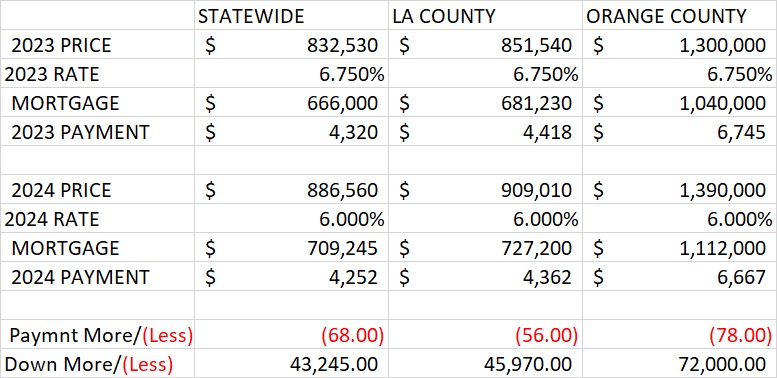
Looking at the median home prices for 2023 and 2024, using the 30-year fixed rate mortgage for the last Friday of July 2023 and July 2024 here is a look at monthly mortgage payments and amount of down payment needed (using 20% down payments and 80% loan to value mortgages).

As you can see, July to July the median prices are higher, the down payments are higher, and the monthly principal and interest payments are higher than one-year ago.

That said, with rates dropping since the end of July, the payments on the July median prices are a little bit less than the monthly payments from last July. We will not know until next month if the 30-year fixed rate and median prices for August 2024 will show higher or lower payments.

Note, even though the payment may be slightly lower, because the median prices increased 6.5 – 7.0% in the past year, the down payments are considerably higher than one year ago.

Digging into the data from the California Association of Realtors, we see that statewide the median price increased 6.5% from last July, however the median price dropped 1.6% from June—as did interest rates from June to July. Because of this the median home statewide was more affordable in July than it was in June.

More locally, in Los Angeles County the July median price was 6.7% higher than a year a year ago, and up 2.2% from June. Because the median price rose more than mortgage rates dropped from June to July, in LA County, homes are less affordable.

While the median home in Orange County was less affordable in July than it was last year, it was more affordable than it was the prior month. The median home price in June for Orange County was $1,450,000, 4% higher than it was in July. As well, because of the price, with 20% the mortgage in June would be $1,160,000**—too high for a conforming mortgage rate resulting in a high-balance mortgage rate that was 7.375% in June. As a result, the monthly payment for the median Orange County home in June would be $8012 per month, compared to $6937 in July, a savings of $1075 by waiting one month.

** Being very strict with my calculations. In reality, we would advise the client put down $10,175 more to get a conforming mortgage for a 6.375% rate and $7173 payment, $236 more than if client waited one month and purchased in June.

Depending on where in California you are buying, because rates are lower than last year, purchasing a new home may be more affordable in terms of payment and cash to close than a last summer—or than earlier this summer.

 Schedule an appointment to discuss your options if you are considering purchasing a new home or property, or refinancing an existing one and want to know the mortgage options available to you. 

Have a question? Ask me!

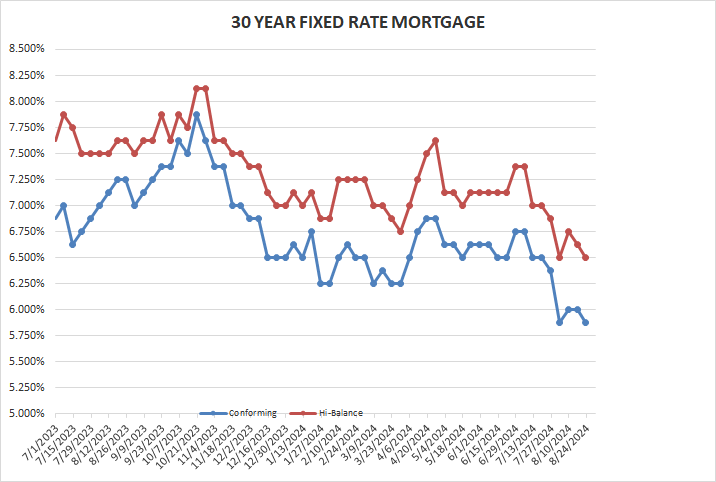
Rates for Friday August 23, 2024: Rate markets had already priced in  cut by the Fed next month. Today Federal Reserve Chair Jerome Powell in a much anticipated speech in Jackson Hole removed any uncertainty that the Fed’s benchmark rate will be cut next month. His statement also indicates that it will be the first in a series as the policy of the Fed will be changing from fighting inflation to boosting employment and trying to avoid a “hard landing” for the economy, i.e. a recession. Investors like what they are hearing and rates hit, for the second time in three weeks, a twenty month low.

FIXED RATE MORTGAGES AT COST OF 1.25 POINTS LOCKED FOR 45 DAYS FOR PURCHASE TRANSACTIONS:

30-year conforming                              5.875%        Down 0.125%

30-year high-balance conforming        6.500%        Down 0.125%

Please note that these are base rates and adjustments may be added for condominiums, refinances, credit scores, loan to value, no impound account and period rate is locked. Rates are based on 20% down with 740 FICO score for purchase mortgages.

Greetings from Vancouver, where Leslie and I are spending a few days before getting a on big boat with 2650 soon to be closest friends to cruise through Alaskan waters.

Vancouver is a beautiful city, much like Seattle, but without, from we have seen so far, much of the outdoor living arrangements clogging sidewalks.

Since we discussed median home prices above, the median price for a single family home in Vancouver is about $1.6 million Canadian, devaluing for the exchange rate to the United States dollar by about 75% , the median price is about $1.2 million greenbacks.

Driving in from the airport we saw a lot of new, and ongoing, housing construction on the main road for apartments, condos, multifamily housing, in neighborhoods with older large homes on large lots. As well, plenty of cranes in the downtown areas building large hi-rise residential properties.

Driving past a gas station and seeing a price of 1.70, it took me a minute to realize that we were not back in time to 2016, but that the price was per liter (or litre here in Canada). Doing some quick conversion of liters to gallons and dollars Canadian to U.S. I ascertained the cost is about $4.83 per gallon—not too incomparable to Southern California. Our cab driver when asked about the gas price groused that there were too many taxes, one that is national and another put on by the Provence of British Columbia—that too is comparable to our home region with California’s different taxes on fuel.

Should we change our homeowners’ insurance?

Question of the week:   Should we change our homeowner’s insurance?

Answer: We can also put “auto insurance” in the question of the week as well.

It is not new news that insurance premiums are increasing dramatically in California for all types of coverages. Because of these increases many are shopping around for cheaper rates to cover their homes and autos.  Some have no choice as their insurance companies may have declined to renew policies.

While it makes sense to see if lower cost coverage is available, the question is whether it makes sense actually change your insurer.

A major insurer has had a national advertising campaign for the past few years stressing bundling your coverage, which I strongly suggest. The more policies you have with one company, the lower your rates as all insurers have discounts for bundling coverages.

As well, discounts are also given if you are “claim free.”

Going to a new insurer with just your home or auto, may result in an increase in the premium for the other policy based due to breaking the bundle.

While not a written policy, when it comes time to decline renewals, some companies are retaining those customers who have a long-term relationship with the company.

Inability to raise rates for several years due to the California Department of Insurance Commissioner Ricardo Lara’s office denying requests for increases, higher payouts on claims due to wildfires, tremendous increase in costs to repair, replace, rebuild properties due to higher costs of building materials and labor, have all contributed to higher costs for home insurance.

Auto rates are jumping in part to the first item above, as well as more accidents, higher traffic volume, increase in car and car parts theft, and, like home insurance, costs to repair vehicles due to higher price for parts and labor.

Before making a change in your insurer weigh the savings, your current relationship, if any, with your agent, and risk of possibly being dropped by  new insurer if you have a claim in the first, or second, year of your policy.

 Schedule an appointment to discuss your options if you are considering purchasing a new home or property, or refinancing an existing one and want to know the mortgage options available to you. 

Have a question? Ask me!

Cooling trend in effect, in regards to prices not the weather. July’s Consumer Price Index showed prices increased 0.2% for the month, with a year-over-year increase of 2.9%. The annual CPI is the lowest since March 2021, 2.6%, which was followed in April by a jump to 4.2% inflation. The closely watched “core index” (food and energy stripped from index) also rose 0.2% for the month and was up 3.2% from last July. Continuing to put upward pressure on CPI is cost of housing as home prices and rent continue to climb. Overall, the news is positive for rates and, depending on the jobs report for August, strongly support the Federal Reserve lowering its benchmark rate in September.

Not cooling, retail sales. Retail sales jumped 1.00% in July, after dropping 0.2% in June. The monthly increase is the highest in eighteen months. A major force in the higher retail sales was a big rebound in auto sales, which were impacted in June due to the cyberattack on auto dealers. Taking out automobiles and parts from the data sales increased 0.4% for the month. Taking out the 0.2% increase in prices from Wednesday’s CPI data, and sales rose about 0.2%, not bad, not great. That said, the increase in sales shows a moderately strong economy, and allays concerns after last month’s jobs report that economy is slowing and heading into recession.

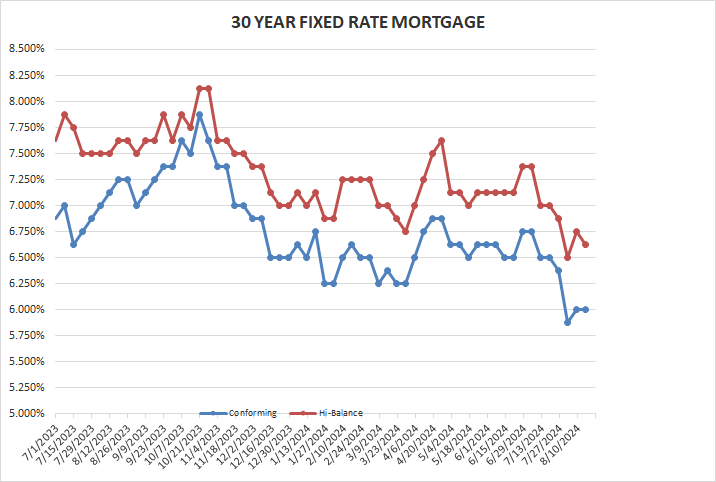
Rates for Friday August 16, 2024: Fixed rate markets, bonds and mortgages, were overall pretty flat this week as the data presented did little to change long-term expectations for rates heading down—at some point. The conforming rate is flat from last Friday, a slight dip in high-balance rates.

FIXED RATE MORTGAGES AT COST OF 1.25 POINTS LOCKED FOR 45 DAYS FOR PURCHASE TRANSACTIONS:

30-year conforming                              6.00%          Flat

30-year high-balance conforming        6.625%        Down 0.125%

Please note that these are base rates and adjustments may be added for condominiums, refinances, credit scores, loan to value, no impound account and period rate is locked. Rates are based on 20% down with 740 FICO score for purchase mortgages.

The dog days of summer ended this week, which astrologically means so should the hot and humid days, drought, thunderstorms, lethargy, fever and mad dogs. I’m not sure about the lethargy part—for some of us that can be longer than 40-days—nor when I step outside most of the rest of the list. Though it has been a while since I have seen a mad dog.

The term dog days of summer originated during the Roman Empire and lasts from July 3rd through August 11th; twenty days before and after the rise and fall of the star Sirius, the brightest star in the sky that is also known as the Dog Star. The attributes of the dog days are part of Hellenistic astrology.

Hellenistic astrologists were obviously oblivious to Southern California in September when determining the hottest weather and thunderstorms for our region. Not to mention increase lethargy as students are back in school staring out windows and trying to stay awake when learning about astrology, mythology, and dog days of summer they miss so much.

Should we buy off-campus housing with our college student child?

Question of the week:   Should we purchase off campus housing with our college student child?

Answer: Maybe.

With colleges and universities starting classes in the near future, many of you will be moving your kids into dorm rooms, and double checking the room and board fees for the upcoming semester, or quarter, wondering why it costs so much.

On-campus housing is a very under-reported cost of higher education, and to me the most egregious of the expenses paid by parents and students.

In most college areas, off-campus housing is usually less expensive than dorms, or Greek society housing with fraternities or sororities. Consider paying up to $2000 per month, or more, for a five to six hundred square foot room shared with one, or two, other students, with a bathroom down the hall, or shared with another room of students.

Using today’s interest rates of 6.00% for a 30-year fixed rate mortgage, $2000 per month is the monthly payment for a $335,000 mortgage. Pretty low given the median prices around the country. However, what if you add rent for two other students at $1500 per month each—less that what they would be paying for a dorm room. Now you have $3000 per month in rent, which is a $500,000 mortgage.

Depending on where your student is attending college, with 10% down you can purchase a $555,000 home off-campus, use the rent to pay the mortgage and your savings from not making the payment for a dorm room to pay insurance, taxes and likely still have funds left over.

Assuming your child is over 18 years old, they can be on the loan, which enables you to have owner-occupied financing.

A bonus is that because your son or daughter is also an owner with you, they are the landlord and learn responsibilities of homeownership and property management.

When your child graduates, if they decide to leave the area where they went to college, you can either retain the property as a rental to future students, or sell the property. If you sell there are many options for the proceeds, including transferring to another home to co-sign/own with you child, or taking your initial costs of purchase from the sale proceeds and use the balance to payoff any student loans, or give to your graduate as a graduation present.

Although we could not afford to purchase an apartment in New York City for our daughter to live in, two years ago our daughter moved out of the dorms and into an apartment with three roommates. Between dorm costs and mandatory food plans, we estimate the savings at more than $9000 per year that was either not added to student loans, or paid out of pocket.

Living on campus is a fantastic experience for most students, however weighing the costs and benefits of on- versus off-campus housing, many families find choosing off-campus housing is the way to go.

 Schedule an appointment to discuss your options if you are considering purchasing a new home or property, or refinancing an existing one and want to know the mortgage options available to you. 

Have a question? Ask me!

Rates for Friday August 9, 2024: Ohhhmmmm….investors and markets took a deep cleansing breath this week, settling down to a “normal” market after last week’s tumultuous ending. To start the week rates continued to decline. Then, on Wednesday, the Treasury Department auctioned about $42 million in 10-year notes and had a hard time finding buyers without pushing yields up. As a result, mortgage rates bounced recent lows, and rates are up a bit from last Friday’s large drop.

FIXED RATE MORTGAGES AT COST OF 1.25 POINTS LOCKED FOR 45 DAYS FOR PURCHASE TRANSACTIONS:

30-year conforming                              6.00%          Up 0.125%%

30-year high-balance conforming        6.75%          Up 0.250%

Please note that these are base rates and adjustments may be added for condominiums, refinances, credit scores, loan to value, no impound account and period rate is locked. Rates are based on 20% down with 740 FICO score for purchase mortgages.

I’ll admit to not being sad in certain events when American athletes miss out on a gold medal to an athlete from a country that has never won gold in an event. Or, as in the case of Julien Alfred in the women’s 100-meter race, the athlete wins the first gold medal ever for their country, in Alfred’s case Saint Lucia. To me, that is one of the best aspects of the Olympics, a competitor from a nation the size of Phoenix, with a population smaller than Huntington Beach, winning medals, especially gold, for the first time.

What always amazes me is how close so many of the competitions are. Everyone was slack-jawed at the finish of the men’s 100 meter race when American Noah Lyles and Jamaican Kishane Thompson finished with identical times of 9.79 seconds, but Lyles’ torso crossed the line two inches ahead of Thompson’s.

Two inches in a foot race is the equivalent of two feet in archery. In the men’s final American Brady Ellison and South Korean Kim Woo-jin each shot three straight “10s” (bullseyes) in their final set to force a shoot-off. The gold medal shoot-off is decided by a one-arrow sudden death. Woo put his arrow in the center 10-point ring. Ellison’s arrow ended up three millimeters outside the 10-point ring, and ended up with the silver.

Did you ever think archery could have an exciting finish? I didn’t until I happened to sit down to watch Ellison and Kim go at it while walking through the family room on Sunday with the television planted on NBC’s Olympic coverage.

The personal stories, the triumphs and tragedies, the competitors at the end congratulating each other, add up to a wonderful two weeks every four years.

For those who read last week’s WR&MU, our extended relative Nikki Hiltz cruised through qualifying and semifinal heats and will be racing in the women’s 1500-meter final tomorrow at 11:15 PDT. Go Nikki!!!