
Posts

What is mortgage insurance?

Question of the week:  What is mortgage insurance?

Over the past few weeks I have had several questions regarding the various insurances involved in a real estate transaction. I have decided the best way to address the questions for the next several weeks to have a series on insurance in the Weekly Rate and Market Update, this series will cover home warranty, homeowners’, title, mortgage, and finally mortgage life/disability insurances.

Answer: It is important to note that mortgage insurance does not protect you, it protects your lender.

Back to our question, what is mortgage insurance?

Mortgage insurance is coverage to protect the lender in case the borrower defaults. It is required on all FHA mortgages and most conventional mortgages that are over 80% loan-to-value.

For FHA mortgages, there are two premiums paid for the mortgage insurance, one is paid upfront and added to the loan amount, the other is a monthly premium that is paid for the life of the loan.

For conventional and jumbo mortgages, there are three options for mortgage insurance premiums. The “lender paid” option is what it says, the lender pays for the mortgage insurance premium, this is done through a higher interest rate. Another option is the “upfront” option, where a lump sum is paid for the mortgage insurance, and is typically added to the loan amount. The third, and most popular, option is a monthly premium.

If you have the monthly premium option the mortgage insurance coverage you have likely has the option to remove the mortgage insurance premium if certain conditions are met. Typically, these conditions are that you have made twenty-four consecutive payments on time and your loan to value is below 78 or 80% depending on the policy.

For the lender, after a foreclosure on a loan that has mortgage insurance, the insurer will reimburse the lender for all the costs of the foreclosure, unpaid interest and depending on the coverage and totals perhaps pay down some of the principle on the loan.

It should be noted that in most cases because of the cost and length of time it takes for the foreclosure process that even with mortgage insurance coverage most lenders lose money when a property is foreclosed.

Regular readers of the WR&MU are aware of prior updates that discussed mortgage insurance. For a more in depth look at mortgage insurance, and why I encourage many clients to structure their deals with mortgage insurance here is link to the March 8, 2019 “Why is mortgage insurance a good thing?”

Next week we will discuss mortgage life/disability insurance and what it covers.

Links for prior posts in our insurance series:

Home Warranty Plans

Homeowner’s Insurance

Title Insurance

Have a question? Ask me!

Flat and flat. That is the news on prices consumers are paying for goods and services as the Consumer Price Index data for Septembers showed prices for the month increasing a scant 0.1% due to lower fuel prices and year-over-year prices remain at a 1.7% growth rate from last month’s year look back. The news is mortgage rate friendly as it lends support to the Fed cutting rates again if the economy shows any signs of slowing, or growing slower.

Up and up. News is that President Trump is meeting with the Chinese trade delegation today. That the President is joining the meetings sends a signal that some type of trade deal is imminent. This has caused investors to leave the safety of bond, and mortgage, investments causing those prices to drop, which results in rates climbing, and stock prices are climbing today. As stated, this is not good news for mortgage rates.

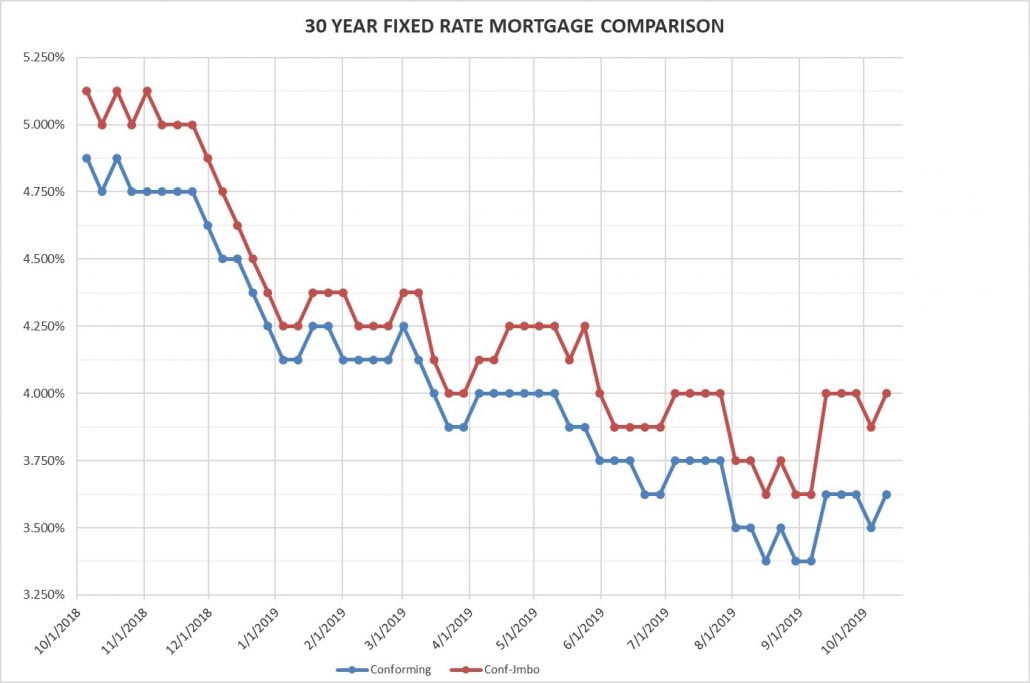
Rates for Friday Ocotber 11, 2019: Even before today’s jump rates have been trending up this week. After our little dip last Friday we have bounced up this week to where rates were the prior three weeks. Market is volatile, do not get caught and lock when you can.

FIXED RATE MORTGAGES AT COST OF 1.25 POINTS LOCKED FOR 45 DAYS:

30 year conforming                                            3.625%     Up 0.125%

30 year high-balance conforming                     4.00%   Up 0.125%

Please note that these are base rates and adjustments may be added for condominiums, refinances, credit scores, loan to value, no impound account and period rate is locked. Rates are based on 20% down with 740 FICO score for purchase mortgages.
The Weekly Rate & Market Update last week was written and produced in Chattanooga, Tennessee. I was as part of a small contingent from the Rotary Club of Long Beach at the “Large Club Conference.” The conference gathers the president-elects, president-nominees and executive directors from the largest clubs in North America to discuss best practices and processes to keep our clubs strong and help them grow.

I very much enjoyed Chattanooga, it sits on the Tennessee River, is surrounding by very high hills (almost “mountain”) and is on the border with Georgia and a five minute drive from Alabama. We had sticker shock at how inexpensive everything was from beer to barbecue (both delicious).

Also enjoyable was the opportunity to interact for several days with Rotarians from around the country, mostly the Midwest and South, who are dedicated to making their clubs, communities, country and world a better place. Rotary International is the single organization that is responsible for the eradication of polio, taking it on as a cause in the 1950’s and leading the governments and organizations in the fight—and still active in delivering millions of vaccines per year around the world. Rotarians worldwide are concentrating on literacy and education as well as delivering clean, fresh water to villages and communities around the world; our club in Long Beach has raised funds and help drill wells for several villages in Mozambique.

One common desire all of the clubs gathered had was to attract younger members, those in their thirties and forties. The stereotype that many people have is that the clubs consist of old-white-guys, which used to be true but today clubs have women in leadership and striving to have  demographics that are match their communities. If you are feeling the need to contribute to your community I suggest you look to a local Rotary club and learn more about the group and what they accomplish. It is very fulfilling for me to be part of a group that have built friendships while also helping others, it can be for you as well!

Have a great week,

Dennis

Past Weekly Rate & Market Updates can be found on my blog page at my website www.DennisCSmith.com/my-blog

1-25-19: What are the different types of mortgages available?

Question of the week:  What are the different types of mortgages available?

Answer:  In the years immediately following the real estate and mortgage market meltdowns many mortgage products left the market. In the last few years many of the products that were available for home buyers and owners prior to 2008 have returned presenting more options for financing residential real estate, and enabling those who are unable to qualify for traditional mortgages.

In response to the collapse of the real estate markets the Dodd-Frank Act was put into law. Dodd-Frank has a regulation for mortgage lenders that created “qualified mortgages,” or QM loans. There are several factors that go into a mortgage being eligible for the QM designation, the primary being that borrowers must show income and the ability to make the monthly mortgage payments. Having funds available to pay off the mortgage is not evidence of ability to repay the mortgage, unless using a certain formula income from the asset account(s) generate income that would enable qualification.

If a lender funds non-QM mortgages they must have “skin in the game,” this is had by the mandate that lenders must retain at least 5% of such mortgages. All conventional mortgages are sold in secondary markets, which is what Fannie Mae and Freddie Mac, where they become security for Mortgage Backed Securities (MBS). Most jumbo loans are sold by lenders to investors who create their own investment vehicles backed by the mortgages. Government loans, VA and FHA, are sold by lenders to Ginnie Mae, who like Fannie and Freddie, bundle the mortgages and sell them to investors.

Conventional mortgages and most “jumbo” mortgages meet the QM criteria as they are underwritten to the guidelines established by Fannie Mae and Freddie Mac. Also meeting the QM standards are VA and FHA mortgages using underwriting guidelines established by the VA and HUD respectively. One of the reasoning behind the QM policy is that investors in mortgage backed securities of conventional or government mortgages investors know the quality of the investment. The primary reason for the mortgage market collapse was the tremendous percentage of mortgages in the Fannie and Freddie MBS pools were funded without income verification, nor asset verification and for many no appraisal of the property used as collateral. With the QM rule investors have reasonable certainty that all the borrowers of the mortgages in their MBS investments have shown ability to repay their mortgages.

Here is a quick comparison of the mortgage options available in today’s markets:

Conventional mortgages can have relatively high loan to values, depending on loan amount and ability to qualify as high as 97% of the property value with several options for mortgage insurance.

FHA mortgages have a minimum down payment of 3.5% and have mandatory mortgage insurance regardless of the loan-to-value. The underwriting guidelines for FHA mortgages are a bit more lenient for qualifying than conventional mortgages.

VA mortgages are for eligible veterans, either active duty or discharged from the service (unless discharge was dishonorable). Veterans who qualify can purchase their home with no money down and the loan limit for purchases can far exceed the limits for conventional or FHA mortgages. The mortgages have a “funding fee” added to the loan amount, which is VA’s version of mortgage insurance.

Non-conforming, or jumbo, mortgages mirror conventional mortgages in many respects, however most will not fund mortgages above 90% of the value of the property and have tighter underwriting guidelines for qualifying.

Non-QM, or Alternative, mortgages have many variations to provide mortgages for borrowers with poor credit scores, borrowers with high debt-to-income ratios, self-employed borrowers with low income on their tax returns are some of the most common applicants for Alternative mortgages. Lenders in this section of the market have products that use deposits into business or personal accounts to calculate income, statements from accountants to accompany tax returns to explain losses or other criteria. Because of the more relaxed underwriting standards, and the retention rules for non-QM products, rates on these mortgages are higher than those on QM mortgages.

It is estimated that $5-6 billion of non-QM mortgages were funded in 2018 for residential borrowers and predicted that the total volume will increase considerably in 2019.

Too often we meet with clients who are able to purchase, or refinance, their home using alternative mortgage products but the bank or mortgage professional they were working with did not have such products available, encouraging them to obtain a co-signer, obtain more funds or otherwise try to fit into the products they have available. Because we work with many lenders, in the QM and non-QM spaces, we often have the ability to help them with their purchase or refinance.

If you, or someone you know, is in need of a mortgage to purchase or refinance their home please contact me to go through all their mortgage options to help them find the best financing for their ability to qualify.

Have a question? Ask me!

Home sales are cooling off. The California Association of Realtors have released sales data for December and every major market in the state except San Francisco had a drop in sales from December 2017. Locally, Los Angeles County saw a drop in sales from November of 3% and from last December of 16.3%; the median sales price in December was $588,140 in the county up 6.2% from the prior month and 1.8% for the year. In Orange County sales tumbled 15.5% for the month and 18.3% for the year with the median price in December of $785,000, off 1.3% from November and 0.1% from the prior year. Nationwide real estate sales are at a three year low. Historically December is a slower month for home sales so a dip from November is not surprising. Are these numbers a “dip” or are they foreshadowing a decline in the market that will last for….how long? Next week I will compare the current real estate market to that leading up to the 2007-8 start to the collapse that led to the Great Recession.

Rates for Friday January 25, 2019: Rates are steady from last Friday, though some movement up and down during the short week. So far, the federal government shutdown has not impacted the economy. Unlike if 800,000 workers in the private sector were laid off, the furloughed federal employees will go back to work and cash flow shortages for federal workers and vendors will be back filled; because of this any negative impact on the overall economy is short termed. It appears that there is some movement in Washington to settle differences and re-open the government and I am optimistic the normal dysfunction in our nation’s capital will return.

FIXED RATE MORTGAGES AT COST OF 1.25 POINTS LOCKED FOR 45 DAYS:

30 year high-balance conforming                    4.375%     Flat     

30 year conforming                                            4.25%       Flat

Please note that these are base rates and adjustments may be added for condominiums, refinances, credit scores, loan to value, no impound account and period rate is locked. Rates are based on 20% down with 740 FICO score for purchase mortgages.

Those who know me will not be surprised by this statement: I love pie. And cookies, but pie holds a bit of a higher place because it is usually not as readily available as a cache of thin mints in the freezer. Thankfully my oldest also loves pie and over the years she and I have made many runs to the best pie purveyor in Long Beach, Jongewaard’s Bake-N-Broil. For the past several years we have gone to Bake-N-Broil on January 23rd to celebrate National Pie Day.

With her attending university in Boston I knew I would be spending National Pie Day alone. Thankfully for this first year I was likely to be without my pie-buddy on 1/23 Winter Storm Harper hit the Northeast. Why thankful? Late Friday night JetBlue sent her an email that her flight to Boston on Sunday morning was cancelled. By the time we go through to get her a seat back to school the only available flight was a red-eye leaving Tuesday, January 22nd. So though it was a day early we were able to celebrate National Pie Day together—she had lemon lush and I had French apple. Thank you Harper for letting me continue a tradition. (She plays in the pep band for BU and let me know that at the basketball game on Pie Day they had free pie available—she got a slice of Boston Cream Pie. I’m so proud.)

Have a great week,

Dennis

Past Weekly Rate & Market Updates can be found on my blog page at my website www.DennisCSmith.com/my-blog

8-10-18: It takes so much money to purchase a home, what are some ideas for saving money?

Question of the week:  It takes so much money to purchase a home, what are some ideas for saving money?


 Answer:  Two of the hardest things to do are lose weight and save money. Both objectives require the same habits, or routines, to be successful. You need to be committed to your goal, dedicated to your plan to be successful; commitment plus dedication equals success. How disciplined you are with your behavior will determine the time frame for achieving your goal, which should be a very realistic part of your goal—not only what you want to achieve but when you want to achieve it.


Saving money is pretty simple, just like losing weight. To lose weight you need to be more active than you are now with the same diet, or eat less with the same amount of activity and ideally you are both, more active and eat less. As you begin to achieve success and enjoy the feeling you change your activity to be more physically challenging, and you change your diet to intake fewer calories and also better calories, i.e. more healthy foods and beverages.


When it comes to saving money you either need to earn more and spend the same, or spend less while earning the same amount. It is generally easier to control your spending than your income but with some willingness to push yourself you can find ways to do both—the weight loss equivalent of waking up at 5:00 a.m. to work out and stop feeding your cookie cravings.


Let’s tackle the harder discipline first: increasing income. Absent getting a new job in your current profession that pays more, which is always the best option if available, how can you increase your income?


The most obvious way without changing jobs is to look within your company to see if there is available overtime or other duties you can take on for more income. I have found many clients over the years who have told their employers they want to purchase a home and are willing to take on more duties, even if it means more time at work, to earn the funds needed for a down payment. It is not unusual for many employers to have some additional work available, it is cheaper to pay you more and expand your duties than to hire someone else. As you get closer to your goal keep them apprised of your status so they are invested in your success.


Do you have a skill that can be monetized? Are you crafty? Using your free time, you can make things to sell on-line or at local shops. Can you write well? Search for companies looking for content for their websites or blogs, for a few years during the market meltdown I wrote for a company that provided content for mortgage blogs and I was writing content for 3-4 mortgage websites. Are you able to work on weekends or evenings? Perhaps pick up some part-time work? I had one client who worked for three years as a night watchman at a manufacturing facility on Friday and Saturday nights and added 25% to his income—which he put right into savings. What time do you have and what skills do you have that can turn into part-time work to add to your savings account.


Reducing expenses and putting money into savings is not that hard, it is just a matter of what you are willing to do without. Just like losing weight, am I willing to do without a cookie or two after dinner, or a glass of wine or a beer after work every night, or pasta three to four times a week? If not my chances of success in reaching my weight goal are greatly reduced.


Where are you spending money that could be put into savings? Starbucks is one of the biggest drains on savings accounts in our country. Sure, there are other coffeeshops where a lot of money is spent but the ubiquitous white with green logo cups are seemingly in every third or fourth person walking into office buildings every morning. The average cost for most Starbucks coffee only orders is about $4, five mornings a week that is $20, fifty weeks a year that is $1000. Using a coffee maker or French press (easier to make single or two cup servings) costs about $0.20 per cup. I like to start people saving by challenging their “I have to have it…” Starbucks or morning coffeeshop purchase because once that habit is broken a lot of others are easy. Why? Because it completely changes your morning routine, and for most the routine is for the better as they can start their coffee making process while getting dressed or doing something else and save standing in line and waiting for an order in a retail outlet. Saving $1000 towards what is needed to purchase a home does not seem like a lot and it’s easy to say, “I’ll save somewhere else…” but if you can start here then it makes it easy to stop other expenses and convert them to savings.


What are you driving? Do you have a car payment? Is it more than two to three percent of your income? If so then you can save a lot of money by changing your car. I drive a 2006 Honda Pilot and have saved a lot of money in car payments over the years, Leslie drives a 2010 Honda Odyssey van, our daughter has a 2001 Infiniti i30. Obviously, we do not need the newest cars with the newest features, because of this we do not have large car payments. When we shuffle cars later this year when our oldest goes to college the plan is for our 16 year old to get my car, my wife to drive the Infinity and me to drive the van; sometime in 2019 we will get a car for Leslie, but a used car to save money and if we decide to finance do so at a lower loan amount.


That’s us, we are not car people. I get that there are car people out there who want the latest and greatest. My advice is to get the garage and then the car. Are you worried your friends or co-workers will make fun of you driving a six-year-old vehicle? Tell them you want to buy a house and aren’t willing to compromise saving to purchase something that sits for more than 90% of the day in a parking lot, garage or on the street. If you have a car with a high payment look at what options you have to trade it in and buy down. If you are near the end of the loan keep the car and do not get a new one. If you are leasing talk to the dealer about options to reduce your payments or purchasing a used car with a low loan amount. It is not uncommon for me to meet with clients who have two large car payments that are almost 10% of their gross income who are renting and are short of funds needed to purchase a home. Sell one or both of the cars and get into cheaper payments. Last year I went through the math with a couple and within two weeks sold their less than one year old cars and purchased used cars, they are saving almost $1000 a month in car payments and will be buying in the Spring. Like your morning coffee, your car may be a necessity but how you fill the need may be a luxury.


Another big expense item that many do not like to curb is entertainment. Concerts and sporting events are very costly, they can easily cost as much as ten to twenty weeks of Starbucks purchases. It can be tough to tell your friends, “hey we can’t afford to go we want to buy a home,” but good friends will understand, others will try to guilt you into breaking your commitment and dedication. Nights out at expensive restaurants, trips with large airfares and expensive hotels, also have the ability to take a lot out of or put a lot into your savings accounts. Part of your commitment is to forego many fun adventures for the bigger goal, owning your own home.


Success requires trade-offs, what are you willing to trade for success? Where are you spending money now that could be reduced or eliminated in order to put more money in your savings account? Most families have no idea where they are spending their money so do not know where they can cut back. Pull out your bank and credit card statements for the past several months—ideally for a year—and categorize all your spending into categories: necessities, which are only housing, food for home and utilities for now, transportation, dining, entertainment, travel, clothing (yes, it is a necessity but it depends on what you are buying and how often). Add up the totals you are spending and you may be surprised at not only how much but where you are spending your money. Then start making reductions and eliminations.


If you are married this process needs to be done with no judgment, one spouse may be a clothes horse and the other a car nut; or one buys a lot of very nice wine and the other plays a lot of really good golf courses.


Once you are in  your home you can determine if you can, or want to, start adding back some of the spending you have cut during your saving period.


It bears repeating: Success requires trade-offs what are you willing to trade to purchase your home?


Have a question? Ask me!


Spend more, borrow less. That is what consumers have been doing, at least less spending on credit cards. Credit use for revolving credit has been dropping while consumer spending has been growing, interestingly the personal savings rate has been increasing. So consumers are spending their some of their earnings for purchases that have been put on credit cards in the past, and are borrowing on long term loans for large expenditures like autos and college.  This is generally good news for the economy as it shows consumers have a positive outlook for their personal economic future. This is not a big mover for mortgage rates except as it feeds into the overall data on economic strength and outlook.


Prices won’t push rates, for now. Following June’s strong increase in the Producer Price Index (up 0.3%) wholesale prices cooled off to no increase, or decrease, in July. Following the increase in June for wholesalers it is little surprise that the Consumer Price Index increased from 0.1% growth in June the CPI increased 0.2% for July. The “core” price increase (no energy or food costs) was up 0.2% for the month and 2.4% year over year, the highest increase in the index since September 2008…the month before the real estate and mortgage market melt-downs. The news is not positive for interest rates, and pretty much cements the Fed increase rates in September—which means those with Home Equity Lines of Credit will see their rates increase by 0.25%, possible but not probably more.


Rates for Friday August 10, 2018: Rates improved from last week, primarily because the Treasury $78 billion in U.S. debt that was absorbed rather easily in the market, investors liked the market reaction and rates dipped strongly on Wednesday. The price data mentioned above was somewhat expected, therefore priced into the market, so did not negatively impact mortgage rates. Overall rates have reversed their increase from two weeks ago. The trade tension between the U.S. and trading partners may come to a head next week, causing rates to make a significant move one way or the other—keeping in mind rates generally go up like a rocket and down like a feather. Be cautious.


FIXED RATE MORTGAGES AT COST OF 1.25 POINTS LOCKED FOR 45 DAYS:

30 year conforming                                            4.375%            Flat

30 year high-balance conforming                      4.50%               Flat


Please note that these are base rates and adjustments may be added for condominiums, refinances, credit scores, loan to value, no impound account and period rate is locked. Rates are based on 20% down with 740 FICO score for purchase mortgages.


Channeling Gene Rayburn and the original Match Game, I keep thinking this week, “It has been so hot lately. (Audience, “How hot is it?”) That Mildred’s BLANK melted off.” I have weird thoughts.


I have had some inquiries and I will admit to procrastination of a task I need to do but not looking forward to doing. When I had my website rebuilt earlier this year I had not yet learned how to effectively put my Weekly Rate & Market Updates on the site. As well there was a gap in the WR&MU from when they were migrated off my old site to when it went live. My objective this month is to reformat the updates, put a title on them referencing the Question of the Week, and loading up 2018 to date on the site with the new format. Your patience is appreciated and I think this will make the site and updates more useful for research on particular topics of interest for you, your friends, clients and family members.


Stay cool and have a great week,


Dennis

5-11-18: Should I use funds from my 401(k) to buy my new home?


Question of the week:  Should I use funds from my 401(k) to buy my new home?


Answer: This is a great question that has come up a few times recently as home prices continue to climb and for many families down payment is a barrier to home ownership.


“Should” is the key word, and as with most of our questions of the week the answer varies from person to person, family to family.


Before we answer “should,” let’s answer “can.”


If you have a 401(k) retirement account through your employer it has several rules, regulations and policies as to how the your account must be handled, including access to funds. Since the money was put into the account before taxes, all the money in your account has accumulated with no taxes being paid. Therefore when the money does come out of the account it will probably be taxed, unless the money is borrowed to be repaid and you do not violate any of the rules and policies of either the plan or the IRS.


Most 401(k) plans allow loans to participants for hardship, medical or education costs and the purchase of a primary residence. Note, “most,” so your plan may not allow loans. One of the provisions of any 401(k) loan is that if it is not repaid on time you will be subject to taxes, and penalties if you are under 59 ½ years of age.


Assuming your plan allows you to borrow money for the purchase of your home, here is how it usually works.


The maximum amount allowed to be borrowed is either $50,000 or 50% of your 401(k) balance, whichever is less.


You must repay the loan with interest that is paid to yourself, at a rate that is set by your 401(k) policy, typically Prime + X. So if your plan has the interest on the loan is Prime + 1 today your rate would be 4.75% + 1 = 5.75%.


The term of repayment varies from plan to plan, most plans have a maximum repayment period of five years, with exceptions for home loans that can be up to ten year amortization periods.


Your repayment is made via your paycheck with after tax dollars. You can, and should, continue to make 401(k) contributions during your repayment period.


If your employment terminates and there is a balance due on the loan you either need to repay the balance or face tax consequences on the unpaid balance. For instance, you are offered a job with another company that is a fantastic opportunity, but you have a $6500 balance due on your 401(k) loan. Your options are to leave the company and roll the 401(k) into another account, either the 401(k) with your new employer if they allow it, or into a rollover IRA, without repaying the loan. In this case the $6500 will be taxable and if you are under 59 ½ you will have a penalty. Or, you can contact the plan administrator, find out who and how to make out a check and pay off the loan, and then transfer the account. Most plans allow you 60-90 days to make arrangements for your employer sponsored retirement account.


The funds for your loan are taken from the funds, or investments, within your 401(k) at your direction. You are borrowing $25,000 for the purchase of your new home, and you have your 401(k) invested in four different mutual funds and company stock. You direct your administrator to take $5000 from each of the funds and the stock account to fund your loan. As you repay the loan most plans allow you to direct the payments back into the funds from which they were taken in the same proportion to which they were liquidated, so your account allocation will still be the same as before the loan was funded.


Now that we know the “how,” let’s look at the “should.”


There are many that argue against borrowing from your 401(k) for any reason, and there are many that argue it is not a bad idea, and in fact can be a good idea. For disclosure purposes, I purchased my first home by borrowing $7500 from my 401(k) for the down payment. It was one of the best financial decisions I ever made.


One argument, and perhaps the one made most frequently, against borrowing the money is that you lose the growth opportunity of those funds invested in the market and growing tax free. This is true, if you take $25,000 from your 401(k) those funds are not subject to any market growth or dividend reinvestment while they being repaid; this also means that the funds are not subject to any declines in market value while they are outstanding. Lost in this argument is the interest you will be repaying yourself. If the interest rate you are paying is equal to or greater than market performance plus and dividends then there is no net loss to your account during the period. If the market grows at a significantly greater rate than your interest rate on the loan then your opportunity costs are the gains in your investments less the percentage you are paying.


Also lost in this argument is the accumulation of equity in the home you are purchasing during the period to loan is outstanding. So the true cost, or benefit of the transaction is the difference between the gain in value of the funds in your 401(k) less the combined gain in market value of your home plus the rate of interest on your 401(k) loan. As an example, the $7500 I borrowed to purchase my first home resulted in substantial equity growth that we then used to purchase our current home—the $7500 invest in 1994 is worth considerably more today than the growth of $7500 in the market during the time period.


Another argument against borrowing against your retirement account to purchase a home is that you are hurting your retirement. This may be true depending on your age and how long until you retire, how much you borrow, whether you are able to repay the loan before retirement to avoid a large tax liability, and what is the status of the home you purchase. If you are young, working for a long time and are able to repay the loan with plenty of time until your retirement and your home value rises then you are not worse off, in fact may be better off, by purchasing your home by leveraging your retirement account.


Bill and Sue are in their late 30’s, have been unable to purchase a home as they do not have enough money saved for down payment and closing costs. They each borrow $25,000 from their 401(k)’s and purchase a $500,000 with 10% down payment. They are able to repay their respective loans in five years. In twenty years when both kids are out of college they are getting close to retirement. Their home is not paid off, they took out some equity for college costs, but they have a lot of equity.  They plan on retiring in about five to ten years and looking at their home value, and costs for homes near where both their kids are living, discover they will probably be able to sell their home and purchase their retirement home without needing a mortgage. They enter retirement with no housing cost—typically the primary cost in retirement—except property taxes and insurance, and retirement accounts that have grown during their years of employment.


Some of the advantages of 401(k) loans used to purchase homes. There are usually no transactions costs, perhaps a $25 processing fee. Most loan programs do not count a 401(k) loan repayment against you for qualifying purposes. There is no qualification process for the funds, as long as you have the money in your account and the plan allows it you can borrow it. Funds are usually available within two weeks or less of your reqest.


Should you borrow from your 401(k) to purchase your new home? Maybe. Give me a call to discuss your situation and I can help you make that determination.


Have a question? Ask me!


Inflation concerns are a bit abated with the Producer and Consumer Price Index data from April, both of which were lower than expectations. On the wholesale side PPI showed 0.1% growth in the month and is up 2.6% year over year. For consumers the CPI was up 0.2% for the month and 2.5% for year. With the tame inflation data for April, investors’ concerns about inflation forcing rates up are dampened and the data announcements had no impact on rates.


Rates for Friday May 11, 2018:  Week to week we are flat once again, three Fridays in a row with the same rate shows some rate stability and what is probably the new “normal” for mortgage rates.


FIXED RATE MORTGAGES AT COST OF 1.25 POINTS LOCKED FOR 45 DAYS:

30 year conforming                                            4.50%       Flat

30 year high-balance conforming                      4.75%       Flat


Please note that these are base rates and adjustments may be added for condominiums, refinances, credit scores, loan to value, no impound account and period rate is locked. Rates are based on 20% down with 740 FICO score for purchase mortgages.


Spoil the moms! Your own, your children’s, your neighbor’s, your brother in-law’s, spoil them all this weekend. And remember what my mom always said, “every day should be mother’s day, not just one day a year…”


Have a great week,


Dennis

4-20-18: Why do you want me to put 21.2% down?


Question of the week:  Why do you want me to put 21.2% down?


Answer: This question came from a new client last week who had been speaking with a representative of a major national lender about loan options for purchasing a new home and called me on the advice of her tax preparer.


She is a first-time buyer who was getting ready to write an offer on a condominium unit and began the call the way many do, “I was given your name by my tax person when I told her I was buying a condo. I’m writing an offer tonight, have spoken to my bank already and will be putting 20% down.”


After getting the necessary information for income, credit, funds for closing I asked about the property she wanted to purchase, price, if she was sure it was a condominium (a great question for next week) and the homeowners’ association fees.


After getting all the information I said, “Everything looks great, you definitely qualify, however instead of putting 20% down I think you should put a bit more down, $6,900 more to be precise, which is 21.2% down.”


This prompted our question of the week.


Because we look at the big picture and have over 30 years’ experience that allows us to quickly sort through options my suggestion was an automatic response.


The offer my client was going to make was for $575,000. If she put 20% down, $115,000, her loan amount would be $460,000. Following my advice putting down 21.2%, which would be $121,900, her loan amount will be $453,100.


Why is that important? Look at the rates for today below. The conforming rate today is 4.375%, the high-balance rate is 4.625%, one-quarter of one percent higher (0.25%). Usually, the difference between the two is one-eighth of one percent (0.125%), however the high-balance rate is always higher by 0.125% or higher.


What is the difference between a conforming loan and a high-balance loan? One dollar.


The maximum conforming loan amount is $453,100. This amount happens to be 78.8% of the $575,000 offer my client wanted to write. The payment on today’s conforming rate for $453,100 is $2262.26 per month. If the client put down 20% the loan amount would be $460,000, which would have a payment of $2365.04 per month. By putting down the extra $6900 she is saving $102.78 per month ($1233 per year).


Having inherited money from her recently deceased father she has the funds to put down the extra 1.2% without any financial harm, and with her income situation the extra $102.78 per month makes her a little more comfortable with the monthly housing payment.


To be fair most lenders would bring up this option to a client in a situation like this, however we find time and again options with small changes to the what the client may pay in closing or monthly payment or manipulating credit or other factors that can provide another option that may be more beneficial in the long run.


Several decades experience enables us to look at a transaction and present several different options to consider so our clients can determine which they feel is the best for them and their family. Experience matters!


(The client’s offer on the condo was not accepted, but she is probably writing another offer this weekend, keep your fingers crossed for her!)


Have a question? Ask me!


The most significant economic news this week was the retail sales report for March, which was very strong. American consumers spent 0.6% more in March than February with auto sales leading the charge. The news was a bit of surprise and put a bit of upward pressure on rates.


Rates for Friday April 20, 2018:  With a lack of economic news this week the increase in mortgage rates was a bit unexpected. Some of the increase can be attributed to investors pricing in a rate hike from the Fed in June, and some speculation of perhaps two more increases in the second half of the year instead of the anticipated one. With a lot of government debt hitting the markets this week, and two major foreign buyers of our debt (China and Japan) not real thrilled with the Trump tariffs, plus the Fed putting bonds and mortgages from its portfolio into the market rising rates should not be a surprise. With a lot of supply coming to market prices are going to drop, when prices drop interest rates go up. The conforming rate increases for the first time in eleven weeks and we see the high-balance rate hit its highest level since January 2014.


FIXED RATE MORTGAGES AT COST OF 1.25 POINTS LOCKED FOR 45 DAYS:

30 year conforming                                            4.125%       Up 0.125%

30 year high-balance conforming                      4.625%      Up 0.25%


Please note that these are base rates and adjustments may be added for condominiums, refinances, credit scores, loan to value, no impound account and period rate is locked. Rates are based on 20% down with 740 FICO score for purchase mortgages.


I love the cool Spring weather we have been having and hope it lasts for a few more weeks. My weather sweet spot is low to mid-70’s with breezes, exactly what we have been having!


Have a great week,


Dennis

1-5-18: With the new tax laws should I keep my Home Equity Line of Credit


Question of the week: With the new tax laws should I keep my Home Equity Line of Credit?


Answer:  With the calendar turning to 2018 we are now under the new tax codes signed into law by President Trump in December. There is still plenty of confusion about how the IRS will treat many of the changes, among them is the interest paid by home owners if they have a Home Equity Line of Credit (HELOC) and if it is deductible on the federal tax return. Reading through many articles and communicating with tax professionals, lenders that specialize in HELOCs and other research I am not entirely clear on how HELOC interest will be treated moving forward—and until the IRS issues a clear ruling I don’t think anyone else is either.


Some people may use the deduction, or lack thereof, to determine how they wish to move forward with their current HELOC, or to obtain one for purposes of home improvement, debt consolidation, college costs, etc. Here are some items to consider if you have, or are considering, a HELOC.


DISCLAIMER: I am not a tax professional, if you have a HELOC please consult with your tax preparer regarding the impact it has on your taxes.


There is a lot of information out that none of the interest on your HELOC will be deductible, regardless of when you obtained it or how the funds were spent (home improvement, debt consolidation, medical expenses, college, etc). Under this line of reasoning, if you have a $100,000 HELOC you obtained when you purchased the home in 2011, the interest is no longer deductible.


However, there are some “experts” that are stating that if your HELOC was used for the acquisition of your primary, or second/vacation home, then the interest paid on the HELOC is still deductible. These are contrary opinions, and if you have a HELOC that you have only used to purchase your home it obviously has an impact on your tax preparation in the future. If acquisition HELOCs will remain deductible then you are fine and continue as you have in the past, if they are not then you will want to meet with your tax and mortgage professionals to determine your best course of action moving forward.


If you obtained a HELOC to put in a pool, remodel your home or do other home improvements, in the past you probably had an interest deduction. Under the new law, based on almost everything I have read and heard, you will no longer be able to deduct that interest from your federal taxes.


If you have a HELOC that you used for medical expenses, college tuition and/or debt consolidation you will also not be able to deduct the interest moving forward.


Back to our question of the week, if you have a HELOC should you keep it? Especially if the interest you pay is no longer deductible?


As with most questions involving mortgages and personal finances, there is no standard answer for everyone. The factors you need to consider are:


How much is the tax deduction you are losing? If you have a balance of $50,000 and are paying $2500 per year in interest, is losing that deduction costing you a lot of money?


What are your options to pay off the HELOC? Do you have cash or assets you can liquidate to pay off the balance? If you do what is your trade off? What has been your return on investment for those assets and what is the rate on your HELOC? Are you making more in interest and/or dividend payments than you are paying for the HELOC?


Or perhaps you pay off the HELOC with a refinance of your primary mortgage and consolidate the two loans. Once again, we do the math, what is your current rate on your primary mortgage, what are your payments, what is the value of your home and the total balances we would be consolidating? And finally, and very importantly, what will be your new rate of interest and monthly payment?


One big factor to consider if you have a HELOC and are considering paying off or refinancing to consolidate the payment is your future interest rates. Almost every HELOC has its interest rate tied to the prime rate. The prime rate tends to move up and down when the Federal Reserve moves its lending rate up and down. In the past year the Fed has hiked its rates three times, each time 0.25% (one-quarter of one percent), resulting in the prime rate also going up 0.25%  three times for a total of 0.75% (three-quarters of one percent) in the past year. If you had a $100,000 HELOC in December 2016 and retained the same balance through the year your interest payment at the end of 2017 was $62.50 per month ($750 per year) more. The Fed has announced it intends to increase rates three more times in 2018, which will increase the rate on your HELOC another 0.75%.


With increases in the prime rate known to be coming in 2018, does it make sense to fix the rate on your HELOC balance and consolidate it with your primary loan?


When making a decision regarding your HELOC keep in mind the tax laws started on Monday, and the longer you wait to make that decision the more impact it could have on your tax returns for 2018 that you will file in 2019.


When you meet with your tax professional to prepare your 2017 taxes if you have a HELOC ask for advice about your interest deduction options for 2018. And before you meet with your tax professional do not hesitate to give me a call to discuss your options if refinancing and consolidating your HELOC is an option for you.


Should you keep your HELOC? Maybe, maybe not, but do your research and explore your options, contact me to discuss some of those options.


Have a question? Ask me!


The final employment report for 2017 was released this week showing the economy added 148,000 jobs in December and the unemployment rate was steady at 4.1%. The total hires in December were down from November and below expectations of those economists polled. A positive news in the report was a 0.3% increase hourly earnings from December, up 2.5% from December 2016. With inflation running below 2%, average wages increasing more than 2% is positive for workers. Within the report there was strength in construction and manufacturing hires and there are signs that scarcity of skilled labor in these sectors could be hindering growth. Overall the news is mortgage rate neutral.


Rates for Friday January 5, 2018: Ending our first week of the new year rates continue the steady pattern of the last few months with no change from last Friday’s rates. Conforming rates start 2018 one-quarter of one percent below (0.25%) what they were the first Friday on 2017.


FIXED RATE MORTGAGES AT COST OF 1.25 POINTS LOCKED FOR 45 DAYS:

30 year conforming                                            3.75%           Flat

30 year high-balance conforming                   3.875%        Flat


Please note that these are base rates and adjustments may be added for condominiums, refinances, credit scores, loan to value, no impound account and period rate is locked. Rates are based on 20% down with 740 FICO score for purchase mortgages.


Today’s WR&MU is being composed from Palm Desert where the Smith family has been compounded for the week. I will admit to feeling no guilt as we have enjoyed very enjoyable weather, getting in a few rounds of golf and spells by the pool, as other parts of the country are digging out of their front doors and wondering which mound of snow in the street is their car. California is not flawless, with perhaps the exception of weather throughout the year and especially weeks like this.


I hope everyone had a wonderful New Year’s celebration and wish you all a very healthy and prosperous 2018!


Dennis


10-27-17: Should I use a “piggy-back” to buy my new home?


Question of the week:  Should I use a “piggy-back” to buy my new home?


Answer:  We start our answer to the question with a question many of you may be asking, “what is a ‘piggy-back’?”


Last week we discussed mortgage insurance and how conventional mortgages require mortgage insurance for loans that are over 80% loan-to-value. If you are buying a home for $600,000 (the median price for a home in LA County) and getting a mortgage for more than $480,000 then you need mortgage insurance.


Using a piggy-back enables you to put less than 20% down and avoid mortgage insurance, because the piggy-back is a second loan that bridges the amount between your down payment and your mortgage of 80% of the purchase price.


For example, you want to purchase a home for $600,000 but you only have $60,000 down. Traditionally you would get a mortgage for $540,000 and pay mortgage insurance. Using a piggy-back you would put down $60,000 and get a 2nd loan for $60,000 and have your primary loan be $480,000, which is 80% of the purchase price and therefore you do not need mortgage insurance.


Not all, but almost all, piggy-back mortgages are Home Equity Lines of Credit (HELOC). What is a HELOC? It is very similar to a credit card, you have a maximum credit limit and you only make payments on the balance you have outstanding. The interest rate on a HELOC is an adjustable tied to the prime rate goes up and down so will the rate on your HELOC.


Another feature of many HELOCs is that the minimum payment is interest only, which makes them very enticing as the interest payment can be very low, however you are not paying down any of the outstanding principal which becomes an issue in later years when you have a very large balance that has to be paid off.


Since the HELOC is used to purchase the home the interest paid on the loan is tax deductible under the current tax code. This is a positive for many families, especially those who are unable to deduct mortgage insurance premiums.


As you can see there are some positive aspects to using a HELOC to purchase your new home, but back to our question of the week: should you use a HELOC to buy your home?


Let’s compare getting a HELOC with using mortgage insurance to purchase the median priced home in LA County of $600,000 with 10% down and you have a credit score of 740.


Let’s start with purchasing with a HELOC. You will have a primary mortgage of $480,000 (80% of purchase price) and a HELOC of $60,000.  The rate on the primary mortgage this morning is 4.00%, the average rate on a HELOC up to 90% total loan to value (combined 80% primary plus 10% HELOC) is Prime Rate plus 2%, today prime is 4.25% so the rate would be 6.25%.


Payment on the primary mortgage is $2292 per month.

The minimum payment on the HELOC is interest only which would be $313 per month*.


The minimum payment you must make is $2605 per month, until the prime rate increases and then your payment will increase as well.


Last year the prime rate was 3.5%, your rate would have been 5.5% for a minimum payment of $275 per month, if the rate increases another three-quarters of a percent in the next year your rate will increase to 8.00% for a payment of $400 per month.


*Most HELOCs are for twenty years, if you want to amortize the payment and include principal the payment at 6.25% would be $439 until the rate changes.


If you purchase using mortgage insurance your primary mortgage will be $540,000 at a rate of 3.875%** and your mortgage insurance premium will be 0.41% of the loan amount.


Primary mortgage payment is $2539 per month.

Your mortgage insurance premium is $185 per month.


Your total payment is $2724 per month as long as you have mortgage insurance, $119 more per month than if you used a HELOC to purchase the home and paid the minimum payment. If you pay additional payments on the HELOC to pay down the principal then you payment purchasing with a HELOC would be higher. As well when the prime rate increases in the future your “savings” with the HELOC will decline.


** It seems counter-intuitive that putting 20% down has a higher rate than putting 10%, however rates are lower for mortgages with mortgage insurance than those without as the lenders are insured for losses should you default. If you default on a mortgage that is 80% of the value of the property the lender will lose 10-20% of the loan amount. If you have mortgage insurance on a 90% loan the lender is covered on losses up to 25% of the value of the mortgage. Even though the risk of loss may be higher with 10% down, the amount of loss to the lender should you go to foreclosure is less than if you had mortgage insurance.


Note the statement above, “as long as you have mortgage insurance…” Those who read last week’s WR&MU will recall that after you make 24 consecutive payments on time and can show you have 20% equity in the property then you can have your mortgage insurance premium released. So between your mortgage principal declining through your payments and the market increasing you let’s assume you will have that 20% in four years (had you purchased the median priced home in LA County in 2015 you would be able to remove your MI this year) after purchasing your property. At that time you go through the process and have your MI payment removed, saving $185 per month, or $2220 per year.


The only way to remove your HELOC payment is to pay it off, and unless you have the ability to make very large payments over the years it will likely take you quite some time to pay off the loan.


Depending on your financial situation, and ability to pay down/off the HELOC rather quickly through sale of another property, large bonuses, etc, for most families the long term best option is to purchase their home using mortgage insurance that will have fixed payments, and the ability to remove the MI premium payments in the future, as opposed to a large equity line tied to a rate, the prime rate, that will be going up over the next few years.


Please call me to discuss your situation and determine the best way for you to purchase your new home. And if you have a HELOC, or mortgage insurance, from a  previous transaction call me to see what your options are to possibly lower your monthly payments, or keep them the same and fix your total monthly payment.


Have a question? Ask me!


Remember, with Dennis it’s not just a mortgage, it’s your complete financial picture.


Economic data released this week for September shows strength building. Durable goods orders in September showed a nice gain, even trying to account for Hurricane Harvey. Showing even more strength was the initial Gross Domestic Product numbers for the 3rd Quarter, increasing 3.0%, a strong following from the 2nd Quarter’s 3.1% growth. Inside the numbers we saw strong growth in consumer spending and durable goods purchases-led by vehicle replacement post hurricane. The soft spot was residential real estate, which has been supporting economic growth for the past several years. Inflation was at 2.2% annualized with is within the Fed’s target range. Overall the report is fairly rate unfriendly and puts upward pressure on rates for the long term.


Rates for Friday October 27, 2017: We see the conforming and high-balance conforming rates un-linked this week. For the first time in almost a year the separation between the two rates is greater than one-eighth of one percent (0.125%) as the high-balance rate increased an eighth of a percent this week and the conforming rate remains flat. The last time we saw the one-quarter percent gap between the two mortgages was the week ending November 11, 2016 when we saw rates increase three-quarters of a percent in six weeks following the election. There is upward pressure on rates, the advice is to lock when you can.


FIXED RATE MORTGAGES AT COST OF 1.25 POINTS LOCKED FOR 45 DAYS:

30 year conforming                                            3.75%           Flat

30 year high-balance conforming                   4.00%          Up 0.125%

Please note that these are base rates and adjustments may be added for condominiums, refinances, credit scores, loan to value, no impound account and period rate is locked. Rates are based on 20% down with 740 FICO score for purchase mortgages.


Well baseball fans are getting a treat, at least two treats so far with the first two games of the World Series, I am hoping we get five more similarly exciting games.


I will go out on a limb and presume that many (most? all?) of your households are like ours and the Halloween candy purchased in preparation for Tuesday evening has been thoroughly tested and perhaps the testing has gone so well as to require another purchase of candy for the witches, princesses, firefighter and bumble-bees on Tuesday night. Halloween candy, the official start to the end of the year belt-tolerance limit as we flow from the candy to Thanksgiving to Christmas and the non-stop treats, pies, cakes, etc for the next sixty plus days.


Stay strong, say no to yourself and Think Blue,


Dennis