Posts

Will I be affected by the change in the credit scoring model?

Question of the week:  Will I be affected by the change in the credit scoring model?

Answer:  Most likely, yes, you will be affected. Will it affect you if you are applying for a mortgage? Most likely, no.

In January, Fair Isaac Corporation announced that it would roll-out a new credit scoring model this summer. Fair Isaac Corporation is the data company whose algorithms produce the FICO credit scores used by lenders for credit cards, auto and personal loans, and mortgages.

Before we get into the new credit scoring model and its impact, or no impact, on you, let’s look at what the credit score is and does. In credit parlance your credit score is known as your “FICO,” so named from the original score established by Fair, Isaac and Company. The FICO score started in 1989 and since then has had several versions as the company looks to better predict credit risk for lenders based on individuals credit history.

The model for scoring uses several different aspects of your credit data obtained from subscribing creditors. Some, but not nearly all, the information includes number of open accounts, accounts with balances, how long you have had credit, what percentage of your available credit is being used, what type of credit you have used and are using, and very importantly how have you paid your credit obligations. The data is broken down into five categories and each category is given a weight for calculating your credit score. The categories and weights are payment history (35%), amounts owed (30%), length of credit history (15%), new credit (10%) and credit mix (10%).

Credit scores are like bowling not golf, the higher your score the better. As you can see your payment history carries the most weight, so the better your payment history, i.e. payments made on time, the higher your score. Conversely, the more payments you have that were not on time the lower your score.

Please keep in mind that with all models so far, FICO scores have been generally positively impacted by having a good mortgage record. If mortgage payments are made in a timely fashion over a period of time there is a strong positive impact on your credit score. The same is generally true for auto loans. These credit obligations show that you have the ability, and history, to manage your finances such that you are a good credit risk for long term high balance credit obligations. A high balance mortgage does not impact your score as much as high balances on revolving credit, i.e. credit cards. For instance, a $400,000 mortgage is a lot to owe but will not negatively impact a credit score, whereas $50,000 owed on credit cards can, and in many instances will, negatively impact a credit score.

The new FICO Score 10 model is intended to give a more accurate numerical judgment of current credit risk to lenders than the current model.

Since the beginning, FICO scores have put the most weight in the model on payment history, the new model will increase the weight on delinquent payments, especially delinquencies in the past two years.

As noted above, the second highest weight in scoring is the amount owed on credit. To clarify, this amount owed weight is not necessarily the total dollar amount owed. Of great importance on the credit balances score is the percentage of credit outstanding to credit available, or credit utilization. In other words, how close to being maxed out are you on your credit cards? Someone owing $20,000 on credit cards with total available credit on those cards of $25,000 will likely have a lower score than someone with $20,000 on credit cards with total available balances of $50,000.

The third area that will see more weight on credit scores is personal loans. These are loans that are made by finance companies, have very high rates of interest and are considered high risk as many of the applicants for such loans are unable to get credit elsewhere. FICO Score 10 will weight these loans more heavily than previously.

FICO Score 10 will put more weight on not only missed payments over the past two years but also account balances. While Fair Isaac does not release the exact recipe for their algorithms, their release on the changes makes it easy to infer if your credit balances have been increasing the past two years your credit score will likely be lower than if your credit balances have been consistent or lower. Again, when addressing credit balances the impact is on revolving credit and personal unsecured obligations.

To sum up, the biggest changes made to the credit scoring model with FICO Score 10 are the weight given to recent history of delinquent payments, history of high credit utilization, and borrowers who apply for personal loans.

Estimates are that 110 million American consumers will be impacted by the new scoring system, seeing their scores either increase or decrease just by the change in the model. Many will see their scores increase, however an estimated 40 million will see their scores drop 20 points or more according the Fair Isaac.

Because the new model looks back twenty-four months of credit utilization (outstanding balances compared to available balances) it will be harder to increase your credit score. One of the actions we use to help mortgage applicants raise their credit scores is to pay down balances on credit cards to get below certain utilization percentages on individual cards. Recently I had a client who paid a total of $7500 down over two credit cards and we were able to raise his scores by 20 points, which enabled us to lower his interest rate. With FICO Score 10 it appears this will not be an action that can be taken as the change in current utilization percentages does not have the same impact due to the twenty-four month look back.

What about mortgage applicants, how will you be affected? In the short term not at all.

As mentioned above the FICO score was introduced in 1989. In 1995 Fannie Mae introduced its “Desktop Underwiter,” an Automated Underwriting System (AUS) that uses artificial intelligence to underwrite and approve mortgage applicants. A key factor in the success of Fannie’s Desktop Underwriter, and subsequently Freddie Mac’s Loan Prospector, was the ability to assess credit history and risk. FICO scoring enabled risk assessment of the part of an borrower’s application.

Over the next several years the AUS and FICO programs were refined to more accurately predict credit risk with the objective of approving mortgage applications within acceptable risk for the GSE, i.e. to enable wide spread lending with an acceptable amount of delinquencies and foreclosures.

The Federal Housing Finance Authority is the government overseer of Fannie Mae and Freddie Mac. As discussed in many WR&MU over the years, Fannie and Freddie (GSE) underwriting guidelines are the basis for most other lenders, whether government insured (FHA and VA) or jumbo mortgages. There are some differences but many guidelines and policies are the same.

One policy that is the same is the credit score criteria used by the GSE, which is the FICO model used by the GSE, and therefore most other mortgage lenders and products. The FICO model used today for mortgage applications was introduced around 2004 or 2005. Before the mortgage and real estate market melt downs and the Great Recession.

Because the FICO model we are currently using is not changing, yet, the impact on mortgage applicants of FICO Score 10 is currently no impact.

“Yet.” For several years VantageScore Solutions, LLC has been pressuring the FHFA to adopt, or at least enable, its VantageScore credit model to be used by Fannie and Freddie; which would likely open it to be used by other mortgage lenders and programs. The company is a joint venture of the three primary credit-reporting companies, Equifax, Experian and TransUnion. A lot of the resistance to allowing VantageScore to be an acceptable scoring model was due to the major credit bureaus ownership of the product’s company and concerns about conflicts of interest.

Last August FHFA issued a rule that Fannie and Freddie will have to consider credit-score alternatives to Fair Isaac Corporations’ FICO scoring model. The rule was huge for VantageScore as it provides an opportunity to compete for business in the mortgage industry.

Since the ruling last August Fannie and Freddie have been negotiating on joint guidelines for credit score acceptability and starting this month will allow credit scoring companies to begin submitting applications using their scoring models for assessment and comparison to determine if their models are acceptable alternatives to the current FICO models being used for mortgage approvals.

The results could have tremendous impact on the mortgage industry, and therefore mortgage applicants, as it may open up lenders to use more than one credit scoring model, enable borrowers to shop credit scoring models to provide the best score for underwriting (similar to high school students taking multiple SAT’s and using the best score for college admissions) or result in a scoring model that results in lower scores for many applicants and little opportunity to improve their scores in a short period of time. In other words, adoption of FICO Score 10 or something similar.

Any changes in the scoring models for mortgages will take quite a while to get through the testing and bureaucracy, but there is a strong chance that there will be some changes in the future.

Have a question? Ask me!

Employment data for April released today showed a 20 million jobs were lost for the month. The unemployment rate, which was at a 50 year low of 3.5% just two months ago, has surged to 14.7%, and is likely higher as furloughed employees are not counted in the figure. In an indication of who is losing employment, the average hourly income jumped $1.34, or 4.7%, in April. The income spike indicates workers in the lower wage end of the workforce are losing their jobs while higher-earners are retaining theirs. Which is not surprising since the vast majority of lost jobs are in the hospitality industries which shed 7.6 million jobs in April. Also showing large losses were retail (2.1 million) and health-care (1.5 million).

Job losses, savings gains. The Bureau of Economic Analysis released the personal income and savings rates for March. As stated many times in the WR&MU, consumer spending is 65-70% of our GDP. Covid-19’s shutdown of businesses, especially hospitality, has seen a dramatic drop in personal spending. In March personal incomes decreased 2.0%, when the stay-at-home orders first were issued across the country. At the same time personal spending decreased 7.5%. As a result of spending dropping a lot more than income dropped, the personal savings rate was 13.1%, the highest since 1981.

Looking down the road…with many cities, counties and states slowly opening up businesses this week, and a more open economy in sight in the distance, the question is how will consumers react? How much of their savings will they retain and now much will they spend to release their pent up desire for new shows, weekend trips, dinners out. Has Covid-19 changed our habits enough so that when the economy is open again consumers will return to old spending habits, or will spending change such that some industries will not see a return to prior sales and revenues?

Rates for Friday May 1, 2020:  We have found stability in the mortgage markets, for purchases at least. Purchase rates are the same for conforming rates for the third week in a row and for the second week for high-balance transactions. Refinances are case-by-case depending on your situation so call to go through your options.

FIXED RATE MORTGAGES AT COST OF 1.25 POINTS LOCKED FOR 45 DAYS:

30 year conforming                                            3.125%     Flat

30 year high-balance conforming                    3.375%     Flat
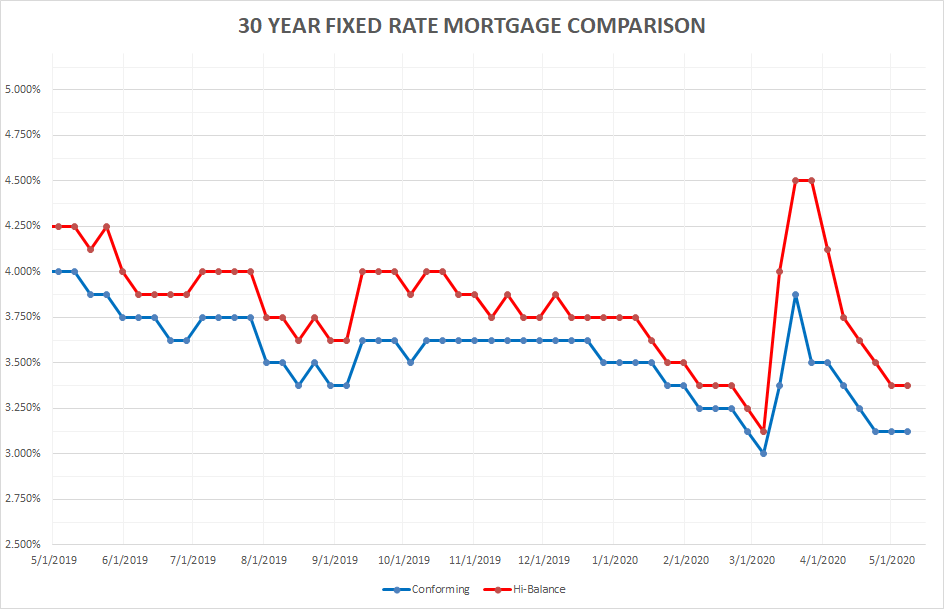
Please note that these are base rates and adjustments may be added for condominiums, refinances, credit scores, loan to value, no impound account and period rate is locked. Rates are based on 20% down with 740 FICO score for purchase mortgages.

How do you celebrate Mother’s Day without the requisite wait to get into the brunch buffet with your siblings’ families all toasting mom? Or the outing to the park with the kids so your wife can be pampered at the local spa? Or the nice dinner out after both of the above?

The Smith home is being transitioned to the Smith Resort on Sunday so Leslie can lounge and read by the pool while be served fancy drinks (pina coladas, mimosas, or anything else she desires), snacks, grilled shrimp tacos for lunch and poolside grilled steak dinner.

It appears that many families will be adding to their savings rates this Mother’s Day with stay at home creations to celebrate the moms.

Happy Mother’s Day,

Dennis

Past Weekly Rate & Market Updates can be found on my blog page at my website www.DennisCSmith.com/my-blog

Can I get a mortgage if my parents co-sign because of my poor credit?

Question of the week:  Can I get a mortgage if my parents co-sign because of my poor credit?

Answer: Over the past year, years really, we have had several Questions of the Week that deal with credit reports; What can I do about my credit, Should we consolidate our credit, Why did my credit score drop, and How do inquiries impact my credit, are just a few of them.

What we have not addressed in several years is what if you have poor credit and want to buy a home. The question of if your parents, or another connected party, can help you purchase your new home if you have poor credit.

The quick answer is, No. Of the three factors that are considered for a borrower in loan qualifying, income, credit and cash to close, credit is the one area that outside assistance is not able to enable qualifying.

Mortgage underwriting guidelines state that the lowest middle credit score of all borrowers on an application is the score that will be used for qualifying and pricing the loan. For instance, Angela and Adam are recently married and wish to purchase a home. Angela’s credit scores from the three major credit agencies (Experian, TransUnion and Equifax) are 763, 744 and 768; her middle score is 763. Adam had a few issues in his past and his middle scores are 689, 703 and 679; his middle score is 689. Since Adam’s middle score is the lowest of the two, the score for the file is 689.

Some programs require a minimum score of 700 to be eligible. If one of these programs were the one Angela and Adam wanted for their home purchase or refinance they would not be eligible for the program. “Dennis, what can we do? Can my parents co-sign for us?”

If you are unable to qualify because your income is low, we can add a “non-occupant co-borrower” to your mortgage application to enable you to qualify. If you are short funds to close you can get a documented gift from your parents or other connected party to qualify. If you have a credit score that is too low for the loan program for which you are applying the only way you can qualify for that program is to increase your credit score.

All is not lost. There are different options that may be available to Angela and Adam to achieve their home purchase or refinance goal.

One option is to look at Adam’s credit report and see if there is something that can be done to increase his score. Perhaps paying an account down, or off, may raise the score the eleven or more points needed; or sometimes opening an account will get the extra points needed. Not all credit reports are the same and the composite data that creates the credit score is influenced by many, many factors. Depending on what is on the report it may be fairly easy to increase the score.

A second option is to see if there is another program that may enable Angela and Adam to achieve their goal. While more expensive because of mortgage insurance, FHA mortgages are often used for clients with lower credit scores because their minimum scores for different programs are a lot lower than those for conventional and most jumbo programs. The decision factor in this case is the trade-off between the current higher mortgage cost due to the mortgage insurance versus the potential higher cost if waiting to purchase or refinance due to higher home values and/or rates. It is not an unusual reaction to want to have the mortgage product with the lower costs, however that product is not available to you, a change in mindset may be the most beneficial to you in the long term as you are able to purchase your home today.

A third option is that perhaps mom and dad can co-sign—with Angela. Depending on the ability of everyone involved and the mortgage program, by dropping Adam from the mortgage and adding mom and dad as co-signers the transaction may be able to continue.  

One other option we have employed is for mom and dad to purchase the property as an investment property. Angela and Adam move in and make all the payments for the mortgage, property taxes and insurance. In the future, when Adam’s credit scores are better, depending on the rates and the market Angela and Adam may want to refinance to put the home and mortgage in their own name.

Since a low credit score cannot be cured with adding co-borrowers, it is advisable for you to know what is on your report and address any issues that are negatively impacting your credit as soon as you can. We have plenty of experience analyzing credit reports and assisting borrowers increase their scores.  Sometimes this can happen in a short period of time, sometimes not. For the latter, I always bring up a client from more than twenty years ago, Yvonne.

Yvonne and her husband wanted to purchase their home but had undergone some economic traumas that resulted in low credit scores. Yvonne was determined to own her own home and for almost two years she worked to improve their credit. She would constantly check in with me and we would review her accounts and her plan, checking her credit report every 5-6 months to see where they stood. Finally, the day came when their credit was rehabilitated and they purchased their home. When I called to tell Yvonne her loan had funded and she was going to be a homeowner she was not the only one on the call with a catch in her throat and blurry eyes.

Poor credit and low scores can delay your home ownership, but do not let it prevent it. Be like Yvonne and tackle the problem as soon as you can.

In regard to parents co-signing, in March we answered, “Should we co-sign for our son or daughter’s home purchase.”

Have a question? Ask me!

This was a very busy week for market impacting news and data. In order of the announcements this week and positive or negative impact on rates:

One year after hitting a peak, consumer confidence in October was down slightly from September, but by less than prior months. Over the past year the consumer confidence chart looks like a ride at Knott’s Berry Farm. The valleys have been getting higher since January and the trend line looks like the next trend is back up. The over-riding news from the report is that consumers are reasonably confident and holiday spending should not be curtailed. Over all the news is somewhat negative for rates as high consumer confidence can lead to high consumer spending, which is about 65-70% of our economy, which leads to economic growth.

Consumer confidence and spending resulted in another positive quarter of growth for the Gross Domestic Product. The 3rd quarter increase of 1.9% was down a peg from the 2nd quarter growth, but higher than the 1.6% that was expected from most of the experts. Inside the report, the spending by consumers in the quarter more than counter-balanced a large drop in business investment caused by a drop in oil prices and the trade conflict with China. Showing stronger than expected growth, despite consumer spending dropping from the extremely strong 4.6% growth in the 2nd quarter to 2.9% in the 3rd quarter, plus residential housing investments increasing for the first time in five years, the GDP data is negative for mortgage rates.

Following the GDP data release was the announcement from the Fed that it cut its benchmark interest rate by 0.25%. This move was expected and on its own had not impact on mortgage rates. In making the rate announcement the Fed used its normal Fed-Speak to announce that it would likely take a pause before enacting any more rate cuts. Some investors have expected more rate cuts in the near future and a pause puts them on the wrong side of the market. From their announcement, it appears the Fed is content with the current path on rates as they forecast continued moderate growth in the economy, a continuing strong labor market and inflation very near its 2% target. Overall the news is a bit rate negative due to the Fed taking off the table the certainty of another rate increase and the more positive message than it has supplied in prior announcements.

Thursday, it was back to consumers as the Commerce Department released data for September on consumer spending, personal income and inflation. Consumer spending increased for the month at a mundane 0.2% rate, down from August’s dull 0.3% growth. While dull and mundane, September was the seventh month in a row of increased spending. The increase in spending was supported by higher earnings as incomes rose 0.3% in September, reflecting the strongest labor market in fifty years. With spending increasing at a slower pace than incomes it is not surprise that the savings rate increased to 8.3%, near post-recession highs and showing that while consumers are spending steadily they are doing so within budgets that enable saving as well—something that was absent prior to the Great Recession. Because the growth in spending and incomes have been moderate the pressure on prices has been the same, prices have increased only 1.3% from September 2018, the matching February as the lowest since 2016. This news is neutral for mortgage rates as it reflects an economy that is not booming nor busting but chugging along.

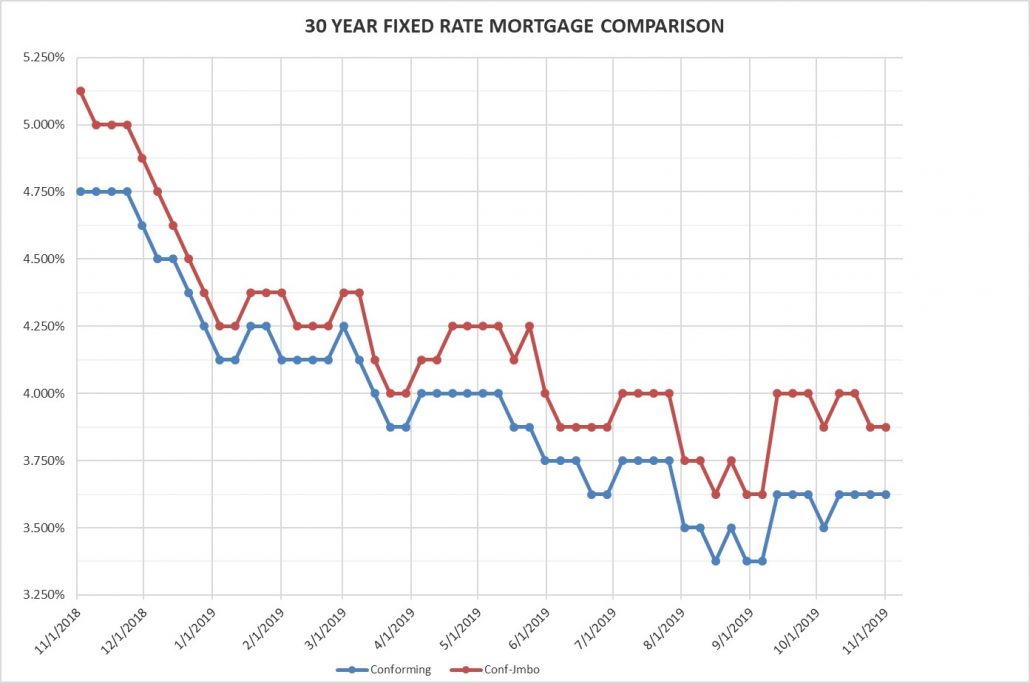
Rates for Friday November 1, 2019: Last week there was an error in the rate numbers below, the chart was correct but not the numbers, they did not reflect the 0.125% drop in the high-balance rate from the prior week. This week the high-balance rate further compresses to the conforming rate, which is flat this week. Following all the economic news reported today I was expecting rates to be a bit higher. We may be nearing the end of a cycle so a bump next week would not surprise me.

FIXED RATE MORTGAGES AT COST OF 1.25 POINTS LOCKED FOR 45 DAYS:

30 year conforming                                            3.625%     Flat

30 year high-balance conforming                    3.75%      Down 0.125%

Please note that these are base rates and adjustments may be added for condominiums, refinances, credit scores, loan to value, no impound account and period rate is locked. Rates are based on 20% down with 740 FICO score for purchase mortgages.

Do not forget to turn your clocks back before you go to sleep on Saturday night or you’ll be early for church…or is it late? I can never keep that part straight.

If you live anywhere in Southern California you have likely smelled smoke over the past few days. Unfortunately, it is that time of year again where too many of our fellow Californians are experiencing trauma and tragedy due to major fires. Here is what has become a semi-annual link I provide for those who are wanting to help: Donate to the Red Cross The Red Cross does what no other entity, public, private or non-profit, does when it comes to disaster relief and assistance, every little bit helps. If everyone who receives this Weekly Rate & Market Update donates just $10, more than $6000 will be raised to assist with food, blankets and housing. Take a minute and click-it!

I was half-right last Friday, the Washington Nationals did win their first World Series ever, but it took more games than I thought. How amazing that every game was won by the visiting team!

Have a great week,

Dennis

Past Weekly Rate & Market Updates can be found on my blog page at my website www.DennisCSmith.com/my-blog

What can I do about my credit?

Question of the week:  What can I do about my credit?

Answer:  This is a question that has been asked several times over the past month or so as we have received more inquiries from clients looking to purchase a new property or refinance one they currently own and have some issues on their credit report.

Credit report “issues” can vary from having derogatory reporting to credit scores. If you have negative credit issues many of them can be rectified, depending on severity. Let’s look at various credit issues and what you may be able to do to improve your credit.

The interest rate you are offered on credit, be it for credit cards, auto loans or a home mortgage, is impacted by your credit score. The lower your score the higher the interest rate; and you may be declined credit if your score is below a certain level. There are five elements that have the biggest impact on your credit score: payment history, credit utilization, length of credit history, new credit and the mix of your credit. Some of the elements you may be able to work on to improve your credit score, other items you will have little to no ability to influence.

The most important element by a long shot is your payment history. The more recent a late, or derogatory, payment is reported the larger the impact on your credit score. As well, the more serious the delinquency the larger the impact. For instance, a 30 day late on a credit card from December 2012 will have a lower impact than a 90 day late on a house payment from June 2019. Depending on the severity of the derogatory reporting, you may be able to have the reporting creditor agree to change the way the account is being reported.

While a 30 day late payment on a credit card is the most benign of derogatory payments they are also some of the hardest to have removed from your credit report, especially if the account is with a major bank. Typically to have late payments removed you will need to provide proof that you were not more than 30 (or 60, 90…) days late on your payment. This will entail providing a series of bank statements or cancelled checks to show your payment history and no payment being late. If you have an excellent history with the creditor and have on 30 day late they may (key word “may”) agree to remove the reporting of the late payment to retain you as a customer.

If you have late payments on a mortgage you will have to show that you have made your payments on time from before and after the late payment reported. While it does not happen often it is not that rare that borrowers who have been making on time payments and have had their servicing transferred to a new lender may be reported late due to misapplication of payments by the new lender or issue with the previous lender transferring records. It may take some patience and time, but if you have had a derogatory reporting on your mortgage for which you have made on time payments provide the records showing you have made the payments and the lender(s) accepted them. In May our Question of the Week was what you should do if your mortgage servicing has been transferred.

If you have collection accounts on your credit report, depending on their status they may be able to be removed and therefore have any negative impact removed as well. Collection companies purchase delinquent accounts at a discount and begin charging fees and interest on the obligation. Some collection companies will work with clients and agree to remove the accounts. Typically, if the account has been paid off already the collection company will not agree to remove the account—they have already received their money and you have no leverage. If you owe a balance the collection company may agree to provide you with a letter stating that no money is owed and the reporting of a collection was made in error. If you have an account that is reported in collection my advice is to contact the collection company, always being very friendly and nice as most of customer service people get yelled at and abused most of the time, and apologize for having the balance, ask how much is owed, and then ask if it is possible for you to obtain a letter saying nothing is owed and the account is reporting in error if you pay off the balance today. They may say yes and they may say no. If they say no, tell them thank you, ask if they can send you a written itemized bill and that you will work on paying the debt. Wait a day or two and call back. If there are not notes in your file and you receive another customer service representative, s/he may be in a more generous mood to your request and work with you.

Whether they agree to remove the reporting or not, if you have an outstanding collection account the impact on your report is more than a paid collection. The paid collection will stay on your report for seven years, so it is worth it to contact accounts that have been paid every six months or so to see if they will agree to remove the account from your credit bureau reports. If they do agree to do so ask if you can get a letter to the effect and send it to the credit bureaus yourself in case they do not follow up with the bureaus.

If you have a county, state or federal tax lien or judgment on your report the chances of you getting it removed are extremely slim. On the taxes the only way to get them removed is for the taxing entity to acknowledge to you that your taxes were paid as agreed and not in default, and they have to contact the credit bureaus directly. Like a collection account, unpaid tax liens on your report are more harmful than liens recorded against you but reporting paid. These recorded liens will report on your report for seven years.

Note that it takes a while for most tax agencies to file a lien against you. If you owe back taxes and are notified it is best to negotiate a payment agreement and begin payments. Most tax agencies will not file a lien as long as you are making timely payments towards paying off the obiligation.

Civil judgments, such as from small claims court, will either show an amount owed or that the obligation has been satisfied. If you lost a civil judgment and have paid it off it is very important that you receive a  notice that the plaintiff has file a “satisfaction of judgment” with the court. Once  you make the payment for the amount owed make sure you get a copy of the satisfaction of judgment and communicate to the court the judgment has been paid. If you do not receive a satisfaction of judgment contact the court and show them you have paid off the amount owed so they can either get the plaintiff to file the satisfaction or the court can file one showing no debt is owed.

The next most impactful element on your credit score is “credit utilization,” i.e. how much you owe. Not only is this the total amount of credit you owe but what kind of credit you owe and how much do you owe in relation to how much you can borrow. For many borrowers with scores that are lower than what is needed to either be eligible for a mortgage program, or what is needed for the next best interest rate, paying down or off some credit accounts can improve their score.

If you have a credit card with a $10,000 credit limit and owe $9500, this will have a negative impact on your credit score. If you are able to pay down the balance to $7000 your score will improve. What we do with many clients with high balances on revolving credit accounts to run a report and asking “what if?” What if different balances are lower and by how much, how will the score improve? What if an account were paid in full? Sometimes when we run these reports the scoring model suggests a new account be opened with a certain limit and a small balance is put on the account.

Credit utilization is much more fluid than payment history in how it impacts credit scores. We have tools to use with our clients that can show how much credit scores can be raised if certain actions occur.

I have found over the years than many people with some credit challenges are reluctant to address them, sort of like those who are hesitant to go to the doctor when they have a pain or probable medical condition—they are worried about what they will learn. However, until you have the condition looked at a remedy cannot be provided; and just because you do not have the condition looked at does not mean it will go away.

The sooner you have any credit issues addressed the sooner you are getting closer to having them resolved. Some issues can be corrected in a short period of time, and others make take quite a while. I have had several clients over the years with significant credit issues. We put together a plan and the clients followed the plan we agreed upon and after, in a few cases, a few years they were finally able to purchase a home. Had they done nothing they would have had to wait five, six or more years to purchase a home.

Finally, before you say, “I want to wait to buy a home until my credit score is higher,” let’s take a look at your credit report and score and see what rate and cost a mortgage will be with your current score, what the time and cost will be to increase your score, and what your rate and cost would be with that higher score. For many clients the cost in monthly payments is not as significant as they think to purchase a home today with their current score as opposed to spending time and money to try to raise their score for an incrementally better rate.

If you think you have credit issues and this thought is preventing you from exploring the opportunity to purchase a new home please contact me so that we can assess your credit situation and options for purchasing a new home. Rates are very low, waiting to increase your score may end up costing you more if rates go higher by the time your score has improved than if you were to purchase today with the score you have.

Have a question? Ask me!

What’s next? That is the question investors and business owners are looking for the Fed to answer. Last year the Fed policy was to raise rates two to three times in 2019 after raising rates four times in 2018. This was because the Fed was concerned about the economy growing too fast as indicated by every tightening labor markets, consumer spending and inflation hovering around its 2% target. The first quarter came and went with no rate increases and at the end of the second quarter the minutes from the Federal Open Market Committee (FOMC—the gang that determines the Fed’s interest rate charged to member banks) indicated many wanted to lower rates a few times through the remainder of the year. Earlier this month the Fed lowered its benchmark rate by 0.25% (one-quarter of one percent) because of concerns that the economy was not growing fast enough and concerns there might be a recession in the offing. This minutes from the meeting where rates were lowered were released, and comments from Fed Chair Jerome Powell indicated that the rate drop in early August was a “mid-cycle adjustment” and not part of a long-term policy.

Investors, business owners, elected officials, almost everyone, who makes long term decisions with money do not like uncertainty. Uncertainty makes planning difficult, close to impossible. Uncertainty leads to short term decisions and rapid and multiple changes of direction. Uncertainty leads to bad decisions and bad results. The Fed with its words and actions have created uncertainty in our markets and in the economy. As I have stated several times over the past few months, it appears the Fed has been acting on “what-ifs,” “mays,” “coulds” and “perhaps.” Our economy has been growing since 2010 at annual rates of 1.6% to 2.9%, to slow for some and worrisome that it may grow too fast for others. There is nothing wrong with this long, slow and sustained growth for nine years, likely ten. The Fed needs to sit on its hands and ignore the calls to “do something” in reaction to the news of the minute and instead look at the economic data that has accumulated.

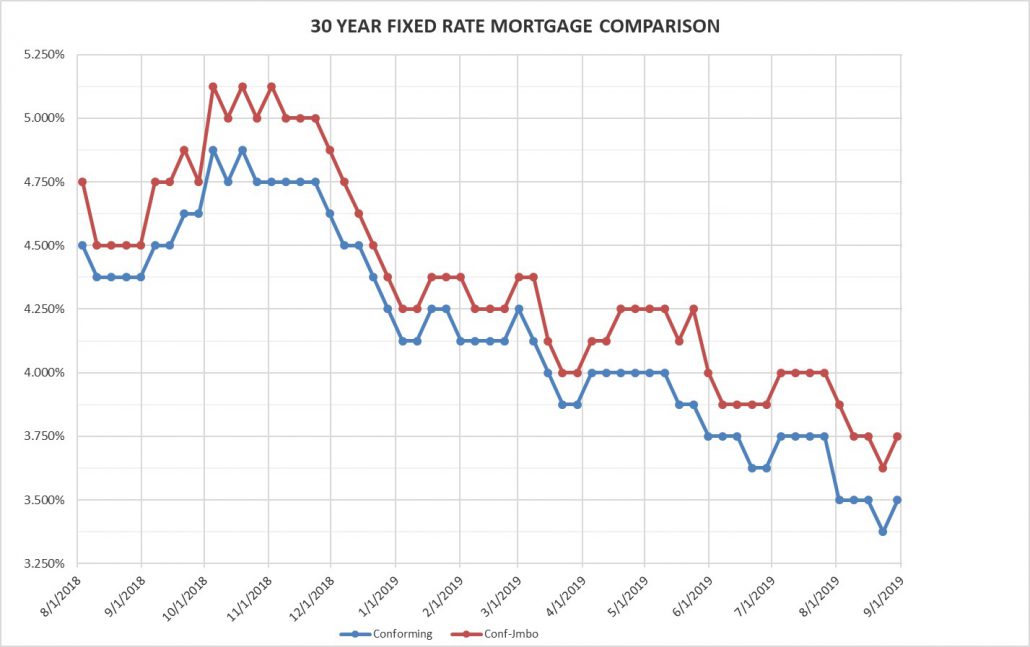
Rates for Friday August 23, 2019: Rates bounced this week off last week’s multi-year low. Mostly in reaction to the Fed speak as well as the news cycle that we are heading into recession in 2020. With a rebound today in the mortgage markets we have paired some of the losses.

FIXED RATE MORTGAGES AT COST OF 1.25 POINTS LOCKED FOR 45 DAYS:

30 year conforming                                            3.5%     Up 0.125%

30 year high-balance conforming                    3.75%    Up 0.125%       

Please note that these are base rates and adjustments may be added for condominiums, refinances, credit scores, loan to value, no impound account and period rate is locked. Rates are based on 20% down with 740 FICO score for purchase mortgages.

Our home is slowly returning back to the “new normal” established last year when our eldest went off to Boston to get some learnin’ in bio-engineerin’. She flew off East early this morning putting us almost on normal footing—which will occur next week when Long Beach Unified opens its doors for students and our youngest begins her senior year at Poly High (Go Jackrabbits). I consider the school year “normal” as there is a set routine daily and I am a person who thrives on routine. Summer and holiday schedules throw me for a loop.

Not sure what I will do in a year when they are both away at college and there is no set routine of a school bell to meet every week day from September to June; the schedule we have followed for fourteen years.

Have a great week,

Dennis

Past Weekly Rate & Market Updates can be found on my blog page at my website www.DennisCSmith.com/my-blog
Why did my credit score drop?

Question of the week:  Why did my credit score drop?

Answer:  This question was posed to me by Bryan, with a Y, a young man who is starting his career, renting and already planning for his future which includes getting married and purchasing a home. He was concerned because he receives updates from his big Bank in America with whom he has a credit card about his credit score, and he received notification that his score had dropped about twenty points. Why?

Before I answered his question, I asked him another: why do you care?

My question was not meant to belittle Bryan, or to be sarcastic. I asked the question because I come across so many people who are very concerned about their credit score when they really do not need to be.

Bryan’s answer was typical, “because, I want to have a good score.” Well, even with the sudden decline in his credit score Bryan still has a really good score—the drop had no impact on his finances, credit or life in general. But still he was concerned.

In our conversation, I brought up when a credit score is important, when you are seeking credit.

By now everyone knows, or should know, that the cost you pay for credit depends to a large extent on your credit scores. The higher your scores the lower your costs for credit, the lower your scores the higher costs of credit.

When you are applying for a credit card, auto loan, a mortgage, your credit scores are important. When you are not applying for credit, or do not intend to for some time, your scores are not as important.

Does this mean you should not worry about your credit? As I told Bryan, live your life, buy what you need, use credit responsibly and you will have very good credit scores. If you use credit wisely and responsibly when it comes time for a large purchase you will have good scores.

Back to Bryan’s question: Why did his credit score suddenly drop?

  • Here are the primary factors that impact your credit score in order of importance:
  • What is your payment history—How you pay your credit obligations is the largest determinant of your credit score. The more serious any derogatory, i.e. late, payments are the more they hurt your score; a charge off or collection account is considerably more damaging than a 30 day late.
  • How much you owe and how much is available—While not as impactful on your score as your payment history, it is almost as important. Your debt utilization rate is more important than the total amount you owe. Debt utilization is the percentage of your available credit on an account that you have borrowed, the higher the percentage the higher the negative impact on your credit card. If you have a card that has a $10,000 limit and your balance is $9,350 the account will cost you points on your credit score; if on that same card you owe $4500 your score would be higher. For many clients we work with to improve credit scores this area is a primary focus as it is easier to lower credit balances than to get creditors to remove late payments.
  • How old is your credit—Having accounts that have been reporting for a longer period of time is better than having new accounts, especially revolving accounts such as credit and department store cards. If you are thinking of buying a home at the start of the year do not succumb to the department store discounts if you open a charge card with them during the Christmas season. As well, if you are considering purchasing a home do not close accounts until after you are in your new home.
  • What kind of credit do you have—Do you have a lot of installment debt or revolving debt or are you pretty balanced? The more broad the type of credit you have, mortgage, auto loan, student loan, credit cards, the better your score will be as long as they are within the parameters above. This factor is not a big impact on your credit score, but does have some influence.
  • Have you been shopping for credit—Multiple inquiries within a short period of time can hurt your credit score. That said some inquiries are worse than others. If you are purchasing a home or new car the scoring systems recognize you are shopping for installment debt, which if successful will most likely result in one auto loan or one home loan, and the impact of more than a few credit inquiries is not significant or perhaps have no impact. If there are multiple inquiries within a short period of time from credit card companies and department stores it is evident you are searching for credit which may signify some type of financial difficulty and the impact on your score could be several points.

Back to Bryan….It seems Bryan and his friends are going on a golf trip and Bryan fronted the funds for the reservations on his credit card. The total amount he charged to secure accommodations and tee times put his card balance over 80% of the card’s limit. Referring to factor two above, credit utilization, the high percentage of used to available credit on his card caused Bryan’s score to drop. When his friends repay their portion of the vacation expenses to Bryan and he uses those funds to pay down the credit card balance his score will increase to its prior level.

Credit scores are important as they are a very good indication of the risk a creditor takes when they lend money to someone. For individuals it is important to behave responsibly in credit use, but it is also important to not let concern about your credit score have too much influence on how you live your life.

Take Bryan, he is not buying a car or a home in the near future, so his credit score dropping twenty points for a short period of time is not very relevant. If he knew the credit score dip was going to occur would he have not made all the reservations for the guys’ golf trip? Probably not, Bryan’s a good guy and would make it easier for his friends, and himself, to secure the accommodations and tee times they needed so they can go ahead with their plans.  If Bryan was using a credit card that had “points” or other advantages, such a move was also very smart on his part.

In July of last year our Question of the Week was, “When should we have our credit report pulled when exploring the purchase of a new home.” If you missed this incredibly informative WR&MU you can read it here.

Have a question? Ask me!

Good timing award, goes to me for discussing personal debt and credit scores the same week the Federal Reserve released its monthly report on financial stability, in the report the Fed stated, “Household borrowing remains at a modest level relative to incomes, and the debt owed by borrowers with credit scores below prime has remained flat.” Consumer credit growth has slowed in recent months, while personal incomes have grown. It appears consumers are either increasing their purchases with cash and/or increasing their savings with their increased incomes.

Inflation remains tame. Both the Producer Price Index and Consumer Price Index increases in April were below expectations. Pushed higher by gas and energy prices the growth was only 0.2% for the PPI and 0.3% for the CPI (adjusted to 0.1% when food and energy stripped out of the data to obtain the “core” index). Year over year inflation for consumers edged up slightly from 1.9% to 2.0% in April, well within the Fed’s range of comfort. The news is rate neutral as it reinforces common sentiment that rates should remain stable for quite some time.

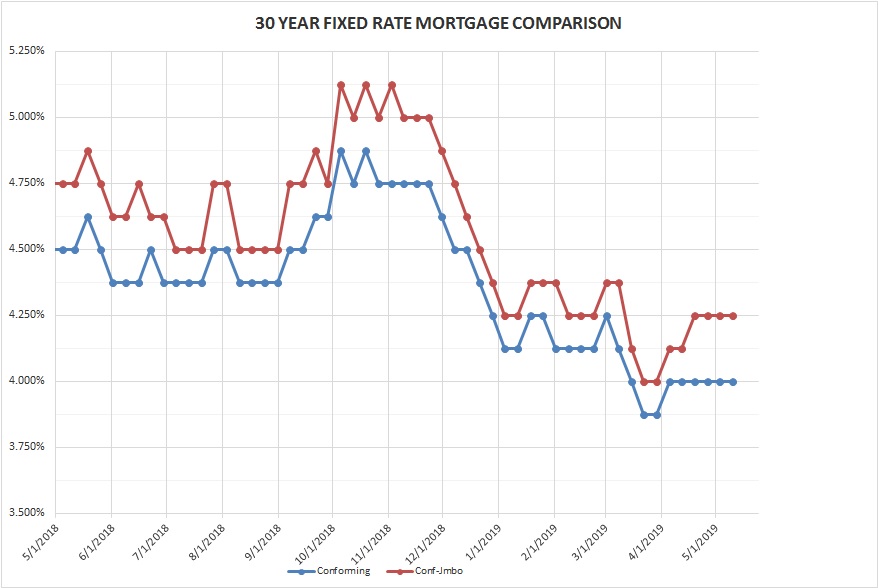
Rates for Friday May 10, 2019: This week was a good example of why watching financial data on an hour to hour, day to day, basis can be a bit maddening. As investors reacted to the comments by President Trump leading up to today’s trade negotiations with China and his then threat, now reality, to increase tariffs on Chinese goods by selling off in the stock markets, then buying back, then selling off we saw a similar see-saw in rate markets. Now that the words have become deeds, as I write this both credit and equity markets have rebounded. Over all the impact on rates from last Friday has been nil, we are flat for the fifth week in a row for conforming rates.

FIXED RATE MORTGAGES AT COST OF 1.25 POINTS LOCKED FOR 45 DAYS:

30 year conforming                                            4.00%        Flat

30 year high-balance conforming                   4.25 %       Flat

Please note that these are base rates and adjustments may be added for condominiums, refinances, credit scores, loan to value, no impound account and period rate is locked. Rates are based on 20% down with 740 FICO score for purchase mortgages.

We are a culture of hyperbole, everything is the best this, the worst that, the most awesome thing ever. Social media, if anything, has exacerbated our tendency to hyperbole—enhanced with pictures and comments from friends validating our hyperbolic opinions J!!

Where the word “best” is not hyperbolic is when used like this, “I have the best Mom ever…” Because for the overwhelming majority of people this is true—our Moms are/were the best ever. The best at hugs, the best at turning tears into laughs, the best at being your personal chef to cut off the crusts or leave off the mustard. The first and best at unconditional love.

To all the Moms, you are the best! Thank you for being the best for all of us sons and daughters! (And from us husbands, thanks for being the best Moms for our children as well!)

One final note, a special happy birthday wish to my big sister who has spent many years filling some of Mom’s roles for my brother and I. We love you.

Have a great week,

Dennis

Past Weekly Rate & Market Updates can be found on my blog page at my website www.DennisCSmith.com/my-blog
7-13-18: How do inquiries impact my credit score?

Question of the week:  How do inquiries impact my credit score?


Answer:  A lot or not at all.


Quite frequently we have new clients tell us, “don’t run a credit report because I don’t want it to hurt my score.”


My response is, “First I cannot give you a solid pre-qualification and absolutely no pre-approval without running my own report, and second it will not impact your score unless you have had several inquiries recently—have you been speaking with other mortgage professionals and have any of them run reports and if so when?”


Conventional wisdom is that credit inquiries push down your credit score, so when you need credit just by applying your score drops, which may mean a higher rate or credit denial.


Conventional wisdom is not always right, especially when it comes to credit reports. Let’s take a look at when credit inquiries do harm your score and when they do not.


If you are applying for several credit cards, department store cards or signature lines of credit the chances are your credit score will be negatively impacted. If you are applying for one such item of credit your score will most likely not be impacted at all. The credit score programs have in their algorithms risk factors and if they are told that you are making several inquiries to obtain revolving, easy to access credit that activity is a high credit risk—it is evident you are searching for funds from many sources. What if you apply for two department store cards and two credit cards within two weeks. You could very quickly have access to several thousand, tens of thousands, of dollars in credit. If you already have several open credit accounts with high balances compared to credit limits these inquiries will push your score down considerably.


If you have some open credit accounts and the balances are not very high compared to available credit and you apply for a new credit card, say one that will give you airline points so you can leverage your purchases for plane tickets to visit your kid at college, if this is the only revolving credit inquiry on your credit report then your score will not, should not, be impacted.


What about purchasing a home? We routinely see credit inquiries on our clients’ credit reports from other mortgage lenders, usually over the past month or so, and these inquiries do not generally impact the credit score. I say generally because if there are more than five or six there could be an impact but not necessarily. As a rule three or four, or fewer, inquiries for home loans will not impact your credit.


The reason for this is that it is not unusual for someone looking to obtain a mortgage, either for home purchase or refinance, to call more than one lender (unless they call Stratis Financial which is usually the last call needed). This behavior is programmed into the credit score software, so if there are multiple inquiries from mortgage companies in a somewhat short time frame, about 4 weeks or so, your credit score is not impacted.


The same is true about auto loans. Many people speak to many car dealers, who run reports themselves or through different banks, looking for auto loans and these inquiries are treated similarly to mortgage inquiries.


If you have multiple inquiries for long term debt obligations, like home or auto loans, you credit score will likely not be impacted, if you have multiple inquiries for revolving credit your credit score will likely be impacted negatively.


Have a question? Ask me!


Pressure, no pressure, was the impact on interest rates with the price data released this week. On Wednesday the Producer Price Index for June was released and the data put pressure on rates to increase as wholesale prices increased 0.3% for the month and were up 3.4% from last June (2.8% when food and energy are stripped from the data, called the “core” rate). This strong data for prices caused great anticipation for the Consumer Price Index data release the following day. Would the stronger PPI figures show inflation for consumers beyond what the Federal Reserve would prefer? No, the CPI data did not show a significant increase in prices in June, putting Fed interest rate decision makers at ease. Month over month prices rose a scant 0.1% for you across the economy’s basket of goods and services and the generic American consumer paid 2.9% more than in June 2016 (2.3% using the core rate). This data was met with a bit of a sigh, and a shrug. Looking ahead, will the June wholesale price increase bleed into July for consumers resulting in higher rates? We will on August 10th when that data is released.


Rates for Friday July 13, 2018:  A tame week in the rate markets with not a lot of movement, so little that rates are the same as last Friday. We like a flat market!


FIXED RATE MORTGAGES AT COST OF 1.25 POINTS LOCKED FOR 45 DAYS:

30 year conforming                                            4.375%            Flat

30 year high-balance conforming                      4.500%             Flat


Please note that these are base rates and adjustments may be added for condominiums, refinances, credit scores, loan to value, no impound account and period rate is locked. Rates are based on 20% down with 740 FICO score for purchase mortgages.


While we have had some significant summer heat early in July, we are still a week away from the Dog Days of Summer, which officially begin on Sunday, July 22nd and end on Thursday, August 23rd. Wait, there are official Dog Days of Summer? Yup. Based on ancient Roman and Greek astronomy, the time when the star Sirius (the star that is the nose of the constellation Canis Major) rises in the morning before the sun. This year Sirius will rise before the sun starting next Sunday and ending on August 24th (the sunrise after August 23rd).


In those times the period of the dog days were not looked forward to as it was during this period when sickness, war and catastrophes would occur—perhaps coincidence, perhaps not!


Have a great week,


Dennis

7-6-18: When should we have our credit report pulled when exploring the purchase of a new home?

Question of the week:  When should we have our credit report pulled when exploring the purchase of a new home?


Answer: “We got a copy of our credit report on-line, can you just use that?” This is usually the question that precipitates our question of the week.


When should you have a credit report pulled? Our most common answer to the Question of the Week is, “that depends…” and it applies in this case as well.


Many people are fearful of having credit reports run because they are concerned the inquiry will hurt their credit score. As a result, when we ask them somewhat generically, how is your credit history, they often reply that they recently obtained a report on-line and would like us to use that for their pre-qualification and approval.


If we are in the very preliminary stages of the qualification process, using a generic report from one of the free on-line services can be helpful, but we will not issue a pre-approval or a strong prequalification recommendation unless we are able to obtain our own report.


Why?


Because. (I’m a dad so I get to answer “why” questions with “because.”


We need our own report for several reasons. First and foremost, our reports are what are known as “tri-merge” reports, meaning they include the data from the three main credit reporting bureaus, Equifax, TransUnion and Experian. This will provide us with a very complete credit history and with credit scores from the three bureaus so we know which score will be used for qualifying and rate pricing (we use the middle score, if two or more borrowers we use the lowest middle score).


Second, not all credit companies report to all bureaus. We have seen many “clean” reports over the years provided by one credit bureau and then when we pull our tri-merge items appear that were reported to one of the other bureaus. For instance, you obtain a report from Equifax and it shows your car and student loans, credit card balance and history with a late payment from Macys in 2013. That is pretty good. However, when we pull our report there is a collection from a medical bill in 2013 that showing unpaid that reported to both TransUnion and Experian. Suddenly we have an issue to deal with we did not know about. As well, the collection will give you a lower score on the bureaus reporting it than the one that did not, how much lower? Does it knock us out of the program we want to use? Does it change the rate significantly?


Back to our question of the week, when should we have the tri-merge report pulled?


It depends on where you are in the process. Are you just starting the process of purchasing your new home? You have really looked yet but have been talking about it and want to see where to begin, how to begin, what needs to be done to begin? If that is the case you are likely going to be some time away from actively engaging in the process, in which case we will probably speak in generalities, broad strokes, and begin prepping for the full on assault on the housing market.


If in our initial conversation you make some statements or provide some answers that leads me to believe we might have some issues creep onto the credit report I would suggest we pull a report to get a starting point and see if we have any work to do. What might come up that would lead us to want to pull a report? You are divorced—how did the credit separation go? Are you still linked to your ex-spouse on any open accounts? You mention you had a medical issue in the past that took some time to resolve—did any accounts go to collection? You are self-employed and had to change tax preparers as you were not satisfied with his/her performance—were there unpaid taxes that became a lien? There are several variables that thirty years’ experience can hear and suggest a credit report.


One thing we consider when strategizing the credit report is that after sixty days lenders will want a new report to make sure nothing has changed. If we pulled a report May 5th, and you are still looking for a home today, do we pull a new report them?


Probably not. Once we pull our initial report we tend to stick with that for as long as we can. In the current market it can, and does, take some buyers several months to find the home they want, and can, buy and have their offer accepted. If we did pull a report in May, or even April, and you write an offer this weekend, as part of my pre-approval package I would include the information form that May, or April, report and advise that we do not want to pull reports every sixty days to reduce inquiries with your credit bureaus and one of the conditions of the seller’s acceptance of your offer can be my providing updated information on your credit scores and ability to qualify within 24-48 hours using a fresh report.


On the one hand we do like to limit the number of reports we pull. On the other hand we have to have the tri-merge report to know exactly what we are going to be dealing with for qualifying and approval.


When is the best time to have your credit report pulled? Just before we are in “go mode” for a home purchase and will be writing offers, or if you think there may be some issue from the past that could have an impact or be an issue we need to deal with.


Next week we look at credit inquiries and their impact on your credit score.


Have a question? Ask me!


Words and numbers impact rates. Words released by the Federal Reserve Open Market Committee (FOMC) from their last meeting in June when it raised rates by 0.25% indicate Fed members see labor markets continuing to tighten and inflation should retain its 2% level in the near future. Concerns about the future were expressed as short-term rates are approaching long term rates, what is known as a flattening yield curve. This rate behavior often coincides with a recession—is the Fed predicting one? Not exactly but keeping an eye on data that often does. The minutes gave some relief to investors anticipating higher rates in the short term as the minutes were somewhat rate friendly.


The data supported the Fed’s assessment.  Our monthly First Friday Labor Department release of employment data happened this morning and most of the data supports the Fed’s course of two more rate increases this year. The economy added 213,000 jobs in June, over 202,000 in the private sector. As well the labor force grew by 601,000 in June. This increase in the job force caused the headline unemployment rate to increase for the first time in a long time from 3.8% in May to 4.0% in June. The increase is result of the growing work force, i.e. more people seeking employment, and the labor participation rate (percentage of individuals eligible for work who are working, or participating in the workforce) increasing from 62.7% to 62.9%. This news is rate neutral to the extent most people who follow this sort of thing anticipated numbers close to what was released. The number that caused some pause was the earnings portion of the report as wages grew 0.2% for the month and are up 2.7% from last June. This relative slack increase in earnings as employment grows indicates more workers are seeking work enabling employers to hold wages steady. This removes some concerns about inflation being driven by wages, and is rate friendly.


Rates for Friday July 8, 2018:  Our last recession ended in June 2009, it would certainly seem a course correction for the economy is long over-due as we start our tenth year of economic growth. That is just back drop for the political and economic issues that are impacting domestic and international economies that have more and more economists and investors starting to look at the horizon for signs of an economic downturn. When economies slow down or go into recession interest rates either lead in anticipation, or follow. The possibility now being brought up more and more of not whether but when the next recession will occur puts a bit of a parachute on rates trying to climb.


FIXED RATE MORTGAGES AT COST OF 1.25 POINTS LOCKED FOR 45 DAYS:

30 year conforming                                            4.375%            Flat

30 year high-balance conforming                      4.500%             Down 0.125%


Please note that these are base rates and adjustments may be added for condominiums, refinances, credit scores, loan to value, no impound account and period rate is locked. Rates are based on 20% down with 740 FICO score for purchase mortgages.


How messed up is your internal calendar? Mine was out of whack all through June for whatever reason, I’m blaming school being let out and my routine being thrown off. Now starting the month with a holiday smack in the middle of the week has me really thrown off. Did we get two Mondays and two Fridays this week? I need a Tuesday and/or Thursday thrown in once in a while—but that does not mean I advocate for our Independence Day celebration and holiday to become a mandated Monday holiday with different dates every year a la Labor and Memorial Days.


I hope you enjoyed your celebrations on the 4th, our family did.


Have a great week,


Dennis

3-30-18: Credit report states impacted by natural disaster


Question of the week:  Why do some of the creditors on my credit report say, “Affected by Natural or Declared Disaster” when I live nowhere near a natural disaster that has occurred?


Answer: Because creditors were not all A+ students in geography class.


Last year saw many natural disasters across the country, from hurricanes in Texas and Florida to wildfires up and down the state of California. Many people were severely impacted by the disasters, some of the more fortunate only lost some days at work and had the financial burden of cleaning up after the disaster, however many lost their homes, cars, places of work and neighborhoods. While trying to recover from the disasters, dealing with the emotion of such tremendous loss they also had the reality of bills still due, negotiating with insurance companies to cover losses and added costs of where to stay and how to get there.


Understanding that financial disasters create tremendous financial burden on those in the impacted areas more and more credit companies are automatically putting into their reports to the three major credit bureaus that the debtor resides in a natural disaster area. The purpose of this statement is to let those reviewing the credit report for the possibility of extending credit will understand if there are any late payments on the account that the natural disaster could be responsible for the late payments. Essentially letting future creditors know there is likely a very good reason for the late payments that should be taken into account when extending credit.


So why are these notices popping up on credit reports for people who have not been affected by a natural disaster? Because the notices are put on credit reports using computer models and the computer models, from what we have seen, are using counties or regions when determining which accounts to label.


For instance, a couple in Long Beach, which has not been impacted by any natural disaster in decades, has a couple of accounts labelled with the natural disaster language. While Long Beach has not had a natural disaster declared, within the last twelve months there have been severe fires in both Los Angeles and Orange Counties; Long Beach is in LA County and borders Orange. It appears the creditor plugged in LA County as having a natural disaster and tagged all its accounts in the county, not realizing the size of the county and how geographically distant Long Beach is from any of the fires that occurred.


In Texas and Florida people are facing similar reporting, while they were not severely impacted by any of the storms they live near enough, or are in counties, declared natural disaster areas that they have had accounts tagged with the natural disaster warning.


Does this impact your credit? No, it does not. Does it impact your mortgage underwriting? As this reporting is relatively new on credit reports we have had some underwriters request appraisers note on the report if the property was impacted by a natural disaster.


At this point we have not seen any impact on credit scores, positively or negatively. Meaning if you have an account that has a 30-day late payment on the credit report and that same account is labelled “Affected by Natural or Declared Disaster,” we have not seen your credit score not impacted by the late payment—meaning your score is still depressed due to the late payment.


If this label is on some of  your accounts do not be concerned that it is in any way impacting your credit or ability to obtain a mortgage or other applied for credit such as an auto loan. It is merely a head’s up to other creditors that if you do have any late payments in the recent past there may be a very good reason why—if you in fact did live in a natural disaster area and were negatively impacted.


If you have any questions about your credit report please do not hesitate to contact me.


Have a question? Ask me!


A few reports this week that can impact rates. On Wednesday, the final revision to Gross Domestic Product for the 4th quarter of 2017 was released, and the revision was up 0.4% from the prior revisions. Strength in the increase was mainly attributed to consumer spending, which increased 4.0% from the 3rd quarter. The news was somewhat mortgage rate unfriendly as stronger economic data portends higher interest rates in the future.


While consumer spending led the way in 2017, so far in 2018 that has not been the case, causing expectations for GDP growth in the first quarter to be lower than it was in 2017. On Thursday data was released on Personal Income and Consumer Spending. The good news is that wages continue to increase, up 0.4% in February, matching January’s increase. And like January, consumer spending in February was up a lackluster 0.2%. Workers are earning more but spending less, so it is no surprise that the personal savings rate has increased to 3.4%. With the flat growth in consumer spending prices were up 1.8% from February 2017, still below the Fed’s 2% inflation rate target. The increase in earnings is negative for mortgage rates as it creates expectations for wage inflation, however workers putting more of their earnings into savings instead of spending is positive for mortgage rates. Since consumer spending is approximately 65-70% of GDP, a slow-down in spending could slow down GDP growth, keeping upward pressure on rates at bay.


Rates for Friday March 30, 2018:  A short week for markets as stock and commodity exchanges are closed today for Good Friday. Conforming rates continue to hold steady from Friday to Friday, seven weeks in a row now with the same rate. Lenders continue to bounce up and down on the high-balance conforming rates (loans from $463,451 to $679,650) and we are down 0.125% from last Friday. Markets continue to be volatile, and there is more turbulence ahead as indicated by the stock markets down in the first quarter of 2018 after nine consecutive positive quarters. My advice remains to lock through your escrow closing when you can.


FIXED RATE MORTGAGES AT COST OF 1.25 POINTS LOCKED FOR 45 DAYS:

30 year conforming                                            4.25%       Flat

30 year high-balance conforming                      4.375%      Down 0.125%


Please note that these are base rates and adjustments may be added for condominiums, refinances, credit scores, loan to value, no impound account and period rate is locked. Rates are based on 20% down with 740 FICO score for purchase mortgages.


For parents on young ones I will give you this Easter tip learned from my mom, count the number of eggs you hide so you make sure they are all found. My mom learned this lesson when her young sons found an egg or two in the middle of August, in Tulsa, that had been rotting in the sun and heat since March. There was a special kind of scent and cleaning her boys after they found the putrid little bombs and did what boys do (throw at each other) taught to always make sure all the eggs were found on Easter…


Spring Break begins for our kids and many others, after this next week the next stop is summer. Seems like forever for the kids and tomorrow for the parents.


Have a great week,


Dennis