
Posts

Are we ready to buy?

Question of the week:  Are we ready to buy?

Answer:  In the March 1st Weekly Rate & Market Update I covered the number one reason to the question, “Why didn’t you purchase a home sooner?” from the California Association of Realtors 2018 Home Buyer Survey. That reason was “Needed to save for a down payment,” and it came up as I answered the question, should potential home buyers wait to purchase their new home until they have a 20% down payment. Sidebar, I failed to put in the 3/1/19 WR&MU that that most home buyers save for 5 years for their purchase.

The number two reason respondents did not purchase their home sooner was “waiting for our financial situation to improve.” In other words, are ready, or in many cases feel ready, to buy.

My knee hurts. It has been hurting for a little while and I am finally tired of the pain so I make an appointment. I call the orthopedic doctor’s office and make an appointment for next Thursday at 8:00 so he can operate on my knee and fix it.

Wait. What?

That is how many families go about purchasing a home, they try to go right to surgery.

When they think they are ready the go to an open house, or meet with a real estate agent, find a home they like and write an offer. Are they able to qualify for their mortgage? Could they be looking at homes that are higher priced, bigger, in better neighborhoods? Should they be purchasing a home right now, or should they spend more time working on different factors that impact their ability to qualify for the home they want to buy?

 Working with families purchasing new homes my experience has shown three types of buyers:

  • Buyers who write offers, get an offer accepted, go look for a loan, discover if they can qualify for the purchase of the home or not
  • Buyers who meet with me, determine the sales price, loan amount and loan type for which they qualify, go write offers and purchase a home they can afford
  • Buyers who meet with me, have some issues that prevent them from qualifying for the home they would like to buy, work with me to resolve those issues, become able to qualify for the mortgage they need to purchase the home they would like to purchase, go write offers and purchase a home they can afford

The vast majority of clients we work with fall into the second category. We meet, determine qualifying home price and terms and they work with their real estate agent to purchase a home they like and can afford. Often these clients have spent time on their own getting ready to purchase a home, and we find that many of them could have purchased a home sooner, but they did not know they would be able to do so.

Many of our clients fall into the third category. They know they want to purchase a home in the future, but are not sure how long in the future or what they need to do so they can purchase a home in the future.

The first category of buyers we see from time to time, thankfully most real estate agents will require their clients get pre-qualified, or better yet pre-approved, before writing offers and certainly before accepting them if they are representing the seller.

When we pre-qualify a family for a home purchase, we are answering their question, “are we ready to buy.” For some the answer is, yes immediately. For others it is either yes but not for as high a price as you would like or not yet; if this is the case we show where they are deficient in the qualifying guidelines and put together a plan so they will be ready to buy.

What deficiencies might potential home buyers have?

Not surprisingly, while there are many factors that going into a loan approval the primary ones are about you and money; how much do you make, how much do you have, how much do you owe and how well you pay what you owe. For most home buyers one of these determines their maximum purchase price and loan amount. You make great income and have little to no debt, but the funds you have for down payment determine your price. You have a nice savings account and little to no debt but your income limits the amount of a mortgage you can qualify for to purchase. You have good income, nice savings but a lot of debt and high monthly payments on your credit cards which impacts your qualifying. Or, good income, nice savings, not a lot of debt but in the past you had some serious delinquencies that could impact your ability to obtain a mortgage.

Some of these issues are easier to solve than others depending on your financial situation. By working with a mortgage professional as soon as you decide you want to purchase a home in the not too distant future you can work on the area(s) that you need to improve to increase your ability to qualify. My definition of “not too distant future” is up to 24 months, and it is routine for us to work with clients for up to that amount of time before they purchase their new home.

My knee has been hurting. I go to my chiropractor and after a few sessions she tells me I need to see a physical therapist. I see the therapist and he says it appears it is something structural that therapy will not cure and tells me I need to see an orthopedist. I see the orthopedist, he orders and X-ray and an MRI which shows some damage. I can either continue to live with the paid or have a surgery that will fix the issue.

Am I ready for surgery? I know more about my situation now that I have met with professionals who have guided me through the process—a much better scenario than just scheduling a surgery and letting the doctor figure it out once I am on the table.  

Before you have surgery, or buy a home, get the proper advice and take the proper steps to ensure you are ready when the time is right.

Are you ready to buy? Maybe, maybe not but the only way to know is to call me to make an appointment so we can see where you stand today for qualifying to purchase a new home, and if necessary what you need to do so you are qualified sooner rather than later.

Have a question? Ask me!

Economic data slow to reach the public due to the government shutdown is being published as the analysts play catch up. One of these reports was retail sales for January, which increased 0.2% in January after the largest drop in monthly sales in decade to end 2018. Removing auto and gasoline sales and the increase was a somewhat robust increase of 1.2% for the month. The news was neutral for mortgage rates, higher consumer activity is generally negative for rates since that is 65-70% of our economy.

Inflation is not a concern. Both the core Consumer Price Index and core Producer Price Index saw very modest increases in February, both up 0.1% for the month and CPI up 2.1% year over year and PPI up 2.3% annually (the “core” index removes food and energy from the basket of goods used to calculate the price indices as they tend to be very volatile and can skew data). The target rate of inflation for the Federal Reserve, and therefore an indication of whether rates should go up or down for investors, is 2.0% and the economy is pretty much on the target. The news is slightly positive for mortgage rates as it removes a reason for the Fed to increase rates, or for investors to behave with the expectation of higher rates and therefore cause rates to increase.

Rates for Friday March 15, 2019: Rates hit a fourteen month low this week due to economic stability and no major news that could create market turbulence. The analysts and forecasters are reading the data, technical factors that include chart shapes, ranges and other factors and it appears we should be in a period somewhat stable rates for a few weeks, “should” being key word. Now is the time to take advantage of the lowest rates we have seen since last January when they started to rise.

FIXED RATE MORTGAGES AT COST OF 1.25 POINTS LOCKED FOR 45 DAYS:

30 year conforming                                            4.00        Down 0.125%

30 year high-balance conforming                    4.375%   Down 0.25%  

Please note that these are base rates and adjustments may be added for condominiums, refinances, credit scores, loan to value, no impound account and period rate is locked. Rates are based on 20% down with 740 FICO score for purchase mortgages.
Everyone is Irish this week, because how many people do not like the opportunity to gather with friends and (or?) family and sip beer, eat good food, tell corny jokes and laugh? We’ll be spending part of the weekend with Leslie’s family for the annual gathering as March 17th happens to be our niece’s birthday, and as her maiden name is McCormick a gathering to tip a toast to St. Patrick in gratitude for ridding the homeland from snakes is appropriate. As well, her sister makes wonderful corn beef and husband Dave is a serviceable home bartender! Since my mother was a Kennedy and the “C” in my name is for Cleary after my great-grandfather I am partial to celebrations of the Irish bent I look forward to the annual birthday and St. Patrick’s festivities.

Wherever your St. Patrick’s Day weekend may take you I hope you spend it with those you love, those you like and those who make you laugh and that everyone returns to their homes safely.

Slainte!

Have a great week,

Dennis

Past Weekly Rate & Market Updates can be found on my blog page at my website www.DennisCSmith.com/my-blog

What do you need to pre-qualify us for our new home purchase?

Question of the week:  What do you need to pre-qualify us for our new home purchase?

Answer:  There are three legs to the pre-qualification stool: Money, Credit, Income. To get pre-qualified, or pre-approved which takes the same amount of time and information, I need information on each of the three legs. 

Money How much money do you have for down payment and closing costs? Is all the money your money and in your bank account right now? Are you getting a gift from a family member to cover some, or all, of the funds needed? Copies of your most recent bank, investment accounts and retirement account statements will let us know how much money you will have for your purchase and any reserves your particular loan program may require. I have had clients in the past who have not shown me all their asset statements because, as one client put it, “If I show it to you then you will spend it.” Not true and not possible. I cannot spend any of your money, but I can show you different options for sales prices, loan amounts and monthly payments if I know about all your asset accounts and in what manner they are held.

Credit This category covers not only your current outstanding credit obligations, such as auto loans, student loans and credit cards; but also, if you have any spousal or child support payments or other court ordered payments. We need to know how much you owe, how much you have to pay on a monthly basis and your history of making payments. The quickest and easiest way for us to get this information is from a credit report (which will not show spousal or child support payments). “Is it necessary?” is a very common question when we request the authorization to run a credit report. The answer is, yes if you want to make sure you are getting an accurate pre-qualification for how much of a house you can buy. We can put in the information you provide us and provide some price and loan options, however unless we are viewing a recent credit report the information is not fully reliable for the basis of being pre-qualified. “If you run a credit report you will hurt my credit score,” is a common objection we hear. Running a credit report for the purposes of obtaining a mortgage, or getting pre-qualified, will very likely not have any impact on your credit score—if you have had several (by which I mean more than four or five) such reports run in the last few months one more inquiry may take a few points off your score. If you have had no inquiries run in the last few months for mortgages then our obtaining a report will not have an impact.

Income How are you paid? Are you self-employed? Do you have investment property? Do you have multiple streams of income? How long have you been receiving your income from its current source? Do you have overtime or bonuses? For most clients, this is a fairly easy question to answer. Most people are salaried employees who receive a W2 at the end of the year and we can easily and quickly calculate income. If this is the case then we need recent paystubs and most recent W2. If this is not the case then we will want to see at minimum the most recent federal income tax return that has been filed, and very likely returns for the past two years.

With all of this information we can usually pre-qualify, or pre-approve, you very quickly for a sales price and mortgage amount—by very quickly I mean less than fifteen minutes. If your income is a bit more complicated then we may need a bit more time and information.

What is most typical however, is a conversation that will take more than a few minutes, ideally in person but over the phone is also effective, so I can learn what you are looking for, your tolerances for payments and funds to spend, and making sure you have a full understanding of the transaction you are about to enter into, how the process works and most importantly that you are comfortable with the figures I am providing for price, loan amount, cash to close and monthly payment.

If you, or someone you know, if considering purchasing a home in the future please contact me to go through your options. If the potential purchase is not schedule for several months I strongly recommend having the initial conversations about how to purchase your new home sooner rather than later so that if there are any areas that need to be worked on to ensure approval you can start right away and not delay your purchase in the future.

Have a question? Ask me!

It has been ten years since real estate sales in California were as low as they were in January. The California Association of Realtors released home sale data for January and total sales were the lowest statewide since April 2008, with volume dropping 3.9% from December and down 12.6% from January 2018. The median price is up from last January by 2.1% statewide, but off 3.4% from the prior month with a value of $538,690. In Southern California both the LA and Orange County markets so drops in sale volume month-to-month and year-to year; LA down 25.5% for the month and 14.2% for the year while the OC saw sales drop 17% monthly and 13.2%. The median price in LA County in January was $588,140, down 3.8% from December’s $566,010 and up 0.3% from last January’s $564,100. Across the border in Orange County the median price was $796,500, up 1.5% from the prior month’s median price of $785,000 and up 2.1% from last year’s $780,000. January is historically a slow closing month for real estate as not a lot of escrows are opened between Thanksgiving and Christmas, that said this January was particularly slow. Anecdotally, our office has seen an upswing in purchase business so far this month from prior months—we will see if that is a regional and/or a statewide trend as well.

Rates for Friday February 22, 2019: With not a lot of economic news this week rates are flat from last Friday. There is a bit of possible long-term softening as the Federal Reserve Open Market Committee (the FOMC, who sets the direction for the Fed on rates and monetary policy) minutes from their last meeting indicated they will be slowing down their sale of assets consisting of Mortgage Backed Securities and U.S. Treasuries, this will put less supply on the  market and less upward pressure on interest rates in the markets.

FIXED RATE MORTGAGES AT COST OF 1.25 POINTS LOCKED FOR 45 DAYS:

30 year conforming                                            4.125    Flat

30 year high-balance conforming                    4.25%   Flat        

Please note that these are base rates and adjustments may be added for condominiums, refinances, credit scores, loan to value, no impound account and period rate is locked. Rates are based on 20% down with 740 FICO score for purchase mortgages.

This is a joyous and remembrance week in our family as on the 19th our youngest celebrates a birthday and on the 21st we remember my father who passed away on that date in 2014. Many people over the years have told me they may not read all of the WR&MU, but always ready this third section, the personal bit. This always causes me to smile as my dad did not like that I included this segment, “who wants to read that stuff? You have some good information and then put in that your daughter dances ballet.” I told him many times over the years, “Dad, this is the only section some people read and the only section almost everyone reads.”

Thank you for reading this and validating my stance with Dad.

Have a great week,

Dennis

Past Weekly Rate & Market Updates can be found on my blog page at my website www.DennisCSmith.com/my-blog

9-14-18: Can we afford this payment?

Question of the week:  Can we afford this payment?


 Answer:  Statistically, yes you can.


Statistics dictate the underwriting guidelines when determining how much of a mortgage and housing payment a family can afford to get loan approval to purchase a new home, or refinance an existing home. The key number is the debt-to-income (DTI) ratio which is your new housing payment (mortgage, property taxes, insurance and homeowners association dues if applicable, collectively referred to as PITI) divided by your adjusted gross income (income before taxes). Depending on the loan program this percentage of your total income for your total new debt obligations inclusive of housing payment cannot exceed between 43 and 50% of your gross income. (Note, VA mortgages do not adhere strictly to DTI guidelines for qualifying.)


For instance, if you are purchasing a new home and the total housing payment is $3,000 and you have car payment, student loan payment and credit cards with monthly payments reported on your credit report totaling $1275 per month, your total obligations are $4275 per month. If your gross monthly income is $10,000 per month you have a DTI of 42.75%, generally good enough to qualify for most programs.


Statistically. The debt-to-income guidelines were created based upon data from millions of property owner’s history of making payments in a timely fashion, and more important those that have not. Mortgage data is analyzed to see the percentage of defaults for debt-to-income ratios and there is a breaking point at which the percentage of defaults become untenable risk for lenders and that is where the DTI guidelines are set. It is important to note that the default data is also analyzed for occupancy, type of property and credit scores among other criteria and this is how rates are priced (sounds like a good question for next week).


Back to if you can afford the payment that we have given you which would be approved by underwriting.


I tell almost all clients purchasing a new home when we are going through the qualification process, “there are three things that are very true regarding your new home purchase. One, I will not use my savings to purchase the home. Two, I will use my income to help you make the monthly payment. Three, I will not spend any time sleeping or living in your home.” This is to say, while I may feel comfortable with the payment I am giving you for your potential new mortgage, property taxes and insurance, I am not making the payment so it is important that you are comfortable with what you feel you can afford.


That said it is also important to stretch a little of your comfort if your comfort level is well below your income ability, unless there are some exceptions. One gauge many first-time buyers, and some move up buyers, use for their new housing payment is what they are currently paying in rent. If you make $10,000 per month and are paying $2200 per month, using the $2200 per month to be what you would like your new housing payment to be you will be looking at homes that are significantly below your ability to qualify, and from my experience frustrated in the homes you will be looking to purchase as few, if any, will feel “right” for you and your family.


If the payment I am quoting feels too high for a client I ask that they take a look at where they spend their money, and is this likely to continue once they become homeowners. Purchasing a home is not just purchasing a place to live, it is also entering a new lifestyle, that of homeowner. For most first-time buyers, purchasing a home occurs before they start a family, or with younger children. This changes your lifestyle dramatically and the stability of owning a home and fixing your housing payment pairs perfectly with a growing family. Most meals will be made at home, changing your budget if you eat out a lot. Weekends will likely be spent with the family at different events, games and activities involving the children, which means fewer weekends travelling to the wine country or Vegas.


Essentially, is your expectation that your lifestyle and spending habits that make your potential new housing payment seem uncomfortable to remain the same? Chances are very, very high that it will not. When considering your new home and the cost also consider the changes you will be making in your lifestyle, and therefore expenses.


Finally, why are you buying a home? Is it to change your life in a positive manner? If so what other changes are you willing to make so you can experience the value of homeownership?


Pretty much everything decision in life has trade-offs and consequences, even not making a decision. One area at which I will immodestly say I do very well is explaining to my clients the positives and negatives of the options available to them when purchasing a home. If you think owning a home is not in your budget please contact me so we can discuss your financial situation and options.


Have a question? Ask me!


August economic data was interesting. The Producer Price Index dropped 0.1% in August, the first month over month decline in 18 months and read by many as a sign that inflation may be easing. Supporting the read was the Consumer Price Index for August that showed prices rose 0.2% for the month, however up only 0.1% for the “core” rate (minus fuel and food). The monthly increase was the fifth straight increase, however the size of the CPI increase lowered the year over year inflation for the core index to 2.2% from 2.4%. Gas and rent were the primary factors putting upward pressure on the index, many other consumer sectors fell, primarily clothing which saw prices drop for the third month in a row—good news if you have growing children. The news is mostly positive for interest rates as any easing of inflation releases pressure for rates to go higher.


Retail sales also grew at a slower pace in August from the prior month, however the slow down was not unexpected given the surge in sales in July. Supporting future increases in sales was the Michigan Consumer Sentiment Index which continues to rise, reaching it second  highest level since 2004, and highest since March of this year. Positive consumer sentiment leads to consumer spending, which drives the economy and can lead to higher rates.


Rates for Friday September 14, 2018: A large drop in Mortgage Backed Security (MBS) prices in the middle of the week put strong upward pressure on rates. Some easing later in the week saw us with rates this Friday flat from last Friday. I have been asked a lot lately what I thought rates will do, my standard response is that I feel they should be higher than they are currently given the economic data.


FIXED RATE MORTGAGES AT COST OF 1.25 POINTS LOCKED FOR 45 DAYS:

30 year conforming                                            4.50%             Flat

30 year high-balance conforming                      4.75%      Flat


Please note that these are base rates and adjustments may be added for condominiums, refinances, credit scores, loan to value, no impound account and period rate is locked. Rates are based on 20% down with 740 FICO score for purchase mortgages.


Thankfully Hurricane Florence started losing power earlier in the week and when it made landfall this morning in North Carolina had lost enough power to be designated a tropical storm instead of a hurricane. Even with the winds at less power the amount of water that will be dropped in the southeast will be significant, especially if the storm remains in place. As always when nature becomes fierce the Red Cross is there to help residents through the event and after. We are truly fortunate to have such a wonderful organization looking after people negatively impacted around the globe by human and natural acts that displace and harm people.


Many communities are also grateful they have a Waffle House or two in their communities. The butt of many jokes, mostly from those not in the Waffle House regions, the company does great work when disasters are about to hit. So great in fact that FEMA follows the company’s “Waffle House Index” to help determine the severity of a storm. Waffle Houses rarely close, they want to stay open as long as possible as the company knows in many communities it may be the only place for residents and emergency personnel to get a meal. The company also assists with employees from other stores in nearby, less effected, regions to go into disaster zones and fill the jobs at Waffle Houses so those employees can take care of their families and situations as a result of the hurricane, tornado or other event.


Here is a good article on the Waffle House Index. Just so you know, Stage Yellow probably means no bacon—you can get sausage because it takes up less grill space and takes less time to cook so the restaurant can serve more people faster by taking bacon of the restricted menu.


Have a great week,


Dennis

7-20-18: What is the process for our mortgage application when we purchase a home?

Question of the week:  What is the process for our mortgage application when we purchase a home?


Answer:  Mortgage application packages are very deadline oriented. For a purchase this is because we have a closing date that is agreed upon by the buyer and seller, for a refinance the deadline is when the rate lock expires.


Here is a not so detailed look at the timeline on a purchase, much of it is the same as with a refinance.


Ideally the first step in your mortgage process when purchasing a home is we have detailed conversations and review your records to determine your ability to qualify for a mortgage to purchase at a certain price with a certain amount down. This is the pre-qualification, or pre-approval, stage. We review your income by looking at paystubs and tax documents. We obtain a credit report to see you credit score and confirm your balances and payments on outstanding credit. We look at your asset statements so we know how much we have in funds for down payment, closing costs and reserves if necessary. And we discuss your objective, long term plans and other factors that may influence the amount and type of mortgage that would be ideal for you and your family. This step can take an hour or several days depending on the complexity of your finances or issues we need to address. Next step: Look at houses and write offers.


You have your offer accepted and we begin the formal application process. At this stage we complete any information for the loan application so you can sign the application and disclosures. We collect necessary documents supporting income, credit, obligations, funds being used for closing and other items we discuss as necessary. Once we have the signed application and necessary items we lock in your loan rate for a specified period of time that matches your escrow time frame but in 15 day increments (i.e. lock for 30 or 45 days). As well, we communicate with both your agent and the seller’s agent to establish clear lines of communication, confirm who will be the person for the appraiser to contact to set up inspection of the property. We also initiate contact with the escrow officer to make sure s/he and our staff have each other’s contact information as they will be sending a lot of information and documents back and forth. Finally in this stage, we order the appraisal. This stage is generally one to two days depending on how quickly you get the required items to us. Next step: Processing.


During the processing period our staff is collecting the necessary information to ensure underwriting will approve your loan as applied for. All your information will be reviewed and verified. During the review our staff will ask questions that may need additional information to support answers: what is this large deposit, there are some statements in the tax return that indicate another business or sources of income to verify. At this time they are also collecting necessary documents for the approval. The appraisal report will be completed and reviewed. We will obtain a copy of the preliminary title report on the property. Escrow will send us the escrow instructions which detail the agreement between you and the seller. We will communicate with your insurance company to ensure there will be sufficient coverage of the property to protect the lender should there be fire or other major damage. Any loose ends or issues that may arise as all this information is collected and reviewed are addressed and the necessary parties are contacted and additional information requested to cover the issue so underwriting will approve the file. The timing for this stage depends on the how quickly others respond to our request for items. If the listing agent puts off the appraisal inspection for a week or ten days that slows us down. If we request additional statements on an account, tax returns on a business entity, source of funds, this can slow us down if the information is not forthcoming. If everything is into us in a very timely manner this step should be about 10 business days. Next step: Underwriting.


The mortgage application package, at this point several inches thick (our record is over 1 foot high with clients who had multiple companies and properties resulting in about ten tax returns for various entities). All the documentation, disclosures, reports are then sent to the underwriting department. Once received it is assigned to an underwriter who reviews the file and issues an approval, usually “conditional” approval as the underwriter generally asks for items to complete the file, an updated paystub, a letter of explanation for some issue, clarification on the appraisal, support for continuing income from commissions, overtime or bonus, a myriad of items may come up. The underwriting period is generally two to three business days. Depending on the additional conditions requested the time frame from initial approval to final approval can be as short as 3 to 4 days or considerably longer depending on conditions requested and ability to provide them. Next step: Loan Docs.


Once we get the approval and are moving into the final stages of the transaction we will issue to you the Closing Disclosure (or CD). We usually like to issue this via DocuSign as when you acknowledge the CD will start a timer on when you can sign loan documents, which is three days not counting Sundays and holidays. So if we issue the CD on Friday and you open the link and “sign” on Sunday you cannot sign loan documents until Wednesday, if you had signed on Friday you could sign docs on Tuesday. Does one day make a difference? Next step: Funding.


The loan documents will be sent to escrow and available for you to sign the day you are eligible to sign after the CD rescission period is up. Escrow will contact you to set up a time to sign in their office, or if more convenient set up a mobile notary. At this time we will know the amount of funds needed to complete the closing of the transaction. Escrow does not take personal checks, the funds for closing need to be either via a cashier’s check or a wire (see important note below). After you sign loan docs and your funds are in escrow we fund the loan. If we have the loan docs in our office in the morning and all is in order we can fund the day we get the loan docs, the time from doc signing to funding can be as short as one day. Next step: Closing.


Closing occurs when the deeds are recorded by the title company at the county recorder where the property is located. The grant deed conveying title from the seller to you is recorded first, then the trust deed securing the property as collateral for the mortgage is recorded. Depending on what county you live in recording happens either the same day (Orange County is a same day recording county), or it occurs the next day (Los Angeles County will not allow funding and recording on the same day). This is where that one day difference on the CD can impact closing. Since we cannot fund and record on the same day in some counties we very rarely fund a loan in those counties on a Friday for many reasons, for one you are paying interest for two additional days on a property you do not own. Second, if something happens to the property, or the current owner, we have two loans on the property and two insurance policies (your policy must be in effect before we can fund). As you can imagine this creates several issues that need to be unwound. While something could happen to the property between funding on Wednesday and recording on Thursday, it is less likely than something happening between funding Friday and recording Monday. So the closing step is either same day or next day. Next step: Move In!


NOTE, VERY IMPORTANT! There has been a wire fraud scheme occurring with real estate closings. The scam works like this. You are in escrow to purchase a property and you receive an email from what looks like your escrow officer. It is instructing you to wire your funds for closing and provides the necessary information. The email has the escrow company’s email address, signature on the email looks the same and by all accounts is from the escrow company. This email will come near closing but before funds are usually asked for from escrow. What has occurred is that at some point your email was hacked, it could have been last month or last year or even longer ago. The hackers run your emails through their filters which are set to look for keywords in your emails, such as “escrow,” “mortgage,” “purchase home,” etc. When any keyword occurs the account is monitored to determine is you are engaging in a real estate transaction. The next step is to determine who is who in the communications and then spoof the email account for the closing agent, i.e. escrow, and send you the email requesting you wire the funds into the scammers account. Do not reply to the email, do not send the funds to the account listed in the email and do not call the number listed in the email as chances are it is not the escrow company you are using. Before sending funds call the escrow officer from the number printed on the escrow instructions you have, or by getting the number from us or your agent, and verify the amount of funds required and ask them to send you an email with the wire instructions, then call back to verify the information is correct.


As you can see the time frame for closing an escrow on a purchase can be 30 days or a little less, or longer depending on everyone having the information needed and requested and providing it in a very timely fashion. Closing times are dependent on many actors all performing together and when needed.


Have a question? Ask me!


Consumers appear to be happy. Retail sales for June were reported on Monday and showed a 0.5% increase from the prior month. This is good news, what was pretty incredible news was that May retail sales were revised upward 0.5% for a total increase of 1.3% from April, that is a very rare number to reach. Auto sales had strong months in May and June, up almost 1% each month, and restaurants also showed strong increases, up 1.5% in May and 2.6% in June. This news indicates consumers willing to increase their discretionary spending, what’s more discretionary than eating out instead of at home? The news is somewhat negative for rates as higher consumer spending supports stronger economic growth, which leads to higher interest rates.


Historic is the word to describe yesterday’s jobless claims report. Last week 207,000 initial jobless claims were filed, the lowest weekly amount since December 1969. Continuing jobless claims, as sign of length of unemployment, are at 1.738 million which is at a level last seen in the early 1970s. The news is interest rate unfriendly as a tight labor market can, should, lead to some wage inflation which will lead to higher interest rates.


Rates for Friday July 20, 2018:  The economic data suggests rates should be higher than they are, especially with the Fed selling off billions of dollars of mortgages and bonds every month. However investors, who ultimately control interest rates, do not look at just American economic data when making their decisions on what to buy and sell for long range profits, the also look at foreign economies, and as importantly domestic and international politics. It is the latter that has investors holding onto their fixed return investments (i.e. mortgages and bonds) as a hedge against some major event that could trigger a run on bonds and therefore lower rates. It is a strange set of market circumstances we have been experiencing. Thankfully we have benefited from flat rates for the past two months.


FIXED RATE MORTGAGES AT COST OF 1.25 POINTS LOCKED FOR 45 DAYS:

30 year conforming                                            4.375%            Flat

30 year high-balance conforming                      4.500%             Flat


Please note that these are base rates and adjustments may be added for condominiums, refinances, credit scores, loan to value, no impound account and period rate is locked. Rates are based on 20% down with 740 FICO score for purchase mortgages.


We have been down to one kid in the house since early in the month as the younger one is spending her annual month in Minnesota at camp, unfortunately for the older one she is basically termed out this year and must spend the summer at home. It has been nice to have her home with us since she leaves in 4-5 weeks to Boston for college and then we will be a one kid home for a few years before the younger ones decides to leave as well. We are in that period when our oldest is still our daughter and little girl but our relationship is slowly transitioning to daughter and adult. Certainly a unique summer for our family, and one that we will fondly remember for years to come. I hope you and your family are having a great, and unique, summer as well!


Have a great week,


Dennis

7-13-18: How do inquiries impact my credit score?

Question of the week:  How do inquiries impact my credit score?


Answer:  A lot or not at all.


Quite frequently we have new clients tell us, “don’t run a credit report because I don’t want it to hurt my score.”


My response is, “First I cannot give you a solid pre-qualification and absolutely no pre-approval without running my own report, and second it will not impact your score unless you have had several inquiries recently—have you been speaking with other mortgage professionals and have any of them run reports and if so when?”


Conventional wisdom is that credit inquiries push down your credit score, so when you need credit just by applying your score drops, which may mean a higher rate or credit denial.


Conventional wisdom is not always right, especially when it comes to credit reports. Let’s take a look at when credit inquiries do harm your score and when they do not.


If you are applying for several credit cards, department store cards or signature lines of credit the chances are your credit score will be negatively impacted. If you are applying for one such item of credit your score will most likely not be impacted at all. The credit score programs have in their algorithms risk factors and if they are told that you are making several inquiries to obtain revolving, easy to access credit that activity is a high credit risk—it is evident you are searching for funds from many sources. What if you apply for two department store cards and two credit cards within two weeks. You could very quickly have access to several thousand, tens of thousands, of dollars in credit. If you already have several open credit accounts with high balances compared to credit limits these inquiries will push your score down considerably.


If you have some open credit accounts and the balances are not very high compared to available credit and you apply for a new credit card, say one that will give you airline points so you can leverage your purchases for plane tickets to visit your kid at college, if this is the only revolving credit inquiry on your credit report then your score will not, should not, be impacted.


What about purchasing a home? We routinely see credit inquiries on our clients’ credit reports from other mortgage lenders, usually over the past month or so, and these inquiries do not generally impact the credit score. I say generally because if there are more than five or six there could be an impact but not necessarily. As a rule three or four, or fewer, inquiries for home loans will not impact your credit.


The reason for this is that it is not unusual for someone looking to obtain a mortgage, either for home purchase or refinance, to call more than one lender (unless they call Stratis Financial which is usually the last call needed). This behavior is programmed into the credit score software, so if there are multiple inquiries from mortgage companies in a somewhat short time frame, about 4 weeks or so, your credit score is not impacted.


The same is true about auto loans. Many people speak to many car dealers, who run reports themselves or through different banks, looking for auto loans and these inquiries are treated similarly to mortgage inquiries.


If you have multiple inquiries for long term debt obligations, like home or auto loans, you credit score will likely not be impacted, if you have multiple inquiries for revolving credit your credit score will likely be impacted negatively.


Have a question? Ask me!


Pressure, no pressure, was the impact on interest rates with the price data released this week. On Wednesday the Producer Price Index for June was released and the data put pressure on rates to increase as wholesale prices increased 0.3% for the month and were up 3.4% from last June (2.8% when food and energy are stripped from the data, called the “core” rate). This strong data for prices caused great anticipation for the Consumer Price Index data release the following day. Would the stronger PPI figures show inflation for consumers beyond what the Federal Reserve would prefer? No, the CPI data did not show a significant increase in prices in June, putting Fed interest rate decision makers at ease. Month over month prices rose a scant 0.1% for you across the economy’s basket of goods and services and the generic American consumer paid 2.9% more than in June 2016 (2.3% using the core rate). This data was met with a bit of a sigh, and a shrug. Looking ahead, will the June wholesale price increase bleed into July for consumers resulting in higher rates? We will on August 10th when that data is released.


Rates for Friday July 13, 2018:  A tame week in the rate markets with not a lot of movement, so little that rates are the same as last Friday. We like a flat market!


FIXED RATE MORTGAGES AT COST OF 1.25 POINTS LOCKED FOR 45 DAYS:

30 year conforming                                            4.375%            Flat

30 year high-balance conforming                      4.500%             Flat


Please note that these are base rates and adjustments may be added for condominiums, refinances, credit scores, loan to value, no impound account and period rate is locked. Rates are based on 20% down with 740 FICO score for purchase mortgages.


While we have had some significant summer heat early in July, we are still a week away from the Dog Days of Summer, which officially begin on Sunday, July 22nd and end on Thursday, August 23rd. Wait, there are official Dog Days of Summer? Yup. Based on ancient Roman and Greek astronomy, the time when the star Sirius (the star that is the nose of the constellation Canis Major) rises in the morning before the sun. This year Sirius will rise before the sun starting next Sunday and ending on August 24th (the sunrise after August 23rd).


In those times the period of the dog days were not looked forward to as it was during this period when sickness, war and catastrophes would occur—perhaps coincidence, perhaps not!


Have a great week,


Dennis

7-6-18: When should we have our credit report pulled when exploring the purchase of a new home?

Question of the week:  When should we have our credit report pulled when exploring the purchase of a new home?


Answer: “We got a copy of our credit report on-line, can you just use that?” This is usually the question that precipitates our question of the week.


When should you have a credit report pulled? Our most common answer to the Question of the Week is, “that depends…” and it applies in this case as well.


Many people are fearful of having credit reports run because they are concerned the inquiry will hurt their credit score. As a result, when we ask them somewhat generically, how is your credit history, they often reply that they recently obtained a report on-line and would like us to use that for their pre-qualification and approval.


If we are in the very preliminary stages of the qualification process, using a generic report from one of the free on-line services can be helpful, but we will not issue a pre-approval or a strong prequalification recommendation unless we are able to obtain our own report.


Why?


Because. (I’m a dad so I get to answer “why” questions with “because.”


We need our own report for several reasons. First and foremost, our reports are what are known as “tri-merge” reports, meaning they include the data from the three main credit reporting bureaus, Equifax, TransUnion and Experian. This will provide us with a very complete credit history and with credit scores from the three bureaus so we know which score will be used for qualifying and rate pricing (we use the middle score, if two or more borrowers we use the lowest middle score).


Second, not all credit companies report to all bureaus. We have seen many “clean” reports over the years provided by one credit bureau and then when we pull our tri-merge items appear that were reported to one of the other bureaus. For instance, you obtain a report from Equifax and it shows your car and student loans, credit card balance and history with a late payment from Macys in 2013. That is pretty good. However, when we pull our report there is a collection from a medical bill in 2013 that showing unpaid that reported to both TransUnion and Experian. Suddenly we have an issue to deal with we did not know about. As well, the collection will give you a lower score on the bureaus reporting it than the one that did not, how much lower? Does it knock us out of the program we want to use? Does it change the rate significantly?


Back to our question of the week, when should we have the tri-merge report pulled?


It depends on where you are in the process. Are you just starting the process of purchasing your new home? You have really looked yet but have been talking about it and want to see where to begin, how to begin, what needs to be done to begin? If that is the case you are likely going to be some time away from actively engaging in the process, in which case we will probably speak in generalities, broad strokes, and begin prepping for the full on assault on the housing market.


If in our initial conversation you make some statements or provide some answers that leads me to believe we might have some issues creep onto the credit report I would suggest we pull a report to get a starting point and see if we have any work to do. What might come up that would lead us to want to pull a report? You are divorced—how did the credit separation go? Are you still linked to your ex-spouse on any open accounts? You mention you had a medical issue in the past that took some time to resolve—did any accounts go to collection? You are self-employed and had to change tax preparers as you were not satisfied with his/her performance—were there unpaid taxes that became a lien? There are several variables that thirty years’ experience can hear and suggest a credit report.


One thing we consider when strategizing the credit report is that after sixty days lenders will want a new report to make sure nothing has changed. If we pulled a report May 5th, and you are still looking for a home today, do we pull a new report them?


Probably not. Once we pull our initial report we tend to stick with that for as long as we can. In the current market it can, and does, take some buyers several months to find the home they want, and can, buy and have their offer accepted. If we did pull a report in May, or even April, and you write an offer this weekend, as part of my pre-approval package I would include the information form that May, or April, report and advise that we do not want to pull reports every sixty days to reduce inquiries with your credit bureaus and one of the conditions of the seller’s acceptance of your offer can be my providing updated information on your credit scores and ability to qualify within 24-48 hours using a fresh report.


On the one hand we do like to limit the number of reports we pull. On the other hand we have to have the tri-merge report to know exactly what we are going to be dealing with for qualifying and approval.


When is the best time to have your credit report pulled? Just before we are in “go mode” for a home purchase and will be writing offers, or if you think there may be some issue from the past that could have an impact or be an issue we need to deal with.


Next week we look at credit inquiries and their impact on your credit score.


Have a question? Ask me!


Words and numbers impact rates. Words released by the Federal Reserve Open Market Committee (FOMC) from their last meeting in June when it raised rates by 0.25% indicate Fed members see labor markets continuing to tighten and inflation should retain its 2% level in the near future. Concerns about the future were expressed as short-term rates are approaching long term rates, what is known as a flattening yield curve. This rate behavior often coincides with a recession—is the Fed predicting one? Not exactly but keeping an eye on data that often does. The minutes gave some relief to investors anticipating higher rates in the short term as the minutes were somewhat rate friendly.


The data supported the Fed’s assessment.  Our monthly First Friday Labor Department release of employment data happened this morning and most of the data supports the Fed’s course of two more rate increases this year. The economy added 213,000 jobs in June, over 202,000 in the private sector. As well the labor force grew by 601,000 in June. This increase in the job force caused the headline unemployment rate to increase for the first time in a long time from 3.8% in May to 4.0% in June. The increase is result of the growing work force, i.e. more people seeking employment, and the labor participation rate (percentage of individuals eligible for work who are working, or participating in the workforce) increasing from 62.7% to 62.9%. This news is rate neutral to the extent most people who follow this sort of thing anticipated numbers close to what was released. The number that caused some pause was the earnings portion of the report as wages grew 0.2% for the month and are up 2.7% from last June. This relative slack increase in earnings as employment grows indicates more workers are seeking work enabling employers to hold wages steady. This removes some concerns about inflation being driven by wages, and is rate friendly.


Rates for Friday July 8, 2018:  Our last recession ended in June 2009, it would certainly seem a course correction for the economy is long over-due as we start our tenth year of economic growth. That is just back drop for the political and economic issues that are impacting domestic and international economies that have more and more economists and investors starting to look at the horizon for signs of an economic downturn. When economies slow down or go into recession interest rates either lead in anticipation, or follow. The possibility now being brought up more and more of not whether but when the next recession will occur puts a bit of a parachute on rates trying to climb.


FIXED RATE MORTGAGES AT COST OF 1.25 POINTS LOCKED FOR 45 DAYS:

30 year conforming                                            4.375%            Flat

30 year high-balance conforming                      4.500%             Down 0.125%


Please note that these are base rates and adjustments may be added for condominiums, refinances, credit scores, loan to value, no impound account and period rate is locked. Rates are based on 20% down with 740 FICO score for purchase mortgages.


How messed up is your internal calendar? Mine was out of whack all through June for whatever reason, I’m blaming school being let out and my routine being thrown off. Now starting the month with a holiday smack in the middle of the week has me really thrown off. Did we get two Mondays and two Fridays this week? I need a Tuesday and/or Thursday thrown in once in a while—but that does not mean I advocate for our Independence Day celebration and holiday to become a mandated Monday holiday with different dates every year a la Labor and Memorial Days.


I hope you enjoyed your celebrations on the 4th, our family did.


Have a great week,


Dennis

6-15-18: We have plenty of money in our accounts and a ton of equity, why is my income so important?


Question of the week:  We have plenty of money in our accounts and a ton of equity, why is my income so important?


Answer: Because it is not 2007 anymore and in 2010 the Dodd-Frank Act was passed by Congress and signed into law.


Some history. After the mortgage and housing market melt downs Congress behaved as politicians usually behave, they felt the need to “do something” as a reaction. The “something” was the Dodd-Frank Act which ran 2300 pages with the intention of reforming the American financial system and preventing future market collapses.


One of the many facets of the Act was mortgage reform that required any lender that wanted to avoid risk retention rules to follow the guidelines set forth by six different government agencies for underwriting what are termed Qualified Residential Mortgages, or QRM’s. If a lender wants to have more leeway in its underwriting guidelines it can choose to not follow the QRM guidelines but must retain at least 5% of the mortgages it funds and then securitizes—i.e. they have some “skin in the game.”


All conventional, FHA and VA mortgages are underwritten to the QRM standards, as are most Jumbo loans and the vast majority funded by individual banks and lending institutions. Those loan that are not QRM qualified are typically have higher rates and often are some type of hybrid ARM (fixed for 3, 5, 7 years then rate is adjustable).


The primary principle of the Qualified Residential Mortgage guidelines is Ability to Repay. Lenders funding a QRM mortgage must document the borrower’s ability to repay the mortgage under the terms of the note on a consistent and regular basis. In layman’s terms, you have to show proof of income that will support the monthly mortgage payment of principal and interest on the loan.


Income is defined as money received on a constant and consistent basis as demonstrated almost always on tax returns (some exemptions may be regular distributions from a Roth IRA or annuity, or starting in 2019 for divorce agreements made prior to December 31, 2018 alimony received).


What is not income?


The equity in your home is an asset, not income. If you have a home worth $600,000 and owe $200,000 you have $400,000 in equity and a loan to value of only 33%. That is great, but it does not help qualify your mortgage as a QRM for the lender.


The funds in your investment account are an asset, not income.* +  If you have an account with a brokerage that has $500,000 invested in various mutual funds, stocks, bonds and some cash, for most mortgage products the account balance is not able to provide assistance for the income needed for mortgage qualifying. That said, one of the factors for qualifying income is constant and consistent. Presumably the account generates interest, dividend and some capital gains income that you report on your tax returns. If you can prove the constant and continuing nature of the income (i.e. two years tax returns showing you paid taxes on interest, dividend and capital gains income) that income can be used for qualifying.


*If you have investment accounts that are retirement accounts, 401k, IRA’s, etc and you are over 59 ½ and eligible to take withdrawals without penalty and a regular payment from the account(s) has been established that payment can be used for qualifying income.


+Some loans will allow “asset depletion” guidelines on very large accounts where by a formula is used to convert the asset account to income. Not every loan program allows the asset depletion and those that due make it a bit challenging for most to have it qualify for income.


Here is an example that seems contrary to common sense (not uncommon it seems in our industry).


Couple have a home worth $2,000,000 and owe $300,000 on their current mortgage. They wish to remodel the home and to do so want to obtain a new mortgage in the amount of $800,000. After the loan funds they will have a loan that is only 40% of the value of the property.


The couple have an investment account with $1.2 million invested in various funds. The funds were mostly inherited in 2017 so they only have one year with substantial income reported on their tax returns from interest, dividends and capital gains.


Both couples work and have annual income of about $130,000 per year with two car payments and small credit card balances.


Can they qualify for the $800,000 refinance mortgage? With many lenders the answer is no, they will not qualify based on the lack of history of receiving income from their investment account. Some lenders may qualify them using asset depletion, but since the money was inherited and it was recently most lenders’ guidelines would not allow the asset depletion guideline until there is more seasoning on the funds.


With 60% equity in the property and one and a half times the amount of the applied for mortgage available in somewhat liquid assets common sense indicates the couple will make payments on the mortgage. But as we have seen only a decade ago, if the economy turns very sour, their housing value drops as does the balance in their investment account and they struggle to make the payment on the home with their salaries will they continue to make payments? Will they take what may be left in their investment account and pay it off or dip further into it to make payments?


Lenders are not in business because they make loans based on if the borrower does not make payments they can foreclose, sell the home and get their money back. That is a losing business premise due to the very high costs to foreclose and unknown future market conditions. If this was the case most loans would be what they were before the creation of the Federal Housing Administration as part of Roosevelt’s Alphabet Agencies created during the New Deal—50% down, short term mortgages.


This couple can get a loan, but it could well be a non-QRM product that will have a higher interest rate and possibly not a 30 year fixed rate.


When a future market downturn occurs, and it will, there will be significantly fewer foreclosures, which will dampen the impact of the market downturn, in large part because of the Qualified Residential Mortgage guidelines requiring the overwhelming majority of mortgages on homes across the nation have borrowers who were able to prove they have the income to support their mortgage payments.

It is great to have money in the bank and investment plus a lot of equity, but when it comes to qualifying for a mortgage those factors are not as important as your qualifying income.


Have a question? Ask me!


A lot of data this week on the economy. Prices continue to increase with the Consumer Price Index in May up 0.2% for the month and 2.2% from last May. Wholesale prices also rose, up 0.3% for the month and 2.4% year over year. The steady price increases are positive for the economy and consumer prices are over the Fed target of 2.% inflation, overall the news is somewhat unfriendly for mortgage rates. Also unfriendly is the unemployment claims data which shows the four week moving average of continuing claims at their lowest since December 1973—that is an amazing statistic given the size and breadth of the labor markets today compared to 45 years ago. Throwing more pressure on rates was a very positive month for retails sales which were 0.8% higher in May than April, despite being held back by slower auto sales.


The Federal Reserve Open Market Committee had a surprise. On Tuesday the FOMC announced a 0.25% increase in its discount rate, that was no surprise as the stated intention from the Fed last year was for three rate increases this year, and this was long slated to be the second increase. What was a surprise was the report that accompanied the rate announcement. One surprise was an omission from prior reports, taken out of the statement was that rates will remain low for some time. The other surprise was the Fed indicating there will more than likely be two more rate increases this year instead of one. With the announcements the immediate impact is on homeowners with Home Equity Lines of Credit as your underlying rate, the prime rate, increased this week to 5%, the announcement of two more increases indicates the prime rate will likely be 5.5% by New Year’s Day 2019 and likely 6.25-6.5% by 2020.


Rates for Friday June 15, 2018:  There is a lot of conflicting factors impacting interest rates. Positive economic news at home putting upward pressure on rates, economic and financial challenges in Europe putting downward pressure, international trade conflicts over tariffs putting downward pressure on rates and investors trying to figure this all out have reacted by moving money back and forth between stocks and bonds. The result for the mortgage applicant is a steady week for conforming rates and a bit of a bump for high-balance rates from last week. The mortgage market remains somewhat unstable and the advice is not to try to guess when rates will drop but to lock in your rate when you are able.


FIXED RATE MORTGAGES AT COST OF 1.25 POINTS LOCKED FOR 45 DAYS:

30 year conforming                                            4.375%      Flat

30 year high-balance conforming                      4.75%        Up 0.125%


Please note that these are base rates and adjustments may be added for condominiums, refinances, credit scores, loan to value, no impound account and period rate is locked. Rates are based on 20% down with 740 FICO score for purchase mortgages.


What a week being the parent of high school kids. Those who read last week’s very brief WR&MU know I was in Boston with the oldest going through orientation—it was a very good but tiring trip (starting off on a red-eye has that impact on me). Getting a chance to take a tour of Fenway Park and then to see a game there with a buddy of mine from high school was one of the highlights. Then we came home to family in town for the Baccalaureate at Poly High School on Sunday followed by graduation on Wednesday. Phew, time for a little down time—perhaps a weekend watching the U.S. Open will restore my energy….


Happy Father’s Day to all the dads out there!


Have a great week,


Dennis

5-4-18: Do I need to get re-pre-qualified?


Question of the week:  Do I need to get re-pre-qualified?


Answer: Probably.


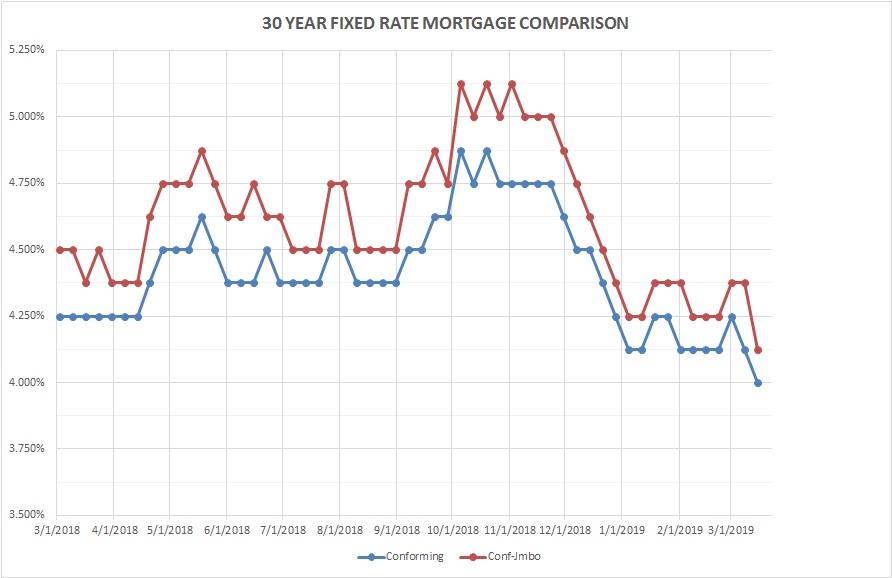
As you can see from the chart below rates for 30 year fixed rate mortgages are about three-quarters of one percent (0.75%) higher than they were in January.

In real numbers, on a $400,000 mortgage that is a difference of about $175 more per month. Depending on several factors, with the increase in the rate you may not qualify for the same price today you did in January.


Let’s assume that you were pre-approved for the purchase of a $500,000 home with 20% down and a $400,000 30-year fixed rate mortgage in January. Your credit obligations are about 10% of your gross income. When we pre-approved you in January your income was about $6500 and you were at the maximum debt-to-income ratios will all factors considered (cash reserves, credit score, etc). If there are no other changes to your financial situation for the same purchase of a $500,000 home with 20% down you will need to earn $500 more per month to qualify.


If your income is the same, then you either need to pay down your debt so your monthly payments drop $175 per month, or lower your sales price and loan amount. Using the same $100,000 down your new sales price would be $470,000, a drop of $30,000 in purchase price due to the increase in rates.


As the prices and loan amounts go higher, so do the differentials in monthly payment with the rate increase, for a $500,000 loan the difference is about $255 more per month today than January.


For those who have been waiting for prices to come down before entering the real estate market you are losing more purchasing power with rate increases than you may be looking at whenever any market correction may occur. Take the example above, with a decrease of $30,000 in purchasing power the borrower has lost 6% in value from what s/he could have purchased in January.


If you have been pre-approved to purchase a new home longer than three to four weeks ago I strongly suggest you have your information updated so you know what you are qualified to purchase. If you are a real estate agent, I strongly suggest any pre-approval you receive has current rates and “fresh” qualification information—they potential buyer may have been qualified in February, but may not be qualified today to purchase your listing.


To go through your options for purchasing a new home, please contact me so we can run through your options.


Have a question? Ask me!


First week of the month economic data is always interesting. On Monday we learned that personal incomes rose a modest 0.3% in March, which was outpaced by consumer spending which was 0.4% higher in March than February. With the increase in spending above income the savings rate declined slightly for the month to 3.1%. The eye grabbing news for investors in the report is that the core inflation rate year-over-year for March was 1.9%, nudging up against the Fed’s 2.0% target rate. Overall the news was somewhat mortgage rate unfriendly, while the increases are somewhat subdued; they are nonetheless reflective of continued growth in the economy and employment.


Taking into consideration the inflation rate, on Wednesday the Federal Reserve released its minutes from it meetings this week. The Fed’s expectation for inflation was a high of 1.9% for the year, again just below its target rate of 2.0%. With prices hitting their expected high in the first quarter there is concern from Fed members that they may need to make some unannounced, or expected, rate increases this year. At this point it appears there will be another hike of 0.25% in June, but if inflation speeds up we should expect more rate increases as the Fed tries to keep ahead of prices and not have to chase inflation. The meeting notes were somewhat concerning to investors and puts upward pressure on rates.


April employment showed continued growth at a solid pace. Payroll growth was within the range of expectations;164,000 new jobs over all of which 168,000 were in the private sector. Hourly earnings were up a scant 0.1% from March and are up 2.6% year over year. The headline number is the unemployment rate dropping below 4% to 3.9% for the month. The news shows growth in employment, a bit mild but still solid, and that is negative for mortgage rates.


Rates for Friday May 4, 2018: An opportunity to catch our breath with rates flat from last Friday after a few consecutive weeks of rates increasing. The expectation is not for rates to drop, if they do it will either be very temporary or as result of some major negative event. What we are looking for is the top of the range. Rates, like stock prices, generally stay within a range for a period of time before breaking out, up or down, and establishing a new range. With rates increasing one-quarter of one percent (0.25%) in two weeks we are looking for when the increases will stop and rates remain within a range week-to-week. Perhaps we have found a new range, but we won’t know until at least two more weeks. Lock your rate when you can!


FIXED RATE MORTGAGES AT COST OF 1.25 POINTS LOCKED FOR 45 DAYS:

30 year conforming                                            4.49%       Flat

30 year high-balance conforming                      4.75%        Flat


Please note that these are base rates and adjustments may be added for condominiums, refinances, credit scores, loan to value, no impound account and period rate is locked. Rates are based on 20% down with 740 FICO score for purchase mortgages.


Star Wars fan? Me not so much. I enjoy the movies, but am not a big fan or follower. For instance, I got really confused when they started the making movies that were decades beyond the release of the first one and then called it Episode 1. I have no knowledge of the characters beyond the originals, the hairy thing, the beep-boop robot and the others, but understand others are very much into the whole genre. And to them I, somewhat reluctantly, say May the Fourth be with you!


Have a great week,


Dennis