


What happens if the appraisal or home inspection present a problem?
Question of the week: What happens if the appraisal or home inspection present a problem?
Answer: In last week’s Weekly Rate & Market Update we covered the difference between an appraisal and a home inspection. To recap, an appraiser’s duty is to set the value of the property for the buyer, and the lender if a mortgage is funding part of the purchase price; the inspector’s duty is to inform the buyer as to the condition of the property and improvements.
Not all appraisal and inspection reports are green lights to continue with the transaction, some are yellow lights to proceed with caution and occasionally a bright red blinking light telling the buyer to Stop! What happens if you are not getting a green light from the appraiser’s or home inspector’s reports?
The standard purchase contract contains several very important clauses, at the top of the list are the time frames during with buyers can complete necessary investigations to determine if they wish to continue the transaction. These dates are known as contingency periods.
Within this period the buyer obtains an appraisal and completes any necessary inspections. If, after review of the reports, the buyer has concerns about the property and/or the price to purchase the property as agreed to with the seller, the buyer has the ability to cancel the transaction and receive a full refund of their good faith deposit, provided such notification is made during the contingency time frames in the purchase contract.
But is cancelling the only option?
Here are the options should your appraisal or home inspection report not support the sales price or reveal concerns regarding the condition of the property.
Appraisal
There are two primary issues in an appraisal report that could create an issue for a borrower. The most obvious issue is the value provided by the appraiser is lower than the sales price. The other issue is the appraiser notates issues with the property that need to be corrected.
We will cover the property condition issue first. In last week’s WR&MU when discussing the role of the appraiser we mentioned that the appraiser does not perform an in-depth inspection of the property, but will notate visible conditions that could impact the health and safety of the occupants or lead to future deterioration of condition; items such evidence of leaky roof, missing flooring, etc. If there are such conditions noted the underwriter will require that these conditions are corrected prior to final loan approval. Prior to issuing the approval the appraiser will need to return to the property and provide a written statement and pictorial evidence of the correction to the underwriter.
If this occurs then the loan is contingent on the repairs being made and the buyer can notify the seller that unless the conditions are correct they will cancel the transaction. The seller can then decide that they will make the corrections, or reply to the buyer no corrections will be made and they are fine with the transaction being cancelled. If the latter occurs the buyer has two options, first, move forward with cancelling the sale. Second, inquire if the seller will allow the borrower to make the corrections at their own cost after initial loan approval and before the close of escrow.
If the seller will not allow the borrower to make any repairs during escrow we move to another option to enable the sale to close. In some instances, the lender will allow the repairs to occur after close of escrow if there is a bid from a licensed professional to make the corrections and the funds plus contingency reserve (usually fifty to one hundred percent of the bid) is left in escrow to fund the cost of the repairs.
Quick recap: Appraisal report notates conditions on the property that need to be completed. Options are a) seller repairs noted conditions b) seller allows buyer to make the repairs before close of escrow c) lender allows buyer to make repairs after close of escrow d) neither party wishes to make the repairs and the transaction is terminated. Which option is decided upon between the buyer and seller depends on the market, seller’s motivation and ability, and the buyer’s motivation and ability.
The other issue that occurs with appraisals, and the one of greatest concern to all parties involved is what happens if the appraised value is lower than the sales price.
Before we get in to the options for the buyer and seller should an appraisal come in under sales price it should be noted that the first action when this happens is a very thorough review of the appraisal and the comps utilized. We then contact the agents for the buyer and seller notifying them of the low value and provide them with the comparables used and ask them to come up with other sales we can ask the appraiser to use that would support a higher value. Since I have access to the Multiple Listing Service, I research the properties used for the comparables in the appraisal report to see if any should not have been used. Perhaps one of the comps was a flip, or the previous owner died in one of the comps, a comp is on a very busy intersection and this was not accounted for, etc. I then research the area for better comps to see if we can find any that would enable the appraiser to increase the value. With the comps from the agents and my own research I write an appeal and submit it requesting the appraiser reconsider the value based on the new information provided. We have a fairly high success rate in having adjustments to the value on low appraisals. There are, however, some properties that are sold at values higher than the current market supports, or there is a lack of comparables available to justify the appraiser increasing the value on the report. In these instances, or if an appraiser rejects our appeal, we must go through the options for having a value lower than the sales price on the appraisal report.
Most home purchases involve the buyer getting a mortgage to enable the purchase to close. A major part of the rate and cost of the loan is the loan-to-value, or LTV, which is what percentage of the purchase price is the loan? If you are putting 10% down the LTV is 90%, If you are putting 25% down the LTV is 75%. The lender calculates the LTV based on the lower of the sales price or the appraised value. If you are putting 10% down on a $500,000 purchase obtaining a 90% loan for $450,000 and the appraised value is $490,000 you LTV has gone from 90% to 91.8% LTV. This move up from 90% LTV changes the rate and/or price of your loan and the premium on any mortgage insurance.
In this scenario, not only are you potentially paying more of your mortgage but you may be more concerned that you are over-paying for the property. So, what are your options. It should be noted that the impact on a low appraisal is of greater concern to those with lower down payments than those with higher down payments as the impact on the cost of the mortgage is less, or none, the lower the LTV; i.e in above scenario there will be a higher rate/cost moving above 90% loan to value with the low value, if the original LTV was 55%, the low appraisal moving the LTV to 56.1% will have no impact on the rate or terms of the mortgage.
There are four basic options when an appraised value is less than the sales price.
The first option is you notify the seller of the lower appraised value and you wish the sales price of the contract to be lowered to the appraised value. The seller agrees to lower the price and you continue with the transaction at $490,000 and you put 10% down for a new loan of $441,000 at 90% of the appraised value and purchase price.
The second option, which occurs if the seller refuses to lower the purchase price to $490,000 you can agree to retain the purchase price of $500,000. If you choose this option you can either put an additional $9,000 down and obtain a loan of $441,000 to retain the 90% LTV rate and terms; or you may decide to retain the $450,000 loan amount with the $50,000 down payment and accept the rate and terms that would be available at the 91.8% LTV. In this scenario, we often go with the lower down payment scenario and move forward with the higher LTV mortgage as the math works in the buyer’s favor; however it depends on the buyer’s cash situation and preference of cash in the bank or higher monthly payment.
The third option occurs if the seller does not want to come down to the appraised value and the buyer does not want to pay the original sales price. Buyer and seller find a price between the appraisal and contact sales price. Usually, but not always the amount is cut in half, in this case the buyer and seller agree to complete the transaction at a price of $495,000. The buyer can then decide to increase the down payment to $54,000 or obtain a low at 90.9% loan to value.
The fourth option is the buyer does not want to pay more than the appraised value and the seller does not want to sell for less than the original sales price and the sale is cancelled. We usually see this option when there is a very wide spread between the sales price and the appraised value, and/or there are significant conditions with the property that will need to be addressed per the appraiser and/or home inspector. If the spread between the appraised value and the sales price is not too wide we rarely see neither side willing to move of their perceived value of the property. From the seller’s side, even if they had multiple offers they may not want go back to a previous buyer and chance another appraisal or worse go back on the open market. For the buyer, long term a few thousand dollars, while a lot of money, will likely make little to no difference in the long run of owning the home.
Of the four options when an appraisal value is lower than sales price in order from most often to least option outcomes we see Options 3 (meet in the middle), Option 2 (buyer pays sales price), Option 1 (seller lowers price to appraised value, Option 4 (transaction is cancelled). Most buyers and sellers want to complete the transaction.
Inspection
Not every home is perfect. Correction, no home is perfect. How unperfect are you willing to accept when you purchase your new home?
In the WR&MU update we discussed how a home inspector will go through, above and under a home and complete a report detailing the condition of the property, notating what is in working condition, what is not, what needs to be corrected now, soon or later, and what is in good condition and will not need to be replaced for quite some time.
Too often buyers are overwhelmed by the report and the list of items that are noted as, let’s say flawed. Cracked or broken switch plates? No home is perfect, move on. Cabinet under the sink damp and pipes rusted? No home is perfect, but this may cost quite a bit to fix and cure.
Upon receipt of the inspection report the buyer should go through the report to determine what falls under routine maintenance and are minor issues, such as the cracked switch plates and walls that need painting, and what issues are somewhat major and need to be addressed fairly soon to prevent further damage to the home or create a health and safety issue, like out of date electrical or plumbing.
After receiving the report and within the contingency period the buyer can provide the seller a list of items that they would like corrected before the close of escrow. In this instance we are discussing repairs that have come up from the inspectors report, we dealt with options for items on the appraisal that underwriting would require to be fixed above.
When this happens we typically see three replies from the seller: a) okay we will do the repairs b) sorry, we will not do the repairs c) we will not do the repairs but we will give you a credit of X thousand dollars so you can make the repairs after escrow closes.
If Option A is the reply to the repair request, woo-hoo! you are saving money on repairs. If Option B is the reply you have a decision to make, cancel the transaction, get your deposit back and start looking again for you new home, or stay in escrow and make the needed repairs yourself after escrow closes.
Which brings us to Option C, the seller offers to provide a credit so the buyer can correct the items themselves after escrow closes. When these credits arise we typically do not lower the sales price, but rather have the credit go through escrow to pay for closing costs for the borrower. This is usually because our clients are leveraging their purchase with a relatively high loan to value mortgage, 75% or more, and a credit for closing costs puts the funds into their pocket dollar for dollar as opposed to lowering the sales price. Huh?
In the above example with a $500,000 sale and the borrower putting down $50,000, or 10%, total cash to close can approach $70,000 when the cost of the loan, escrow, title, recording fees, funds for pro-rated interest and to establish an impound account for taxes and insurance. Let’s assume that the inspection report showed the electrical and plumbing systems needed to be upgraded or replace and the buyer received and estimate of $10,000 for the work to be completed. The seller does not want to live through the work being done while they are working, sending kids to school and packing for moving to their new home so they have agreed to pay for the $10,000 through the sale.
If the buyer agrees to lower the sales price by $10,000 for the credit the amount of cash they will need to close will be close to $70,000 still as the only real cash they are saving is the 10% on the $10,000 reduction (10% of original $500,000 sales price is $50,000; 10% of the reduced sales price of $490,000 is $49,000). There are incremental savings on the other fees but the total will likely be $500 or less. So the buyer saves $1000 in cash to close but will need $10,000 to make the repairs.
If the seller credits the buyer $10,000 in closing costs the buyer needs $60,000 to close the transaction instead of $70,000, a savings of $10,000—the amount to make the repairs.
If the credit is listed in escrow as “$10,000 credit to buyer for repairs listed on home inspection report” the underwriter will ask to see the report and may decide more items need to be fixed, as well the $10,000 plus a cost overrun contingency of 50-100% will need to be left in escrow and released only when proof is provided that the repairs were completed.
It is important to note that very rarely (very rarely) does an underwriter see the report from the home inspector. This enables the buyer and seller to negotiate regarding any repairs the buyer would like to see completed without having the lender mandate any corrections not notated on the appraisal report.
No home is perfect. A low appraisal or discoveries of flaws by a home inspector need not kill your purchase transaction if both parties are committed to closing. If one party is more intent on getting “a deal” than purchasing or selling a home then the opportunity increases for the transaction to no move forward, however if both parties are willing to negotiate and be open to a solution more often than not the buyer will be getting the keys to their new home and the seller will be receiving their net proceeds to move onto their next home or bank account.
Following last week’s update Cathy, real estate agent extraordinaire in the Central Coast, sent me this message, “The biggest difference between an appraiser and an inspector…if you get a stupid appraiser, it is not your fault. If you get a stupid inspector, it is.” Which is why we have an appeal process.
Have a question? Ask me!
Positive news keeps coming. This week we had some important economic data released and all of it was positive. Monday we learned that consumer spending in March had its biggest one month increase, 0.9%, in nearly a decade, and 2.9% increase in spending over the past twelve months. Perhaps fueled by continued increases in personal incomes continuing to rise and having gained 3.8% from last March to this. This data suggests another strong quarter of growth in the second quarter. Strong growth in spending and wages is traditionally mortgage rate unfriendly it supports economic growth which leads to inflation which leads to higher rates. However the core inflation rate released with spending and wage reports showed no increase in prices in March and a dip in the annual rate to 1.6%, just above the Federal Reserve’s floor for what it considers acceptable inflation of 1.5%.
The week started and ended with positive news, as today the Labor Department released employment data for April showing 263,000 new jobs in the economy for the month and a drop in the unemployment rate to 3.6%, the lowest rate since the month my 58 year old brother turned 9 (December 1969). In a separate measure of income from the report on Monday, the Labor Department reported hourly wages increased in April for annual increase of 3.2% from the prior year. Over all the news is also negative for mortgage rates.
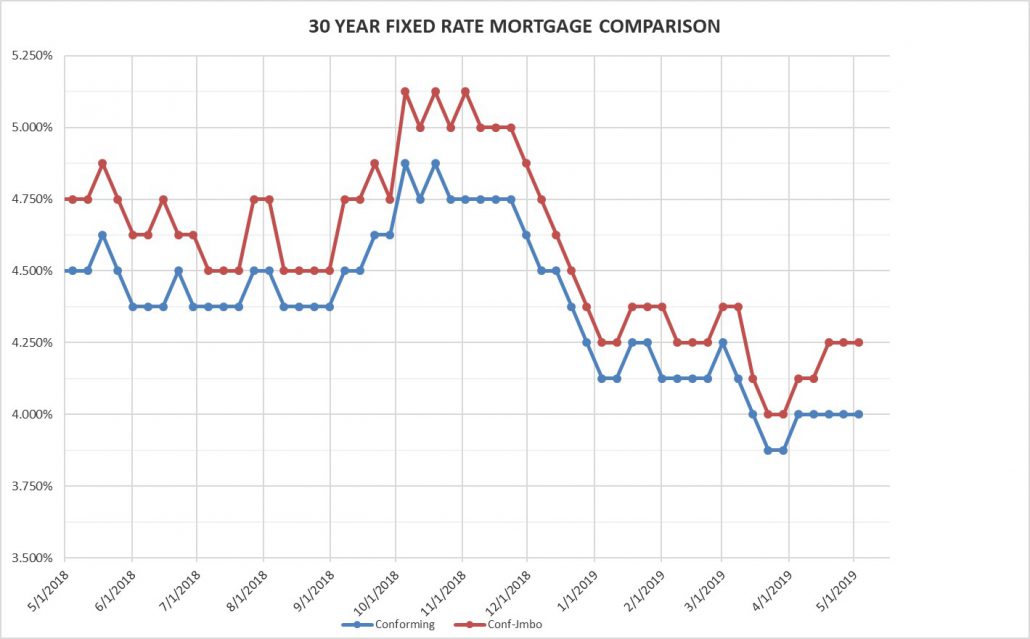
Rates for Friday May 3, 2019: Based on the economic data, or most of it, rates should be higher this week. However the tame inflation numbers have investors backing off expectation for higher rates, and this sentiment was supported by the Fed which this week announced…nothing. No movement expected for the rest of 2019 by the Federal Reserve which has investors sitting tight on fixed rate investments. Week over week we are flat for the fourth week in a row for conforming rates.
FIXED RATE MORTGAGES AT COST OF 1.25 POINTS LOCKED FOR 45 DAYS:
30 year conforming 4.00% Flat
30 year high-balance conforming 4.25 % Flat
Please note that these are base rates and adjustments may be added for condominiums, refinances, credit scores, loan to value, no impound account and period rate is locked. Rates are based on 20% down with 740 FICO score for purchase mortgages.
I guess this Marvel Avengers movie thing is a pretty big deal. Who knew? My daughter did and does. Like many others she saw the latest, and last, of the series on opening night and then again, a few nights later. Reading the receipts for the movie domestically and internationally it seems I might be missing out on something. Can’t wait for it to be on Netflix so I can pause it several times during its three hour run time for some refreshments and subsequently needed bathroom breaks.
I’m pretty old fashioned when it comes to movies, and other things. I like the old Westerns, dramas, mysteries and musicals and have never been a big fan of the Star Wars, comic book genres.
Have a great week,
Dennis
Past Weekly Rate & Market Updates can be found on my blog page at my website www.DennisCSmith.com/my-blog

