
Posts

Are we ready to buy?

Question of the week:  Are we ready to buy?

Answer:  In the March 1st Weekly Rate & Market Update I covered the number one reason to the question, “Why didn’t you purchase a home sooner?” from the California Association of Realtors 2018 Home Buyer Survey. That reason was “Needed to save for a down payment,” and it came up as I answered the question, should potential home buyers wait to purchase their new home until they have a 20% down payment. Sidebar, I failed to put in the 3/1/19 WR&MU that that most home buyers save for 5 years for their purchase.

The number two reason respondents did not purchase their home sooner was “waiting for our financial situation to improve.” In other words, are ready, or in many cases feel ready, to buy.

My knee hurts. It has been hurting for a little while and I am finally tired of the pain so I make an appointment. I call the orthopedic doctor’s office and make an appointment for next Thursday at 8:00 so he can operate on my knee and fix it.

Wait. What?

That is how many families go about purchasing a home, they try to go right to surgery.

When they think they are ready the go to an open house, or meet with a real estate agent, find a home they like and write an offer. Are they able to qualify for their mortgage? Could they be looking at homes that are higher priced, bigger, in better neighborhoods? Should they be purchasing a home right now, or should they spend more time working on different factors that impact their ability to qualify for the home they want to buy?

 Working with families purchasing new homes my experience has shown three types of buyers:

  • Buyers who write offers, get an offer accepted, go look for a loan, discover if they can qualify for the purchase of the home or not
  • Buyers who meet with me, determine the sales price, loan amount and loan type for which they qualify, go write offers and purchase a home they can afford
  • Buyers who meet with me, have some issues that prevent them from qualifying for the home they would like to buy, work with me to resolve those issues, become able to qualify for the mortgage they need to purchase the home they would like to purchase, go write offers and purchase a home they can afford

The vast majority of clients we work with fall into the second category. We meet, determine qualifying home price and terms and they work with their real estate agent to purchase a home they like and can afford. Often these clients have spent time on their own getting ready to purchase a home, and we find that many of them could have purchased a home sooner, but they did not know they would be able to do so.

Many of our clients fall into the third category. They know they want to purchase a home in the future, but are not sure how long in the future or what they need to do so they can purchase a home in the future.

The first category of buyers we see from time to time, thankfully most real estate agents will require their clients get pre-qualified, or better yet pre-approved, before writing offers and certainly before accepting them if they are representing the seller.

When we pre-qualify a family for a home purchase, we are answering their question, “are we ready to buy.” For some the answer is, yes immediately. For others it is either yes but not for as high a price as you would like or not yet; if this is the case we show where they are deficient in the qualifying guidelines and put together a plan so they will be ready to buy.

What deficiencies might potential home buyers have?

Not surprisingly, while there are many factors that going into a loan approval the primary ones are about you and money; how much do you make, how much do you have, how much do you owe and how well you pay what you owe. For most home buyers one of these determines their maximum purchase price and loan amount. You make great income and have little to no debt, but the funds you have for down payment determine your price. You have a nice savings account and little to no debt but your income limits the amount of a mortgage you can qualify for to purchase. You have good income, nice savings but a lot of debt and high monthly payments on your credit cards which impacts your qualifying. Or, good income, nice savings, not a lot of debt but in the past you had some serious delinquencies that could impact your ability to obtain a mortgage.

Some of these issues are easier to solve than others depending on your financial situation. By working with a mortgage professional as soon as you decide you want to purchase a home in the not too distant future you can work on the area(s) that you need to improve to increase your ability to qualify. My definition of “not too distant future” is up to 24 months, and it is routine for us to work with clients for up to that amount of time before they purchase their new home.

My knee has been hurting. I go to my chiropractor and after a few sessions she tells me I need to see a physical therapist. I see the therapist and he says it appears it is something structural that therapy will not cure and tells me I need to see an orthopedist. I see the orthopedist, he orders and X-ray and an MRI which shows some damage. I can either continue to live with the paid or have a surgery that will fix the issue.

Am I ready for surgery? I know more about my situation now that I have met with professionals who have guided me through the process—a much better scenario than just scheduling a surgery and letting the doctor figure it out once I am on the table.  

Before you have surgery, or buy a home, get the proper advice and take the proper steps to ensure you are ready when the time is right.

Are you ready to buy? Maybe, maybe not but the only way to know is to call me to make an appointment so we can see where you stand today for qualifying to purchase a new home, and if necessary what you need to do so you are qualified sooner rather than later.

Have a question? Ask me!

Economic data slow to reach the public due to the government shutdown is being published as the analysts play catch up. One of these reports was retail sales for January, which increased 0.2% in January after the largest drop in monthly sales in decade to end 2018. Removing auto and gasoline sales and the increase was a somewhat robust increase of 1.2% for the month. The news was neutral for mortgage rates, higher consumer activity is generally negative for rates since that is 65-70% of our economy.

Inflation is not a concern. Both the core Consumer Price Index and core Producer Price Index saw very modest increases in February, both up 0.1% for the month and CPI up 2.1% year over year and PPI up 2.3% annually (the “core” index removes food and energy from the basket of goods used to calculate the price indices as they tend to be very volatile and can skew data). The target rate of inflation for the Federal Reserve, and therefore an indication of whether rates should go up or down for investors, is 2.0% and the economy is pretty much on the target. The news is slightly positive for mortgage rates as it removes a reason for the Fed to increase rates, or for investors to behave with the expectation of higher rates and therefore cause rates to increase.

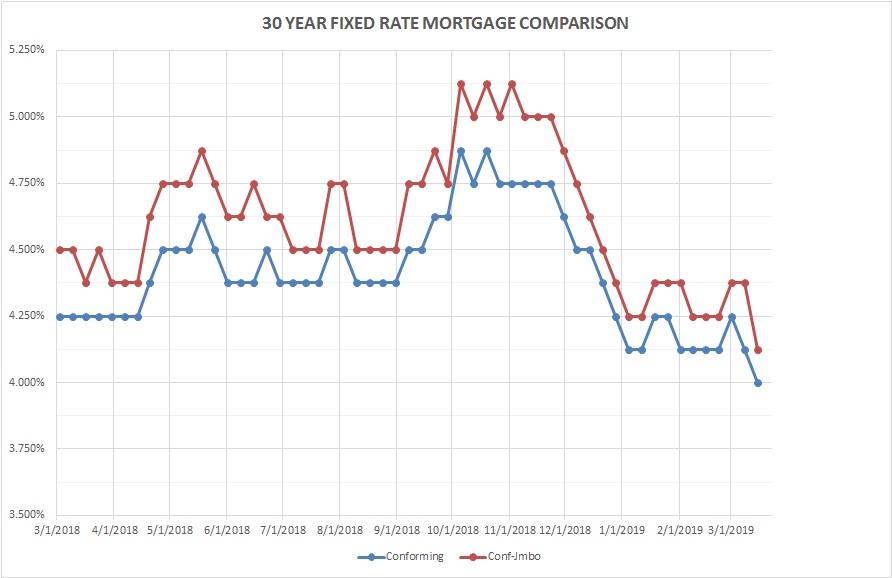
Rates for Friday March 15, 2019: Rates hit a fourteen month low this week due to economic stability and no major news that could create market turbulence. The analysts and forecasters are reading the data, technical factors that include chart shapes, ranges and other factors and it appears we should be in a period somewhat stable rates for a few weeks, “should” being key word. Now is the time to take advantage of the lowest rates we have seen since last January when they started to rise.

FIXED RATE MORTGAGES AT COST OF 1.25 POINTS LOCKED FOR 45 DAYS:

30 year conforming                                            4.00        Down 0.125%

30 year high-balance conforming                    4.375%   Down 0.25%  

Please note that these are base rates and adjustments may be added for condominiums, refinances, credit scores, loan to value, no impound account and period rate is locked. Rates are based on 20% down with 740 FICO score for purchase mortgages.
Everyone is Irish this week, because how many people do not like the opportunity to gather with friends and (or?) family and sip beer, eat good food, tell corny jokes and laugh? We’ll be spending part of the weekend with Leslie’s family for the annual gathering as March 17th happens to be our niece’s birthday, and as her maiden name is McCormick a gathering to tip a toast to St. Patrick in gratitude for ridding the homeland from snakes is appropriate. As well, her sister makes wonderful corn beef and husband Dave is a serviceable home bartender! Since my mother was a Kennedy and the “C” in my name is for Cleary after my great-grandfather I am partial to celebrations of the Irish bent I look forward to the annual birthday and St. Patrick’s festivities.

Wherever your St. Patrick’s Day weekend may take you I hope you spend it with those you love, those you like and those who make you laugh and that everyone returns to their homes safely.

Slainte!

Have a great week,

Dennis

Past Weekly Rate & Market Updates can be found on my blog page at my website www.DennisCSmith.com/my-blog

1-18-19: Will the federal government shutdown impact the timing of my loan approval?

Question of the week:  Will the federal government shutdown impact the timing of my loan approval?

Answer:  No, well very, extremely likely no.

Unless you are in a rural area and obtaining a USDA or perhaps waiting for FHA to approve a condominium complex in which you are purchasing or refinancing one of the units.

At the start of the shutdown there was some delay for borrowers with properties in areas that required flood insurance, which is available only through the National Flood Insurance Program, however Congress passed legislation and the President signed into law a bill authorizing the program to May 2019 so the policies could be written.

For the vast majority of mortgages for residential mortgages there is minimal interaction with the federal government during the loan process.

One requirement for many mortgages is verification of your income by a review of your tax transcripts as filed with the IRS (to see why we need this form here is the WR&MU from April 2018 on the subject. For this process, we use IRS Form 4506-T, during a government shutdown the requests for a copy of your returns are not processed. Having experienced such delays in the past, in recent years lenders have eased the burden by allowing some work arounds to the Form 4506-T requirement, typically a copy of the cancelled check or other proof you paid taxes owed on the tax returns provided, or a copy of a bank statement showing the deposit of your refund that matches the refund on your tax returns provided.

Government insured loans, such as VA or FHA, are not impacted by the shutdown as the processing and underwriting is performed by private companies and not government agencies. While Fannie Mae and Freddie Mac are quasi-government agencies they are operated as private companies and are unaffected by the shutdown.

The primary area of impact during government shutdowns, once flood insurance is authorized, are inquiries for loan issues in which a response is required from either VA or FHA. It is very rare that a situation arises in which a lender will require a response from either of the agencies in order to approve a loan, but they do arise from time to time and any such cases arising during the shutdown will likely face delays until someone is available to reply.

In a broader view, the impact of the shutdown on mortgages is the impact it may have on the economy and subsequent impact on interest rates. Fundamentally, if there is an impact on rates it would be for rates to decline. A very prolonged shutdown could result in negative economic impact and regular readers of the WR&MU know that poor economic performance usually leads to lower interest rates.

If you are concerned that the government shutdown will impact your current loan in process, or a home mortgage you are contemplate, do not be concerned.

Have a question? Ask me!

With the government shutdown some key economic data that could impact mortgage rates is not being release. This week we would have had retail sales data for December, a key piece of information for gauging economic activity since consumer spending comprises 65-70% of the nation’s economy. With no data on how the Christmas shopping season went for retailers investors are left to speculate whether the 4th quarter GDP data will show 2018 ended strong and total growth over 3% or slowed down with growth being under 3%. The lack of information had no impact on rates as investors looked to other bits of news to guide their decisions.

Rates for Friday January 18, 2019: Stocks and bonds are in their traditional relationship, if stocks go up so do rates, if stocks go down so do rates. Stocks climbed this week, much of the increase on speculation that the trade dispute with China is cooling down and on rumors the United States may lower some tariffs. Investors fled their prior “flight to safety” of bonds and invested their sales proceeds in stocks. After thirteen weeks of rates being flat or down from the previous Friday we see mortgage rates tick up this week—the first Friday to Friday increase in rates since October 19th.

FIXED RATE MORTGAGES AT COST OF 1.25 POINTS LOCKED FOR 45 DAYS:

30 year conforming                                            4.25%      Up 0.125%

30 year high-balance conforming                    4.375%     Up 0.125%      

Please note that these are base rates and adjustments may be added for condominiums, refinances, credit scores, loan to value, no impound account and period rate is locked. Rates are based on 20% down with 740 FICO score for purchase mortgages.

After four weeks it is time for our daughter to return to Boston to finish her freshman year. Always a bit of a weather nut, looking at the national weather maps in the paper every day, something I got from my dad, I am much more so concerning weather in the Northeast these past five months. My weather-nerdness has us on somewhat of a concerned profile as a very big winter storm is on track to hit the Boston area late Saturday and into Sunday—include her 2:30 landing time at Logan Airport. Part of going to school back east, or anywhere that winter weather is not 50 degrees and some rain, is dealing with weather delays at the airport.

Not all lessons are learned in the classroom. Our plan tomorrow is to spend a bit of time at the bookstore to get some “old fashioned” books in case her Kindle runs out of juice.

Have a great week,

Dennis

Past Weekly Rate & Market Updates can be found on my blog page at my website www.DennisCSmith.com/my-blog

7-20-18: What is the process for our mortgage application when we purchase a home?

Question of the week:  What is the process for our mortgage application when we purchase a home?


Answer:  Mortgage application packages are very deadline oriented. For a purchase this is because we have a closing date that is agreed upon by the buyer and seller, for a refinance the deadline is when the rate lock expires.


Here is a not so detailed look at the timeline on a purchase, much of it is the same as with a refinance.


Ideally the first step in your mortgage process when purchasing a home is we have detailed conversations and review your records to determine your ability to qualify for a mortgage to purchase at a certain price with a certain amount down. This is the pre-qualification, or pre-approval, stage. We review your income by looking at paystubs and tax documents. We obtain a credit report to see you credit score and confirm your balances and payments on outstanding credit. We look at your asset statements so we know how much we have in funds for down payment, closing costs and reserves if necessary. And we discuss your objective, long term plans and other factors that may influence the amount and type of mortgage that would be ideal for you and your family. This step can take an hour or several days depending on the complexity of your finances or issues we need to address. Next step: Look at houses and write offers.


You have your offer accepted and we begin the formal application process. At this stage we complete any information for the loan application so you can sign the application and disclosures. We collect necessary documents supporting income, credit, obligations, funds being used for closing and other items we discuss as necessary. Once we have the signed application and necessary items we lock in your loan rate for a specified period of time that matches your escrow time frame but in 15 day increments (i.e. lock for 30 or 45 days). As well, we communicate with both your agent and the seller’s agent to establish clear lines of communication, confirm who will be the person for the appraiser to contact to set up inspection of the property. We also initiate contact with the escrow officer to make sure s/he and our staff have each other’s contact information as they will be sending a lot of information and documents back and forth. Finally in this stage, we order the appraisal. This stage is generally one to two days depending on how quickly you get the required items to us. Next step: Processing.


During the processing period our staff is collecting the necessary information to ensure underwriting will approve your loan as applied for. All your information will be reviewed and verified. During the review our staff will ask questions that may need additional information to support answers: what is this large deposit, there are some statements in the tax return that indicate another business or sources of income to verify. At this time they are also collecting necessary documents for the approval. The appraisal report will be completed and reviewed. We will obtain a copy of the preliminary title report on the property. Escrow will send us the escrow instructions which detail the agreement between you and the seller. We will communicate with your insurance company to ensure there will be sufficient coverage of the property to protect the lender should there be fire or other major damage. Any loose ends or issues that may arise as all this information is collected and reviewed are addressed and the necessary parties are contacted and additional information requested to cover the issue so underwriting will approve the file. The timing for this stage depends on the how quickly others respond to our request for items. If the listing agent puts off the appraisal inspection for a week or ten days that slows us down. If we request additional statements on an account, tax returns on a business entity, source of funds, this can slow us down if the information is not forthcoming. If everything is into us in a very timely manner this step should be about 10 business days. Next step: Underwriting.


The mortgage application package, at this point several inches thick (our record is over 1 foot high with clients who had multiple companies and properties resulting in about ten tax returns for various entities). All the documentation, disclosures, reports are then sent to the underwriting department. Once received it is assigned to an underwriter who reviews the file and issues an approval, usually “conditional” approval as the underwriter generally asks for items to complete the file, an updated paystub, a letter of explanation for some issue, clarification on the appraisal, support for continuing income from commissions, overtime or bonus, a myriad of items may come up. The underwriting period is generally two to three business days. Depending on the additional conditions requested the time frame from initial approval to final approval can be as short as 3 to 4 days or considerably longer depending on conditions requested and ability to provide them. Next step: Loan Docs.


Once we get the approval and are moving into the final stages of the transaction we will issue to you the Closing Disclosure (or CD). We usually like to issue this via DocuSign as when you acknowledge the CD will start a timer on when you can sign loan documents, which is three days not counting Sundays and holidays. So if we issue the CD on Friday and you open the link and “sign” on Sunday you cannot sign loan documents until Wednesday, if you had signed on Friday you could sign docs on Tuesday. Does one day make a difference? Next step: Funding.


The loan documents will be sent to escrow and available for you to sign the day you are eligible to sign after the CD rescission period is up. Escrow will contact you to set up a time to sign in their office, or if more convenient set up a mobile notary. At this time we will know the amount of funds needed to complete the closing of the transaction. Escrow does not take personal checks, the funds for closing need to be either via a cashier’s check or a wire (see important note below). After you sign loan docs and your funds are in escrow we fund the loan. If we have the loan docs in our office in the morning and all is in order we can fund the day we get the loan docs, the time from doc signing to funding can be as short as one day. Next step: Closing.


Closing occurs when the deeds are recorded by the title company at the county recorder where the property is located. The grant deed conveying title from the seller to you is recorded first, then the trust deed securing the property as collateral for the mortgage is recorded. Depending on what county you live in recording happens either the same day (Orange County is a same day recording county), or it occurs the next day (Los Angeles County will not allow funding and recording on the same day). This is where that one day difference on the CD can impact closing. Since we cannot fund and record on the same day in some counties we very rarely fund a loan in those counties on a Friday for many reasons, for one you are paying interest for two additional days on a property you do not own. Second, if something happens to the property, or the current owner, we have two loans on the property and two insurance policies (your policy must be in effect before we can fund). As you can imagine this creates several issues that need to be unwound. While something could happen to the property between funding on Wednesday and recording on Thursday, it is less likely than something happening between funding Friday and recording Monday. So the closing step is either same day or next day. Next step: Move In!


NOTE, VERY IMPORTANT! There has been a wire fraud scheme occurring with real estate closings. The scam works like this. You are in escrow to purchase a property and you receive an email from what looks like your escrow officer. It is instructing you to wire your funds for closing and provides the necessary information. The email has the escrow company’s email address, signature on the email looks the same and by all accounts is from the escrow company. This email will come near closing but before funds are usually asked for from escrow. What has occurred is that at some point your email was hacked, it could have been last month or last year or even longer ago. The hackers run your emails through their filters which are set to look for keywords in your emails, such as “escrow,” “mortgage,” “purchase home,” etc. When any keyword occurs the account is monitored to determine is you are engaging in a real estate transaction. The next step is to determine who is who in the communications and then spoof the email account for the closing agent, i.e. escrow, and send you the email requesting you wire the funds into the scammers account. Do not reply to the email, do not send the funds to the account listed in the email and do not call the number listed in the email as chances are it is not the escrow company you are using. Before sending funds call the escrow officer from the number printed on the escrow instructions you have, or by getting the number from us or your agent, and verify the amount of funds required and ask them to send you an email with the wire instructions, then call back to verify the information is correct.


As you can see the time frame for closing an escrow on a purchase can be 30 days or a little less, or longer depending on everyone having the information needed and requested and providing it in a very timely fashion. Closing times are dependent on many actors all performing together and when needed.


Have a question? Ask me!


Consumers appear to be happy. Retail sales for June were reported on Monday and showed a 0.5% increase from the prior month. This is good news, what was pretty incredible news was that May retail sales were revised upward 0.5% for a total increase of 1.3% from April, that is a very rare number to reach. Auto sales had strong months in May and June, up almost 1% each month, and restaurants also showed strong increases, up 1.5% in May and 2.6% in June. This news indicates consumers willing to increase their discretionary spending, what’s more discretionary than eating out instead of at home? The news is somewhat negative for rates as higher consumer spending supports stronger economic growth, which leads to higher interest rates.


Historic is the word to describe yesterday’s jobless claims report. Last week 207,000 initial jobless claims were filed, the lowest weekly amount since December 1969. Continuing jobless claims, as sign of length of unemployment, are at 1.738 million which is at a level last seen in the early 1970s. The news is interest rate unfriendly as a tight labor market can, should, lead to some wage inflation which will lead to higher interest rates.


Rates for Friday July 20, 2018:  The economic data suggests rates should be higher than they are, especially with the Fed selling off billions of dollars of mortgages and bonds every month. However investors, who ultimately control interest rates, do not look at just American economic data when making their decisions on what to buy and sell for long range profits, the also look at foreign economies, and as importantly domestic and international politics. It is the latter that has investors holding onto their fixed return investments (i.e. mortgages and bonds) as a hedge against some major event that could trigger a run on bonds and therefore lower rates. It is a strange set of market circumstances we have been experiencing. Thankfully we have benefited from flat rates for the past two months.


FIXED RATE MORTGAGES AT COST OF 1.25 POINTS LOCKED FOR 45 DAYS:

30 year conforming                                            4.375%            Flat

30 year high-balance conforming                      4.500%             Flat


Please note that these are base rates and adjustments may be added for condominiums, refinances, credit scores, loan to value, no impound account and period rate is locked. Rates are based on 20% down with 740 FICO score for purchase mortgages.


We have been down to one kid in the house since early in the month as the younger one is spending her annual month in Minnesota at camp, unfortunately for the older one she is basically termed out this year and must spend the summer at home. It has been nice to have her home with us since she leaves in 4-5 weeks to Boston for college and then we will be a one kid home for a few years before the younger ones decides to leave as well. We are in that period when our oldest is still our daughter and little girl but our relationship is slowly transitioning to daughter and adult. Certainly a unique summer for our family, and one that we will fondly remember for years to come. I hope you and your family are having a great, and unique, summer as well!


Have a great week,


Dennis

4-13-18: What is the IRS Form I have to sign with my mortgage application?


Question of the week:  Why do some of the creditors on my credit report say, “Affected by Natural or Declared Disaster” when I live nowhere near a natural disaster that has occurred?


Answer: Because creditors were not all A+ students in geography class.


Last year saw many natural disasters across the country, from hurricanes in Texas and Florida to wildfires up and down the state of California. Many people were severely impacted by the disasters, some of the more fortunate only lost some days at work and had the financial burden of cleaning up after the disaster, however many lost their homes, cars, places of work and neighborhoods. While trying to recover from the disasters, dealing with the emotion of such tremendous loss they also had the reality of bills still due, negotiating with insurance companies to cover losses and added costs of where to stay and how to get there.


Understanding that financial disasters create tremendous financial burden on those in the impacted areas more and more credit companies are automatically putting into their reports to the three major credit bureaus that the debtor resides in a natural disaster area. The purpose of this statement is to let those reviewing the credit report for the possibility of extending credit will understand if there are any late payments on the account that the natural disaster could be responsible for the late payments. Essentially letting future creditors know there is likely a very good reason for the late payments that should be taken into account when extending credit.


So why are these notices popping up on credit reports for people who have not been affected by a natural disaster? Because the notices are put on credit reports using computer models and the computer models, from what we have seen, are using counties or regions when determining which accounts to label.


For instance, a couple in Long Beach, which has not been impacted by any natural disaster in decades, has a couple of accounts labelled with the natural disaster language. While Long Beach has not had a natural disaster declared, within the last twelve months there have been severe fires in both Los Angeles and Orange Counties; Long Beach is in LA County and borders Orange. It appears the creditor plugged in LA County as having a natural disaster and tagged all its accounts in the county, not realizing the size of the county and how geographically distant Long Beach is from any of the fires that occurred.


In Texas and Florida people are facing similar reporting, while they were not severely impacted by any of the storms they live near enough, or are in counties, declared natural disaster areas that they have had accounts tagged with the natural disaster warning.


Does this impact your credit? No, it does not. Does it impact your mortgage underwriting? As this reporting is relatively new on credit reports we have had some underwriters request appraisers note on the report if the property was impacted by a natural disaster.


At this point we have not seen any impact on credit scores, positively or negatively. Meaning if you have an account that has a 30-day late payment on the credit report and that same account is labelled “Affected by Natural or Declared Disaster,” we have not seen your credit score not impacted by the late payment—meaning your score is still depressed due to the late payment.


If this label is on some of  your accounts do not be concerned that it is in any way impacting your credit or ability to obtain a mortgage or other applied for credit such as an auto loan. It is merely a head’s up to other creditors that if you do have any late payments in the recent past there may be a very good reason why—if you in fact did live in a natural disaster area and were negatively impacted.


If you have any questions about your credit report please do not hesitate to contact me.


Have a question? Ask me!


A few reports this week that can impact rates. On Wednesday, the final revision to Gross Domestic Product for the 4th quarter of 2017 was released, and the revision was up 0.4% from the prior revisions. Strength in the increase was mainly attributed to consumer spending, which increased 4.0% from the 3rd quarter. The news was somewhat mortgage rate unfriendly as stronger economic data portends higher interest rates in the future.


While consumer spending led the way in 2017, so far in 2018 that has not been the case, causing expectations for GDP growth in the first quarter to be lower than it was in 2017. On Thursday data was released on Personal Income and Consumer Spending. The good news is that wages continue to increase, up 0.4% in February, matching January’s increase. And like January, consumer spending in February was up a lackluster 0.2%. Workers are earning more but spending less, so it is no surprise that the personal savings rate has increased to 3.4%. With the flat growth in consumer spending prices were up 1.8% from February 2017, still below the Fed’s 2% inflation rate target. The increase in earnings is negative for mortgage rates as it creates expectations for wage inflation, however workers putting more of their earnings into savings instead of spending is positive for mortgage rates. Since consumer spending is approximately 65-70% of GDP, a slow-down in spending could slow down GDP growth, keeping upward pressure on rates at bay.


Rates for Friday March 30, 2018:  A short week for markets as stock and commodity exchanges are closed today for Good Friday. Conforming rates continue to hold steady from Friday to Friday, seven weeks in a row now with the same rate. Lenders continue to bounce up and down on the high-balance conforming rates (loans from $463,451 to $679,650) and we are down 0.125% from last Friday. Markets continue to be volatile, and there is more turbulence ahead as indicated by the stock markets down in the first quarter of 2018 after nine consecutive positive quarters. My advice remains to lock through your escrow closing when you can.


FIXED RATE MORTGAGES AT COST OF 1.25 POINTS LOCKED FOR 45 DAYS:

30 year conforming                                            4.25%       Flat

30 year high-balance conforming                      4.375%      Down 0.125%


Please note that these are base rates and adjustments may be added for condominiums, refinances, credit scores, loan to value, no impound account and period rate is locked. Rates are based on 20% down with 740 FICO score for purchase mortgages.


For parents on young ones I will give you this Easter tip learned from my mom, count the number of eggs you hide so you make sure they are all found. My mom learned this lesson when her young sons found an egg or two in the middle of August, in Tulsa, that had been rotting in the sun and heat since March. There was a special kind of scent and cleaning her boys after they found the putrid little bombs and did what boys do (throw at each other) taught to always make sure all the eggs were found on Easter…


Spring Break begins for our kids and many others, after this next week the next stop is summer. Seems like forever for the kids and tomorrow for the parents.


Have a great week,


Dennis