Posts

What can I do about my credit?

Question of the week:  What can I do about my credit?

Answer:  This is a question that has been asked several times over the past month or so as we have received more inquiries from clients looking to purchase a new property or refinance one they currently own and have some issues on their credit report.

Credit report “issues” can vary from having derogatory reporting to credit scores. If you have negative credit issues many of them can be rectified, depending on severity. Let’s look at various credit issues and what you may be able to do to improve your credit.

The interest rate you are offered on credit, be it for credit cards, auto loans or a home mortgage, is impacted by your credit score. The lower your score the higher the interest rate; and you may be declined credit if your score is below a certain level. There are five elements that have the biggest impact on your credit score: payment history, credit utilization, length of credit history, new credit and the mix of your credit. Some of the elements you may be able to work on to improve your credit score, other items you will have little to no ability to influence.

The most important element by a long shot is your payment history. The more recent a late, or derogatory, payment is reported the larger the impact on your credit score. As well, the more serious the delinquency the larger the impact. For instance, a 30 day late on a credit card from December 2012 will have a lower impact than a 90 day late on a house payment from June 2019. Depending on the severity of the derogatory reporting, you may be able to have the reporting creditor agree to change the way the account is being reported.

While a 30 day late payment on a credit card is the most benign of derogatory payments they are also some of the hardest to have removed from your credit report, especially if the account is with a major bank. Typically to have late payments removed you will need to provide proof that you were not more than 30 (or 60, 90…) days late on your payment. This will entail providing a series of bank statements or cancelled checks to show your payment history and no payment being late. If you have an excellent history with the creditor and have on 30 day late they may (key word “may”) agree to remove the reporting of the late payment to retain you as a customer.

If you have late payments on a mortgage you will have to show that you have made your payments on time from before and after the late payment reported. While it does not happen often it is not that rare that borrowers who have been making on time payments and have had their servicing transferred to a new lender may be reported late due to misapplication of payments by the new lender or issue with the previous lender transferring records. It may take some patience and time, but if you have had a derogatory reporting on your mortgage for which you have made on time payments provide the records showing you have made the payments and the lender(s) accepted them. In May our Question of the Week was what you should do if your mortgage servicing has been transferred.

If you have collection accounts on your credit report, depending on their status they may be able to be removed and therefore have any negative impact removed as well. Collection companies purchase delinquent accounts at a discount and begin charging fees and interest on the obligation. Some collection companies will work with clients and agree to remove the accounts. Typically, if the account has been paid off already the collection company will not agree to remove the account—they have already received their money and you have no leverage. If you owe a balance the collection company may agree to provide you with a letter stating that no money is owed and the reporting of a collection was made in error. If you have an account that is reported in collection my advice is to contact the collection company, always being very friendly and nice as most of customer service people get yelled at and abused most of the time, and apologize for having the balance, ask how much is owed, and then ask if it is possible for you to obtain a letter saying nothing is owed and the account is reporting in error if you pay off the balance today. They may say yes and they may say no. If they say no, tell them thank you, ask if they can send you a written itemized bill and that you will work on paying the debt. Wait a day or two and call back. If there are not notes in your file and you receive another customer service representative, s/he may be in a more generous mood to your request and work with you.

Whether they agree to remove the reporting or not, if you have an outstanding collection account the impact on your report is more than a paid collection. The paid collection will stay on your report for seven years, so it is worth it to contact accounts that have been paid every six months or so to see if they will agree to remove the account from your credit bureau reports. If they do agree to do so ask if you can get a letter to the effect and send it to the credit bureaus yourself in case they do not follow up with the bureaus.

If you have a county, state or federal tax lien or judgment on your report the chances of you getting it removed are extremely slim. On the taxes the only way to get them removed is for the taxing entity to acknowledge to you that your taxes were paid as agreed and not in default, and they have to contact the credit bureaus directly. Like a collection account, unpaid tax liens on your report are more harmful than liens recorded against you but reporting paid. These recorded liens will report on your report for seven years.

Note that it takes a while for most tax agencies to file a lien against you. If you owe back taxes and are notified it is best to negotiate a payment agreement and begin payments. Most tax agencies will not file a lien as long as you are making timely payments towards paying off the obiligation.

Civil judgments, such as from small claims court, will either show an amount owed or that the obligation has been satisfied. If you lost a civil judgment and have paid it off it is very important that you receive a  notice that the plaintiff has file a “satisfaction of judgment” with the court. Once  you make the payment for the amount owed make sure you get a copy of the satisfaction of judgment and communicate to the court the judgment has been paid. If you do not receive a satisfaction of judgment contact the court and show them you have paid off the amount owed so they can either get the plaintiff to file the satisfaction or the court can file one showing no debt is owed.

The next most impactful element on your credit score is “credit utilization,” i.e. how much you owe. Not only is this the total amount of credit you owe but what kind of credit you owe and how much do you owe in relation to how much you can borrow. For many borrowers with scores that are lower than what is needed to either be eligible for a mortgage program, or what is needed for the next best interest rate, paying down or off some credit accounts can improve their score.

If you have a credit card with a $10,000 credit limit and owe $9500, this will have a negative impact on your credit score. If you are able to pay down the balance to $7000 your score will improve. What we do with many clients with high balances on revolving credit accounts to run a report and asking “what if?” What if different balances are lower and by how much, how will the score improve? What if an account were paid in full? Sometimes when we run these reports the scoring model suggests a new account be opened with a certain limit and a small balance is put on the account.

Credit utilization is much more fluid than payment history in how it impacts credit scores. We have tools to use with our clients that can show how much credit scores can be raised if certain actions occur.

I have found over the years than many people with some credit challenges are reluctant to address them, sort of like those who are hesitant to go to the doctor when they have a pain or probable medical condition—they are worried about what they will learn. However, until you have the condition looked at a remedy cannot be provided; and just because you do not have the condition looked at does not mean it will go away.

The sooner you have any credit issues addressed the sooner you are getting closer to having them resolved. Some issues can be corrected in a short period of time, and others make take quite a while. I have had several clients over the years with significant credit issues. We put together a plan and the clients followed the plan we agreed upon and after, in a few cases, a few years they were finally able to purchase a home. Had they done nothing they would have had to wait five, six or more years to purchase a home.

Finally, before you say, “I want to wait to buy a home until my credit score is higher,” let’s take a look at your credit report and score and see what rate and cost a mortgage will be with your current score, what the time and cost will be to increase your score, and what your rate and cost would be with that higher score. For many clients the cost in monthly payments is not as significant as they think to purchase a home today with their current score as opposed to spending time and money to try to raise their score for an incrementally better rate.

If you think you have credit issues and this thought is preventing you from exploring the opportunity to purchase a new home please contact me so that we can assess your credit situation and options for purchasing a new home. Rates are very low, waiting to increase your score may end up costing you more if rates go higher by the time your score has improved than if you were to purchase today with the score you have.

Have a question? Ask me!

What’s next? That is the question investors and business owners are looking for the Fed to answer. Last year the Fed policy was to raise rates two to three times in 2019 after raising rates four times in 2018. This was because the Fed was concerned about the economy growing too fast as indicated by every tightening labor markets, consumer spending and inflation hovering around its 2% target. The first quarter came and went with no rate increases and at the end of the second quarter the minutes from the Federal Open Market Committee (FOMC—the gang that determines the Fed’s interest rate charged to member banks) indicated many wanted to lower rates a few times through the remainder of the year. Earlier this month the Fed lowered its benchmark rate by 0.25% (one-quarter of one percent) because of concerns that the economy was not growing fast enough and concerns there might be a recession in the offing. This minutes from the meeting where rates were lowered were released, and comments from Fed Chair Jerome Powell indicated that the rate drop in early August was a “mid-cycle adjustment” and not part of a long-term policy.

Investors, business owners, elected officials, almost everyone, who makes long term decisions with money do not like uncertainty. Uncertainty makes planning difficult, close to impossible. Uncertainty leads to short term decisions and rapid and multiple changes of direction. Uncertainty leads to bad decisions and bad results. The Fed with its words and actions have created uncertainty in our markets and in the economy. As I have stated several times over the past few months, it appears the Fed has been acting on “what-ifs,” “mays,” “coulds” and “perhaps.” Our economy has been growing since 2010 at annual rates of 1.6% to 2.9%, to slow for some and worrisome that it may grow too fast for others. There is nothing wrong with this long, slow and sustained growth for nine years, likely ten. The Fed needs to sit on its hands and ignore the calls to “do something” in reaction to the news of the minute and instead look at the economic data that has accumulated.

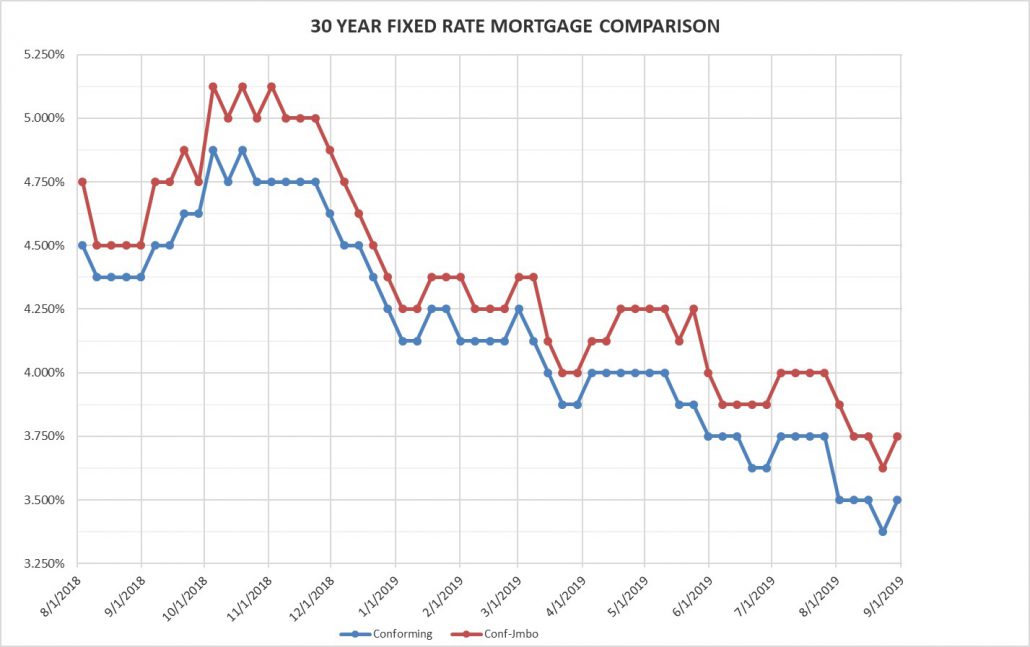
Rates for Friday August 23, 2019: Rates bounced this week off last week’s multi-year low. Mostly in reaction to the Fed speak as well as the news cycle that we are heading into recession in 2020. With a rebound today in the mortgage markets we have paired some of the losses.

FIXED RATE MORTGAGES AT COST OF 1.25 POINTS LOCKED FOR 45 DAYS:

30 year conforming                                            3.5%     Up 0.125%

30 year high-balance conforming                    3.75%    Up 0.125%       

Please note that these are base rates and adjustments may be added for condominiums, refinances, credit scores, loan to value, no impound account and period rate is locked. Rates are based on 20% down with 740 FICO score for purchase mortgages.
Our home is slowly returning back to the “new normal” established last year when our eldest went off to Boston to get some learnin’ in bio-engineerin’. She flew off East early this morning putting us almost on normal footing—which will occur next week when Long Beach Unified opens its doors for students and our youngest begins her senior year at Poly High (Go Jackrabbits). I consider the school year “normal” as there is a set routine daily and I am a person who thrives on routine. Summer and holiday schedules throw me for a loop.

Not sure what I will do in a year when they are both away at college and there is no set routine of a school bell to meet every week day from September to June; the schedule we have followed for fourteen years.

Have a great week,

Dennis

Past Weekly Rate & Market Updates can be found on my blog page at my website www.DennisCSmith.com/my-blog

12-7-18: I have tax liens; will that prevent me from purchasing a new home?

Question of the week:  I have tax liens; will that prevent me from purchasing a new home?


Answer:  Liz is an attorney and specializes in negotiating settlements with federal and state tax authorities, and a friend of mine. We were having a few weeks ago and this question came up as we often have clients that have state and/or federal tax liens and it was great to get some input on some options for tax liens.


Before we answer the question of whether tax liens will prevent you from obtaining a mortgage to purchase a new home, let’s answer the question: What is a tax lien?


A lien is the right to keep possession of someone’s property until a debt or obligation is paid. In the case of the government it is the right to take possession of someone’s property until a tax debt is paid—i.e. a tax lien.


If you have unpaid taxes and a lien has been filed against you the guidelines for all loans are that until the obligation is paid a loan will not be funded and closed.


Example: You are purchasing a new home for $575,000 and applying for a mortgage of $517,500 and are qualified to obtain loan approval. You have a lien for unpaid state taxes of $5000 from 2014 that is recorded in the county where you lived when the lien was filed. We submit your loan and the underwriter approves the application with a condition that we must show proof that the state tax lien from 2014 is satisfied and show evidence of where the funds for satisfying lien came from before the loan will be able to close. In many instances we coordinate satisfying the lien with the title company so you can pay the amount owed, initial amount plus penalties and interest, as part of the total funds needed for closing. Title will then guarantee to the lender, and you, the lien is paid and record the deeds needed for closing.


There are some instances with FHA mortgages where if you have established a payment plan to satisfy a lien recorded against you and are making payments on a constant and consistent basis. These situations are approved on a case-by-case basis, so if you are in such a situation do not assume you are automatically able to be approved. Before you write an offer and open escrow we would want to run your situation and any evidence through an underwriter for an opinion as to whether the lender would approve the loan with your payment agreement.


For unpaid taxes, or other debts, to become liens or judgments the obligation has to be outstanding for a fairly significant period of time. If you are aware of an unpaid obligation, especially taxes, it is strongly recommended you contact the public agency to which the obligation is owed and establish the amount owed and if necessary a payment plan. Many tax debtors are fearful of contacting the public tax authority thinking they may attach bank accounts or employment income to repay the back taxes due. This is not the case, these measures happen if a lien is filed and there has been no communication from you for a long period of time. Generally, for most private citizens for what the tax authorities would consider small amounts owed, the agency is willing to wait until you are forced to pay the tax obligation because you are purchasing a home or some other event.


Should you have an outstanding tax obligation it is strongly recommended you contact the agency to which the taxes are owed and negotiate a settlement amount and if you are unable to pay the full amount do at that time to set up a payment plan to pay off the taxes and retire the debt. In almost all cases, if you set up a payment plan and make the payments on time for the amount owed the agency will not file a lien against you. Depending on the loan type for which you are applying some lenders will approve and fund a loan if you show you are making consistent and timely payments on your obligation—counting the monthly payment amount as part of qualifying.


If you are having your pay garnished to collect a judgment or other obligation the garnishment is not considered a payment plan since it was not voluntary. Before a mortgage can be approved and funded the total obligation must be paid and the garnishment removed.


Prior to this year when running credit reports public records would show on the report that would impact whether we would be able to obtain loan approval, or what steps we would need to take to obtain loan approval: Federal and state income tax liens, county property tax liens, judgments from lawsuits or court cases, unpaid child or spousal support and bankruptcy being the most common. Beginning earlier this year these types of public records were no longer reported on credit reports, with some exceptions if a case somehow fell through the cracks.


Because a lien or judgment is not on your credit report does not mean we will not find out about it. As part of the mortgage process we obtain title insurance, part of the title insurance process is your completing a Statement of Information that includes name, addresses and employment for the past ten years, spouse(s), etc. The title companies runs this information through their data bases to determine if there are any public records filed in your name and notify us if that are any.


When there is a public record filed it needs to be addressed before we can obtain final loan approval and fund your mortgage. Because this is now the only way any public records will be discovered it is highly recommend you inform us at the beginning of the transaction if you have any public records for taxes, support payments, bankruptcy etc so we can begin working on the issue at the beginning of the transaction instead of waiting to find out from title closer to our scheduled closing date.


We have had transactions that have fell apart because borrowers delayed in completing their Statement of Information until close to closing, a lien popped up with title and we were unable to solve the issue in a timely fashion to satisfy the seller.


If you know, or suspect, there may be a lien let us know up front, complete a Statement of Information right away for title to run it through databases and if there is something filed we will have to ability to determine our best options and proceed accordingly.


Ignoring tax or other public record obligations thinking they will go away is not a long term success strategy. We have helped many families over the years with serious debt delinquency get their debt paid and in a position to purchase a home. The longer you wait to begin the process of satisfying the debt and clearing your public record the longer before you are free and clear. Start the process today, you will have a tremendous mental weight lifted just by beginning the process.


As always, if you or someone you know has public records and feel they will prevent obtaining a mortgage please contact me to discuss your situation and potential solutions we can begin to work on so you can become a homeowner.


Have a question? Ask me!


Higher loan limits for 2019 were announced by the Federal Housing Finance Agency. Starting for loans funded after January 1st, 2019 the conforming loan limit for single family residences (including condos) will increase from $453,100 to $484,250; for “high-balance” areas (LA and Orange Counties for example) the limits for Fannie and Freddie mortgages increase from $679,650 to $726,525. Will the loan limit increases have a dramatic impact on the housing markets? Not so much, at any given time the rate difference between the conforming loan amount and the high-balance amount is from one-eighth to one-quarter of one percent (0.125% or 0.25%). There will be some advantage to those borrowing more than the prior limit and at or below the new limit for high-balance as qualifying for the high-balance mortgage is generally easier than for “jumbo” or non-conforming mortgages.


November employment report contains no news that impacts rates. First Fridays are a big event for economic data geeks such as myself and investors as the Department of Labor releases job reports for the prior month. Today’s reports are nothing too exciting. The economy created 155,000 new jobs last month, significantly less than the 237,000 in October and below the expectations of most investors; however the total jobs added is not insignificant and still reflect a healthy employment market. Enough jobs were added to keep the unemployment rate at a near 50 year low at 3.7%. Wages continue to grow, up 3.1% over the past year—a factor in whether the Fed will increase rates later this month.


Rates for Friday December 7, 2018: Last week’s WR&MU mentioned that Presidents Trump and Xi were meeting at the G20 summit to discuss the tariff disputes. Following the meeting they announced a 90 day moratorium on new tariffs and agreed to negotiate the recent tariffs enacted by both countries. The news was well met by investors and stocks and bonds improved. As the week has progressed many have noticed the decline in stock markets, due in large part to continued uncertainty as to the trade war truce. Rates have benefited from this  uncertainty as the funds pulled out of stocks have flowed into long-term fixed assets, i.e. mortgages. As a result rates drop for the second Friday in a row and are at their lowest in three months.


FIXED RATE MORTGAGES AT COST OF 1.25 POINTS LOCKED FOR 45 DAYS:

30 year conforming                                            4.50%      Down 0.125%

30 year high-balance conforming                   4.75%     Down 0.125%


Please note that these are base rates and adjustments may be added for condominiums, refinances, credit scores, loan to value, no impound account and period rate is locked. Rates are based on 20% down with 740 FICO score for purchase mortgages.


For the past year I have been listening to an incredibly detailed podcast about World War II. To give you an idea how detailed, the podcaster began the podcast in December 2011, this past week he finally got to Pearl Harbor—seven years to cover three to four years. As a history buff I love the detail, he spends about ten episodes just on Churchill, but now that I am caught up I will have to wait a week or more (he is great at putting together information and his commentary, not so great at sticking to a schedule) before his next podcast. I anticipate his completing the war in around 2026.


I bring this up because today is the anniversary of Pearl Harbor and I feel its importance in our nation has declined over the years—not surprisingly. When the Japanese planes approached Oahu and began their bombing and strafing many on the island, civilian and military, thought the planes were part of a drill—even as bombs exploded many thought there must have been some mistake made. Once reality hit the general attitude went from disbelief to anger very quickly. Sentiments quickly echoed across the country as the news was broadcast that Sunday.


In Gilmore, Iowa seventy-seven years ago a boy named Don had turned twelve that morning, and the radio told his parents and the community what had occurred in far off Hawaii earlier that day. I asked Don several years ago what was his memory of that birthday and Pearl Harbor. His response was, “I didn’t get a chance to ride the pony.” They lived on the farm and he had eleven brothers and sisters and before it was his turn to ride the family pony they were all called into the house.


Happy 89th birthday to Don McCormick, my father in-law.


On a final note, thank you to everyone who bore with my very long WR&MU last week and those who replied with positive comments!


Have a great week,


Dennis


Past Weekly Rate & Market Updates can be found on my blog page at my website www.DennisCSmith.com/My-Blog

7-13-18: How do inquiries impact my credit score?

Question of the week:  How do inquiries impact my credit score?


Answer:  A lot or not at all.


Quite frequently we have new clients tell us, “don’t run a credit report because I don’t want it to hurt my score.”


My response is, “First I cannot give you a solid pre-qualification and absolutely no pre-approval without running my own report, and second it will not impact your score unless you have had several inquiries recently—have you been speaking with other mortgage professionals and have any of them run reports and if so when?”


Conventional wisdom is that credit inquiries push down your credit score, so when you need credit just by applying your score drops, which may mean a higher rate or credit denial.


Conventional wisdom is not always right, especially when it comes to credit reports. Let’s take a look at when credit inquiries do harm your score and when they do not.


If you are applying for several credit cards, department store cards or signature lines of credit the chances are your credit score will be negatively impacted. If you are applying for one such item of credit your score will most likely not be impacted at all. The credit score programs have in their algorithms risk factors and if they are told that you are making several inquiries to obtain revolving, easy to access credit that activity is a high credit risk—it is evident you are searching for funds from many sources. What if you apply for two department store cards and two credit cards within two weeks. You could very quickly have access to several thousand, tens of thousands, of dollars in credit. If you already have several open credit accounts with high balances compared to credit limits these inquiries will push your score down considerably.


If you have some open credit accounts and the balances are not very high compared to available credit and you apply for a new credit card, say one that will give you airline points so you can leverage your purchases for plane tickets to visit your kid at college, if this is the only revolving credit inquiry on your credit report then your score will not, should not, be impacted.


What about purchasing a home? We routinely see credit inquiries on our clients’ credit reports from other mortgage lenders, usually over the past month or so, and these inquiries do not generally impact the credit score. I say generally because if there are more than five or six there could be an impact but not necessarily. As a rule three or four, or fewer, inquiries for home loans will not impact your credit.


The reason for this is that it is not unusual for someone looking to obtain a mortgage, either for home purchase or refinance, to call more than one lender (unless they call Stratis Financial which is usually the last call needed). This behavior is programmed into the credit score software, so if there are multiple inquiries from mortgage companies in a somewhat short time frame, about 4 weeks or so, your credit score is not impacted.


The same is true about auto loans. Many people speak to many car dealers, who run reports themselves or through different banks, looking for auto loans and these inquiries are treated similarly to mortgage inquiries.


If you have multiple inquiries for long term debt obligations, like home or auto loans, you credit score will likely not be impacted, if you have multiple inquiries for revolving credit your credit score will likely be impacted negatively.


Have a question? Ask me!


Pressure, no pressure, was the impact on interest rates with the price data released this week. On Wednesday the Producer Price Index for June was released and the data put pressure on rates to increase as wholesale prices increased 0.3% for the month and were up 3.4% from last June (2.8% when food and energy are stripped from the data, called the “core” rate). This strong data for prices caused great anticipation for the Consumer Price Index data release the following day. Would the stronger PPI figures show inflation for consumers beyond what the Federal Reserve would prefer? No, the CPI data did not show a significant increase in prices in June, putting Fed interest rate decision makers at ease. Month over month prices rose a scant 0.1% for you across the economy’s basket of goods and services and the generic American consumer paid 2.9% more than in June 2016 (2.3% using the core rate). This data was met with a bit of a sigh, and a shrug. Looking ahead, will the June wholesale price increase bleed into July for consumers resulting in higher rates? We will on August 10th when that data is released.


Rates for Friday July 13, 2018:  A tame week in the rate markets with not a lot of movement, so little that rates are the same as last Friday. We like a flat market!


FIXED RATE MORTGAGES AT COST OF 1.25 POINTS LOCKED FOR 45 DAYS:

30 year conforming                                            4.375%            Flat

30 year high-balance conforming                      4.500%             Flat


Please note that these are base rates and adjustments may be added for condominiums, refinances, credit scores, loan to value, no impound account and period rate is locked. Rates are based on 20% down with 740 FICO score for purchase mortgages.


While we have had some significant summer heat early in July, we are still a week away from the Dog Days of Summer, which officially begin on Sunday, July 22nd and end on Thursday, August 23rd. Wait, there are official Dog Days of Summer? Yup. Based on ancient Roman and Greek astronomy, the time when the star Sirius (the star that is the nose of the constellation Canis Major) rises in the morning before the sun. This year Sirius will rise before the sun starting next Sunday and ending on August 24th (the sunrise after August 23rd).


In those times the period of the dog days were not looked forward to as it was during this period when sickness, war and catastrophes would occur—perhaps coincidence, perhaps not!


Have a great week,


Dennis

7-6-18: When should we have our credit report pulled when exploring the purchase of a new home?

Question of the week:  When should we have our credit report pulled when exploring the purchase of a new home?


Answer: “We got a copy of our credit report on-line, can you just use that?” This is usually the question that precipitates our question of the week.


When should you have a credit report pulled? Our most common answer to the Question of the Week is, “that depends…” and it applies in this case as well.


Many people are fearful of having credit reports run because they are concerned the inquiry will hurt their credit score. As a result, when we ask them somewhat generically, how is your credit history, they often reply that they recently obtained a report on-line and would like us to use that for their pre-qualification and approval.


If we are in the very preliminary stages of the qualification process, using a generic report from one of the free on-line services can be helpful, but we will not issue a pre-approval or a strong prequalification recommendation unless we are able to obtain our own report.


Why?


Because. (I’m a dad so I get to answer “why” questions with “because.”


We need our own report for several reasons. First and foremost, our reports are what are known as “tri-merge” reports, meaning they include the data from the three main credit reporting bureaus, Equifax, TransUnion and Experian. This will provide us with a very complete credit history and with credit scores from the three bureaus so we know which score will be used for qualifying and rate pricing (we use the middle score, if two or more borrowers we use the lowest middle score).


Second, not all credit companies report to all bureaus. We have seen many “clean” reports over the years provided by one credit bureau and then when we pull our tri-merge items appear that were reported to one of the other bureaus. For instance, you obtain a report from Equifax and it shows your car and student loans, credit card balance and history with a late payment from Macys in 2013. That is pretty good. However, when we pull our report there is a collection from a medical bill in 2013 that showing unpaid that reported to both TransUnion and Experian. Suddenly we have an issue to deal with we did not know about. As well, the collection will give you a lower score on the bureaus reporting it than the one that did not, how much lower? Does it knock us out of the program we want to use? Does it change the rate significantly?


Back to our question of the week, when should we have the tri-merge report pulled?


It depends on where you are in the process. Are you just starting the process of purchasing your new home? You have really looked yet but have been talking about it and want to see where to begin, how to begin, what needs to be done to begin? If that is the case you are likely going to be some time away from actively engaging in the process, in which case we will probably speak in generalities, broad strokes, and begin prepping for the full on assault on the housing market.


If in our initial conversation you make some statements or provide some answers that leads me to believe we might have some issues creep onto the credit report I would suggest we pull a report to get a starting point and see if we have any work to do. What might come up that would lead us to want to pull a report? You are divorced—how did the credit separation go? Are you still linked to your ex-spouse on any open accounts? You mention you had a medical issue in the past that took some time to resolve—did any accounts go to collection? You are self-employed and had to change tax preparers as you were not satisfied with his/her performance—were there unpaid taxes that became a lien? There are several variables that thirty years’ experience can hear and suggest a credit report.


One thing we consider when strategizing the credit report is that after sixty days lenders will want a new report to make sure nothing has changed. If we pulled a report May 5th, and you are still looking for a home today, do we pull a new report them?


Probably not. Once we pull our initial report we tend to stick with that for as long as we can. In the current market it can, and does, take some buyers several months to find the home they want, and can, buy and have their offer accepted. If we did pull a report in May, or even April, and you write an offer this weekend, as part of my pre-approval package I would include the information form that May, or April, report and advise that we do not want to pull reports every sixty days to reduce inquiries with your credit bureaus and one of the conditions of the seller’s acceptance of your offer can be my providing updated information on your credit scores and ability to qualify within 24-48 hours using a fresh report.


On the one hand we do like to limit the number of reports we pull. On the other hand we have to have the tri-merge report to know exactly what we are going to be dealing with for qualifying and approval.


When is the best time to have your credit report pulled? Just before we are in “go mode” for a home purchase and will be writing offers, or if you think there may be some issue from the past that could have an impact or be an issue we need to deal with.


Next week we look at credit inquiries and their impact on your credit score.


Have a question? Ask me!


Words and numbers impact rates. Words released by the Federal Reserve Open Market Committee (FOMC) from their last meeting in June when it raised rates by 0.25% indicate Fed members see labor markets continuing to tighten and inflation should retain its 2% level in the near future. Concerns about the future were expressed as short-term rates are approaching long term rates, what is known as a flattening yield curve. This rate behavior often coincides with a recession—is the Fed predicting one? Not exactly but keeping an eye on data that often does. The minutes gave some relief to investors anticipating higher rates in the short term as the minutes were somewhat rate friendly.


The data supported the Fed’s assessment.  Our monthly First Friday Labor Department release of employment data happened this morning and most of the data supports the Fed’s course of two more rate increases this year. The economy added 213,000 jobs in June, over 202,000 in the private sector. As well the labor force grew by 601,000 in June. This increase in the job force caused the headline unemployment rate to increase for the first time in a long time from 3.8% in May to 4.0% in June. The increase is result of the growing work force, i.e. more people seeking employment, and the labor participation rate (percentage of individuals eligible for work who are working, or participating in the workforce) increasing from 62.7% to 62.9%. This news is rate neutral to the extent most people who follow this sort of thing anticipated numbers close to what was released. The number that caused some pause was the earnings portion of the report as wages grew 0.2% for the month and are up 2.7% from last June. This relative slack increase in earnings as employment grows indicates more workers are seeking work enabling employers to hold wages steady. This removes some concerns about inflation being driven by wages, and is rate friendly.


Rates for Friday July 8, 2018:  Our last recession ended in June 2009, it would certainly seem a course correction for the economy is long over-due as we start our tenth year of economic growth. That is just back drop for the political and economic issues that are impacting domestic and international economies that have more and more economists and investors starting to look at the horizon for signs of an economic downturn. When economies slow down or go into recession interest rates either lead in anticipation, or follow. The possibility now being brought up more and more of not whether but when the next recession will occur puts a bit of a parachute on rates trying to climb.


FIXED RATE MORTGAGES AT COST OF 1.25 POINTS LOCKED FOR 45 DAYS:

30 year conforming                                            4.375%            Flat

30 year high-balance conforming                      4.500%             Down 0.125%


Please note that these are base rates and adjustments may be added for condominiums, refinances, credit scores, loan to value, no impound account and period rate is locked. Rates are based on 20% down with 740 FICO score for purchase mortgages.


How messed up is your internal calendar? Mine was out of whack all through June for whatever reason, I’m blaming school being let out and my routine being thrown off. Now starting the month with a holiday smack in the middle of the week has me really thrown off. Did we get two Mondays and two Fridays this week? I need a Tuesday and/or Thursday thrown in once in a while—but that does not mean I advocate for our Independence Day celebration and holiday to become a mandated Monday holiday with different dates every year a la Labor and Memorial Days.


I hope you enjoyed your celebrations on the 4th, our family did.


Have a great week,


Dennis

6-29-18: Why have I received a lot of solicitations for mortgages recently?

Question of the week:  Why have I received a lot of solicitations for mortgages recently?


Answer: Because the credit companies sell your information to credit companies.


Data mining and selling has been in the news a lot in the past year, mostly centered on Facebook and other social media companies. But selling data is not new. It is a huge, and often sole, revenue source for many companies that do business on the internet. The major credit agencies are no different and have contracts with credit providers for many types of credit, mortgages, auto loans, credit cards, student loans, to provide the credit information for consumers who have credit reports run by companies within their industry. If you apply for a credit card from a department store you can expect to get credit card offers in the mail. If you apply for an auto loan you can expect to get offers for auto loans.


If you apply for a mortgage…here is what happens in our case.


When we run credit reports we use a company, Funding Suite, that provides us a detailed report with data from the three major agencies, Equifax, Experian and TransUnion. When these companies see that there was an inquiry on your account from a mortgage company processing an application for a residential mortgage that triggers their algorithms. Sifting through the data on location, balances, payments and most importantly your credit score, the agency sends you information to mortgage companies that have paid them for data that meets certain parameters.


The mortgage company purchasing the data processes the information and sends contact information to their marketing department and contact is initiated.


We have learned a loophole that works some, not all but some, of the time by masking your application on the initial inquiry as for a non-residential mortgage, but that dodge is being figured out by the programmers and data is still being sold.


There is good news. You can stop the solicitations by opting out of receiving offers from credit providers. Click on this link. At this site, OptOutPrescreen.com, you can choose to opt out of receiving offers for five years, or permanently, or if you want to receive offers for credit cards, auto loans, etc you can choose to opt-in to receive offers. As the site shows, there are some advantages to receiving offers that you may want to consider before opting out of all offers.


When you receive any type of unsolicited credit offer please keep in mind the primary purpose of the solicitation is to get you to reply, then it is a numbers game for the credit company to convert a certain percentage of responses into applications and then a percentage of those into new accounts. Because of this the initial marketing message is *certain conditions apply; meaning the rate/terms on the offer are usually not what will be offered.


Next week we will discuss when you should have a credit report pulled when exploring the purchase of a new home.


Have a question? Ask me!


There is no shortage of news that impacts mortgage rates. Consumer spending is approximately 60-70% of our economy, so data on consumer confidence impacts interest rates. In May the Consumer Confidence Index dipped slightly, mostly on the expectations component of the index (how consumers expect their future economic well-being to be), likely due to concern over how the tariff impositions around the globe in reaction to President Trump’s initiate new tariffs for products imported to the United States, most notably steel. The dip was very small so no impact on mortgage rates, but a warning that future confidence could slip further which would be positive for rates.


The third and final revision to 1st Quarter GDP revised economic growth from January through March was down from 2.2% to 2.0%. This news on its own would be positive for rates, however with the revision to economic growth was a revision to price data, i.e. inflation. The core price index (prices less food and energy) showed an increase from 1.9% to 2.2%. With prices increasing more than 2% the expectation is for rates to increase as well.


This morning we had what I consider the most important economic data release for the week: Personal Income and Spending. As mentioned above consumer behavior is by far the most important factor in our national economy, ergo what consumers earn and spend is vital information for investors and planners. In May wages increased 0.4%, a strong increase that was in line with expectations. With the increase in earnings it is no surprise that spending increased as well, which it did with consumers spending 0.2% more in May than in April. The increase in spending was modest, especially in light of the earning increase. With earnings growth outpacing spending growth it is follows that personal spending should increase and it did rise 0.2% to a rate of 3.2%. Are consumers spending for future large purchases or for future rainy day?


The number in the income and spending data that is very rate related was the price index in the report, showing core prices are up 2.0% in May, right at the Federal Reserve’s price target. It is a major moment for the Fed as it has been chasing 2% inflation for a decade and now it appears it has been reached. If this inflation rate holds it means the Fed does not need to worry about stimulating the economy but instead turns to focus on inflation and keeping it in check. This means higher interest rates.


Rates for Friday June 29, 2018: While economics and political science are two different fields they are intimately connected. Does government policy shape economic activity or does economic activity shape policy? The answer is yes. Each influences the other in the short, medium and long term. We are seeing this in our current markets as the economic data should lead to higher interest rates for consumers, but public policy has led to rates experiencing a slight dip in the past month and prevented rates from increasing. So despite positive economic news that should put upward pressure on rates, despite billions of dollars of U.S. Treasury debt on the market plus billions more being sold by the Fed from its Treasury and mortgage holdings we have seen rates behaving contrary to what fundamental economic principles dictate. Investors concerned with global economic slowing have been selling stocks and purchasing long term fixed rate investments, i.e. bonds and mortgages, which has countered current economic data. In this environment there is little stability for the future of rates and the advise remains to lock when you can. If public policy on tariffs changes rates will increase suddenly, and as we have seen in the past year and a half policy can change quickly and unexpectedly.


FIXED RATE MORTGAGES AT COST OF 1.25 POINTS LOCKED FOR 45 DAYS:

30 year conforming                                            4.375%            Flat

30 year high-balance conforming                      4.625%             Flat


Please note that these are base rates and adjustments may be added for condominiums, refinances, credit scores, loan to value, no impound account and period rate is locked. Rates are based on 20% down with 740 FICO score for purchase mortgages.


Throughout our nation’s history there have been deep disagreements on policy, which means solutions to problems. The arguments between factions when the Declaration of Independence was being written and voted upon by the Second Continental Congress were very personal and filled with rhetoric—these men were debating if they should vote to be considered traitors. After the Revolution there were intense debates, very nasty attacks via anonymous writings in pamphlets and papers centered on the Constitution and how, or whether, the states would come together with a federal government. Throughout our history there have been issues that have created deep philosophical and ideological differences, that these disagreements continue today should not be a surprise to anyone, and in fact are somewhat healthy for our Republic.


Next week is Independence Day and as I do every year I encourage everyone to read the Declaration of Independence. Most Americans know, or should know, the beginning of the document, “When in the course of human events…” and the most famous line, “We hold these truths to be self-evident, that all men are created equal, that they are endowed by their Creator with certain unalienable Rights, that among those are Life, Liberty and the pursuit of Happiness.” The latter is, in my opinion, perhaps the most important sentences every put forward for a vote by a governing body for it is the foundation of a nation and its laws.


Much less known, but very important is the final sentence in the Declaration, for it cemented the commitment of those in the Congress to not only the Declaration, but also each other. It is, again in my opinion, the same sentiments under which millions of Americans have volunteered to serve in our armed services to enable our nation to exist and continue to evolve with ever growing liberty and freedom.


Celebrate our nation’s founding next week, as well celebrate the differences that have and will continue to have that make our nation the greatest in human history.


Have a great week,


Dennis

3-30-18: Credit report states impacted by natural disaster


Question of the week:  Why do some of the creditors on my credit report say, “Affected by Natural or Declared Disaster” when I live nowhere near a natural disaster that has occurred?


Answer: Because creditors were not all A+ students in geography class.


Last year saw many natural disasters across the country, from hurricanes in Texas and Florida to wildfires up and down the state of California. Many people were severely impacted by the disasters, some of the more fortunate only lost some days at work and had the financial burden of cleaning up after the disaster, however many lost their homes, cars, places of work and neighborhoods. While trying to recover from the disasters, dealing with the emotion of such tremendous loss they also had the reality of bills still due, negotiating with insurance companies to cover losses and added costs of where to stay and how to get there.


Understanding that financial disasters create tremendous financial burden on those in the impacted areas more and more credit companies are automatically putting into their reports to the three major credit bureaus that the debtor resides in a natural disaster area. The purpose of this statement is to let those reviewing the credit report for the possibility of extending credit will understand if there are any late payments on the account that the natural disaster could be responsible for the late payments. Essentially letting future creditors know there is likely a very good reason for the late payments that should be taken into account when extending credit.


So why are these notices popping up on credit reports for people who have not been affected by a natural disaster? Because the notices are put on credit reports using computer models and the computer models, from what we have seen, are using counties or regions when determining which accounts to label.


For instance, a couple in Long Beach, which has not been impacted by any natural disaster in decades, has a couple of accounts labelled with the natural disaster language. While Long Beach has not had a natural disaster declared, within the last twelve months there have been severe fires in both Los Angeles and Orange Counties; Long Beach is in LA County and borders Orange. It appears the creditor plugged in LA County as having a natural disaster and tagged all its accounts in the county, not realizing the size of the county and how geographically distant Long Beach is from any of the fires that occurred.


In Texas and Florida people are facing similar reporting, while they were not severely impacted by any of the storms they live near enough, or are in counties, declared natural disaster areas that they have had accounts tagged with the natural disaster warning.


Does this impact your credit? No, it does not. Does it impact your mortgage underwriting? As this reporting is relatively new on credit reports we have had some underwriters request appraisers note on the report if the property was impacted by a natural disaster.


At this point we have not seen any impact on credit scores, positively or negatively. Meaning if you have an account that has a 30-day late payment on the credit report and that same account is labelled “Affected by Natural or Declared Disaster,” we have not seen your credit score not impacted by the late payment—meaning your score is still depressed due to the late payment.


If this label is on some of  your accounts do not be concerned that it is in any way impacting your credit or ability to obtain a mortgage or other applied for credit such as an auto loan. It is merely a head’s up to other creditors that if you do have any late payments in the recent past there may be a very good reason why—if you in fact did live in a natural disaster area and were negatively impacted.


If you have any questions about your credit report please do not hesitate to contact me.


Have a question? Ask me!


A few reports this week that can impact rates. On Wednesday, the final revision to Gross Domestic Product for the 4th quarter of 2017 was released, and the revision was up 0.4% from the prior revisions. Strength in the increase was mainly attributed to consumer spending, which increased 4.0% from the 3rd quarter. The news was somewhat mortgage rate unfriendly as stronger economic data portends higher interest rates in the future.


While consumer spending led the way in 2017, so far in 2018 that has not been the case, causing expectations for GDP growth in the first quarter to be lower than it was in 2017. On Thursday data was released on Personal Income and Consumer Spending. The good news is that wages continue to increase, up 0.4% in February, matching January’s increase. And like January, consumer spending in February was up a lackluster 0.2%. Workers are earning more but spending less, so it is no surprise that the personal savings rate has increased to 3.4%. With the flat growth in consumer spending prices were up 1.8% from February 2017, still below the Fed’s 2% inflation rate target. The increase in earnings is negative for mortgage rates as it creates expectations for wage inflation, however workers putting more of their earnings into savings instead of spending is positive for mortgage rates. Since consumer spending is approximately 65-70% of GDP, a slow-down in spending could slow down GDP growth, keeping upward pressure on rates at bay.


Rates for Friday March 30, 2018:  A short week for markets as stock and commodity exchanges are closed today for Good Friday. Conforming rates continue to hold steady from Friday to Friday, seven weeks in a row now with the same rate. Lenders continue to bounce up and down on the high-balance conforming rates (loans from $463,451 to $679,650) and we are down 0.125% from last Friday. Markets continue to be volatile, and there is more turbulence ahead as indicated by the stock markets down in the first quarter of 2018 after nine consecutive positive quarters. My advice remains to lock through your escrow closing when you can.


FIXED RATE MORTGAGES AT COST OF 1.25 POINTS LOCKED FOR 45 DAYS:

30 year conforming                                            4.25%       Flat

30 year high-balance conforming                      4.375%      Down 0.125%


Please note that these are base rates and adjustments may be added for condominiums, refinances, credit scores, loan to value, no impound account and period rate is locked. Rates are based on 20% down with 740 FICO score for purchase mortgages.


For parents on young ones I will give you this Easter tip learned from my mom, count the number of eggs you hide so you make sure they are all found. My mom learned this lesson when her young sons found an egg or two in the middle of August, in Tulsa, that had been rotting in the sun and heat since March. There was a special kind of scent and cleaning her boys after they found the putrid little bombs and did what boys do (throw at each other) taught to always make sure all the eggs were found on Easter…


Spring Break begins for our kids and many others, after this next week the next stop is summer. Seems like forever for the kids and tomorrow for the parents.


Have a great week,


Dennis