


Our parents have left their home, it has a reverse mortgage, what are our options?
Question of the week: Our parents have left their home, it has a reverse mortgage, what are our options?
Answer: Reverse mortgages are one of the most misunderstood financial instruments available to consumers and inappropriately maligned because they are misunderstood. The latter primarily because of their history, we’ll explain this history a bit further in the WR&MU.
A very quick and broad overview of what a reverse mortgage is and how it works.
A standard mortgage is a loan secured by property, the borrower pays a monthly payment to the lender that is either only the interest owed for the amount outstanding on the loan and/or an amount that is the amount owed in interest for the loan plus a certain amount of principal. The overwhelming majority of mortgages are “amortized,” meaning that each month the payment on the mortgage is calculated so that the interest owed for the month plus a certain amount of principal is calculated so the mortgage is paid off at a known date in the future. If you take out a $300,000 30-year fixed rate mortgage with the first payment due July 1st 2019 and a $1500 payment per month, and make that $1500 payment every month on time for 360 months, on June 1, 2049 your last payment of $1500 will payoff the loan.
With each payment you make on a conventional mortgage the balance of your loan decreases, the decrease accelerates as the loan ages as you pay a smaller amount of interest with each successive payment since the balance is decreasing.
A reverse mortgage is the reverse of a conventional mortgage. There are several options for reverse mortgages, for simplification we will use the option where a lump sum is funded at closing on a reverse mortgage.
The primary benefit of a reverse mortgage is that there is no required monthly payment. If you obtain a $300,000 reverse mortgage you do not have to make any payments for interest, or principal, as long as you own and live in the home. When you “leave” the home the original principal, plus all the accumulated interest that was not paid, is due—in other words, the loan must be paid off.
The longer you own the home and have the reverse mortgage the higher the balance will be that needs to be paid to the lender to close the mortgage. Unlike a traditional mortgage where the balance due declines over time, the reverse is true as the balance increases.
I will not go into the benefits and detriments of reverse mortgages in this week’s WR&MU, but get back to our question of the week, and the clause in reverse mortgages that when the borrower(s) leave the property the loan must be paid off.
Several decades ago saw some major companies in the reverse mortgage market funding mortgages to seniors that were very lender friendly and often ended up in the family losing the home to the lenders when the borrowers passed away or needed to leave their homes for whatever reason. This is no longer the case. Federal regulations changed the rules governing reverse mortgages, enabling families the opportunity to either retain properties with reverse mortgages or sell the properties and retain the resulting equity.
Several times a year we have clients whose parents had a reverse mortgage on their primary mortgage and the parents have either passed away, or moved into assisted living or some other residence, perhaps with one of their children. Reverse mortgages have a clause that when the last borrower, assuming a husband and wife co-signed the mortgage, no longer has the subject property as their primary residence the mortgage must be paid off.
Let’s assume that Nancy, mother to Kyle and Susan, took out a reverse mortgage ten years ago that enabled her to payoff a conventional mortgage with payments she could no longer afford after her husband George passed away so she could remain in the home they shared and raised their children in for forty years. Nancy has passed away and the reverse mortgage has a balance of $300,000 and the home is valued at $500,000. Nancy and George were smart and put their home and other assets into a trust they created many years ago. When George passed away Nancy became the sole trustee and the children were the sole beneficiaries of the assets in the trust when she passed away.
Kyle and Susan, following the advice of the family attorney administering the trust, contact us as they are not sure what to do with the family home. They are fearful that the lender will foreclose on the property and they will lose not only the family home, but also the equity in the home. What are their options? Will they lose the home and equity? We ease their concerns and communicate the standard rules for most reverse mortgages upon the death, or leaving of the property by the borrower(s), is the lender needs to be notified within 30 days of the intention of whoever controls the property as to what will happen with the property and plans to payoff the mortgage. The person in control can be the borrower who has vacated the property, individual with power of attorney and legal guardian, executor of the estate, or if no estate the heirs and/or probate attorney. Typically, the plan communicated to the lender must be executed within six months.
Kyle and Susan have four options, nothing, sell, refinance, buy-out. Susan is the executor of her mother’s estate and will need to communicate to the lender which of these options will be taken to payoff the lender.
Doing nothing is always an option. Generally, not the best option, but an option nonetheless. In this case doing nothing will result in the lender going through the foreclosure process, which will result in more interest accumulating on the mortgage, fees and costs of foreclosure being added to the amount owed to the lender and the lender then auctioning the property at a foreclosure sale with the minimum bid being the total amount owed. Bidders will see a property worth $500,000 and perhaps $375,000 owed to the lender to clear the loan balance, principal owed and costs. Any amount over what is owed the lender will be paid to Nancy’s estate and available for Kyle and Nancy to split. For instance, if the winning bid is $425,000 then $50,000 will be paid to the estate. If there are no bidders then the lender will take possession of the property and the estate will lose the asset. It should be noted, if the amount owed on the reverse mortgage is at or above the value of the property then giving the property to the lender is not necessarily a bad option. Susan does not communicate this option to the lender.
Kyle and Nancy do not want to do nothing and risk the loss of equity and/or the property.
We are down to three options, sell, refinance or buy-out.
Kyle and Nancy must decide what they want. Does one, or both, wish to retain the property? If not then the obvious option is to contract with a real estate agent to list the property. Once the property is on the market Susan, as executor, should communicate the status of the property to the reverse lender, this will almost always put any action by the lender on hold. Continue to communicate. When an offer is made and accepted, Susan, again contacts the reverse mortgage lender; lets them know the property is in escrow and the scheduled close of escrow. She also provides the lender with the contact information for the escrow company and tris to get the name and contact information for an individual at the lender for escrow so they can communicate status and timing as closing nears. When the sale is concluded the net proceeds of the sale will be sent to Nancy’s estate to be disbursed according to the trust, typically evenly between Kyle and Susan.
Before deciding to sell the property, Kyle and Susan should discuss if they wish to retain the home. We discuss this option which will entail refinancing the reverse mortgage with a new loan to Kyle and Susan, and perhaps their spouses, and when the transaction is concluded they will jointly own the property. Typically, when this is the scenario the property is then held as an investment property and rented; providing income and appreciation of value for Kyle and Susan. If this is the option Kyle and Susan choose, then Susan, as executor, contacts the reverse mortgage lender, informs them of the intent to retain the property provides my contact information and escrow’s so everyone is communicating status and timing to ensure the lender does not file a notice of default or initiate a foreclosure process.
In discussing retaining the property, Kyle, who lives in Denver, does not wish to be a landlord, especially for a property so far away. He would rather receive his portion of the equity in cash as the part of the division of the estate. Susan, who has been renting her home sees an opportunity to become a home owner and wants to retain the property as her primary residence. Running the numbers, Susan qualifies for a mortgage needed for her to obtain title to the property after paying off the reverse mortgage and sufficient proceeds to buy-out Kyle.
Now our math can get a bit complicated as we must fund a mortgage to pay off the reverse mortgage, and extract enough equity to buy-out Kyle’s share of the property. If there are no other assets the simple math is the property is worth $500,000 and $300,000 is owed, leaving $200,000 equity to be split, therefore Kyle needs to receive $100,000. Our new loan would need to be $400,000 to cover paying off the reverse mortgage and Kyle. At this point we typically discuss “fairness,” as if the property were to be sold on the open market costs can range from 7-8%, or $35-40,000, for real estate commissions, transfer taxes, escrow, title, potential costs for repairs or other items. So, if the property were sold for $500,000 the net proceeds after paying off the reverse mortgage and costs can be around $160,000, or $80,000 each for Kyle and Susan.
Kyle and Susan get along very well, Kyle sees the math if the property were sold and agrees to accept $80,000 from the refinance that will transfer title to Susan. We will therefore fund a loan of $380,000 to clear the mortgage and Kyle.
Unless….when Nancy passed away there was approximately $120,000 in cash and investments. This would be split $60,000 each to Kyle and Susan. However, they agree that Kyle will get $80,000 of the liquid assets in exchange for any proceeds from the sale of the home. Nancy will get $40,000 from the liquid assets in the estate and the title to the property. We fund a mortgage of $300,000 to payoff the reverse mortgage, the other assets are distributed accordingly and everyone is happy.
If your parents, or a client, or you, have a reverse mortgage, there are several options available to heirs and estates when the time comes to payoff the reverse mortgage. Too often we hear from clients, attorneys, accountants, or financial advisors, stories of families panicking and selling a home because there was a reverse mortgage and they were misinformed that the loan had to be paid off and selling the property was to the way to pay it off without risking foreclosure. This is not the case!
If you, or someone you know, is in this situation a steady and calm approach reviewing all the options, the benefits and costs of each, will enable a sound decision to be made as to how to payoff the amount due to the reverse mortgage lender. The amount of equity in the property, other assets in the estate, desire of the heirs and their abilities to finance a new mortgage if that is the preferred option, will determine the best option for the property and paying off the reverse mortgage.
We handle many such situations every year, not just properties with reverse mortgages that need to be paid off but also properties in family estates that one, or multiple, heirs wish to retain. If you, or someone you know, is in this situation, please call me to go through all the options available.
Have a question? Ask me!
Like Mark Twain, the economy is saying, “The reports of my death are greatly exaggerated.” Twain made this comment in a cable to the press in the United States upon reading of his death in the papers while in London. The economy is making this comment with data on retail sales, industrial production and capacity utilization (how much is being produced compared to what could be produced) showing an economy that is not faltering as many reports and commentators have indicated, but rather continues to show steady growth and economic activity. Much of the reports are due to inflation remaining very low, typically an indicator of a slow economy, and slowing growth in the labor markets, due to scarcity of labor more than scarcity of job openings.
Retail sales are good and better. The Commerce Department’s report on retail sales for May showed a strong 0.5% increase from April, which would be discounted by many since last month the report showed April sales decreased 0.2% from March. However, the discount is voided when the report also shows April sales revised from the 0.2 decrease to a 0.3% increase in April, thus showing May to continue a string of months with American consumers consuming in solid numbers. This is important as consumer spending is 65-70% of our nation’s economy. The news is somewhat interest rate unfriendly.
Balancing the sales data were the releases for producer and consumer prices. Both indices showed growth of 0.1% in May, essentially indicating a lack of any substantial inflation in the market place. This data seems to support speculation that the Fed will lower rates at the July meeting of its Federal Open Market Committee, as for many it portends a slowing economy that will need a drop in rates to promote investment and growth.
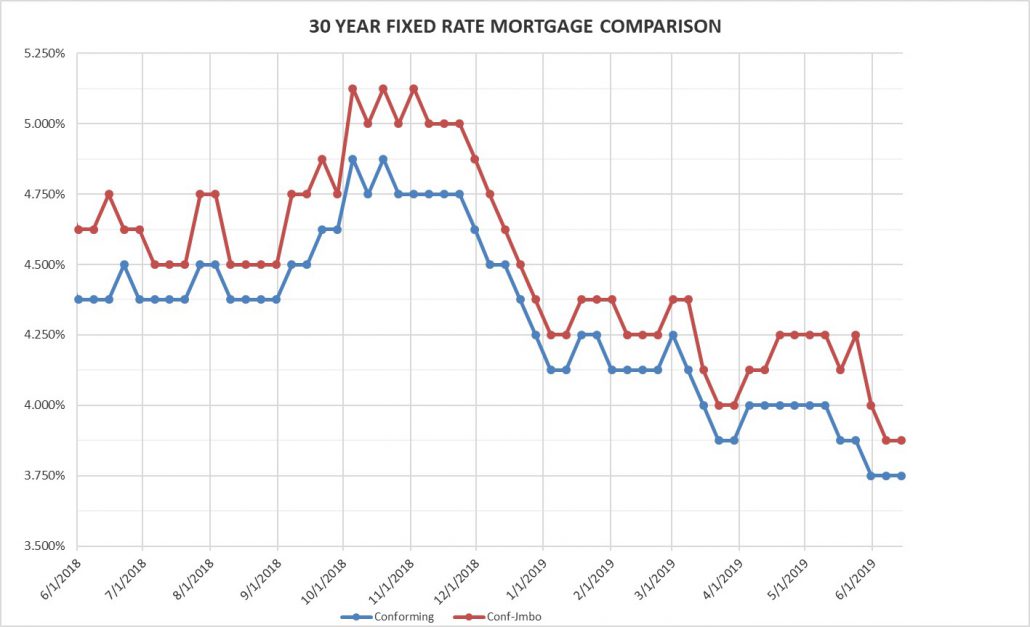
Rates for Friday June 14, 2019: Reports, commentary, speculation, these are what drive a lot of decisions for investors as they try to stay ahead of downturns and get in before upswings. The tariff issues with China, Mexico and other nations, lack of inflation, slowing job growth, the Fed lowering rates, all have investors anticipating lower rates—which creates lower rates as they influence the markets. Mortgage rates reflect this anticipation, a Fed rate drop is already priced into our market, as rates continue to sit at lows last seen in January 2018. If the Fed surprises the markets and lowers rates at its meeting next week instead of waiting for July, my expectation is that mortgage rates will bump up as investors move to stocks in anticipation of rising prices in the equity markets. Stay tuned, and lock in when you can.
FIXED RATE MORTGAGES AT COST OF 1.25 POINTS LOCKED FOR 45 DAYS:
30 year conforming 3.75% Flat
30 year high-balance conforming 3.875% Flat
Please note that these are base rates and adjustments may be added for condominiums, refinances, credit scores, loan to value, no impound account and period rate is locked. Rates are based on 20% down with 740 FICO score for purchase mortgages.
Happy Father’s Day to the dads out there. If you are a golf fan, here is hoping you have a chance in being celebrated to watch the conclusion of the U.S. Open, especially if it is an exciting finish. For many years we started our summer family trip on Father’s Day and I watched many holes of golf in airports or rushing to get to our accommodations to catch the finishes.
One of the primary lessons I learned from my dad that I hope my children adhere to as well is he used to say, “I’d rather lose a friend telling the truth that to keep or make one telling a lie.” Of course, this also means do not penalize your friends for telling you the truth.
Happy Father’s Day!
Have a great week,
Dennis
Past Weekly Rate & Market Updates can be found on my blog page at my website www.DennisCSmith.com/my-blog

