

Do we have to pay closing costs?
Question of the week: Do we have to pay closing costs?
Answer: Frequent readers of the WR&MU know the standard answer to the majority of questions of the week: Yes. No. Maybe.
All real estate and mortgage transactions have costs, the question being asked is does the borrower have to pay them or can someone else?
Everyone has heard the ads, “no closing costs…” This is semi-truth in advertising. There are always closing costs, and someone is paying them, who and how?
Before we dig into who and how the closing costs can be paid we need a look at what closing costs are present in mortgage transactions.
Closing costs is usually a general term for any funds collected during the transaction. In reality, there are actual costs and recurring payments that combine to be called closing costs, we define these as non-recurring and recurring costs.
Non-recurring costs are fees you are paying only because you are in this transaction, fees for the appraisal, escrow, title, lender, county recorder are paid once, i.e. they do not happen again until the next time you enter into a transaction to purchase or refinance real property.
Recurring costs are funds that are collected to pro-rate mortgage interest, homeowner’s insurance and property taxes. These are costs that you pay because you own a home and have a mortgage. The funds to cover these costs will depend on three primary factors: whether you will have an impound or escrow account set up for the lender to collect and pay your property insurance and taxes, what day of the month your transaction closes, and what month of the year your transaction closes.
Closing costs are different for purchase transactions and refinance transactions, typically costs for purchases are higher due to the escrow and title fees being higher than for a refinance. If your transaction is a refinance there are two options for closing costs to be paid, if you are purchasing a new home you have those two options plus one more.
The first option is the most obvious one, you pay the closing costs. In refinance, you usually can add them to the new loan, which means you will be paying the costs over the life of the loan. If you are purchasing a home it does not make sense to add them to the loan amount as it would change your down payment, and that would change your loan to value, and that could change your rate. For example, you are purchasing a property for $450,000 with 10% down and your closing costs total $10,000, you add the costs to your loan increasing the loan amount from $405,000 to $415,000, this increases your loan to value from 90% to 92.2% which can impact your interest rate and mortgage insurance. For most refinance transactions, we encourage clients not to add the recurring costs for interest, insurance and taxes to their loan balance so they are not paying interest on those fees they would be paying whether they refinanced or not.
The second option is for the lender to pay the costs. This option occurs very frequently in refinance transactions where we close “no points” transaction and the other costs are either paid by the borrower or added to the loan. The lender can pay part or all of the closing costs for borrowers in a refinance or purchase transaction, on paper. In reality, the borrower is paying for the closing costs through a higher interest rate. Long-term readers of the WR&MU know the teeter-totter relationship between costs to close and monthly payments. The higher the interest rate, and therefore your payment, the lower the costs to close. This is because the higher rate a lender has on a mortgage the more money it can sell that loan for in the secondary market. If you are an investor with $100,000 looking for a relatively safe long term fixed rate investment and you have the choice for either a 4% return or a 4.5% return which would you want? If the cost for both is $100,000 you would obviously take the 4.5% return, but because of the way the market works the 4% investment would be offered to you for less than $100,000 because you will receive $500 less per year, conversely you would pay more for the 4.5% option because the return is higher. Here is the simple way to understand the relationship between costs and interest rates:
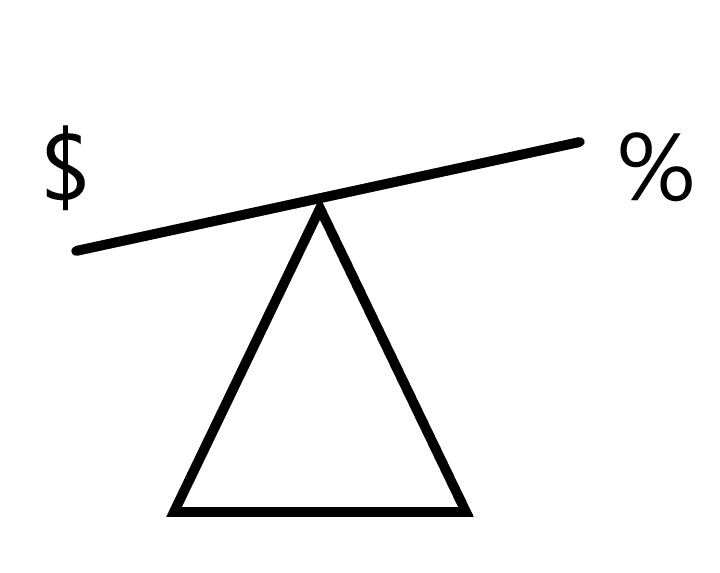
Lower Costs
When locking in a loan for either a purchase or a refinance we will give a range of interest rates and their corresponding payments and what the total costs for each of those options will be. Some borrowers prefer spending more money for a lower rate and others are looking to minimize costs to them out of pocket and opt for the higher rate and payment. As a rule the breakeven point for having lender paid fees due to a higher interest rate is between five to seven years depending on the loan amount and costs; i.e. if you are saving $3500 out of pocket on a refinance by taking a rate that is 0.25% higher costing you about $45 more per month, it will take you about six and a half years to pay for the costs due to the higher payment (3500 divided by 45 = 77.78 months); or the other way if you pay the $3500 up front and reduce your payment by $45 per month you save the $3500 in 77.78 months. Long term you pay more for the costs being added to your rate, short term you do not have to pay the $3500.
The third option, available for those purchasing a property, is to have someone else involved in the transaction pay some or all of your costs for you—most typically the seller. I have always thought this a great option for homebuyers, but it is more popular during periods when the home sales market is slower. Here is how it works. You find a home you like for $525,000. We go through the numbers and with 10% down all your costs for the transaction including points to buy down the loan, escrow, title, etc total $13,000. You have a total of $56,000 in your accounts, so not enough for the down payment and closing costs. You write your offer to the seller for $538,000 with the seller to credit you $13,000 at closing for costs. The seller is going to net almost the same amount at closing—a bit less since if typically costs sellers about 8% to sell their home on the open market using real estate agents. Yes, you pay more for the property, but you save $13,000. Instead of $52,5000 down payment and a much higher rate to cover the $13,000 you do not have, your down payment is $53,800 and your loan amount goes from $472,500 to $484,200; at a 4% rate your payment is $56 more per month. Your “payback” for the $13,000 you did not pay at closing is almost twenty years; if you purchased the home for $525,000 and pay the closing costs of $13,000 and put $56 every month into a coffee can in the kitchen it will take you twenty years to save the $13,000 you could have saved when you purchased the home. I really like this option for home buyers even if they have the funds to pay their own closing costs, unfortunately not many agents encourage their clients to write such offers, or if they are representing sellers to accept such offers.
Like most mortgage questions there is no simple answer to whether you should pay the closing costs of your transaction, it depends on your situation and what makes you the most comfortable in trading off costs and payments. Not being a cookie-cutter lender, I always run through all the options with my clients for their purchase and refinance transactions so they can choose the option that works best for them and their families. Call me to explore the options for your transaction.
Have a question? Ask me!
Playing catch-up from the shutdown, the federal government economic data releases are giving us a picture of the economy in January as well as February. Combining the first and second revisions to the Gross Domestic Product for the 4th quarter of 2018, the initial 2.6% growth in the quarter was revised down to 2.2% and the overall growth in 2018 was 2.86% for the economy. This news is somewhat neutral for rates as the growth is of moderate strength, which should put upward pressure on rates, but with the revision being lower than the initial announcement showing slowing growth that is positive for rates to remain stable.
Consumers still in good shape, per the reports on income, spending and inflation. We will get the February data in the future, but for January consumer spending rebounded 0.1% to the positive after the surprising decline, and very surprising amount of decline, in December. The Price of Consumer Expenditures (PCE), the primary guage of inflation for the Fed, also should 0.1% growth for the month. The annual PCE increase dropped from 1.8% in December to 1.4% in January. The large drop in prices year over year from the prior month is positive for rates as it is well below the target 2% inflation rate. Overall this news is positive for rates as it portends a slowing economy and supports the Fed’s announcement at it most recent meeting that it is backing off on the number of rate increases in 2019.
Possibly putting upward pressure on rates, personal incomes continue to grow as they rose 0.2% in the month of February. Higher personal income reflects a strong labor market, which combined with low inflation should lead to higher consumer spending and economic growth. Overall the news is somewhat mixed for the economy with labor markets signaling a stronger economy than inflation and spending have shown.
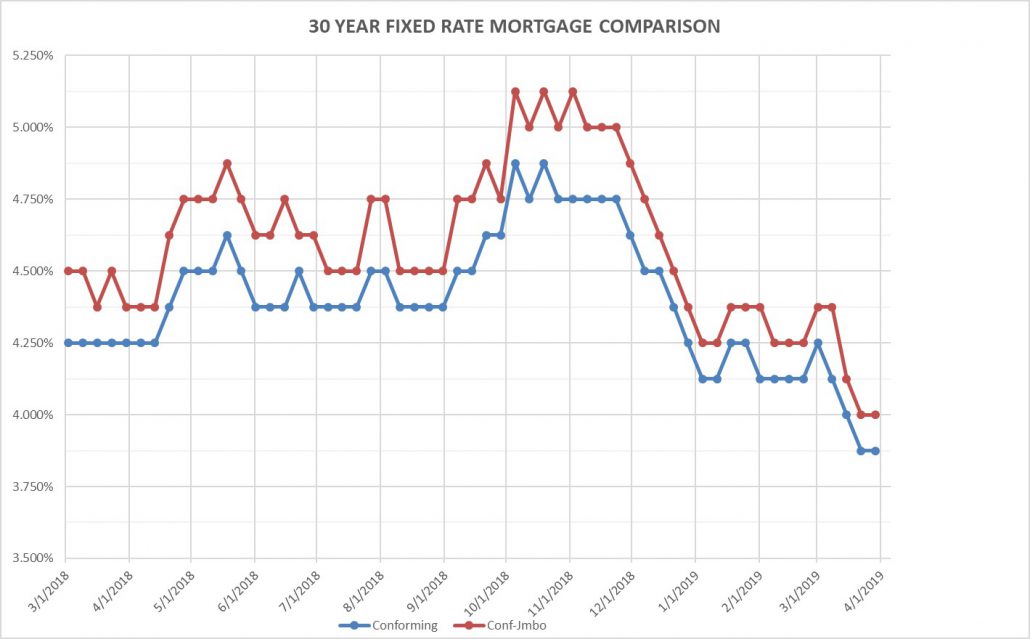
Rates for Friday March 29, 2019: Rates tried to break a bit lower early in the week but are flat today from last Friday and the conforming rate is below 4% for back to back weeks for the first time in fourteen months. Now is a great time to explore your options for refinancing to lower your payment, consolidate a HELOC or other debt or purchase a new home—Call me!
FIXED RATE MORTGAGES AT COST OF 1.25 POINTS LOCKED FOR 45 DAYS:
30 year conforming 3.875% Flat
30 year high-balance conforming 4.00 % Flat
Please note that these are base rates and adjustments may be added for condominiums, refinances, credit scores, loan to value, no impound account and period rate is locked. Rates are based on 20% down with 740 FICO score for purchase mortgages.
The great thing about yesterday was despite losing half of my Final Four in my bracket contest with my friends from college (we estimate the core group has been together in this pool since 1985 or 1986) was that it was Opening Day for baseball. That alone would have taken some of the tarnish off Michigan and Tennessee’s horrible shooting, but a shine was put on because the Phillies won convincingly and optimism abounds in the City of Brotherly Love—as much as any Philly fan can be optimistic.
The best $20 I spend every year is for my mlb.com subscription which gives me access to every radio broadcast of every major league game and playoffs for the year. If you call me between now and October, depending on the time of day, you will likely hear a baseball game in the background as I prefer that to music as the sound in the office. If the Phillies are not playing I will dial up whatever game is on the air, often looking for the smaller market broadcasts as I love the local advertising—for instance last summer listening to a Kansas City Royals broadcast during the weekend while crawling around pulling weeds I heard an ad for Popsicles. Popsicles! When was the last time you heard an ad for Popsicles!
Go Phillies, ring the bell!
Have a great week,
Dennis
Past Weekly Rate & Market Updates can be found on my blog page at my website www.DennisCSmith.com/my-blog

