


Will I be affected by the change in the credit scoring model?
Question of the week: Will I be affected by the change in the credit scoring model?
Answer: Most likely, yes, you will be affected. Will it affect you if you are applying for a mortgage? Most likely, no.
In January, Fair Isaac Corporation announced that it would roll-out a new credit scoring model this summer. Fair Isaac Corporation is the data company whose algorithms produce the FICO credit scores used by lenders for credit cards, auto and personal loans, and mortgages.
Before we get into the new credit scoring model and its impact, or no impact, on you, let’s look at what the credit score is and does. In credit parlance your credit score is known as your “FICO,” so named from the original score established by Fair, Isaac and Company. The FICO score started in 1989 and since then has had several versions as the company looks to better predict credit risk for lenders based on individuals credit history.
The model for scoring uses several different aspects of your credit data obtained from subscribing creditors. Some, but not nearly all, the information includes number of open accounts, accounts with balances, how long you have had credit, what percentage of your available credit is being used, what type of credit you have used and are using, and very importantly how have you paid your credit obligations. The data is broken down into five categories and each category is given a weight for calculating your credit score. The categories and weights are payment history (35%), amounts owed (30%), length of credit history (15%), new credit (10%) and credit mix (10%).
Credit scores are like bowling not golf, the higher your score the better. As you can see your payment history carries the most weight, so the better your payment history, i.e. payments made on time, the higher your score. Conversely, the more payments you have that were not on time the lower your score.
Please keep in mind that with all models so far, FICO scores have been generally positively impacted by having a good mortgage record. If mortgage payments are made in a timely fashion over a period of time there is a strong positive impact on your credit score. The same is generally true for auto loans. These credit obligations show that you have the ability, and history, to manage your finances such that you are a good credit risk for long term high balance credit obligations. A high balance mortgage does not impact your score as much as high balances on revolving credit, i.e. credit cards. For instance, a $400,000 mortgage is a lot to owe but will not negatively impact a credit score, whereas $50,000 owed on credit cards can, and in many instances will, negatively impact a credit score.
The new FICO Score 10 model is intended to give a more accurate numerical judgment of current credit risk to lenders than the current model.
Since the beginning, FICO scores have put the most weight in the model on payment history, the new model will increase the weight on delinquent payments, especially delinquencies in the past two years.
As noted above, the second highest weight in scoring is the amount owed on credit. To clarify, this amount owed weight is not necessarily the total dollar amount owed. Of great importance on the credit balances score is the percentage of credit outstanding to credit available, or credit utilization. In other words, how close to being maxed out are you on your credit cards? Someone owing $20,000 on credit cards with total available credit on those cards of $25,000 will likely have a lower score than someone with $20,000 on credit cards with total available balances of $50,000.
The third area that will see more weight on credit scores is personal loans. These are loans that are made by finance companies, have very high rates of interest and are considered high risk as many of the applicants for such loans are unable to get credit elsewhere. FICO Score 10 will weight these loans more heavily than previously.
FICO Score 10 will put more weight on not only missed payments over the past two years but also account balances. While Fair Isaac does not release the exact recipe for their algorithms, their release on the changes makes it easy to infer if your credit balances have been increasing the past two years your credit score will likely be lower than if your credit balances have been consistent or lower. Again, when addressing credit balances the impact is on revolving credit and personal unsecured obligations.
To sum up, the biggest changes made to the credit scoring model with FICO Score 10 are the weight given to recent history of delinquent payments, history of high credit utilization, and borrowers who apply for personal loans.
Estimates are that 110 million American consumers will be impacted by the new scoring system, seeing their scores either increase or decrease just by the change in the model. Many will see their scores increase, however an estimated 40 million will see their scores drop 20 points or more according the Fair Isaac.
Because the new model looks back twenty-four months of credit utilization (outstanding balances compared to available balances) it will be harder to increase your credit score. One of the actions we use to help mortgage applicants raise their credit scores is to pay down balances on credit cards to get below certain utilization percentages on individual cards. Recently I had a client who paid a total of $7500 down over two credit cards and we were able to raise his scores by 20 points, which enabled us to lower his interest rate. With FICO Score 10 it appears this will not be an action that can be taken as the change in current utilization percentages does not have the same impact due to the twenty-four month look back.
What about mortgage applicants, how will you be affected? In the short term not at all.
As mentioned above the FICO score was introduced in 1989. In 1995 Fannie Mae introduced its “Desktop Underwiter,” an Automated Underwriting System (AUS) that uses artificial intelligence to underwrite and approve mortgage applicants. A key factor in the success of Fannie’s Desktop Underwriter, and subsequently Freddie Mac’s Loan Prospector, was the ability to assess credit history and risk. FICO scoring enabled risk assessment of the part of an borrower’s application.
Over the next several years the AUS and FICO programs were refined to more accurately predict credit risk with the objective of approving mortgage applications within acceptable risk for the GSE, i.e. to enable wide spread lending with an acceptable amount of delinquencies and foreclosures.
The Federal Housing Finance Authority is the government overseer of Fannie Mae and Freddie Mac. As discussed in many WR&MU over the years, Fannie and Freddie (GSE) underwriting guidelines are the basis for most other lenders, whether government insured (FHA and VA) or jumbo mortgages. There are some differences but many guidelines and policies are the same.
One policy that is the same is the credit score criteria used by the GSE, which is the FICO model used by the GSE, and therefore most other mortgage lenders and products. The FICO model used today for mortgage applications was introduced around 2004 or 2005. Before the mortgage and real estate market melt downs and the Great Recession.
Because the FICO model we are currently using is not changing, yet, the impact on mortgage applicants of FICO Score 10 is currently no impact.
“Yet.” For several years VantageScore Solutions, LLC has been pressuring the FHFA to adopt, or at least enable, its VantageScore credit model to be used by Fannie and Freddie; which would likely open it to be used by other mortgage lenders and programs. The company is a joint venture of the three primary credit-reporting companies, Equifax, Experian and TransUnion. A lot of the resistance to allowing VantageScore to be an acceptable scoring model was due to the major credit bureaus ownership of the product’s company and concerns about conflicts of interest.
Last August FHFA issued a rule that Fannie and Freddie will have to consider credit-score alternatives to Fair Isaac Corporations’ FICO scoring model. The rule was huge for VantageScore as it provides an opportunity to compete for business in the mortgage industry.
Since the ruling last August Fannie and Freddie have been negotiating on joint guidelines for credit score acceptability and starting this month will allow credit scoring companies to begin submitting applications using their scoring models for assessment and comparison to determine if their models are acceptable alternatives to the current FICO models being used for mortgage approvals.
The results could have tremendous impact on the mortgage industry, and therefore mortgage applicants, as it may open up lenders to use more than one credit scoring model, enable borrowers to shop credit scoring models to provide the best score for underwriting (similar to high school students taking multiple SAT’s and using the best score for college admissions) or result in a scoring model that results in lower scores for many applicants and little opportunity to improve their scores in a short period of time. In other words, adoption of FICO Score 10 or something similar.
Any changes in the scoring models for mortgages will take quite a while to get through the testing and bureaucracy, but there is a strong chance that there will be some changes in the future.
Have a question? Ask me!
Employment data for April released today showed a 20 million jobs were lost for the month. The unemployment rate, which was at a 50 year low of 3.5% just two months ago, has surged to 14.7%, and is likely higher as furloughed employees are not counted in the figure. In an indication of who is losing employment, the average hourly income jumped $1.34, or 4.7%, in April. The income spike indicates workers in the lower wage end of the workforce are losing their jobs while higher-earners are retaining theirs. Which is not surprising since the vast majority of lost jobs are in the hospitality industries which shed 7.6 million jobs in April. Also showing large losses were retail (2.1 million) and health-care (1.5 million).
Job losses, savings gains. The Bureau of Economic Analysis released the personal income and savings rates for March. As stated many times in the WR&MU, consumer spending is 65-70% of our GDP. Covid-19’s shutdown of businesses, especially hospitality, has seen a dramatic drop in personal spending. In March personal incomes decreased 2.0%, when the stay-at-home orders first were issued across the country. At the same time personal spending decreased 7.5%. As a result of spending dropping a lot more than income dropped, the personal savings rate was 13.1%, the highest since 1981.
Looking down the road…with many cities, counties and states slowly opening up businesses this week, and a more open economy in sight in the distance, the question is how will consumers react? How much of their savings will they retain and now much will they spend to release their pent up desire for new shows, weekend trips, dinners out. Has Covid-19 changed our habits enough so that when the economy is open again consumers will return to old spending habits, or will spending change such that some industries will not see a return to prior sales and revenues?
Rates for Friday May 1, 2020: We have found stability in the mortgage markets, for purchases at least. Purchase rates are the same for conforming rates for the third week in a row and for the second week for high-balance transactions. Refinances are case-by-case depending on your situation so call to go through your options.
FIXED RATE MORTGAGES AT COST OF 1.25 POINTS LOCKED FOR 45 DAYS:
30 year conforming 3.125% Flat
30 year high-balance conforming 3.375% Flat
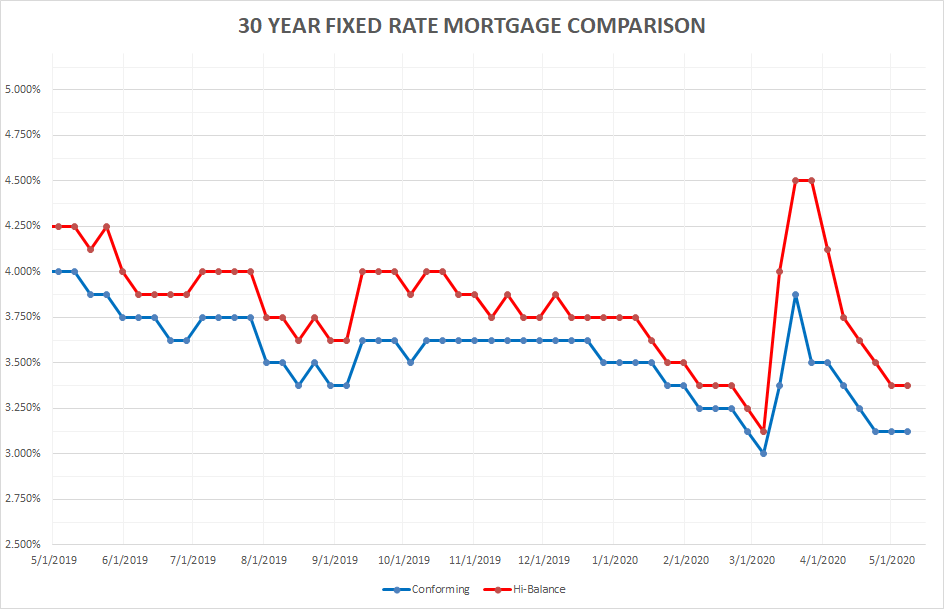
Please note that these are base rates and adjustments may be added for condominiums, refinances, credit scores, loan to value, no impound account and period rate is locked. Rates are based on 20% down with 740 FICO score for purchase mortgages.
How do you celebrate Mother’s Day without the requisite wait to get into the brunch buffet with your siblings’ families all toasting mom? Or the outing to the park with the kids so your wife can be pampered at the local spa? Or the nice dinner out after both of the above?
The Smith home is being transitioned to the Smith Resort on Sunday so Leslie can lounge and read by the pool while be served fancy drinks (pina coladas, mimosas, or anything else she desires), snacks, grilled shrimp tacos for lunch and poolside grilled steak dinner.
It appears that many families will be adding to their savings rates this Mother’s Day with stay at home creations to celebrate the moms.
Happy Mother’s Day,
Dennis
Past Weekly Rate & Market Updates can be found on my blog page at my website www.DennisCSmith.com/my-blog

