

What is happening with rates and economy?
Question of the week: What is happening with rates and economy?
Answer: There is a proverb that is attributed to being a Chinese curse, “may you live in interesting times.” I have always taken the saying to be a positive, I hope my and our lives are interesting.
But as we know, and are currently experiencing, interesting can define many feelings, events and actions. We are certainly in interesting times.
In times of concern and worry some unrelated event to what people are concerned about can become the impetus for actions and events. Last week there were some large daily gyrations in financial markets. From Monday March 3rd to Friday March 6th the Down Jones saw choppy trading daily as investors were concerned about the global impact of the COVID-19 virus. For the week the index was down just over 3%.
Then came the unrelated event last weekend when Saudi Arabia’s state-owned oil company pushed up production. The reason for the large production increase was the breakdown in talks with Russia that were intended to reach an agreement on oil prices. Saudi Arabia’s actions were met by the Russians also increasing production, and a price war began. The immediate result was a drop of over 20% in crude oil prices in the United States. Investors, already concerned over the global economic impact of the COVID-19 virus hit the big red SELL buttons on the morning of Monday March 9th.
Why did a price war between the Saudis and Russians cause U.S. investors to sell? The price of oil per barrel in the United States fell 40% what shale producers need to break even. Such a large drop in oil prices ripples through the economy, and while good for consumers at the pump and heating their homes, investors concerns were more related to economic production and output.
As well, oil and gas sectors make up over 10% of high-yield bond markets, which would be impacted by the price war. Nervous about the COVID-19 impact, investors dumped stocks and bonds, causing prices in both to drop and interest rates to increase.
On Monday the Dow opened about 7% lower than Friday’s close and while gyrating through the day closed with a very small decrease. Tuesday it appeared stability had come to the front as after a mid-day drop the Dow climbed almost 7% in the final hours of trading, and only fractionally lower than Friday’s close. Wednesday saw a slow sell-off. Yesterday, following President Trump’s Wednesday night address to the nation indicating actions that would be taken to try to stabilize markets and stimulate the economy, investors again began selling as soon as the markets opened, dropping the Dow 7%. As I write this the Down is up almost 6% for the day, and down 5.5% from Monday’s open. Like every day this week the trading is choppy with swings up and down, but so far the trend is up for the day with an hour left in trading.
Usually interest rates follow stock prices, when stock prices drop so do rates and vice-versa. Because the impetus for the initial shock trades in the markets on Monday was the oil sector, which is a major influence on fixed rate markets, this week rates have been acting counter to their historical relationship with stocks and as stock prices have dropped rates have increased.
In uncertain times investors put their money in bonds, and mortgages, and the result is lower rates. The uncertainty in direction of the markets each day, the historical disconnect in the stock-bond relationship and the unsatisfaction with the Trump Administration’s announcement on economic action, investors have shown a willingness to sell investments and hold cash.
What’s next? My crystal ball has proven to be cracked, chipped, cloudy and at time myopic over the years. That said here are some things I have been looking at and considering.
When the Fed meets next week, perhaps before but I believe they want to all be in the same room when the announcements are made, it will announce a large cut in its rates—by large I mean 0.75-1.00% (keeping in mind Fed rate changes are infrequent and usually in 0.25% increments). Following the rate cut announcement, I would not be surprised if the Fed announces a Quantitative Easement policy reminiscent of the QE policies enacted after the 2008 real estate market collapse.
The policy will result in the Fed committing to buy billions, tens of billions, of dollars of mortgages and possibly Treasury bills and bonds. This will be to give confidence to investors, stabilize the fixed rate asset markets and provide liquidity so lenders can lend.
The huge unknown for all of us is the impact of the closing of sporting and entertainment events, colleges, and now schools (Long Beach Unified School District is closing classes from Monday until April 20th—one of those weeks was scheduled Spring Break), on the overall economy. Consumer spending is certainly very high right now**, which is very high right now as worried consumers stock up on household items and food. That is very good for the economy, but the untold billions of losses due to cancelled events and the ripple through the economy from the lost wages of workers and sales of tickets, concessions, parking, t-shirts, etc is of great concern.
Economic data from March, and January and December, showed the economy had a continuing strong job market with low unemployment and growth in the number of new hires monthly, and barely any layoffs across most sectors. Consumers were spending a bit more each month than the last, while inflation remained extremely low.
Post-COVID-19 impact is the uncertainty that will keep investors cautious, the actions by the Fed and others will determine how cautious.
In regards to the economy, I have heard many expressing concern that we are going down the same path as 2008, which was also precipitated by a single event. In February 2007, New Century Financial in Irvine could not find a buyer for its sub-prime mortgages. At the time it was the second biggest subprime lender in the country. When it could not sell mortgages to investors it had liquidity problems and stopped lending, eventually filing bankruptcy. Wall Street would not purchase the mortgages due to concerns in the underlying financial strength of the borrowers. This led to closer investigation of other subprime mortgage company offerings, which in turn led to spreading concern of the underlying mortgages that funded the housing bubble.
Back to today, I see the only comparison to 2008 being an event that led to a large drop in equity markets. The biggest difference is the underlying economies. Leading into the Big Recession we had an economy that was fueled by a single sector, housing, that was financed with weak mortgages with borrowers who were deemed “qualified” without verification of income, assets and very often appraisals of real estate. A tremendous percentage of homeowners were highly leveraged and when real estate prices softened many were quickly upside down, which created downward price momentum and we know how that story ended, millions of foreclosures resulting in banks and financial institutions going under.
Our economy since the Great Recession ended in June 2009 has been growing and growing and growing at an unprecedented rate—not in the size of the economic growth but the number of months, quarters and years.
Over the past decade we have seen families purchasing homes with larger down payments, with mortgages they can afford and the ability to lower their monthly payments have interest rates have declined. The housing markets are stable backed by homeowners in homes with a lot of equity and debt they can afford.
Over the past decade we have seen employment growth across all sectors and wages and salaries growing faster than inflation, and most months faster than consumer spending. The result has been a steady growth not only in the economy fueled by personal consumption (65-70% of our economy), but also a steady growth in personal savings rates and retirement accounts. Families are borrowing less on credit cards and saving more of their wages.
When, not if, when the current crisis of the COVID-19 virus is finished, when we get back to “normal” in our activities and actions, we have an economy that has sound fundamentals. This should be reflected in a much quicker recovery in financial markets that in the past when there have been major corrections as investors remember and realize these fundamentals.
In the moment we look around and worry about how we and our families are impacted by major events. In this case the worry is about something unseen that spreads without knowledge or warning until the spread has occurred. The most severe impact appears to be limited to a few demographics, severe enough to justify cancelling large gatherings to protect those most likely to be affected. Hopefully, the actions taken by federal, state and local governments, as well as organizations, to try to limit contact in large congregations of people will quickly “flatten the curve,” as we have been told and this will pass quickly.
As for mortgage rates…they are up significantly from last week as lenders have jumped ahead of the markets to limit their exposure should rates continue to rise—which of course causes rates to rise, which causes lenders to…
As mentioned last week, before this week’s tumultuous markets, lenders were raising rates off and on to control their volume depending on their capacity. The result was intraday jumps and drops in rates from lender to lender and in the market as a whole. I expect this activity to continue as lenders cautiously eye the markets, their pipelines and their competitors to see when they can return to market based rate decisions and more stability in the markets.
It is my contention that in the not too distant future we will see the “V-curves” rebound somewhat sharper than normal; i.e. rates will come down faster than normal and equity markets rise faster than they normally do after a correction. Investors hate “dead money,” or cash, and want their money to work for them. For this to happen they must invest in stocks, bonds and mortgages.
Have a question? Ask me!
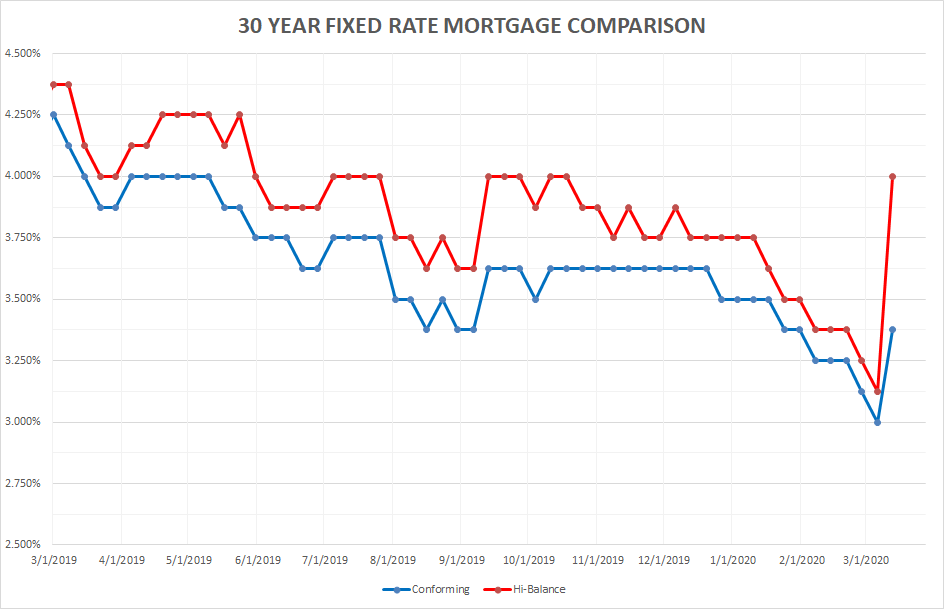
Rates for Friday March 13 2020: This week the rates at 9:00 a.m. have not been the rates at noon which aren’t the rates at 2:00. As mentioned above, the past few days lenders have been pushing rates to protect themselves. Carefully scouring across many lenders we see some lenders dip down to pick up some rate locks and business and then quickly raise their rates later in the day, and the opposite with others. The increase from last Friday for high-balance conforming is the largest one-week jump I think I have ever seen—going back to 1987—and shows the risk-avoidance lenders have to expose themselves until there is some certainty in the market. The conforming rate increase from last week is largest since March 2012 when it also increased three-eighths of one percent (0.375%).
FIXED RATE MORTGAGES AT COST OF 1.25 POINTS LOCKED FOR 45 DAYS:
30 year conforming 3.375% Up 0.375%
30 year high-balance conforming 4.00% Up 0.875%
Please note that these are base rates and adjustments may be added for condominiums, refinances, credit scores, loan to value, no impound account and period rate is locked. Rates are based on 20% down with 740 FICO score for purchase mortgages.
**One or two mornings a month I stop by our local Ralph’s on the way home from my workout class to buy milk. I am there usually around 7:00 a.m. and there are a few other shoppers in the store, also grabbing milk or breakfast items, what appears to be lunch, or items for lunch-time gathering or office celebration. As well, there are a lot of workers stocking shelves with many of the aisles blocked with cartons and pallets.
This morning as I pulled into the parking lot, I wondered why there were so many cars in the parking lot. Entering the store, I saw as many shoppers I would on a Saturday morning. They had carts filled with canned goods, everyone had toilet paper (shelves were empty) and there were a few people with carts filled with cases of bottled water. People doing “regular” shopping of meats, fruits, vegetables and canned goods where as prevalent of the doomsday-shoppers who evidently feel our water supplies are going to be contaminated and an epidemic of dysentery.
Like investors creating self-fulfilling prophecies with their actions to buy or selling thinking markets will go up and down, and thereby causing that to happen, we are seeing consumers behave and react in the same way. I am looking forward to when we have some semblance of reason return to the group mindset and behaviors.
In the meantime, we will have two kids at home due to my older daughter’s university sending all the students home and my younger daughter being home due to LBUSD cancelling classes.
We live in interesting times.
Sorry for the rather lengthy WR&MU this week, a lot I wanted to try to convey in some detail to provide some understanding, I hope.
Have a great week,
Dennis
Past Weekly Rate & Market Updates can be found on my blog page at my website www.DennisCSmith.com/my-blog

