
Posts

Should we consolidate our credit?

Question of the week:  Should we consolidate our credit?

Answer:  With interest rates so low this is a question many people are asking themselves, and me. Like many financial questions there is no uniform answer, and possibly no “right” answer. If you are asking this question the best course of action is to try to make an objective analysis and do the math to determine whether you feel consolidating your credit is right for you and your family.

What does it mean to “consolidate credit?” In its simplest form, consolidating credit is paying off existing credit obligations with an existing, or new, credit account. For instance, you have likely received solicitations in the mail from a credit card company offering you a very low rate of interest, possibly zero percent, for twelve months if you transfer balances from other credit cards. If you make the transfers and pay off other credit card accounts you are consolidating your credit obligations from several accounts to one account.

Here is how the math may look. You have three credit card accounts with five to eight thousand dollars one each account, let’s say the total owed is $20,000. The average rate on credit cards is about 15%. If your accounts are average you are paying $250 per month in interest on your cards. Your minimum payments are probably $400 per month for all the cards, which means you are only paying down $150 per month on the cards. If you transfer the $20,000 to a zero percent account and make the same $400 per month payment you will lower the balance on the account by $4800 in twelve months, versus only $1800 if you had maintained your cards and payment pattern.

Of course, after the initial twelve-month period the interest rate will go up and you will likely be paying 15%, or more, in interest—just on a lower balance.

I am asked the “should we consolidate our credit” question with another objective in mind, the question is really, “should we refinance our home and pull out equity to pay off other debt?”

Using a mortgage for debt consolidation is known as a “cash-out refinance.” Using a cash-out refinance to consolidate debt can the math a bit more complicated.

The most common debt consolidation with a refinance is to pay-off a Home Equity Line of Credit (HELOC) or other second mortgage. Typically, this type of refinance is undergone to fix the rate on a HELOC and force amortization of the balance; most HELOCs have a minimum payment of interest only and therefore many/most homeowners with HELOCs do not pay much, if any, principle on the debt. It us usually the case when a HELOC is refinanced into a new primary mortgage that the mortgage payment will increase, this is in part due to the amortization.

When dealing with consumer debt such as credit cards, student loans, auto loans or other non-mortgage debt, a big factor is the extension of the debt being paid off. Most of these credit obligations have installment periods of less than five to seven years, and while credit card balances can last seemingly forever, if no balance is added making the minimum payments will generally pay off the card within ten years.

If consumer debt is rolled into a new cash-out mortgage transaction  consider that most mortgages are thirty year mortgages, so if you do consolidate credit debt you are extending that debt to a thirty year payment plan—unless you sell the home before the mortgage is paid off.

Depending on your situation a cash-out refinance to consolidate debt may make financial sense for you and your family.

Consider a family that has owned their home for ten years and owe $250,000 on their mortgage with a 3.75% interest rate and their current home value is $525,000. They did some remodeling on their home a few years ago so in addition to the mortgage they have a HELOC with a $100,000 balance and the rate is Prime + 1%, or 6.25%. They also had a medical emergency with a child and needed to help a parent with relocating and have accumulated about $30,000 in credit debt they are having a difficult time paying down.

Their total payments are about $1400 for the mortgage, $525 for the interest on the HELOC and $600 for the credit cards. They have two car payments totaling $700 per month but those will be paid off within the year and will not be part of any consolidation plan.

The balances being considered for being paid off total $380,000 with payments of $2525 per month.

When considering interest rates long-term readers of the WR&MU know that two major factors are the purpose of the loan and the Loan-To-Value (LTV), which is the loan amount divided by the value of the property. The lower the LTV the better the rate, to a certain level. Purchases and rate and term refinances (refinancing just to lower the rate and payment with no equity being pulled out of the property) have better rates and pricing than a cash-out refinance*.

In this case we have a cash-out refinance at 72% loan to value. Let’s assuming the market rate for this loan scenario is 4%, which would result in a monthly payment of about $1815 per month.

With monthly savings of $710 per month it seems to make sense to proceed with the transaction and pay off the debts with a new mortgage. But is this the right decision?

What if instead of paying off the credit card debt just the HELOC was paid off with a new mortgage? Now the mortgage balance is $30,000 less at $350,000 and the monthly payment will be $1670 per month, a savings of $855 per month.

With this scenario, instead of putting revolving credit into a thirty year loan the savings from consolidating the HELOC into a new mortgage are used to pay down/off the credit cards.

If the family keeps their total monthly credit payments, absent the auto loans, the same at $2525 per month, pay $1670 on the new mortgage, they have $855 per month to pay on the credit cards. Instead of paying about $2700 per year in principle on their credit cards they will be paying almost $5800 per year—cutting in half the amount of time to pay them off.

This is just one scenario out of many that we can, and do, run for homeowners who feel their debt is becoming more and more challenging and may be able to take advantage of the current low rates to provide some financial relief and monthly savings.

A few points I need to make in conclusion. First, I do not advocate using one’s equity in their home to finance spending sprees and living above one’s means. People do get in trouble and we can help them out, but I always council that if your credit situation has gotten such that you need to refinance your home to pay off accounts that were used for trips, clothes, eating out, etc then you need to change your spending habits and lifestyle to leave within your means.

Second, make sure you have a plan for the money you will be saving every month. Put it in savings, start an investment account, put the money in 529 college plan accounts for your children, increase your retirement contributions. Have a plan.

*If your loan amount will be over the Fannie Mae/Freddie Mac conforming loan limit of $484,350 then the difference in rate between a purchase/rate-term refinance and a cash-out refinance will be a lot more than the difference for loan amounts at or below $484,350. The “high-balance” conforming (loan limit of $726,525 in many Southern California areas) and jumbo loan programs have fairly significant price add-ons for cash-out refinances, especially those with higher LTV’s. Call me for details.

If you are interested in running “what-if” scenarios to see what your options are for consolidating a HELOC and/or other debt please give me a call and we can do the math for various options. You may be fine with how you are currently set up regarding debt and we can put together a plan to help you payoff some of your debt without having to tap into your equity.

Have a question? Ask me!

Over the last month or so I have gone on some mini-rants about the Fed lowering interest rates to boost an economy that I, and others, see as not needing a boost. The Fed got a little “told-you-so” this week at the Producer Price Index (prices wholesalers pay for goods and services) was up only 0.2% in July and 1.7% from July 2018. The “core” price index (food and energy costs are taken out of the calculation due to their volatility) declined in July by 0.1%. This news is moderately positive for rates, we will see next week when consumer price data is released, and supports those in the Fed who feel soft prices can drag down the economy. I remain unconvinced.

Rates for Friday August 9, 2019: After a price spike on Monday that pushed rates down a bit from last Friday rates bounced back to where we closed a week ago. It appears that we are at the bottom of the most recent range of rates, which means lower rates will be hard to come by—if at all—in the short term, or medium, or long.

FIXED RATE MORTGAGES AT COST OF 1.25 POINTS LOCKED FOR 45 DAYS:

30 year conforming                                            3.50%     Flat

30 year high-balance conforming                    3.75%    Flat      
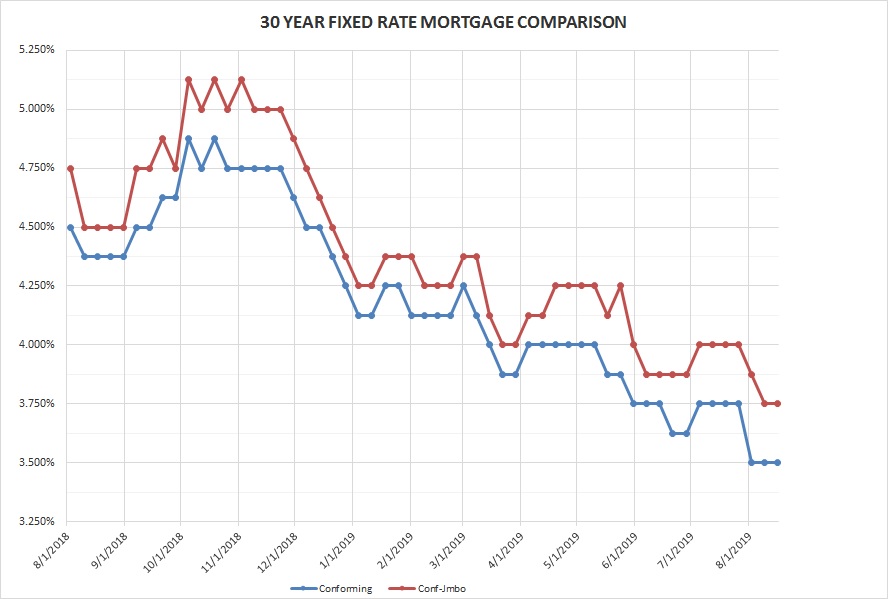
Please note that these are base rates and adjustments may be added for condominiums, refinances, credit scores, loan to value, no impound account and period rate is locked. Rates are based on 20% down with 740 FICO score for purchase mortgages.

Well it was a lot easier writing the Weekly Rate & Market Update this week from a desk than it was from the passenger seat of a Hyundai Tuscon last week! Leslie and I had a great trip traveling to the Midwest and back and are glad to be home with both of our girls. At least for the next few weeks before the eldest heads back to her sophomore year in Boston.

I hope you summer is going well!

Have a great week,

Dennis

Past Weekly Rate & Market Updates can be found on my blog page at my website www.DennisCSmith.com/my-blog

9-21-18: Should we refinance and use proceeds to payoff debt?

Question of the week:  Should we refinance and use proceeds to payoff debt?


 Answer:  Not if you can payoff your debt without tapping into your equity.


With rates still low many families are looking at their accumulated consumer debt and wondering if they should refinance, or get a home equity loan, to payoff their debt and lower their monthly credit payments. Being able to get a rate for a cash-out refinance possibly somewhere around 5% for a 30 year fixed rate mortgage seems better than paying high, possibly as high as 20%, on credit cards. But is it a good idea?


On paper, the math seems really good, but a deeper look shows it probably is not for most families.


Take a scenario where you have a home worth $550,000 and you have a balance of $365,000 on your current mortgage with a rate of 3.75% and your payment is $1850 with about 25 years left on the loan. You do not intend to move anytime in the future as your kids are in, or just about in, middle school.


For various reasons, some emergency, some just consumer spending, you have accumulated about $35,000 in revolving debt (credit cards) with minimum payments totaling about $700 per month, have a few collections from past medical expenses for another $2000, a car payment of $560 with a balance of $20,000 and you need to replace your roof which will cost about $20,000. You have about $10,000 in savings and are making maximum contributions to your retirement accounts. You have been trying to pay down your credit cards but have not seem to be able to make a dent in the total balances and are at the stage where you make minimum payments and pay off most of what you charge each month.


Recapping, you have about $57,000 in debt costing you $1260 per month in minimum payments, this includes collection accounts with no payments being made, and you need about $20,000 for a roof. Should you either refinance and add $77,000 to your mortgage or get a home equity line for close to that amount, to payoff all your debt, fix the roof and start over with only a mortgage payment? To do so would require about $442,000 for a mortgage balance, or your current mortgage with a home equity line.


We would want to keep your new loan amount at or below 80% loan to value, which would be a new mortgage for $440,000, a bit short of what you require but you would be able to pay that off quickly with your new financial obligation shift.


Taking a look at a new mortgage of $440,000 for a cash-out refinance at 80% loan to value you would be looking at a rate of about 5% depending on credit score and other factors. This would make your new mortgage payment about $2350 per month, or $500 more per month than what you are spending now on your credit obligations plus replacing your roof. With the new loan and $500 per month higher payment you are getting rid of $1260 in monthly payments for a net savings of $760 per month.


Sounds pretty good, payoff debt, get a new roof and save $1260 per month. But is this something you should do?


Scenarios I run by clients before initiating the application for such a debt-relief refinance are as follows:


Reconsider including your vehicle loan in any debt consolidation scenario. Auto loans are generally lower rates than credit cards, and in the past several years with decent credit rates below mortgage rates. They are also fully amortized, meaning with every payment you are paying down the loan balance until it reaches zero. In the above scenario, you have about three years left on the loan and you are paid off. If you include it in a mortgage refinance you will be paying for the car as part of a thirty year mortgage. Taking the loan out the new mortgage balance would be $420,000, your payment on the mortgage would drop to about $2245. You would now have a mortgage payment that is just over $400 per month higher than your current mortgage, you are paying off debt with payments of about $700 month for net savings of $200 plus have funds to replace your roof.


Consider a home equity line of credit (HELOC) instead of refinancing your mortgage. The rate will be higher, and adjustable with it going up the next few years, however you will have the opportunity to save on monthly payments, or not depending on how you handle the repayment of the HELOC. If you go this route, you obtain a HELOC for $50,000 (following advice above and leaving vehicle loan out of the consolidation plan) at a rate of Prime plus one-half of one percent. Prime is at 5.00% today giving you a rate of 5.5% on the HELOC. The minimum payment for most equity lines is interest only, in this case that would be about $230 per month which looks like a big savings over what you are paying now—and that is the debt trap. If you pay interest only you are in worse position than you are now. Yes, your monthly cash flow is better but you are making no reduction in the balance. If you get a HELOC my very strong recommendation is you continue making the same total of payments you were making before, except instead of paying minimum payments on credit cards you are paying down your HELOC balance. Currently you are paying $700 on the cards, so pay $700 on the HELOC, this will decrease the balance $470 per month at the current rate. If the rate never changes and you make $700 per month payments you will have the HELOC paid off in about seven years. However, the rate will very likely be going up at least one percent in the next year, and perhaps more in the future. When calculating long term HELOC rates I usually use an average Prime rate of about 8% to be safe, at this average rate and a payment of $700 per month your time frame to payoff the loan for your credit card debt and roof repair is about eight years.


Equity lines often have balloons. One factor to consider with the equity line is the repayment terms. Many are “open” for ten years, meaning you can reuse them as the balance is paid down/off, and during this period they require only interest only. After ten years HELOCs are either fully amortized for the remaining term, or are due with a balloon payment. Because of the change in terms later in the loan it is important to have a payoff plan on the HELOC when you obtain it so you are not in a position in the future where you need to potentially refinance again in the future.


Create a realistic plan to payoff you consumer debt yourself and just borrow to pay for the new roof. Make a very realistic budget of your net income and expenses, including debt payments. See what adjustments you can make to your lifestyle and how much those adjustments will save you per month. Take the savings and dedicate them to paying off your credit cards. Many years ago, before Dave Ramsey became a multi-millionaire by counseling families on paying off debt I would help clients with debt payoff plans that pretty much matches Ramsey’s plan. I called my plan Stop, Drop and Roll. Stop using credit. Drop your credit card balances one at a time, starting with the lowest balance. Roll the payments into the next lowest card when one is paid off. It takes commitment to the payments and whatever austerity measures you put in place but if followed will enable you to payoff your consumer debt without refinancing your mortgage and adding tens of thousands of dollars and years to your existing mortgage.

I am in the debt business, a mortgage after all is a debt—the largest debt for almost every homeowner. If you are feeling overwhelmed with your debt please contact me and I can help you, at no obligation or cost, work through options for paying down/off your credit obligations.


Have a question? Ask me!


August home sales are a bit of a mixed bag. While the total number of sales are down in the state from last year prices continue to rise and days on the market are stretching out in most areas as inventory on the market has grown for the past five months. Looking at the data it looks like the market is trending towards equilibrium between buyers and sellers after we have experienced several years of a sellers’ market. Statewide total sales in August were down 1.8% from July and off 6.6% from August 2018. The statewide median price, $596,410, is up 0.8% for the month and 5.5% from last year. Sales and prices locally are in line with the statewide direction on prices and units sold. In LA County, the median price in August was $607,490, up 1.7% from July and 6.4% from last August, the total number of sales were up 5.5% for the month but down 8.9% from last year. Orange County’s median price in August of $838,500 was 1.1% jump from July and 6.3% increase from 2018 with total sales showing 2.9% drop month to month from July and a 9.7% fall from 2018.


Rates for Friday September 21, 2018: Rates are up from last Friday as investors put money into the equity markets (i.e. stocks) and hedge against next week’s Federal Reserve Open Market Committee meeting—these are the folks that set the Fed rates that impact consumer rates, such as the prime rate that determines equity line rates. The Fed will bump their funds rate by 0.25%, that is expected and priced into the markets. Hedging is occurring because of what the FOMC members say about the future of short term rates, how many future increases, how soon, how high? While they will not directly answer these questions those who can read the Fed tea leaves will discern much from the minutes of their meeting. The consensus appears to be that the Fed will raise rates faster and higher than previously thought. Lock your rate when you can!


FIXED RATE MORTGAGES AT COST OF 1.25 POINTS LOCKED FOR 45 DAYS:

30 year conforming                                            4.625%    Up 0.125%

30 year high-balance conforming                      4.875%     Up 0.125%


Please note that these are base rates and adjustments may be added for condominiums, refinances, credit scores, loan to value, no impound account and period rate is locked. Rates are based on 20% down with 740 FICO score for purchase mortgages.


Long time readers of the WR&MU know I can be a bit of a data geek…well more than a bit. So I found it interesting that the link to the Waffle House index last week had one of the highest click rates I can recall from readers. For those in Southern California the nearest Waffle House is in Goodyear, Arizona, 337 miles away from the Smith abode in Long Beach. There have been plenty of trips home in the family van from Scottsdale that have begun with breakfast at Waffle House, but have not been to the one in Goodyear as I recall. I do love me some waffles!


Looks like a perfect fall weekend, which commences tomorrow (fall and the weekend) in Southern California with great weather, playoff implication baseball plus college and pros going at it on the gridirons. Enjoy your weekend and the first days of fall!


Have a great week,


Dennis