


Why did my credit score drop?
Question of the week: Why did my credit score drop?
Answer: This question was posed to me by Bryan, with a Y, a young man who is starting his career, renting and already planning for his future which includes getting married and purchasing a home. He was concerned because he receives updates from his big Bank in America with whom he has a credit card about his credit score, and he received notification that his score had dropped about twenty points. Why?
Before I answered his question, I asked him another: why do you care?
My question was not meant to belittle Bryan, or to be sarcastic. I asked the question because I come across so many people who are very concerned about their credit score when they really do not need to be.
Bryan’s answer was typical, “because, I want to have a good score.” Well, even with the sudden decline in his credit score Bryan still has a really good score—the drop had no impact on his finances, credit or life in general. But still he was concerned.
In our conversation, I brought up when a credit score is important, when you are seeking credit.
By now everyone knows, or should know, that the cost you pay for credit depends to a large extent on your credit scores. The higher your scores the lower your costs for credit, the lower your scores the higher costs of credit.
When you are applying for a credit card, auto loan, a mortgage, your credit scores are important. When you are not applying for credit, or do not intend to for some time, your scores are not as important.
Does this mean you should not worry about your credit? As I told Bryan, live your life, buy what you need, use credit responsibly and you will have very good credit scores. If you use credit wisely and responsibly when it comes time for a large purchase you will have good scores.
Back to Bryan’s question: Why did his credit score suddenly drop?
- Here are the primary factors that impact your credit score in order of importance:
- What is your payment history—How you pay your credit obligations is the largest determinant of your credit score. The more serious any derogatory, i.e. late, payments are the more they hurt your score; a charge off or collection account is considerably more damaging than a 30 day late.
- How much you owe and how much is available—While not as impactful on your score as your payment history, it is almost as important. Your debt utilization rate is more important than the total amount you owe. Debt utilization is the percentage of your available credit on an account that you have borrowed, the higher the percentage the higher the negative impact on your credit card. If you have a card that has a $10,000 limit and your balance is $9,350 the account will cost you points on your credit score; if on that same card you owe $4500 your score would be higher. For many clients we work with to improve credit scores this area is a primary focus as it is easier to lower credit balances than to get creditors to remove late payments.
- How old is your credit—Having accounts that have been reporting for a longer period of time is better than having new accounts, especially revolving accounts such as credit and department store cards. If you are thinking of buying a home at the start of the year do not succumb to the department store discounts if you open a charge card with them during the Christmas season. As well, if you are considering purchasing a home do not close accounts until after you are in your new home.
- What kind of credit do you have—Do you have a lot of installment debt or revolving debt or are you pretty balanced? The more broad the type of credit you have, mortgage, auto loan, student loan, credit cards, the better your score will be as long as they are within the parameters above. This factor is not a big impact on your credit score, but does have some influence.
- Have you been shopping for credit—Multiple inquiries within a short period of time can hurt your credit score. That said some inquiries are worse than others. If you are purchasing a home or new car the scoring systems recognize you are shopping for installment debt, which if successful will most likely result in one auto loan or one home loan, and the impact of more than a few credit inquiries is not significant or perhaps have no impact. If there are multiple inquiries within a short period of time from credit card companies and department stores it is evident you are searching for credit which may signify some type of financial difficulty and the impact on your score could be several points.
Back to Bryan….It seems Bryan and his friends are going on a golf trip and Bryan fronted the funds for the reservations on his credit card. The total amount he charged to secure accommodations and tee times put his card balance over 80% of the card’s limit. Referring to factor two above, credit utilization, the high percentage of used to available credit on his card caused Bryan’s score to drop. When his friends repay their portion of the vacation expenses to Bryan and he uses those funds to pay down the credit card balance his score will increase to its prior level.
Credit scores are important as they are a very good indication of the risk a creditor takes when they lend money to someone. For individuals it is important to behave responsibly in credit use, but it is also important to not let concern about your credit score have too much influence on how you live your life.
Take Bryan, he is not buying a car or a home in the near future, so his credit score dropping twenty points for a short period of time is not very relevant. If he knew the credit score dip was going to occur would he have not made all the reservations for the guys’ golf trip? Probably not, Bryan’s a good guy and would make it easier for his friends, and himself, to secure the accommodations and tee times they needed so they can go ahead with their plans. If Bryan was using a credit card that had “points” or other advantages, such a move was also very smart on his part.
In July of last year our Question of the Week was, “When should we have our credit report pulled when exploring the purchase of a new home.” If you missed this incredibly informative WR&MU you can read it here.
Have a question? Ask me!
Good timing award, goes to me for discussing personal debt and credit scores the same week the Federal Reserve released its monthly report on financial stability, in the report the Fed stated, “Household borrowing remains at a modest level relative to incomes, and the debt owed by borrowers with credit scores below prime has remained flat.” Consumer credit growth has slowed in recent months, while personal incomes have grown. It appears consumers are either increasing their purchases with cash and/or increasing their savings with their increased incomes.
Inflation remains tame. Both the Producer Price Index and Consumer Price Index increases in April were below expectations. Pushed higher by gas and energy prices the growth was only 0.2% for the PPI and 0.3% for the CPI (adjusted to 0.1% when food and energy stripped out of the data to obtain the “core” index). Year over year inflation for consumers edged up slightly from 1.9% to 2.0% in April, well within the Fed’s range of comfort. The news is rate neutral as it reinforces common sentiment that rates should remain stable for quite some time.
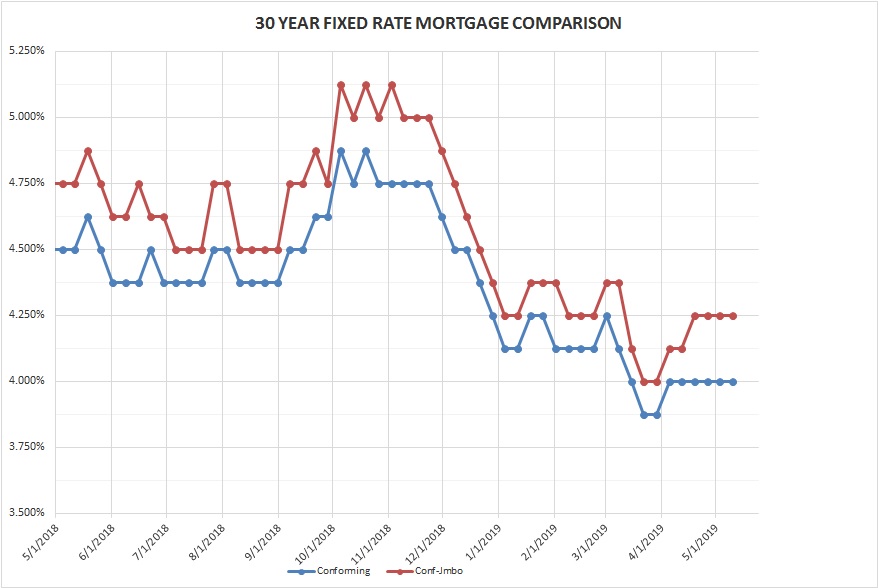
Rates for Friday May 10, 2019: This week was a good example of why watching financial data on an hour to hour, day to day, basis can be a bit maddening. As investors reacted to the comments by President Trump leading up to today’s trade negotiations with China and his then threat, now reality, to increase tariffs on Chinese goods by selling off in the stock markets, then buying back, then selling off we saw a similar see-saw in rate markets. Now that the words have become deeds, as I write this both credit and equity markets have rebounded. Over all the impact on rates from last Friday has been nil, we are flat for the fifth week in a row for conforming rates.
FIXED RATE MORTGAGES AT COST OF 1.25 POINTS LOCKED FOR 45 DAYS:
30 year conforming 4.00% Flat
30 year high-balance conforming 4.25 % Flat
Please note that these are base rates and adjustments may be added for condominiums, refinances, credit scores, loan to value, no impound account and period rate is locked. Rates are based on 20% down with 740 FICO score for purchase mortgages.
We are a culture of hyperbole, everything is the best this, the worst that, the most awesome thing ever. Social media, if anything, has exacerbated our tendency to hyperbole—enhanced with pictures and comments from friends validating our hyperbolic opinions J!!
Where the word “best” is not hyperbolic is when used like this, “I have the best Mom ever…” Because for the overwhelming majority of people this is true—our Moms are/were the best ever. The best at hugs, the best at turning tears into laughs, the best at being your personal chef to cut off the crusts or leave off the mustard. The first and best at unconditional love.
To all the Moms, you are the best! Thank you for being the best for all of us sons and daughters! (And from us husbands, thanks for being the best Moms for our children as well!)
One final note, a special happy birthday wish to my big sister who has spent many years filling some of Mom’s roles for my brother and I. We love you.
Have a great week,
Dennis
Past Weekly Rate & Market Updates can be found on my blog page at my website www.DennisCSmith.com/my-blog

