


11-23-18: What are the options for those who lost homes, or had them severally damaged, in the California wildfires?
Last week I ended the question of the week section (what was the cost of waiting) stating I would answer the natural follow-up question, what will be the cost of waiting, or is there one, for families waiting to purchase until later in 2019 or even 2020. Because of the wildfires in California that have destroyed thousands of homes I have chosen to address a very critical issue for those homeowners, knowing that we have clients, families, friends who are either directly impacted, or have family and /or friends who are impacted with lost or severely damaged homes. Next week I will look at what I feel may be the cost of waiting to purchase a new home.
Question of the week: What are the options for those who lost homes, or had them severally damaged, in the California wildfires?
Answer: Earlies this week I was speaking with a friend whose son and daughter in-law lost their home in Paradise, California in the Camp fire. In our conversation, I went through several different options his son and daughter in-law should consider regarding their family’s future.
The very first thing that should happen is the affected family needs to contact the lender and home insurer and let them know that your home was lost in the fire. You need to ask the lender for payment abatement or suspension while you work your options and ability to make payment. Chances are high many people in the affected areas that lost their homes have also lost the ability to generate income depending on whether their place of employment was lost to the fire, their ability to get to work or other factors. Stay in communication with the lender regarding the monthly payments. Ask if the call is being recorded and if so how you can refer to it later if needed. Keep records of every phone conversation, who you spoke to, what time, what was the conversation about, did the lender make any statements to you regarding the issue. Always request an email from the lender summarizing the conversation and confirming what may have been agreed to, if no email received call back quickly and repeatedly until you do receive the written communication.
With property tax payments due by December 10th a similar conversation should be had with the local county assessor. If the lender has been collecting tax payments confirm with the lender if they will be paying the taxes—at this point they probably already have.
Once the mortgage payment has been figured out time to move onto your insurance company.
Since you have a mortgage your home was insured. The first question you need answered is, how much will our insurance cover? The required coverage for lenders is either the entire loan amount owed, or the replacement cost of the dwelling.
The location of your home, the cost of construction in the area, and the cost of the home will determine whether your insurance policy will cover the cost to rebuild your home or your loan amount; for most developed properties in California the policy will cover replacement costs and not the loan amount. Because dirt is expensive in California the price is impacted, but because dirt does not burn it is not required to be insured.
The lender requirement of replacement cost will be determined by the appraisal which contains on a section where the appraiser calculates “replacement cost new.” This is the amount that must be covered by an insurance policy. For instance, I have a client who is refinancing a mortgage for $550,000 for a property appraised at $800,000; the replacement cost for the structure is $245,000, this is the amount of coverage we must show on the policy to close the transaction.
In Paradise the numbers are smaller, but the policy is generally the same. If the market value of the property is $250,000 the cost to replace may be $145,000 and the outstanding mortgage balance around $200,000.
This difference between mortgage amount and policy coverage is very important to those whose homes have been destroyed or severely damaged when considering, what do we do now?
It is important to note that the lender is a “loss payee” on the homeowner’s policy, meaning that any insurance check is made payable to the homeowner and the lender, both must agree what to do with the money before both parties endorse the payment.
Let’s take the case above, property value before the fire was about $250,000 with an outstanding balance of $200,000 and the insurance policy covers rebuilding the home for $145,000.
The first option is to work with the lender and insurance company to determine the mechanics of what happens if you choose to rebuild your home. Does your policy cover either mortgage payments until you can move back into your rebuilt home? Does it cover housing costs if you need to rent? What is the process regarding contractors, is than approved list you must use, or if you choose a contractor is approval required? How much time do you have to rebuild your home?
Before deciding to rebuild there are several factors to consider. Because there are thousands of homes in the region that have to be rebuilt, what will the actual cost to rebuild be given a limited supply of contractors versus the large demand for their services. What about the cost of building materials? How long will it take before a contractor will be able to take on your rebuilding job? What about designs, engineering, permits? Will there be a building moratorium for political purposes as state, county and local authorities determine if building requirements will be changed that impact costs of construction?
If all those questions are answered to your satisfaction next consider the future of the town and region. What if only one in two, one in five, one in ten, homeowners decide to rebuild? What will be the value of your home? Will it be significantly less than the loan amount? What will the neighborhood and town be like? What about schools and stores? The town will be significantly different, but how and will it be a place where you and your family will want to live?
Once you have this information then you ask the question, what if we decide not to rebuild our home? The answer is that you will likely need to assign the amount covered by the policy over to the lender who will apply it to your mortgage balance. Since the amount of the insurance pay-out is less than the mortgage balance you will still have, in this case, about $55,000. What next? You can ask the mortgage to be recast, meaning if you still have about 25 years left on the loan the lender will amortize the $55,000 for 25 years at your current rate to determine your new payment. If your rate is 4.00% the payment would be $290 per month. You can have the county re-assess your property to lower your tax liability and determine the minimum insurance cost required by the lender.
Once you have the cost to retain what will be a vacant parcel of land you can decide if you want to retain the property for any future development. Or if you want to contact the lender and inform them you have no intention of keeping the property and would like to deed the property to the lender. This will result in a foreclosure on your credit record, which will impact your ability to obtain a traditional mortgage for several years, but you will not be making payments on a property that may or may not be of significant value in the future.
For many families, walking away will be the best answer for their family, selecting what they see not as the best option, but the least worst option. The more people who make this decision the more negative the impact on families who decide they want to try to rebuild as property values, already negative impacted by the devastation to the town, will drop further. As well, property taxes will drop significantly negatively impacting city and county services.
Other factors impacting any decision are will there be assistance that may come from government agencies? Will it be sufficient for you to rebuild or to re-locate? Can you continue at your job and therefore need to stay in the area? What will be your cost of housing with all the other families in the area needing housing as well?
There may be other options I have not yet considered; my primary advice is to not rush into any decisions. Speak to different people you trust and have no stake in the outcome of whatever decision you make. A very big challenge will be to make your decision with as little emotion as possible. Consider the possible long-term consequences of any decisions you make. Decisions should be made on what likely can happen, not necessarily what you would like to happen. Consider the impact of the decisions your neighbors and others in your town may be making and how those decisions will impact you.
Finally, be selfish. Your decisions need to be what is best for you and your family. No one else is going to make your housing payment, you will be the ones residing in wherever you choose to make your home, either where it was before or in a new location. Your financial future is going to be impacted, which will in turn impact the quality of life for your family for year to come so be as clinical as you can through the process.
CAUTIONARY NOTE Unfortunately disasters bring out scam artists and thieves. People posing as contractors with real or fake credentials will be contacting families to collect deposits to build homes and never be seen again. Real, or fake, attorneys or others will be offering consulting services and collect fees without providing any services. Be very careful before signing any contracts, or entering into agreements. Double, triple check backgrounds and services provided. Affected families will be looking for any good news and charlatans tend to be excellent actors able to prey on those in a weakened state. Be careful.
If I can be of any help with questions or what-ifs please do not hesitate to contact me.
To help the Red Cross help those in need click here: Red Cross Donations
Have a question? Ask me!
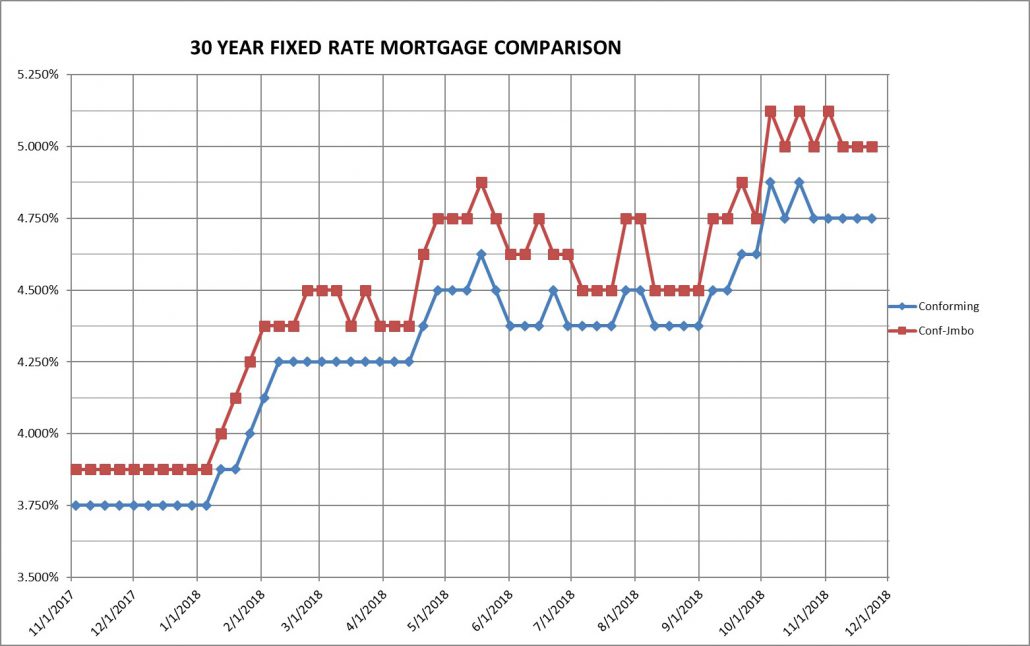
Rates for Friday November 23, 2018: A slow week this week with the Thanksgiving holiday with little news impacting rates. A bit of softening in rates from last Friday but not enough for any change week over week. Rates are a bit steady and this should continue next week as well depending on how well the U.S. Treasury auctions go next week as the government sells over $110 billion in bonds. If the auctions go well rates should remain steady, if they do not go well rates will bump up a bit.
FIXED RATE MORTGAGES AT COST OF 1.25 POINTS LOCKED FOR 45 DAYS:
30 year conforming 4.75% Flat
30 year high-balance conforming 5.00% Flat
Please note that these are base rates and adjustments may be added for condominiums, refinances, credit scores, loan to value, no impound account and period rate is locked. Rates are based on 20% down with 740 FICO score for purchase mortgages.
We were without our oldest for the first time ever on Thanksgiving, she made the bus ride from Boston to Portland, Maine to spend a few days with family friends. Yesterday morning the temperature difference with wind chill was about 65 degrees, glad she has winter clothes. Absence makes the heart grow fonder and we missed her presence and my apple pie did not turn out well as hers do.
With friends and family at our table we had a wonderful day and evening and I hope you did as well.
Have a great week,
Dennis
Past Weekly Rate & Market Updates can be found on my blog page at my website www.DennisCSmith.com

